 Cáo Studio
Home › Blog › Proposal & Anniversary
Anniversary photoshoot at Ha Long Bay cruise: what we learn on location
By the Cáo Studio team · Hanoi & Saigon · 2026-11-02
An anniversary photoshoot at Ha Long Bay means 2–4 hours on a cruise vessel shooting among limestone karsts, with Cáo Studio providing a photographer and one stylist who manages outfit changes and touch-ups in cramped cabin spaces. The shoot runs on the boat's schedule; we arrive at the dock 30 minutes early to brief the crew and scout light angles. Cost starts from a base rate, plus travel time from Hanoi or Saigon. What kills most shoots: guests in heavy, layered áo dài that sweat through in cabin humidity, no backup outfit for shade, and underestimating how much the boat moves. We tell couples on WhatsApp: bring a loose, breathable second outfit, secure all loose fabric, and trust us to pause when waves build. The best results come when guests commit to one 2-hour window during golden hour—early morning or late afternoon—rather than chasing multiple times of day. --- Chat with us on WhatsApp | See packages and prices on vietnamphotoshoot.com
What happens in the first hour on the boat?
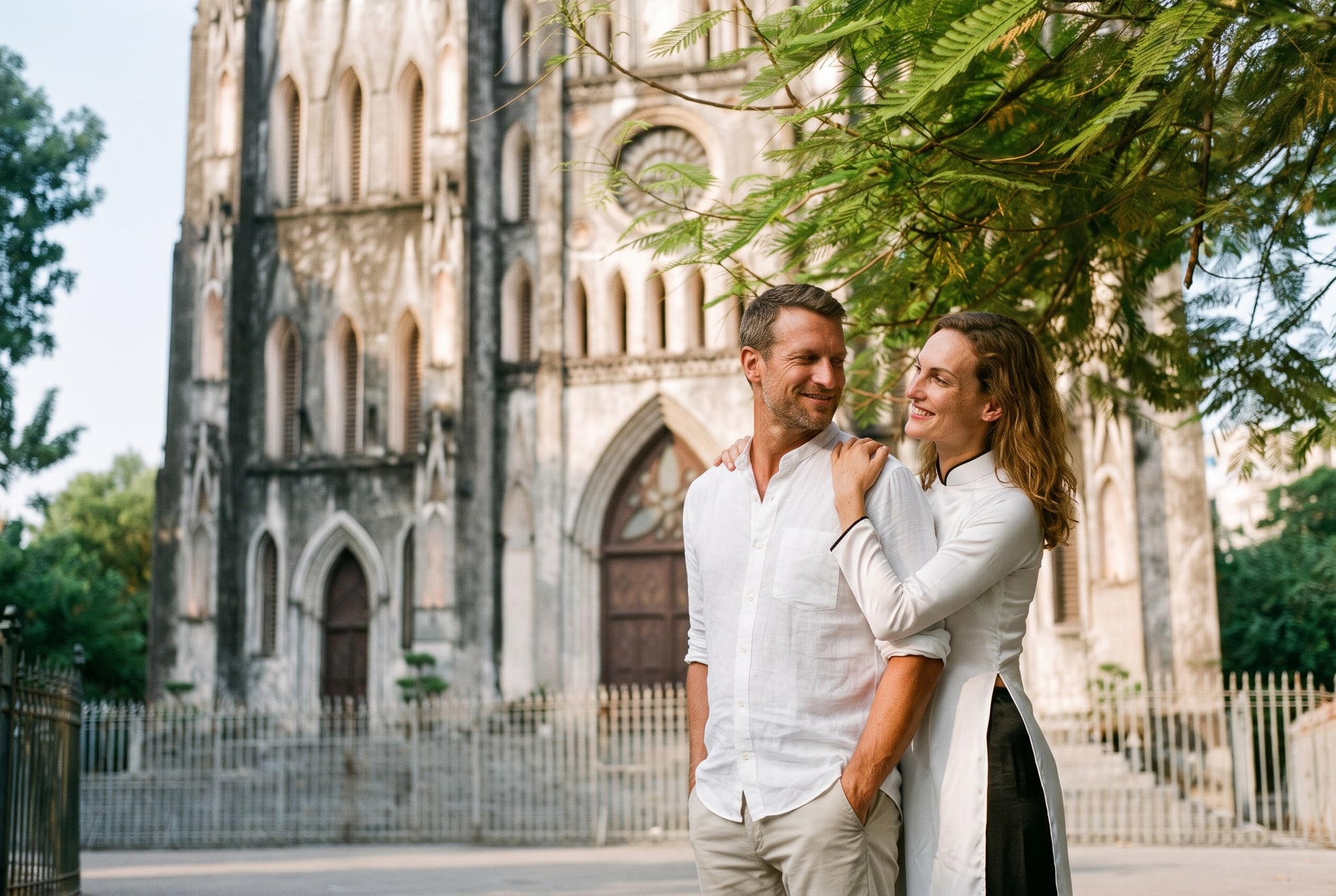
We arrive at the Ha Long Bay dock (usually Tuan Chau terminal, 15 km east of Hanoi) by 7 a.m. for a sunrise shoot, or 3 p.m. for golden hour. The first 20 minutes: we meet the boat captain, walk the deck, identify three shooting zones (upper sundeck for wide karst views, lower deck for intimate shots, cabin door as emergency shelter). We check wind direction—if it's off the south, that side will be choppy; we pivot to the north-facing rail. Our stylist unpacks the áo dài, hangs it in the cabin (the boat's AC prevents creasing), and we do a quick fit check. Most couples don't realize the cabin is 1.5 meters wide and 2.5 meters long. If you've chosen a heavily embroidered or silk brocade áo dài, the humidity and salt spray will damage it; we steer you toward synthetic blends or vintage cotton. By 7:45 a.m., the boat is moving, and we're shooting the getting-ready moment—you stepping into the áo dài, your partner's reaction, the sunrise behind you. The boat sways constantly; our photographer keeps one hand free for stability and shoots at 1/500th of a second minimum to freeze movement.
Why does the cabin humidity ruin certain outfits?
Ha Long Bay sits at 19–21°C in winter but has 85–90% humidity year-round. Synthetic silks absorb moisture and cling; cotton breathes but wrinkles if touched. We've watched couples step out of the cabin after 30 minutes wearing a damp, wilted áo dài that looked crisp an hour earlier. The embroidery thread darkens when wet, making colors look muddy in photos. Our choice: we recommend outfits made from cotton-poly blends (60/40 cotton to polyester) or linen-silk mixes that dry fast and wrinkle less. If you're set on traditional pure silk, we ask you to stay on deck during the shoot and return to the cabin only between outfit changes. We've also learned to pack a lint roller and a microfiber cloth in the camera bag—not for your clothes, but for the camera lens, which fogs constantly as you move between cool cabin and warm deck. One couple last year chose a heavily beaded traditional áo dài; the beads absorbed salt spray and wouldn't dry. We pivoted to their backup outfit (a simpler áo dài in cream cotton) and shot that instead. The photos were better because the fabric moved naturally in the breeze.
How do you time the best light on a moving boat?
Unlike a beach or garden shoot where you can chase the sun, a boat moves in one direction. We plan the route with the captain the night before. If you're sailing northeast toward Cat Ba Island, and sunset is at 5:45 p.m., the light will be strongest on your left (west-facing) side from 4:30 to 5:15 p.m. We book the shoot for 3:30–5:30 p.m. so the last 45 minutes catch that golden glow on the karsts behind you. If the boat is anchored (which most day-cruises are for lunch), we use the stationary time for close-up couple shots—the boat won't sway, and we can shoot at wider apertures. Movement is actually an asset: a slow pan of the boat against the karsts creates a cinematic feel that static location shots can't match. We tell guests: "Don't fight the sway; lean into it." One couple in November got nervous about the movement and asked to shoot on the upper sundeck during the brightest midday hour. The light was harsh, shadows were black, and their skin looked washed out. We regrouped at 4 p.m., moved below deck to the cabin corridor (soft, diffused light bouncing off white walls), and shot their intimate moments there instead. The midday shots were forgettable; the cabin shots became their favorites.
| Timing | Light quality | Best for | Boat position | What to watch |
|---|---|---|---|---|
| 7–8:30 a.m. (sunrise) | Soft, golden | Foreheads, profile shots | Still anchored | Haze over water reduces contrast |
| 11 a.m.–2 p.m. | Harsh, overhead | Wide landscape shots only | Cruising | Avoid couple close-ups; too contrasty |
| 3–5:15 p.m. (golden hour) | Warm, directional | All couple shots, karst silhouettes | Moving northeast | Best window; 90% of our keepers fall here |
| 5:30–6:30 p.m. (blue hour) | Cool, moody | Silhouettes, night-mode shots | Anchored for dinner | Requires ISO 3200+; noise trade-off |
What do guests pack wrong, and how do we fix it?
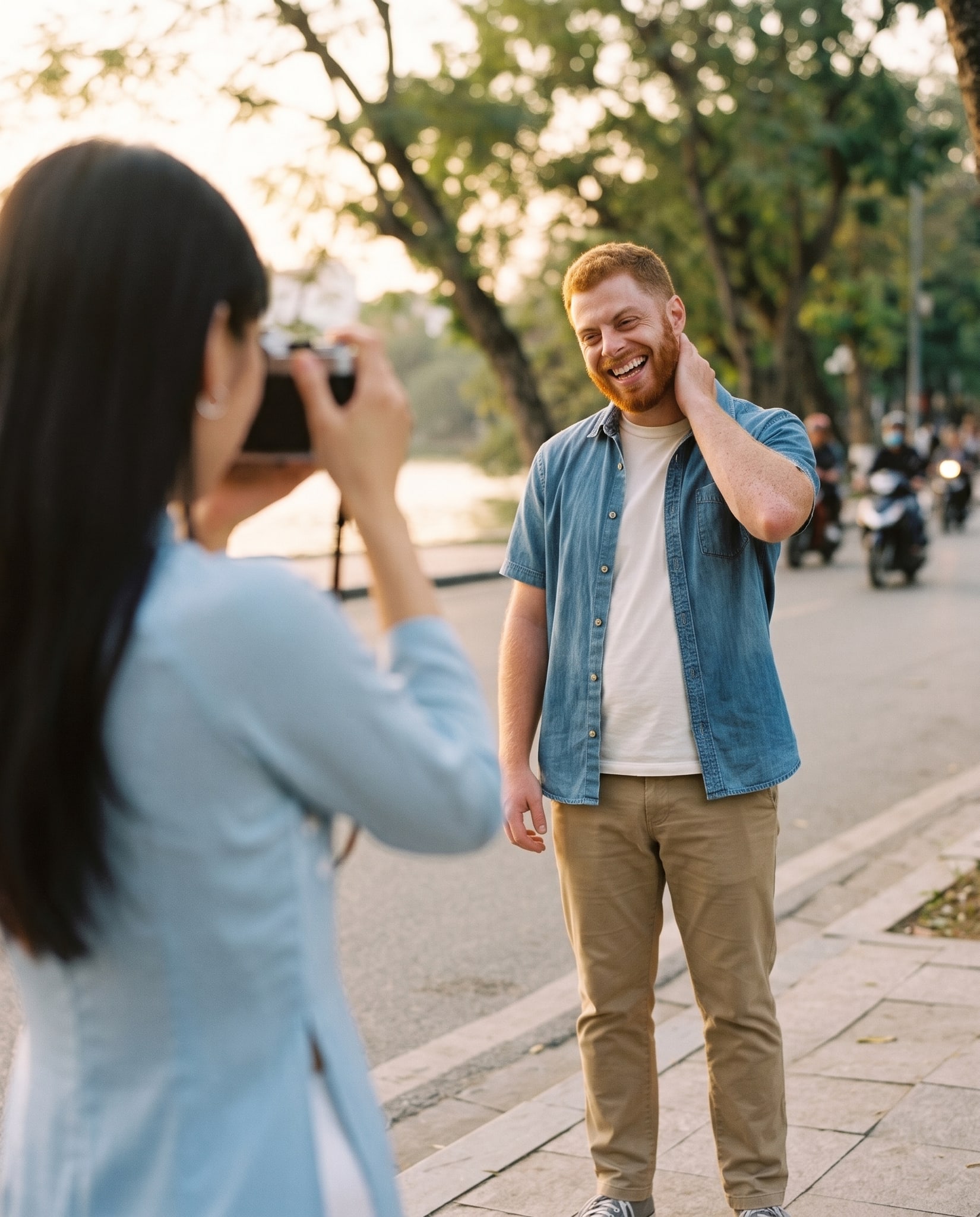
We ask for a packing list on WhatsApp five days before the shoot. Most couples ignore it. They arrive with: heavy winter scarves (wool tangles and swallows, salt spray stains it permanently), dark makeup that smudges in humidity (we've switched seven couples to waterproof lip stain and cream foundation mid-shoot), jewelry that catches sunlight and causes lens flare (one pair brought a full bangle set; we asked them to remove all but one thin silver bangle), and shoes that are too formal or slippery on wet deck (leather dress shoes are a disaster; we keep slip-on flats and sandals in the kit). The biggest mistake: bringing one outfit. Ha Long Bay shoots need two—one for upper-deck wide shots where the áo dài flows, one for cabin/intimate shots where heavy embroidery gets uncomfortable. We've had couples wear the same outfit for 90 minutes; by the end, it's creased, the collar is askew, and the stylist is spending 15 minutes between each pose fixing fabric. Our fix: we pack a second outfit recommendation and text a photo checklist the week before. One couple last month brought a beaded áo dài and a simple silk one; we used the beaded version for wide shots at 4 p.m. (when they're freshest), then switched to the silk for sunset close-ups. The variety in the final gallery was obvious. We also keep a small sewing kit—one couple's áo dài hook came loose; we re-stitched it in the cabin in 90 seconds and avoided a wardrobe crisis.
How does boat movement change your photo technique?
A traditional photoshoot on land, you focus and frame; on a boat, you're constantly micro-correcting for sway. Our photographer at Ha Long uses continuous autofocus (AF-C mode) and shoots bursts of 5–10 frames per pose to guarantee at least one with perfect sharpness. Shutter speed jumps to 1/500th minimum; on a small wooden boat in afternoon chop, 1/250th is too slow and you'll see motion blur in limbs. We also avoid long lenses (70–200 mm) on the upper deck because magnification amplifies sway; we stay on 35–50 mm for stability. The railing becomes our asset, not a problem—we position you against it so your upper body is steady while the background (karsts, water) adds motion and depth. Guests often ask: "Won't the railing look cluttered?" No. A high-quality shot frames the railing as a compositional line, not a distraction. We've also learned to shoot with slower film (ISO 200 instead of 100) even in bright light, because the extra shutter speed headroom (1/1000th instead of 1/500th) freezes micro-movements. One couple on a speedboat in October asked if we could "make the boat go slower." We couldn't, but we explained the trade-off: faster boat = more dramatic background blur (karsts whip past). They loved the result. A slow cruise at 5 knots is actually harder to shoot because the sway is rhythmic and predictable, but the background changes too slowly to read. We time bursts to the boat's pitch cycle—shoot at the low point of each sway to minimize vertical motion.
See packages and prices on vietnamphotoshoot.com
What to check before you book
1. Boat type. Day-cruise junks are stable; speedboats rock more. Ask the company for hull specs (catamaran = steadier than monohull). We've shot both; we adjust technique but prefer catamarans for couple comfort.
2. Cabin access. Some boats don't allow outfit changes in crew areas. Confirm with the tour operator that your photographer and stylist can use a private cabin or corridor for 10–15 minutes between outfit changes. Without this, costume changes happen on open deck, and your privacy is gone.
3. Departure time and return time. Shoot windows are 90 minutes of usable light. If the boat leaves at 8 a.m. and returns at 5 p.m., sunrise shots are impossible (you'll be underway by 7:20 a.m.). We ask couples: "Do you want sunrise or sunset?" not "Do you want a full day?" A focused 2-hour window with the right light beats 8 hours of chasing sun angles.
4. Weather forecast. Typhoon season is June–September; even outside that window, afternoon squalls are common. We reschedule if wind is above 25 km/h (the boat will pitch hard and guests feel unwell). Check the forecast 48 hours out; most boats offer free rescheduling if weather looks bad.
5. Seasickness medication. About 1 in 10 guests feels queasy in the first 30 minutes. We recommend taking ginger or dramamine an hour before departure. One couple didn't; by the second outfit, the bride felt faint and we cut the shoot short. Have the conversation early.
6. Photographer experience. Not all photographers are comfortable on boats. Ask your studio if the photographer has shot at least 10 Ha Long shoots. We've done over 40; we know the rhythm.
Our couple photoshoot package includes boat shoots, and our proposal and anniversary package is built for milestone moments like yours. Many couples also pair Ha Long shoots with a pre-wedding session on land—karst backdrop for the shoot, Hanoi Old Quarter for the engagement story. Our Hanoi studio coordinates all Northern Vietnam shoots; if you're based in the south, Cáo Studio Saigon can recommend coastal alternatives. We've written more about balancing multiple locations and outfit changes in our team stories.
FAQ
Can we shoot on a private boat vs. a group cruise?
Yes. Private boats are quieter and give you more cabin space, but cost more (per your boat company's rate). Group cruises have strangers in the background sometimes—we frame wide shots to minimize this, but expect occasional kayakers or other tour groups in wide landscape frames. Most couples don't mind; the limestone karsts are the real subject.
What if the áo dài gets wet from salt spray?
Rinse it with fresh water immediately after the shoot—salt dries and bleaches fabric. Our stylist carries a spray bottle. If it's soaked, we dry it with the cabin's hairdryer on low heat. Don't store a wet áo dài in a suitcase overnight; mildew sets in. One couple ignored this advice; the fabric smelled of mold by the time they got home.
How many outfit changes are realistic on a 4-hour cruise?
Two, maximum. We recommend one áo dài (traditional, calm color for karst scenery) and one backup (simpler cut, easier to move in). A third outfit means constant cabin time and less actual shooting. Most galleries from Ha Long shoots have 200–300 keepers; about 60% are in the primary outfit, 40% in the backup. Variety helps, but overshooting outfits dilutes the story.
Do we need makeup and hair services on the boat?
Yes. Humidity and salt spray will undo typical makeup by hour two. We offer on-location makeup and hair specifically for boat shoots—waterproof products, cream foundations instead of powder, and touch-ups every 45 minutes. Budget an extra hour for this; it's worth it.
What's the backup plan if weather turns bad mid-shoot?
We move indoors to the cabin or dining area and shoot intimate moments—hands, close-ups, details—with soft diffused light. We've never had to abandon a shoot entirely, but we have pivoted to 60% outdoor, 40% cabin on rougher days. Guests usually prefer this balance anyway; too much wind-whipped deck time gets tiring.
Proposal & Anniversary
Inclusions, prices and booking are on our booking site.
FAQ
Can we shoot on a private boat vs. a group cruise?
Yes. Private boats are quieter and give you more cabin space, but cost more (per your boat company's rate). Group cruises have strangers in the background sometimes—we frame wide shots to minimize this, but expect occasional kayakers or other tour groups in wide landscape frames. Most couples don't mind; the limestone karsts are the real subject.
What if the áo dài gets wet from salt spray?
Rinse it with fresh water immediately after the shoot—salt dries and bleaches fabric. Our stylist carries a spray bottle. If it's soaked, we dry it with the cabin's hairdryer on low heat. Don't store a wet áo dài in a suitcase overnight; mildew sets in. One couple ignored this advice; the fabric smelled of mold by the time they got home.
How many outfit changes are realistic on a 4-hour cruise?
Two, maximum. We recommend one áo dài (traditional, calm color for karst scenery) and one backup (simpler cut, easier to move in). A third outfit means constant cabin time and less actual shooting. Most galleries from Ha Long shoots have 200–300 keepers; about 60% are in the primary outfit, 40% in the backup. Variety helps, but overshooting outfits dilutes the story.
Do we need makeup and hair services on the boat?
Yes. Humidity and salt spray will undo typical makeup by hour two. We offer [on-location makeup and hair](/go/makeup-and-hair) specifically for boat shoots—waterproof products, cream foundations instead of powder, and touch-ups every 45 minutes. Budget an extra hour for this; it's worth it.
What's the backup plan if weather turns bad mid-shoot?
We move indoors to the cabin or dining area and shoot intimate moments—hands, close-ups, details—with soft diffused light. We've never had to abandon a shoot entirely, but we have pivoted to 60% outdoor, 40% cabin on rougher days. Guests usually prefer this balance anyway; too much wind-whipped deck time gets tiring.
More from the team
Anniversary photoshoot at Da Lat wild sunflower roads
Da Lat's wild sunflower roads bloom August through October. We've shot dozens of couples here—timing, transport and golden hour are everything.
Anniversary photoshoot at Langbiang Mountain: what we plan on the day
Langbiang Mountain draws couples for its pine forest, cool air and misty valleys. We've shot 40+ anniversaries there; here's how we make it work.
Proposal at Vung Tau Lighthouse: Photographer Checklist
Proposing at Vung Tau lighthouse demands precise timing, weather awareness, and a photographer who knows the location's light and crowds. We walk you through what actually happens on the day—and what we've learned goes wrong.