 Cáo Studio
Home › Blog › Proposal & Anniversary
Anniversary photoshoot at O Quy Ho pass: what we shoot and how
By the Cáo Studio team · Hanoi & Saigon · 2026-11-01
An anniversary photoshoot at O Quy Ho pass is a full-day session with Cáo Studio where we photograph you on the high pass and surrounding roads, typically 6–8 hours including travel from Ha Giang town. The pass sits at 2,000m with switchback views, silver clouds at dawn, and a quiet stone monument—dramatic light that changes every 30 minutes. We run anniversary shoots as part of our concept and elopement packages; couples choose O Quy Ho for the isolation and otherworldly mist that rolls in after 8 a.m. Costs depend on styling, assistant count, and logistics; ask us for a quote on WhatsApp. The main decision: come at sunrise (5–6 a.m. departure) to catch clear light and beat tour buses, or accept soft cloud cover and solitude. Most pairs find the wind, altitude, and emotional rawness worth every shivering minute.
Is O Quy Ho pass actually worth the 3-hour drive from Hanoi?
Yes—and no. We've driven there dozens of times and learned a sharp rule: the pass only photographs well before 7:30 a.m. or after 4 p.m., because midday sun flattens the stone and washes out the sky. From our Hanoi studio, the departure at 4–5 a.m. means you lose sleep but gain the entire pass empty, mist rolling in waves, and light that moves every two minutes. If you're flying in just for the shoot, stay in Ha Giang town the night before—a 40-minute drive saves you a Hanoi departure at 2 a.m. The pass is 72 km northeast of Hanoi; at that distance, you're not doing a same-day round trip unless you skip makeup or skip lunch. We tell couples: O Quy Ho costs more in logistics than a Hanoi ao dai shoot but you get altitude, silence, and mist that urban studios cannot touch.
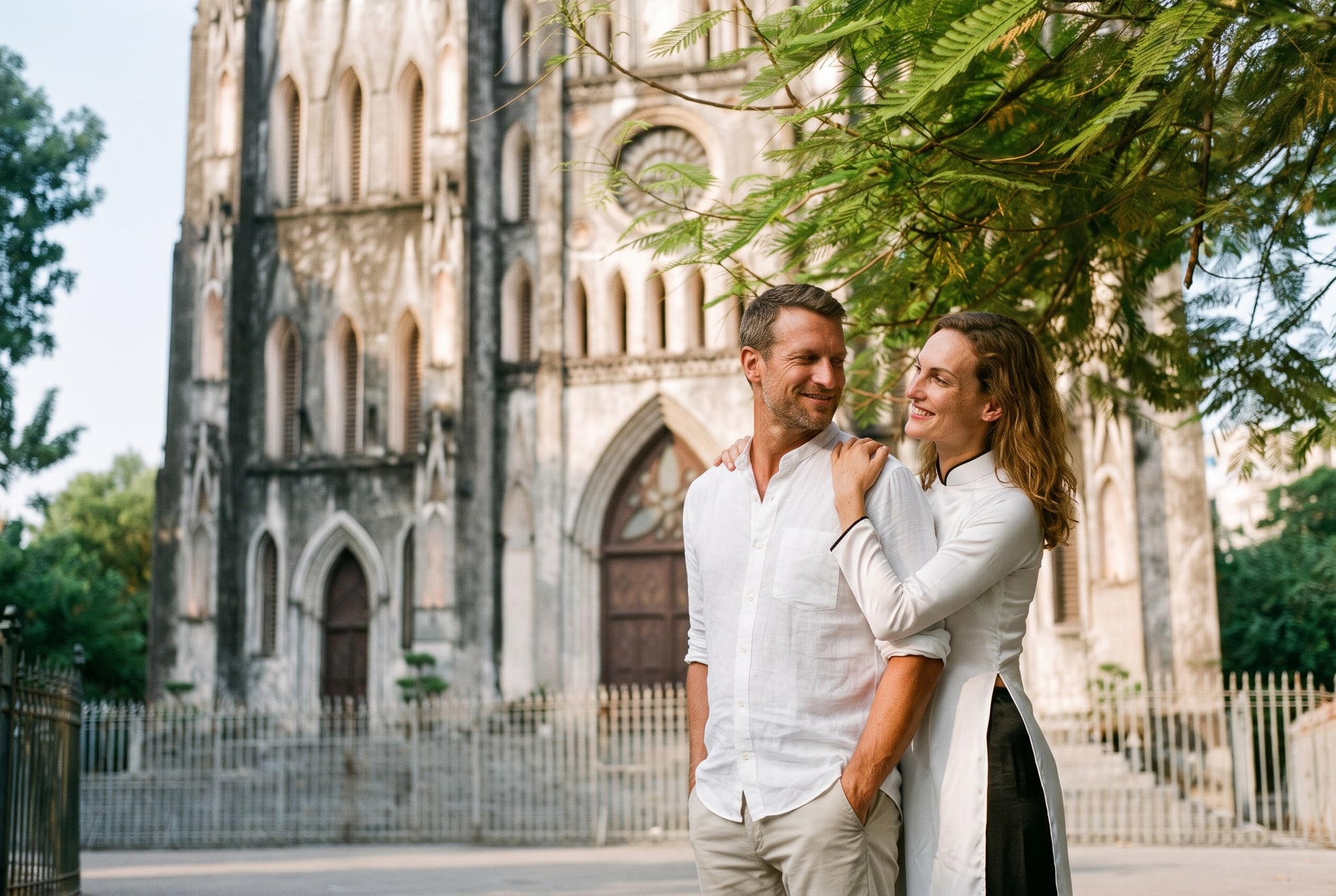
What time of year gives the clearest photos at the pass?
September to November and March to April are our shooting windows. In summer (June–August) afternoon heat brings clouds by 9 a.m. and rain by 2 p.m.; we've abandoned shoots halfway through. In winter (December–February) dawn air is crystal but temperatures drop to 5°C—couple are usually shaking, and wind scatters light onto the stone. Spring and autumn: 10–15°C at dawn, stable cloud cover if you're there by 6 a.m., and 2–3 hours of soft gold before mist thickens. We've noticed November anniversaries yield the sharpest skies; September still has monsoon remnants but offers lusher green on the slopes. Check the forecast 5 days out, not the morning-of: at 2,000m, weather changes in minutes and we cannot predict 6 hours ahead with confidence. The key decision is flexibility—book a date range, not a fixed day, so we can reschedule if storms move in.
How many outfit changes work at high altitude and cold?
We typically plan two, sometimes three, and it depends on your energy and cold tolerance. At 2,000m, wind chill drops perceived temperature 5–10 degrees below what the thermometer reads. On our last anniversary shoot in October, the bride brought four ao dai pieces and changed twice; by the second change her hands were too cold to pin the fabric, so we worked with what she had. We learned: bring one outfit that you want the most, one backup, and skip the third unless it packs small and you've rehearsed the change at home. Ao dai is forgiving—layers underneath, long sleeves, built-in formality—so most couples don't need more than two versions. If you're wearing Western wedding clothes (dress, suit), one outfit usually suffices because re-dressing in wind at 2,000m is a patience test. We handle hair and makeup at the studio in Ha Giang before the drive, or in your hotel room if you're staying nearby; that saves 90 minutes at the pass and lets us reset your look before sunset if clouds clear late.
See packages and prices on vietnamphotoshoot.com
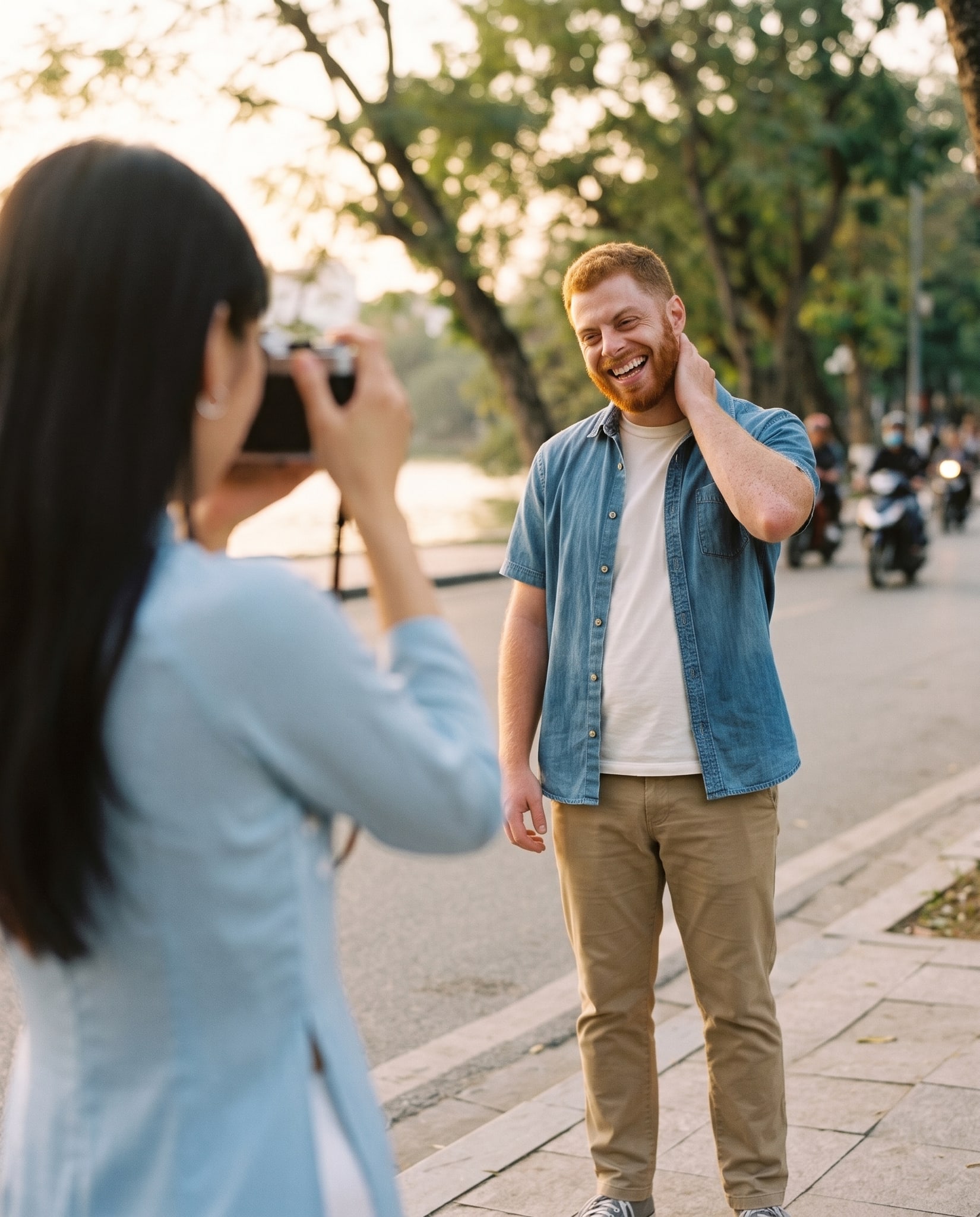
What happens when rain or fog kills the light halfway through?
We pivot. On our most dramatic anniversary shoot last April, we arrived to clear views; by 7:30 a.m. cloud swallowed everything and visibility dropped to 50 meters. We didn't stop—we moved to a secondary location, a stone lookout point 2 km down the road that sits above the cloud layer, and shot through the fog as a dramatic soft-focus backdrop. The couple later said those misty shots were their favorites. What we've learned: the pass has multiple vantage points, and we scout them before the shoot day based on your mood. If you want iconic clear views, we push into the afternoon and wait for cloud to lift (it sometimes does after 3 p.m.). If you want moody and otherworldly, we embrace the fog and work faster, because mist changes light every 3 minutes. Rain is the only true cancel—we reschedule if it's steady by 6:30 a.m. Drizzle we can work with if your clothes are quick-dry or you're wearing ao dai (silk dries fast in mountain wind). The insurance: book for a range of dates, not one fixed day, so we have a backup window.
What's the cost structure for an O Quy Ho anniversary shoot versus a city session?
O Quy Ho costs more than a Hanoi or Saigon studio shoot because we absorb fuel, a guide's time, and typically a second shooter to manage logistics at altitude. A standard couple photoshoot in the city runs one fee; a full-day mountain concept shoot includes longer hours, travel time, and rescheduling risk. Our proposal and anniversary package covers both mountain and urban sessions—you can choose O Quy Ho as your location and we adjust timing and team size to match. We don't publish per-hour rates because a 9-hour mountain day isn't twice a 4.5-hour city session; the planning, scout, and risk are different. Payment is flexible: Visa, Mastercard, bank transfer, or cash are all accepted, and we take online payment links for guests booking from abroad. Ask us for a quote on WhatsApp with your preferred date range, outfit count, and whether you want a second shooter for backup—we'll give you a clear number, not a range.
| Shoot type | Best for | Logistics cost | Why it matters |
|---|---|---|---|
| City studio (Hanoi/Saigon) | Quick, flexible, no altitude | Base rate | Easily reschedulable, makeup resets simple |
| Ao dai in old town (Hoi An/Hanoi) | Cultural look, repeatable light | Moderate | Crowds and timing trade-offs |
| O Quy Ho full-day | Epic scale, isolation, raw emotion | Higher | 3–4 hour travel, altitude risk, one weather window |
| Hotel + city combo | Two moods, rest between | Moderate | Makeup team travels; full-day commitment |
What do we check before confirming your anniversary shoot date?
Before we book, we confirm five things: (1) Your altitude tolerance – Have you been above 1,500m before? (2) Cold-weather comfort – Do you get breathless in cold? O Quy Ho at 5 a.m. is 8–12°C. (3) Outfit reality – Can you move, sit, and kneel in what you've planned? We ask for photos of your clothes. (4) Date flexibility – Can you shift dates 3–5 days if weather sours? We won't shoot in steady rain. (5) Transport – Will you drive yourself or ride with our team? We can coordinate but need to know for timing. We ask these on WhatsApp in the planning phase, not at booking, because we want you prepared and confident—not surprised at 5 a.m.
FAQ
Do we need to hire a separate guide for O Quy Ho, or does Cáo Studio handle navigation?
We handle it. Our team knows the pass roads, safe stopping points, and weather patterns. You don't need a separate guide. We navigate, manage the shoot timeline, and get you back safely. First-time visitors often worry about logistics; we take that off your plate.
How long is the actual shooting time versus travel and setup?
Roughly 3–4 hours of active shooting, 4–5 hours of drive, setup, outfit change, and breaks. A full-day O Quy Ho shoot is 8–9 hours door-to-door. We don't padding time; we use every good-light window and break when light dies.
Can we do an O Quy Ho anniversary shoot in December or January?
Yes, but with caveats. December–January is coldest (3–8°C at dawn), so prepare layers and hand warmers. Light is often clear and beautiful. Rain is less common. The trade: you'll be cold, your hands will shake, and we'll move faster through outfit changes. Some couples love this starkness.
What if we're not physically fit—can we still shoot at 2,000m?
Most couples can handle it at that altitude for photography. You're not hiking; you're standing and walking slowly for portraits. The risk is breathlessness and disorientation if you have heart or lung conditions. We check this beforehand and can adjust pace. If you're unsure, mention it on WhatsApp.
Do you offer same-day turnaround of photos, or do we wait for full editing?
Full editing takes 2–3 weeks. We deliver edited images as a full gallery, not preview-then-order. You can request a few instant phone-camera snaps at the pass to share on social media, but official photos are edited and delivered as a set later.
Can we combine O Quy Ho with a city anniversary shoot in the same trip?
Absolutely. Many couples do a sunrise mountain session at O Quy Ho, then a sunset ao dai shoot in Hanoi's Old Quarter the same evening (after rest and lunch). It's a two-location anniversary package. Ask us for a quote on WhatsApp for combined pricing.
What's the best way to prepare our clothes for the cold and wind?
Ao dai works beautifully because the fabric is structured and recovers quickly from wind wrinkles. For Western wear, choose fabrics with weight (not chiffon). Bring a shawl or jacket for between shots to stay warm—we'll remove it for photos. Have your stylist rehearse fabric placement for wind at home before the shoot. See packages and prices on vietnamphotoshoot.com
Proposal & Anniversary
Inclusions, prices and booking are on our booking site.
FAQ
Do we need to hire a separate guide for O Quy Ho, or does Cáo Studio handle navigation?
We handle it. Our team knows the pass roads, safe stopping points, and weather patterns. You don't need a separate guide. We navigate, manage the shoot timeline, and get you back safely. First-time visitors often worry about logistics; we take that off your plate.
How long is the actual shooting time versus travel and setup?
Roughly 3–4 hours of active shooting, 4–5 hours of drive, setup, outfit change, and breaks. A full-day O Quy Ho shoot is 8–9 hours door-to-door. We don't padding time; we use every good-light window and break when light dies.
Can we do an O Quy Ho anniversary shoot in December or January?
Yes, but with caveats. December–January is coldest (3–8°C at dawn), so prepare layers and hand warmers. Light is often clear and beautiful. Rain is less common. The trade: you'll be cold, your hands will shake, and we'll move faster through outfit changes. Some couples love this starkness.
What if we're not physically fit—can we still shoot at 2,000m?
Most couples can handle it at that altitude for photography. You're not hiking; you're standing and walking slowly for portraits. The risk is breathlessness and disorientation if you have heart or lung conditions. We check this beforehand and can adjust pace. If you're unsure, mention it on WhatsApp.
Do you offer same-day turnaround of photos, or do we wait for full editing?
Full editing takes 2–3 weeks. We deliver edited images as a full gallery, not preview-then-order. You can request a few instant phone-camera snaps at the pass to share on social media, but official photos are edited and delivered as a set later.
Can we combine O Quy Ho with a city anniversary shoot in the same trip?
Absolutely. Many couples do a sunrise mountain session at O Quy Ho, then a [sunset ao dai shoot](/go/ao-dai-photoshoot) in Hanoi's Old Quarter the same evening (after rest and lunch). It's a two-location anniversary package. [Ask us for a quote on WhatsApp](https://wa.me/84338762340) for combined pricing.
What's the best way to prepare our clothes for the cold and wind?
Ao dai works beautifully because the fabric is structured and recovers quickly from wind wrinkles. For Western wear, choose fabrics with weight (not chiffon). Bring a shawl or jacket for between shots to stay warm—we'll remove it for photos. Have your stylist rehearse fabric placement for wind at home before the shoot. [✨ See packages and prices on vietnamphotoshoot.com](/go/proposal-and-anniversary)
More from the team
Anniversary photoshoot at Da Lat wild sunflower roads
Da Lat's wild sunflower roads bloom August through October. We've shot dozens of couples here—timing, transport and golden hour are everything.
Anniversary photoshoot at Langbiang Mountain: what we plan on the day
Langbiang Mountain draws couples for its pine forest, cool air and misty valleys. We've shot 40+ anniversaries there; here's how we make it work.
Proposal at Vung Tau Lighthouse: Photographer Checklist
Proposing at Vung Tau lighthouse demands precise timing, weather awareness, and a photographer who knows the location's light and crowds. We walk you through what actually happens on the day—and what we've learned goes wrong.