 Cáo Studio
Home › Blog › Ao Dai Photoshoot
Ao Dai Photos at Hoi An Rice Fields by Bicycle
By the Cáo Studio team · Hanoi & Saigon · 2026-11-01
A bicycle ao dai shoot in Hoi An rice fields typically runs 3–4 hours: one hour of outfit fitting and styling, two hours pedaling and posing among the paddies (usually 5–7 km of gentle terrain), 30 minutes for final touch-ups and portraits near water. Cáo Studio books these via our ao dai photoshoot package—we supply the bicycle, handle hair and makeup on-site, and deliver 100–150 edited images within two weeks. The rice paddies are gentlest in the dry season (December–April) when paths are firm; avoid June–September when flooded fields block routes. Cost varies by group size and location; ask us for a quote on WhatsApp. Most guests book this as a solo or couple session; families often choose family photoshoot options instead because young children tire quickly on unpaved terrain. Chat with us on WhatsApp | See packages and prices on vietnamphotoshoot.com
What happens in the first hour—styling and location prep?
We arrive at your Hoi An hotel or our studio at 5:30 am for a dawn shoot (or 3:00 pm for sunset). Our stylist spends 45 minutes fitting and pinning your ao dai—most guests bring one custom piece, but we can recommend trusted tailors in Hoi An if needed. Our makeup artist works in parallel, keeping coverage light for heat and humidity; we use sweat-resistant primer and long-wearing lip color because pedaling and the paddies' moisture undo anything fragile. By 6:30 am, we load two bicycles (one for you, one for our photographer), check tire pressure and brakes, and scout the first three paddies for light angle and foreground flowers. If the paddy water is unexpectedly high or a farmer is working the field, we shift location within 500 meters—we know six backup spots between Hoi An town and the Tra Que village side. This first-hour friction saves the shoot: guests who skip fitting end up with ao dai hems tangled in pedals.
How do we handle the bicycle ride itself—pacing and safety?
Our photographer pedals alongside you or walks beside the bicycle with a gimbal—never shoots from a moving bike. We break the 5–7 km route into three segments: a 20-minute ride to the first paddy, a 40-minute shoot with 5–8 outfit changes and walking poses, a 15-minute ride to segment two, repeat. This pacing prevents exhaustion and chafing. We carry water, a small first-aid kit, and a portable phone charger. Paths are gravel or compacted earth; we recommend flat shoes or sandals (never heels). If rain threatens, we have a compact umbrella; most guests are fine because Hoi An's dry season (our peak season) is genuinely dry. One reality: mosquitoes rise at dusk, so we use insect spray on legs and arms before the sunset shoot starts—we've learned this the hard way after guests complained post-shoot. Paved roads are minimal; expect to walk the bicycle on rougher stretches. We've never had a flat tire because we inspect bikes the day before, but if it happens, we have a hand pump and patch kit, and can reshoot the next morning at no extra cost.
When does the light peak—and how do we move if it doesn't?
Golden hour (first 40 minutes after sunrise, or last 60 minutes before sunset) is non-negotiable for ao dai color saturation. We position you facing into the light so the silk glows; backlit shots make the border patterns visible and add rim light. If clouds roll in hard, we shift to overcast-friendly poses: walking toward camera with the paddy edge as framing, or close-ups that emphasize the ao dai's texture rather than sky drama. We take 60–80 frames per segment; about 40 % are keeper-quality on a clear day, 20 % on overcast days. This is why we scout at 5:45 am—if light conditions are worse than forecast, we can move the shoot 3 km west toward open fields near Cam Thanh, or reschedule to the next clear morning at no charge. We've done this five times in the last two years; it always pays off because a rescheduled shoot in perfect light beats a compromised shoot pushed through clouds.
What differs between solo, couple, and family ao dai rides in the paddies?
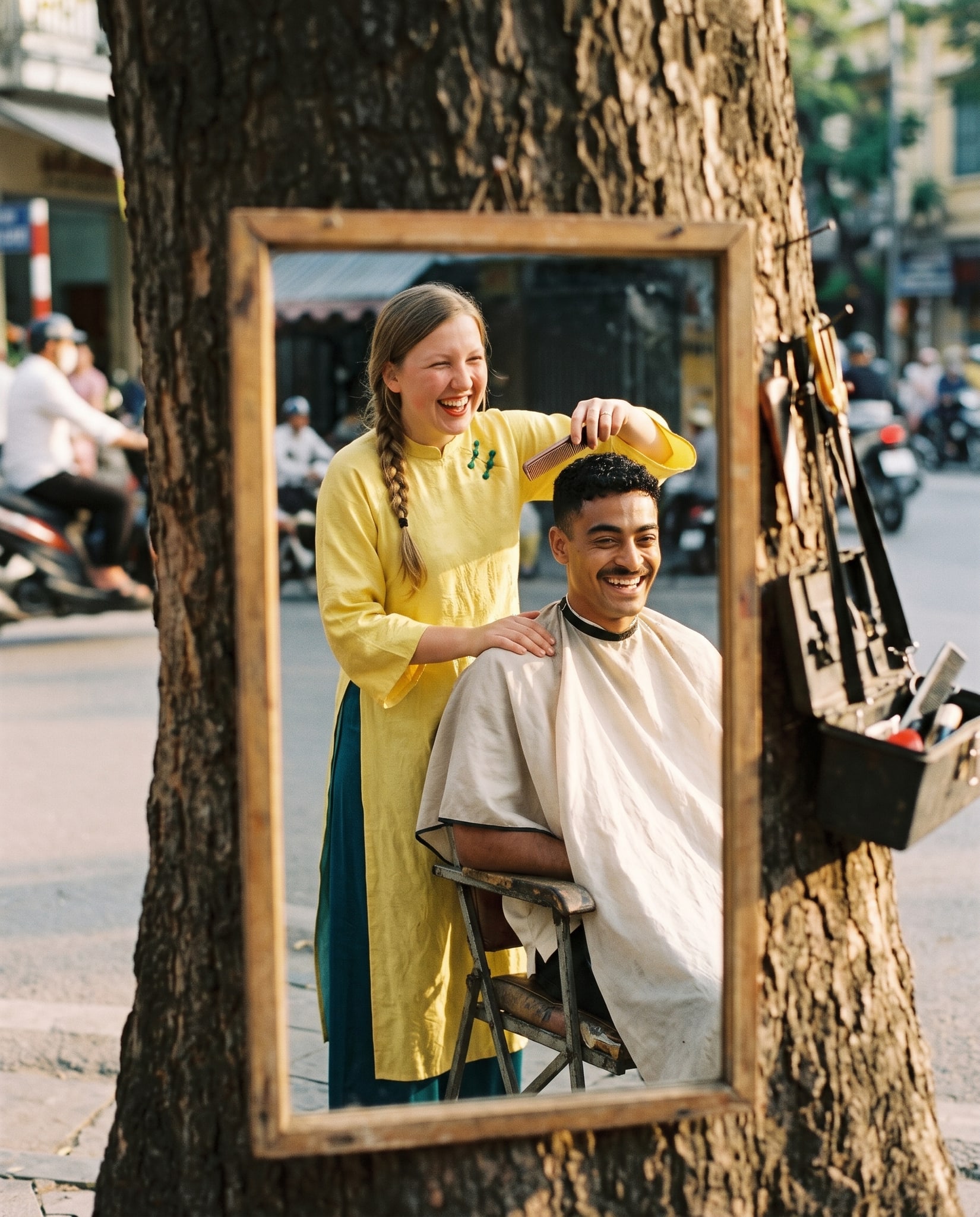
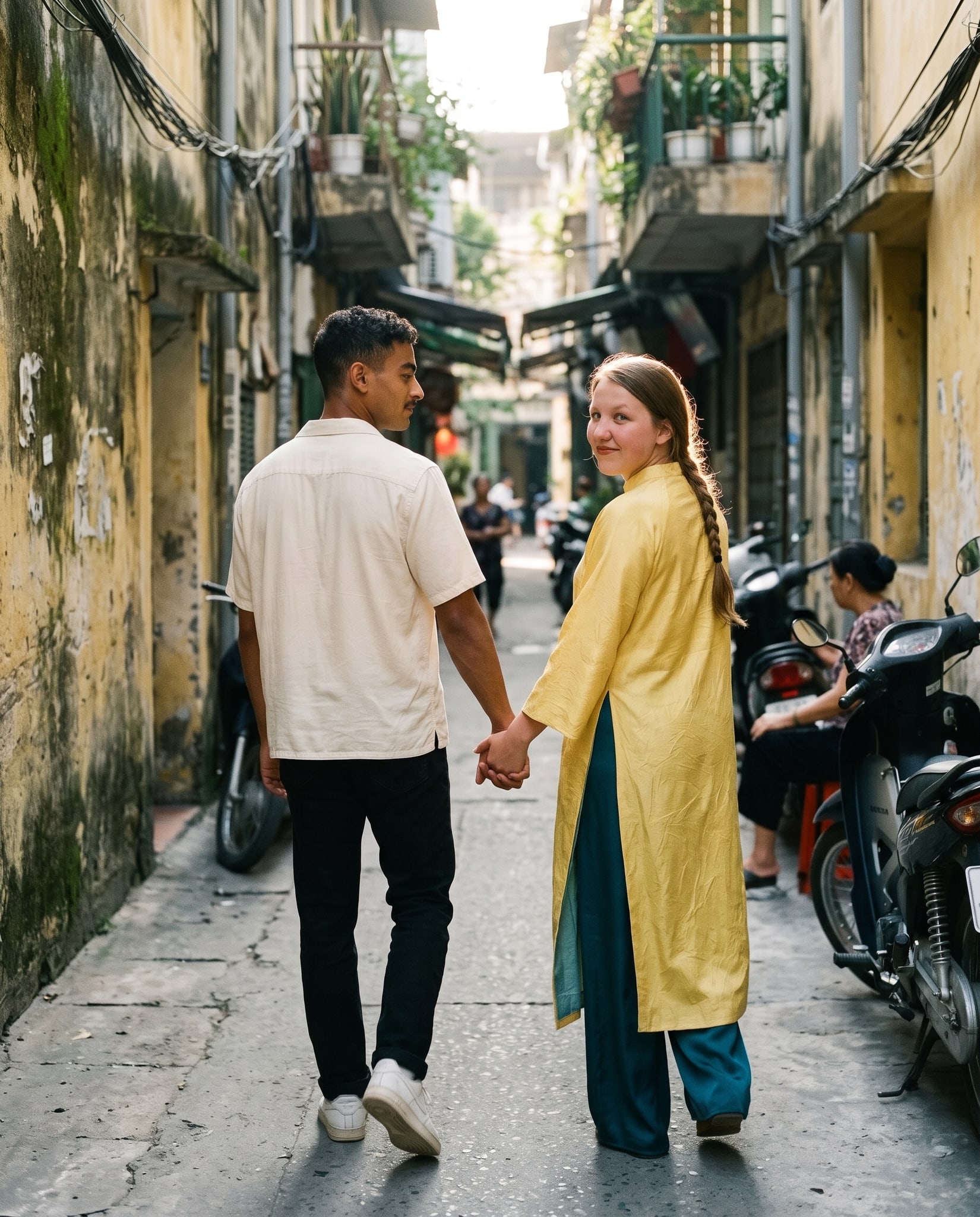
Solo shoots move fastest and let us frame you against the landscape—the bicycle becomes a prop, and we pose you sitting on it, walking it, or standing in the paddy edge looking at your hands. Couple shoots require twice the pedaling (we bring three bikes) and more outfit coordination—we often do matching ao dai with different colors or both in traditional pairs. We shoot 50 % couple poses (on the bicycles together, walking hand-in-hand through the paddy, looking back at each other) and 50 % individual frames. Couple photoshoot bookings here run 4–5 hours because the route stretches to 8–9 km. Family shoots with children under ten are technically possible but exhausting—kids tire after 30 minutes on gravel, and ao dai isn't designed for climbing or sitting in mud. We usually suggest family photoshoot sessions in Hoi An's old town or a nearby orchard instead, where the ao dai lasts longer and everyone stays happier. When a family insists on the rice fields, we limit it to two hours and bring a parent's bicycle in case a child needs a rest ride.
How do you recover the ao dai and deliver the final images—without mud stains?
This is the part guests don't ask about. At the end of the shoot (usually 9:00 am for dawn, 6:30 pm for sunset), we carry two small towels and a garment bag. You step into our shade setup, we remove the ao dai carefully and place it in the bag flat—never folded—with tissue paper between folds. If there's minor mud on the hem, we spot-clean it with a damp cloth on-site; major stains (rare, happens when someone sits directly in wet paddy) require a Hoi An tailor's gentle wash, which we arrange and cover cost-wise. Most ao dai go home spotless because we advise guests to wear slip-on pants or a sarong under the skirt, and we lift the hem when walking in wetter sections. Images are delivered in two batches: 30–40 finals within 48 hours (so you can share on social media before leaving Vietnam), the remaining 80–100 within two weeks (full edits, color grading, and your choice of any accent colors). We deliver via cloud link; you download and share freely. If you're unhappy with framing or retouching on any image, we adjust or swap it within 30 days.
Comparison: Hoi An rice field ao dai shoots vs. other Hoi An backdrops
| Setting | Best for | Weather risk | Physical demand | Outfit durability |
|---|---|---|---|---|
| Rice paddies + bicycle | Adventurous couples; fashion editorial feel | Monsoon season (Jun–Sep) blocks routes | Moderate; 5–7 km gravel terrain | High; muddy hems possible |
| Old town streets + lanterns | Solo; romantic couples; ao dai detail shots | Crowds; heat in midday | Low; flat stone | Very low; no dirt |
| Cam Thanh mangrove boat | Families; dramatic water light | Tidal timing matters | Low; sitting in boat | Very low; you stay dry |
| Orchard or garden | Large families; multiple ao dai | Seasonal flowers fade | Low; manicured paths | Very low; clean ground |
What to check before you book a rice-field ao dai bicycle shoot
- Confirm your ao dai exists and fits. If you're renting, book the tailor 2–3 weeks ahead; rush tailoring creates loose seams that split on bumpy terrain. We can recommend makeup and hair services that include ao dai fittings.
- Ask about your photographer's gimbal or follow-cam setup. Our photographer walks or slowly pedals alongside; some cheaper providers shoot static from the roadside, missing close-up movement and interaction. Watch a portfolio video, not stills.
- Check the specific rice paddies. We work between Hoi An town and Tra Que village; if a vendor promises "pristine rice fields 20 km out," verify the route is actually passable and not a factory farm. Ask for a map.
- Verify season and backup dates. December–April is dry and flower-rich; May–November we offer the shoot but with reschedule guarantees. If your flight is fixed, book April, not September.
- Understand image delivery format. We send cloud links (Google Drive or Dropbox); if you need USB or printed albums, ask us upfront and budget extra time and cost.
- Ask whether your session includes hair touch-ups mid-shoot. We carry a compact kit and repin ao dai if wind or humidity loosens it; not all photographers do.
Our ao dai photoshoot package is the standard entry point for rice-field rides. If you're also planning a proposal or elopement moment in the paddies, check our proposal and anniversary package—we can integrate that into the bicycle route. For standalone concept shoots with custom ao dai or vintage styling, see our special concept shoot options. Reach out on WhatsApp with your dates and group size; we'll confirm paddy conditions and give you an honest timeline.
See packages and prices on vietnamphotoshoot.com
FAQ
Can we do the rice-field shoot in September or October?
Yes, but expect monsoon reschedules. Paddies flood or drain unpredictably, and rain can erase light. We include two free reschedule dates in your booking; most guests move to November or reschedule for January. Ask us for rain-contingency details on WhatsApp.
Do we need to bring our own bicycle or ao dai?
We supply the bicycle. You bring your ao dai (ideally custom-tailored 2–3 weeks prior) or rent one through a Hoi An tailor—we have vendor contacts. If you arrive without one, email us and we'll arrange a rush rental, though cost and quality vary.
How many usable photos do we actually get from a 3-hour shoot?
Our photographer captures 300–400 frames; we deliver 100–150 edited images (roughly 30–40 % keeper rate on clear days). You choose which 30–50 to have fully retouched. This ratio reflects focus on a few sublime moments rather than quantity.
What if the ao dai gets seriously muddy or torn?
Minor mud we clean on-site with our towel kit. Serious tears (rare) or heavy staining we send to a Hoi An tailor for professional wash or repair—we cover the cost. We've never had a guest's ao dai ruined; most concerns are stains that fade in normal washing.
Can we combine the rice-field ride with the old-town lantern shoot?
Absolutely. We can do a 6–7 hour "full-day" session: rice paddies 5:30–9:00 am, a long lunch break, old-town lantern shoot 4:30–6:30 pm. This requires a second ao dai or outfit change. Many couples book this; it's listed as an extended option. Ask on WhatsApp for extended-session pricing.
How far in advance do we need to book?
Peak season (December–April) fills 3–4 weeks ahead. Other months, two weeks is usually enough. Rice-field conditions (water level, weather) confirm within 48 hours of your shoot date. If dates slip, we reschedule with no penalty.
Ao Dai Photoshoot
Inclusions, prices and booking are on our booking site.
FAQ
Can we do the rice-field shoot in September or October?
Yes, but expect monsoon reschedules. Paddies flood or drain unpredictably, and rain can erase light. We include two free reschedule dates in your booking; most guests move to November or reschedule for January. Ask us for rain-contingency details on WhatsApp.
Do we need to bring our own bicycle or ao dai?
We supply the bicycle. You bring your ao dai (ideally custom-tailored 2–3 weeks prior) or rent one through a Hoi An tailor—we have vendor contacts. If you arrive without one, email us and we'll arrange a rush rental, though cost and quality vary.
How many usable photos do we actually get from a 3-hour shoot?
Our photographer captures 300–400 frames; we deliver 100–150 edited images (roughly 30–40 % keeper rate on clear days). You choose which 30–50 to have fully retouched. This ratio reflects focus on a few sublime moments rather than quantity.
What if the ao dai gets seriously muddy or torn?
Minor mud we clean on-site with our towel kit. Serious tears (rare) or heavy staining we send to a Hoi An tailor for professional wash or repair—we cover the cost. We've never had a guest's ao dai ruined; most concerns are stains that fade in normal washing.
Can we combine the rice-field ride with the old-town lantern shoot?
Absolutely. We can do a 6–7 hour "full-day" session: rice paddies 5:30–9:00 am, a long lunch break, old-town lantern shoot 4:30–6:30 pm. This requires a second ao dai or outfit change. Many couples book this; it's listed as an extended option. Ask on WhatsApp for extended-session pricing.
How far in advance do we need to book?
Peak season (December–April) fills 3–4 weeks ahead. Other months, two weeks is usually enough. Rice-field conditions (water level, weather) confirm within 48 hours of your shoot date. If dates slip, we reschedule with no penalty.
More from the team
Ao Dai Photos at Hoi An Lantern Street at Night
Hoi An Lantern Street (Nguyen Hoan) glows at dusk with silk lanterns and reflected light. Our team shoots ao dai here after dark, navigates tight vendor spaces, and handles the low-light challenge with experience from 100+ night sessions.
Ao dai for wedding photos in Quy Nhon: renting, fitting and styling
Quy Nhon's coastal backdrops pair beautifully with traditional ao dai. We walk through rental choices, fitting logistics and how our team coordinates styling on shoot day.
Vietnam Pre-Wedding Photoshoot: What We Book at Cáo Studio
Pre-wedding shoots in Vietnam mean morning light in Hoi An's Old Town, cyclos in Saigon, or terraced fields near Ninh Binh. We walk you through what a session actually costs, how we schedule it, and what goes wrong on the day.