 Cáo Studio
Home › Blog › Ao Dai Photoshoot
Ao dai wedding photos at Fansipan summit: what we do on location
By the Cáo Studio team · Hanoi & Saigon · 2026-11-04
Ao dai wedding photos at Fansipan work best between May and September, when fog clears by midday and temperatures stay above 10°C. The summit sits 3,143 meters above sea level near Sapa in northwest Vietnam; most couples hire us for a 4–6 hour shoot starting at sunrise or early morning from Cáo Studio Hanoi. Expect thin air, fast-changing clouds, and wind that tests lightweight fabrics. We bring extra hair pins, backup ao dai layering, a reflector kit, and a weather-monitor app. Cost depends on styling, assistant count, and whether you need hotel pickup from Sapa town—ask us for a quote on WhatsApp. Most couples pair the summit shoot with a pre-wedding or couple photoshoot package in Sapa's Old Town below. The ao dai must be tailored specifically for mountain wear: stiffer silk, narrower sleeves, no trailing trains, and thick underlayers to keep shape in wind. Chat with us on WhatsApp
Why does altitude change how we style and shoot ao dai on Fansipan?
At 3,143 meters, oxygen drops to 65% of sea-level density. Brides and grooms feel fatigue faster, so we shorten pose holds and build in rest breaks between setups. The ao dai fabric itself behaves differently: silk becomes stiff in cold (around 8–12°C at summit), which looks crisp in photos but limits movement. We layer lightweight merino under the ao dai to regulate warmth without bulk, and we choose heavier silk twill instead of lighter charmeuse—it holds folds better in wind gusts that hit the exposed summit. Light scatters differently at altitude; the sky bleaches earlier in the day, so we shoot the main romantic portraits between 6:30 and 8:30 a.m., before the light flattens. This altitude physics is why we don't schedule Fansipan ao dai shoots the same way we run vacation and solo photoshoot sessions in Hanoi—timing, fabric choice, and breathing rhythm all shift.
What happens to hair and makeup in mountain weather?
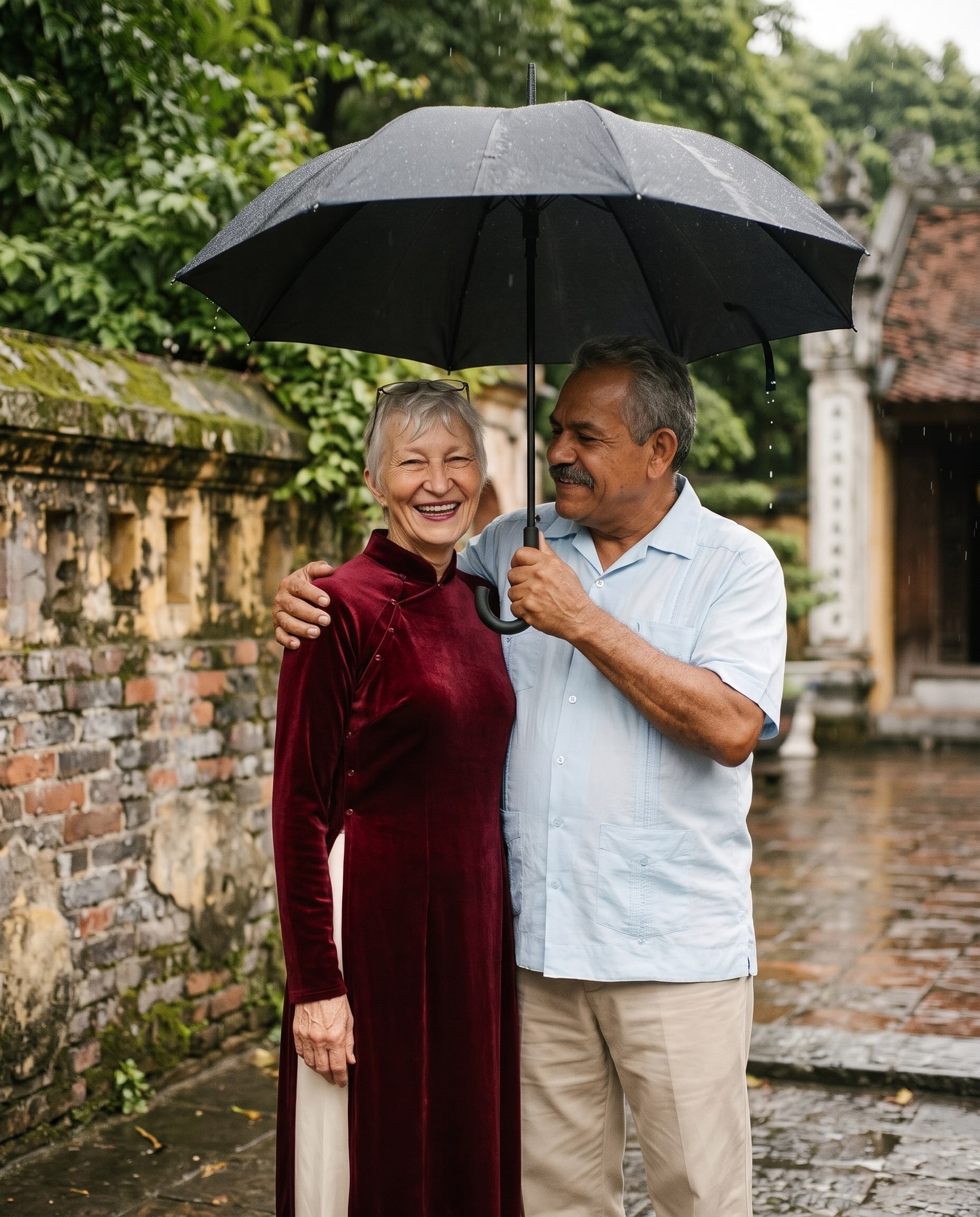
Fansipan wind gusts reach 40–50 km/h on clear mornings. We use heavy-hold hairspray (Tresemmé or L'Oreal Studio Line), backcombing at the crown, and extra bobby pins—usually double the number we'd use in Saigon. Humidity drops as you ascend; skin dries fast, so makeup and hair at your hotel in Sapa town includes a pre-shoot hydrating facial the night before. We apply setting spray in two layers: once after base makeup, again after final blush and lip color. Eyeliner must be waterproof; we skip cream shadow and use long-wear powder formulas. The makeup team arrives 90 minutes before the shoot to apply makeup on location at the summit lodge (not in town), because product oxidizes in the cold air during the 30-minute climb. Hair accessories—flower crowns, vintage combs, silk ribbons—get pinned through the ao dai collar, not just the hair, so wind can't dislodge them. Lipstick touch-ups happen every 20 minutes between outfit changes.
See packages and prices on vietnamphotoshoot.com
How do we manage fog and clouds—and when do we reschedule?
Fansipan sits inside cloud layers 60–70% of days year-round. We check satellite images and local webcams every 4 hours for 5 days before the shoot. If forecast shows <30 minutes of clear sky in your booked window, we offer a date swap with no fee—because a whiteout ao dai shoot doesn't deliver the vistas you paid for. On the day, we arrive at the summit lodge by 5:30 a.m. and wait 45 minutes. If clouds don't break by 6:15, we move to a secondary location: the upper cable-car station (2,900m) or the nearby limestone ridge, both 10 minutes down, where we often catch clearer light. We've shot successful ao dai portraits in partial fog too—the mist creates romance, softens shadows, and photographs beautifully if it's not total whiteout. Our Hanoi team carries a backup plan folder: three alternative locations, time windows, and outfit swaps. We text clients by 6 a.m. with real-time conditions and pivot decisions. This is why Fansipan shoots work best as part of a pre-wedding and elopement package that includes 1–2 days in Sapa: one clear-weather shoot at the summit, one backup shoot in town or rice terraces.
What ao dai styles actually work on a mountain versus what fails?
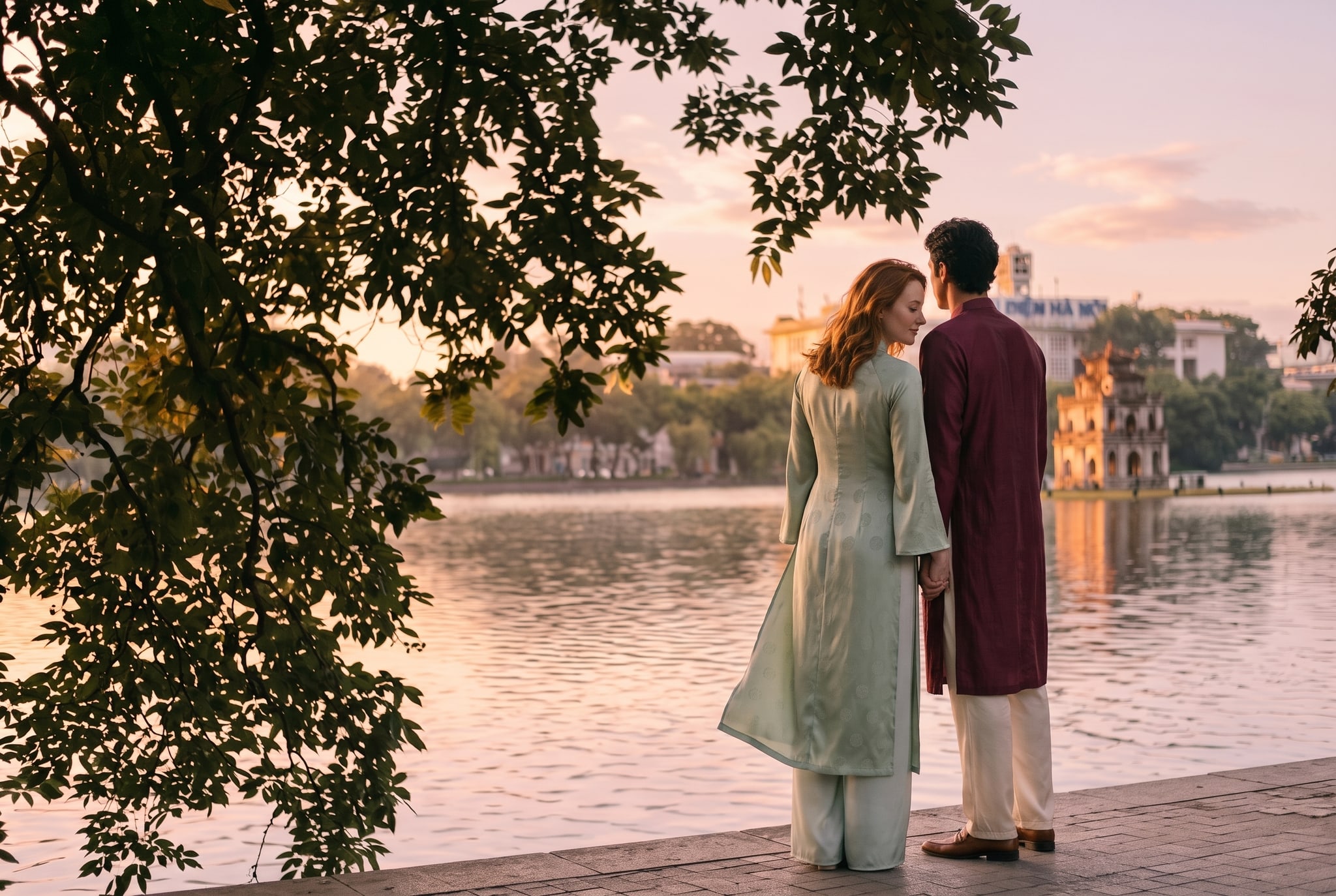
Our stylists choose ao dai fabrics and cuts by wind and movement. Heavy silk twill (140–150 gsm) holds creases and resists billowing; lightweight charmeuse catches air and wraps around legs, killing the clean silhouette in video. We avoid áo dài with floor-length trains (common in bridal styles)—they snag rocks, collect mud, and require constant adjustment. Instead, we tailor hems to mid-ankle, add internal ties at the waist so the ao dai stays centered, and use non-slick sole boots or flat sandals (not heels, which sink into gravel). The color choice matters: jewel tones (burgundy, emerald, sapphire) photograph darker and richer against pale sky; white or cream ao dai glows but shows every dust mark from the climb. We recommend solid colors over intricate embroidery for summit shoots—detail gets lost at distance and in mixed light. For grooms, we often suggest modern tailored áo dài in navy or black paired with minimalist belts, avoiding loose sleeves that flap. Our special concept shoot service includes a pre-shoot style consultation where our lead stylist reviews 3–4 fabric swatches and two silhouettes, photographs them in outdoor light, and shows you the realistic wind behavior on video. This saves the surprises on the day.
How do we compare Fansipan ao dai shoots to other mountain or special-location sessions?
| Location | Best for | Altitude challenge | Light window | Backup plan |
|---|---|---|---|---|
| Fansipan summit | Iconic high-altitude ao dai; romance; international guests | Extreme: 3,143m, thin air, cold | 6:30–8:30 a.m. (short) | Ridge or cable-car station 10 min down |
| Sapa rice terraces | Layered green background; longer shooting window | Moderate: 1,500–1,800m | 7:00 a.m.–11:00 a.m. | Adjacent terraces, village paths |
| Ninh Binh limestone | Drama without altitude; karst reflection; water shoots | Minimal: 0–200m | 6:00–9:00 a.m., 4:00–6:00 p.m. | Multiple boat routes, valley floors |
| Hanoi temple or heritage | Urban ao dai; city backdrop; ease of access | None | Full day flexibility | Covered courtyards, multiple temples |
Fansipan wins for iconic drama and honeymoon-story bragging rights, but demands the most physical stamina, the tightest scheduling, and the highest cost (ascent fees, mountain porter, oxygen risk management). Sapa rice terraces offer similar altitude romance with more flexibility. Ninh Binh limestone gives karst majesty without the climb. Our Hanoi team recommends Fansipan for couples willing to wake at 4:30 a.m., acclimatize the day before, and accept a 60% probability of partial fog. If you want guaranteed clear sky, Ninh Binh or the Sapa lower terraces are smarter.
What to check before you book a Fansipan ao dai shoot
- Fitness & acclimatization: Can both of you walk 30 minutes uphill carrying lightweight bags? Arrive in Sapa the day before the shoot; rest and drink water. If you have heart or lung conditions, consult a doctor—thin air is not trivial.
- Weather window: Ask us for a 5-day satellite forecast before you confirm. Book only if meteorology shows >2 hours of potential clear sky in your window. Fog is normal and beautiful, but total whiteout wastes your budget.
- Ao dai tailoring lead time: Mountain ao dai must be tailored 4–6 weeks ahead. Standard bridal shops don't know wind-proof cuts; tell your tailor "Fansipan summit, thin air, wind-resistant" so they tighten seams, reinforce shoulders, and use stiffer backing.
- Cable car + mountain lodge costs: These are not included in photo packages. Budget separately for the Fansipan cable car (book online to avoid queues) and breakfast at the summit lodge. We coordinate timing; you pay directly.
- Makeup timing: On-location makeup (at the summit lodge, not in Sapa town) is essential. Confirm with us whether your makeup and hair is included in your package or booked separately.
- Backup location: Confirm with us before the shoot which secondary location you prefer if fog closes the summit. This avoids arguments at 6 a.m.
When is the best season to shoot ao dai on Fansipan?
We run Fansipan ao dai shoots May through September. May–June brings moisture but more sunny breaks; July–August peaks in tourist crowds and afternoon fog. September is our favorite: cooler mornings (10–14°C), lower humidity, and clearer midday skies. October and April work occasionally, but frosts and rain increase. November–March is too cold and foggy—ao dai fabrics stiffen, breath becomes visible in photos, and clear-sky probability drops below 40%. Book 6–8 weeks ahead, especially May–September, because the cable car fills and mountain lodges reserve early.
How does our team actually manage the day, hour by hour?
4:00 p.m. previous day: We review final weather models, confirm cable-car tickets, and message you a 5-day outlook. If forecast shifts to <30% clear-sky probability, we offer a reschedule now.
5:00 a.m. shoot day: Photographer and stylist meet you at Sapa town hotel. Breakfast and final ao dai check happen in the lobby. We inspect seams, test wind-resistance with a fan, and adjust hairpins.
5:45 a.m.: Cable car ascent begins. We carry a lightweight gear bag (camera, backup lenses, reflector, hair pins, setting spray, touch-up makeup, water). The climb takes 30 minutes.
6:15 a.m.: Arrival at summit lodge. We scout light direction, check cloud movement, and position you for the first golden-hour portraits. Makeup artist does final touch-ups here.
6:30–7:30 a.m.: Main romantic portraits (couple or individual). This is when light is best and air is coolest (wind is manageable, fabrics don't wilt).
7:30–8:00 a.m.: Motion/walking shots down the short stone paths near the summit. Wind is stronger; we pin the ao dai tighter and increase pose frequency.
8:00–8:30 a.m.: Outfit change (if booked). Second ao dai gets final styling. If clouds have rolled in by now, we pivot to close-up portraits or descend to the secondary location.
8:30 a.m.: If fog is total, we descend. If sky is clear or partly cloudy, we shoot final setups and group shots.
9:00 a.m.: Cable-car descent. By 10 a.m., you're back in Sapa town for brunch and rest. Photographer processes images the same day.
This schedule is why couple photoshoot package guests often pair Fansipan with a second-day shoot in Sapa Old Town or rice terraces—one day for altitude, one for relaxation and detail close-ups.
FAQ
Do we need to hire a professional ao dai, or can we bring our own?
Bring your own if it's tailored for mountains (stiff silk, no trains, reinforced seams). Rentals in Sapa are usually standard wedding weight and tear easily on rocks. Alternatively, commission a tailor in Hanoi 4–6 weeks before the trip; cost is similar to rental, and you own the ao dai forever.
What if we arrive unacclimatized? Can we still shoot at the summit?
Yes, but expect fatigue and shorter pose windows. Drink 1.5 liters of water the day before and rest in Sapa town 4–6 hours before ascending. We build in 5–10 minute rest breaks between photo setups. If you feel dizzy or short of breath, we move the shoot down to 2,900m (cable-car station)—still dramatic, much easier.
Is a professional makeup artist required, or can we do our own makeup in town and just bring it to the summit?
Town makeup degrades in the cold air during the 30-minute climb. We recommend makeup and hair at your hotel or on-location makeup at the summit lodge. It costs extra but guarantees your makeup survives the wind and photos for 3–4 hours without touch-up failure.
What if it rains or snows on the shoot day?
Rain above 2,500m on Fansipan usually means cloud cover and zero visibility. We reschedule immediately (no fee). Snow is rare below 3,500m but possible in December–February—we avoid scheduling shoots in winter for this reason. Confirm rain insurance in your package terms before booking.
Can we do a sunrise shoot (before 6:30 a.m.) to avoid crowds?
Sunrise technically happens around 5:15 a.m. in summer, but light on Fansipan summit is dim and blue until 6:15 a.m. because the peak sits in shadow longer than lower elevations. We recommend starting at 6:00 a.m. for the golden-hour sweet spot without too much pre-dawn dimness.
How many outfits can we fit into one session?
One outfit (60 minutes), occasionally two if you change fast and the light holds. Mountain logistics (acclimatization, wind, cold) slow setup. Special concept shoot packages with extended time allow up to 3 outfits if booked as a full day (8+ hours), but most couples do one ao dai per summit visit.
Ao Dai Photoshoot
Inclusions, prices and booking are on our booking site.
FAQ
Do we need to hire a professional ao dai, or can we bring our own?
Bring your own if it's tailored for mountains (stiff silk, no trains, reinforced seams). Rentals in Sapa are usually standard wedding weight and tear easily on rocks. Alternatively, commission a tailor in Hanoi 4–6 weeks before the trip; cost is similar to rental, and you own the ao dai forever.
What if we arrive unacclimatized? Can we still shoot at the summit?
Yes, but expect fatigue and shorter pose windows. Drink 1.5 liters of water the day before and rest in Sapa town 4–6 hours before ascending. We build in 5–10 minute rest breaks between photo setups. If you feel dizzy or short of breath, we move the shoot down to 2,900m (cable-car station)—still dramatic, much easier.
Is a professional makeup artist required, or can we do our own makeup in town and just bring it to the summit?
Town makeup degrades in the cold air during the 30-minute climb. We recommend makeup and hair at your hotel or on-location makeup at the summit lodge. It costs extra but guarantees your makeup survives the wind and photos for 3–4 hours without touch-up failure.
What if it rains or snows on the shoot day?
Rain above 2,500m on Fansipan usually means cloud cover and zero visibility. We reschedule immediately (no fee). Snow is rare below 3,500m but possible in December–February—we avoid scheduling shoots in winter for this reason. Confirm rain insurance in your package terms before booking.
Can we do a sunrise shoot (before 6:30 a.m.) to avoid crowds?
Sunrise technically happens around 5:15 a.m. in summer, but light on Fansipan summit is dim and blue until 6:15 a.m. because the peak sits in shadow longer than lower elevations. We recommend starting at 6:00 a.m. for the golden-hour sweet spot without too much pre-dawn dimness.
How many outfits can we fit into one session?
One outfit (60 minutes), occasionally two if you change fast and the light holds. Mountain logistics (acclimatization, wind, cold) slow setup. Special concept shoot packages with extended time allow up to 3 outfits if booked as a full day (8+ hours), but most couples do one ao dai per summit visit.
More from the team
Ao dai wedding photos at Vung Tau Back Beach: what we book
Vung Tau Back Beach draws couples and solo travelers for ao dai photoshoots because the sand is textured, the light is soft in late afternoon, and you can wade into shallow water without slipping. We share what our stylists and photographers do on location, what goes wrong, and how to choose between
Áo dài wedding photos at Ben Tre coconut groves
Ben Tre's coconut groves offer water, light and stillness for áo dài wedding photography. We walk you through how our team shoots there, what works, and how to book.
Áo dài for wedding photos in Mai Chau and Pu Luong: rent or buy?
Mai Chau and Pu Luong offer dramatic terraced landscapes for áo dài shoots, but altitude, humidity and rural fittings require different rental and styling choices than Hanoi studios.