 Cáo Studio
Home › Blog › Ao Dai Photoshoot
Ao dai wedding photos at Hanoi Old Quarter: our studio process
By the Cáo Studio team · Hanoi & Saigon · 2026-11-04
Ao dai wedding photos at Hanoi Old Quarter mean a full morning or afternoon session—usually 2–3 hours—in the narrow lanes between Hoàn Kiếm Lake and the Red River. Cáo Studio books sunrise or late-afternoon slots to dodge tour groups, coordinates with a stylist for ao dai fitting and touch-ups, positions a makeup artist on standby, and scouts the exact street corners based on light and fabric drape. The session includes ao dai photoshoot package time, digital files, and location logistics; we also offer couple photoshoot or pre-wedding sessions in the same streets. Most guests pay for styling and hair separately—ask us for a quote on WhatsApp. The main challenge we face is managing reflections off wet streets after rain and timing around temple ceremonies that block access to Thái Hồ and Hàng Buồm streets. Chat with us on WhatsApp
What time of day do you actually photograph at Old Quarter?
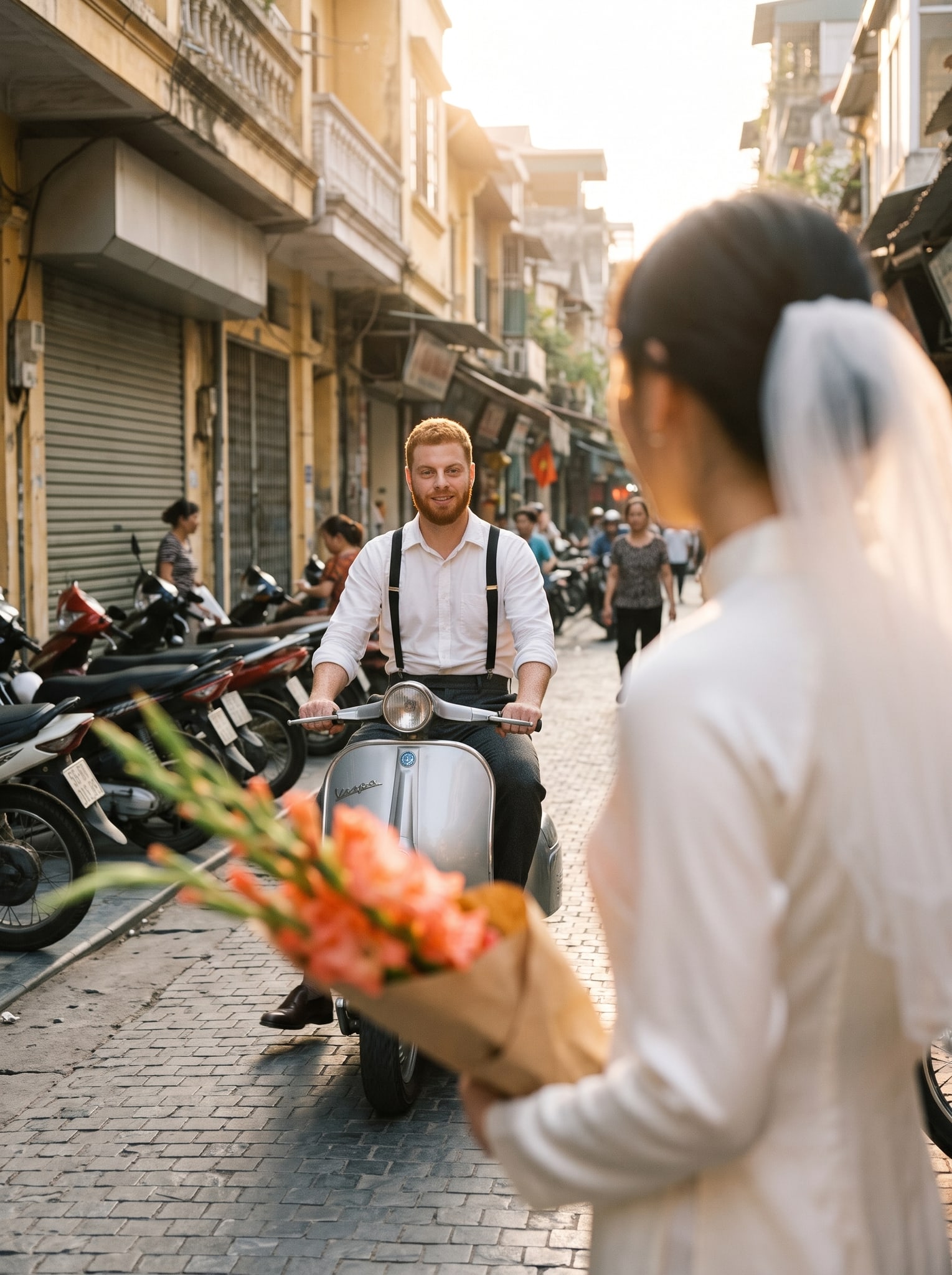
We shoot either 5:30–7:30 a.m. or 4:30–6:30 p.m., never midday. Sunrise light hits the yellow French colonial shophouses and turns wet cobblestones gold; the streets are empty enough for the ao dai to move without bumping into vendor carts. Afternoon light creates warm shadows under the narrow awnings where the silk catches fire. By 6:30 p.m., we're off the streets—tour groups flood back and the cafés open. On overcast mornings we've pivoted to the Hoan Kiem Lake promenade instead, sacrificing the tight alley drama for softer, diffused light. One bride chose a rainy 6 a.m. slot; the ao dai's hem dragged through puddles and took 45 minutes to dry later—we now warn guests that wet streets mean hemming adjustments before the shoot.
How do you pick which lanes actually work for the ao dai?
We rotate between five core locations: Thái Hồ Street (narrow, yellow walls, incense smell), Hàng Buồm (wider, better for walking shots), Hàng Gà (busier, but stunning red lacquer doors), the stairs near Ngôn Temple (dramatic, but slippery), and the Hoàn Kiếm lakeside near Thúc Tây Street. Each has different challenges. Thái Hồ requires a spotter because cyclo drivers still come through; Hàng Gà's cafés fill by 7 a.m. and block sightlines; the temple stairs mean the ao dai's train catches on moss. Before each session, our photographer walks the route two days prior, checks for construction barriers, asks shopkeepers about ceremony schedules, and takes reference photos in the exact light window we'll use. We brief the stylist on which locations suit long trains versus shorter, walking ao dais. If we find a padlocked gate or a festival banner hanging, we know 48 hours in advance and can reschedule or flip to a backup street.
See packages and prices on vietnamphotoshoot.com
What styling mistakes do we see on shoot day—and how do we fix them?
| Styling choice | Who chooses it | What happens on cobblestones | Our fix |
|---|---|---|---|
| Train dragging full length | Brides wanting drama | Hem soaked, silk torn, 30-min delay | Pin train up for walking shots, drop for still frames |
| No undershirt under silk áo dài | First-time wearers | Sheer fabric shows everything in backlighting | We bring a fitted mesh layer, pin it inside the neckline |
| Tight sleeves or stiff embroidery | Rentals (not custom) | Arms can't lift for hugging shots, fabric creases | Steamer on set, we reshape seams between frames |
| Heavy hair jewelry without clip test | Guests who wear it once yearly | Slides off during movement, bride spends 5 min fixing it | We pre-tape combs with fashion tape, do a 2-min walk test in the studio before heading out |
| Shoes chosen for Instagram, not walking | Heel height 8cm+ | Bride limping by frame 40, blisters visible in close-ups | We ask shoe choice 1 week prior, suggest flat ao dai sandals, keep a spare pair of embroidered flats in the van |
On a December shoot, the bride wore a rented ao dài with sleeves so stiff the fabric crinkled every time she moved her arms. We had a portable steamer in the van and spent 15 minutes reshaping the folds between location moves. She didn't realize until we showed her the before/after that the first 20 frames looked creased. Now we ask renters to have their ao dài professionally steamed and loosened the day before; custom-made versions rarely have this problem.
How do you manage Old Quarter crowds without guests looking rushed?
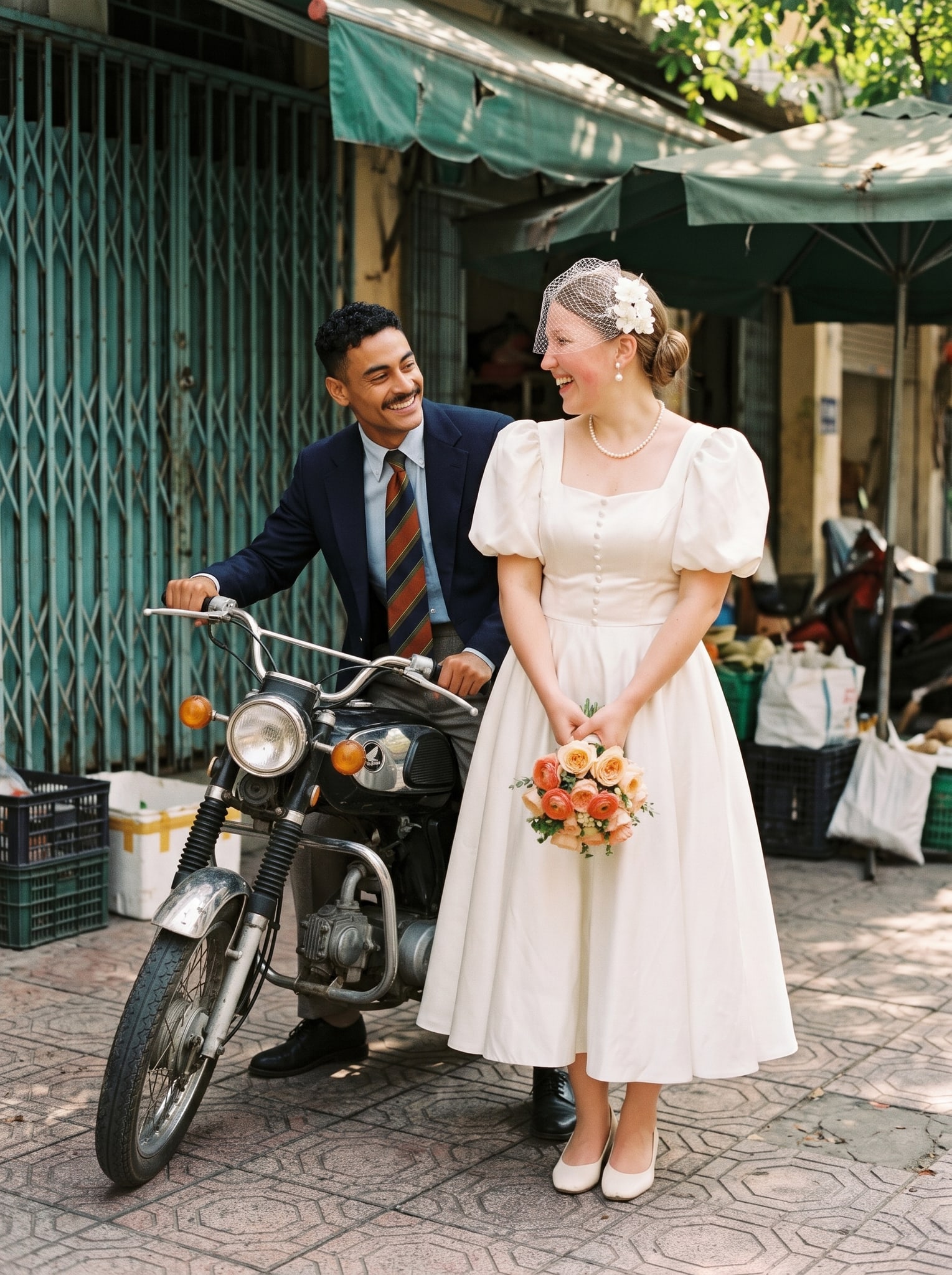
We arrive at locations 30 minutes before the shoot window to set up reflectors, scout the exact angle, and clear any immediate foot traffic by asking vendors politely if they'll pause. Most do—they recognize the camera and ao dài. Our photographer shoots fast: 3–4 frames per pose, minimal fiddling. When a tour group rounds the corner, we step into a doorway and let them pass, resetting after 60 seconds. One October morning, a wedding procession started at Thúc Tây temple at 6:20 a.m., right in the middle of our slot. We pivoted to Hàng Buồm, which was empty, and completed the session by 7:15 a.m. We always have a backup location in mind. The stylist carries touch-up powder and a steam wand on her hip; if the ao dài shifts during a crowd pause, she corrects it in under 2 minutes. We've learned not to fight the Old Quarter's rhythm—we dance with it.
Which ao dai styles photograph best in the Old Quarter's tight spaces?
We recommend ao dai photoshoot styles with these features:
- Train length 1.5–2.5 meters: Long enough for drama when pinned for standing shots; short enough to pin up fully for walking and not drag into vendor carts.
- Fitted bodice, flared or straight hem: Allows the fabric to catch light and move with the breeze between the narrow walls; loose, tent-like cuts flatten in alley shadows.
- Embroidery or brocade in the side panels: The Old Quarter's tight lanes mean the camera shoots from directly in front or 45 degrees—side panels show the detail; solid chest panels disappear.
- Lightweight silk or cotton silk: Heavy brocade holds creases after sitting in a cyclo; light silk wrinkles less and steams faster.
- Contrasting inner áo (shirt): If the outer áo is sheer or patterned, a solid white or cream inner piece keeps the lines clean in backlighting.
A bride wore a 3-meter train with heavy beading last year. She wanted walking shots on Thái Hồ. The beading caught on her own feet twice, and the train picked up dampness from the street. We completed the session, but she told us later she wished she'd chosen a 2-meter train. Now we show couples our portfolio filtered by street type and train length so they can see the actual movement on cobblestones before deciding.
What do you need to check before booking an Old Quarter ao dai session?
- Street access: Check if any Tet ceremonies or construction close streets. Ask us to confirm two weeks before.
- Ao dài condition: If renting, request steaming and inspection. If bringing your own, confirm it fits and moves after any tailoring.
- Shoe comfort: Plan to walk 30+ minutes on cobblestones. Wear the shoes to a test location first.
- Hair and makeup longevity: Old Quarter can be humid. Ask our makeup and hair at your hotel team if your makeup is sweat-proof and your hair pins secure.
- Light window flexibility: We book 5:30–7:30 a.m. or 4:30–6:30 p.m. Sunrise sessions have softer light but require earlier wake-up; afternoon sessions have warmer tones but may catch lingering crowds.
- Backup location: Confirm which street we'll move to if your first choice is blocked.
FAQ
Can we do an Old Quarter ao dai shoot and then move to another location in the same session?
Yes. Most pre-wedding photoshoot and couple photoshoot packages include 3–4 hours and 2–3 locations. Old Quarter takes 1.5–2 hours; we often add the Hoàn Kiếm Lake promenade or Thúc Tây Temple stairs afterward. Let us know your priorities when you book.
What happens if it rains the morning of our shoot?
We wait 20 minutes to see if it clears. If heavy rain continues, we move to Hàng Buồm (wider, better drainage) or reschedule to the following day if you prefer drier streets. Wet cobblestones create beautiful reflections, but ao dài hems suffer; most couples prefer to avoid it.
Do we need to hire a separate stylist for the ao dài, or does the package include one?
Ask us for a quote on WhatsApp. Our ao dai photoshoot package includes photography and locations; styling is typically separate. We coordinate with our preferred ao dài stylists and can arrange one to meet you at the location or your hotel.
How many photos do we get from an Old Quarter session?
Typically 60–80 edited digital files from a 2-hour session. You receive all frames; we don't limit the count. Albums or prints cost extra—ask us for options.
Is it disrespectful to wear an ao dài as a foreigner in the Old Quarter?
No. Wearing an ao dài respectfully—clean, well-fitted, hair and makeup modest—is welcomed. The Old Quarter sees international guests in ao dài almost daily. Temple areas near Thúc Tây require shoulders covered and modest behavior; the ao dài naturally meets this. Avoid wearing it as a costume or beach garment.
Ao Dai Photoshoot
Inclusions, prices and booking are on our booking site.
FAQ
Can we do an Old Quarter ao dai shoot and then move to another location in the same session?
Yes. Most [pre-wedding photoshoot](/go/pre-wedding-photoshoot) and [couple photoshoot](/go/couple-photoshoot) packages include 3–4 hours and 2–3 locations. Old Quarter takes 1.5–2 hours; we often add the Hoàn Kiếm Lake promenade or Thúc Tây Temple stairs afterward. Let us know your priorities when you book.
What happens if it rains the morning of our shoot?
We wait 20 minutes to see if it clears. If heavy rain continues, we move to Hàng Buồm (wider, better drainage) or reschedule to the following day if you prefer drier streets. Wet cobblestones create beautiful reflections, but ao dài hems suffer; most couples prefer to avoid it.
Do we need to hire a separate stylist for the ao dài, or does the package include one?
Ask us for a quote on WhatsApp. Our [ao dai photoshoot package](/go/ao-dai-photoshoot) includes photography and locations; styling is typically separate. We coordinate with our preferred ao dài stylists and can arrange one to meet you at the location or your hotel.
How many photos do we get from an Old Quarter session?
Typically 60–80 edited digital files from a 2-hour session. You receive all frames; we don't limit the count. Albums or prints cost extra—ask us for options.
Is it disrespectful to wear an ao dài as a foreigner in the Old Quarter?
No. Wearing an ao dài respectfully—clean, well-fitted, hair and makeup modest—is welcomed. The Old Quarter sees international guests in ao dài almost daily. Temple areas near Thúc Tây require shoulders covered and modest behavior; the ao dài naturally meets this. Avoid wearing it as a costume or beach garment.
More from the team
Ao dai wedding photos at Thanh Toan tile-roofed bridge
Thanh Toan tile-roofed bridge in Hoi An draws couples for ao dai shoots. We walk through how our team manages light, crowds, costume changes, and what actually happens hour by hour on location.
Ao dai wedding photos at Tam Giang Lagoon: what we shoot, when, why
Tam Giang Lagoon's mirrored water and salt fields create one of Vietnam's most striking backdrops for ao dai wedding photography. We've shot over 200 sessions there—here's what we learned.
Ao dai wedding photos at Hang Mua viewpoint
Hang Mua's dramatic 500-meter viewpoint over Ninh Binh draws couples who want ao dai shots framed by karst peaks and rice fields. We run 2–4 hour sessions there and share what actually happens on the mountain.