 Cáo Studio
Home › Blog › Ao Dai Photoshoot
Ao Dai Wedding Photos at Hoai River Lanterns at Night
By the Cáo Studio team · Hanoi & Saigon · 2026-11-01
Shooting ao dai at Hoai River lanterns at night means arriving in Hoi An 30–45 minutes before dusk, positioning yourself along the river's center or south bank where lantern reflections are strongest, and working through two lighting phases: golden hour (15 minutes) and deep twilight (30–45 minutes) before lanterns blur and crowds peak. Cáo Studio books this location for couples and solo travelers year-round; each session runs 60–90 minutes including 2–3 outfit changes and travel between the river and nearby alleyways. Night shoots here are brighter than you'd expect due to the lanterns themselves—we shoot at ISO 1600–3200, f/2.8–f/4, shutter 1/125–1/250—but crowds, uneven ground, and reflections can ruin focus if your photographer isn't watching exposure metering. Budget for a longer session than a daytime shoot because setup time is longer and location changes take extra care. Chat with us on WhatsApp
What makes Hoai River lanterns the right choice for your ao dai night shoot?
The Hoai River lanterns create a naturally lit, warm frame that flatters ao dai colors and skin tone without needing external flash. The reflections multiply the light; most shots don't need fill flash at all. The lanterns hang at eye level when you're positioned at water's edge, so they frame rather than overpower your face. We choose this location for clients who want romance without studio artifice, but only if they're prepared for crowds during peak season (October–November, December–early January) and understand that the river's tidal shifts and monsoon rains occasionally close access points. The lanterns are brightest between 18:15 and 19:45; after 20:00, you're shooting in dim amber light that can read muddy unless your camera handles shadows well.
How does our team time the shoot hour-by-hour on location?
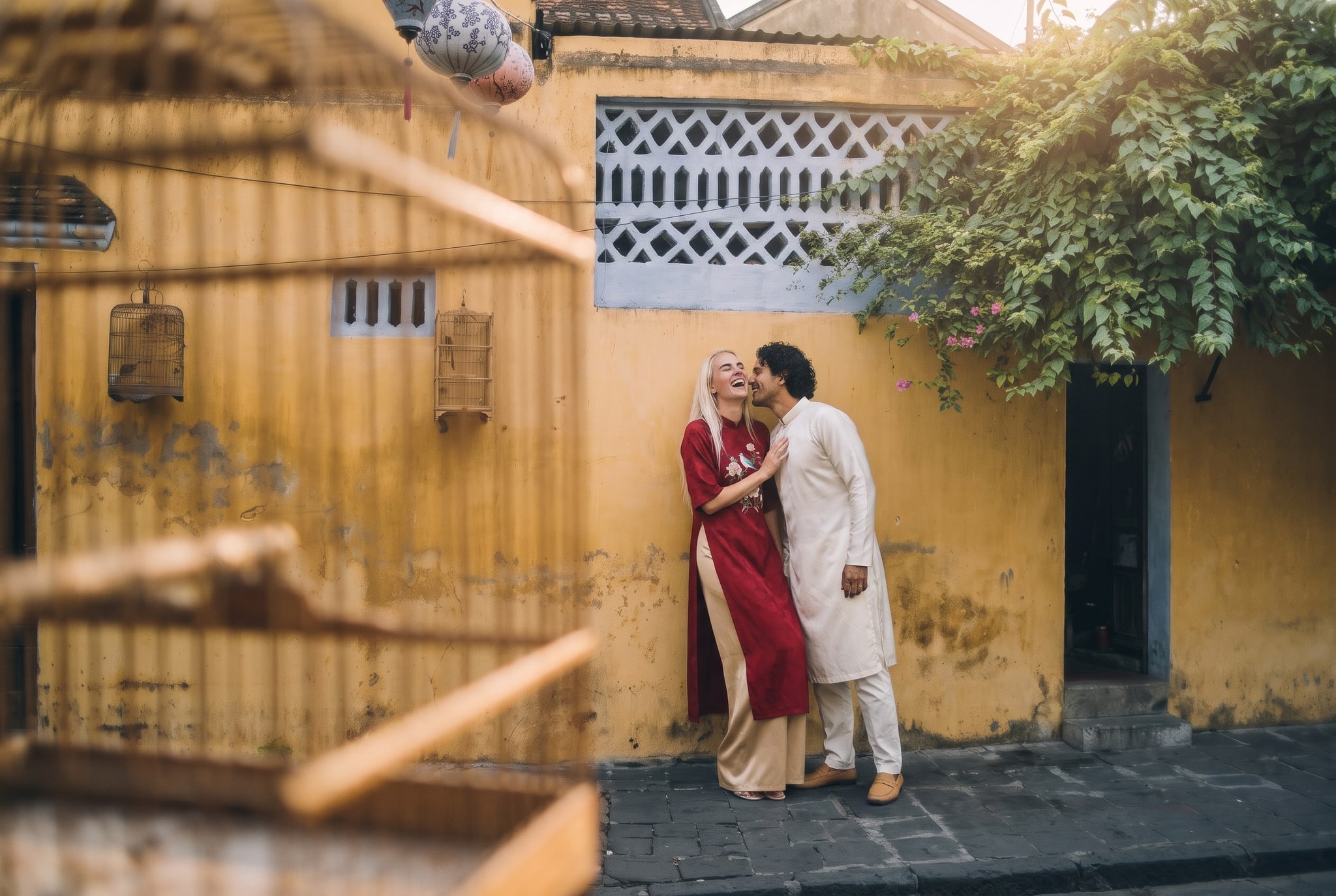
We arrive at our client's hotel 60 minutes before the booked shoot time to confirm ao dai fit, apply last-minute makeup touch-ups via hotel makeup and hair service, and brief on the walk to Hoai River. By 17:45 (example for a 18:30 start), we're positioned at the river with reflector and backup lighting gear. From 17:50–18:05 we shoot wide environmental portraits and close-ups while golden light still hits the water; lanterns are visible but not dominant. 18:05–18:25 is our golden window—lantern glow equals ambient light, faces are sculpted, and reflections pop. By 18:30, blue hour begins; we switch to ISO 2500–3200 and watch white balance drift toward blue, which we correct in post or by asking the client to step under a warmer lantern cluster. At 18:45, foot traffic peaks; we move to side alleys (Tan Ky Street, Japanese Bridge area) for outfit change 2. By 19:15, lanterns fully dominate; we frame tighter and rely on their glow. Most clients leave by 19:30 unless they've booked extended couple sessions or pre-wedding packages that include a second location.
See packages and prices on vietnamphotoshoot.com
What equipment and backup plans does Cáo Studio bring to night shoots?
We carry full-frame cameras with fast lenses (24–70 mm f/2.8 or faster), high ISO capability (clean to ISO 3200 minimum), and tripods for stability during 1/100 shutter speeds when clients need sharp reflections without motion blur. We bring a 5-in-1 reflector to bounce lantern light onto faces from below, a small LED panel (3200 K) for fill if a pose happens in shadow, and backup batteries because night shooting drains power 40% faster than daylight. Our gaffer watches shadow fall across the face in real time; if the ao dai's traditional high neckline blocks light on the chin, we tilt the reflector or reposition. We always shoot in RAW to recover blown highlights in lantern clusters and to shift white balance post-shot without color noise. On rare monsoon nights (September–October), we have a weather plan: either reschedule, move the session 30 minutes earlier to catch more twilight, or pivot to a sheltered concept shoot in a nearby heritage building. We've never cancelled outright; rescheduling or location pivot is always an option on our booking terms.
How do location changes within Hoi An affect your timeline and final images?
The river itself is compact—maybe 200 meters of shootable riverfront—so we rotate between the central footbridge, the restaurant terraces on the south bank, and Japanese Bridge's eastern approach. Each micro-location has a different lantern density and background depth. The central bridge offers the widest lantern view but has the most foot traffic; the south bank is quieter but requires steps down and better shoe grip. Japanese Bridge (15-minute walk inland) gives darker, more intimate lighting and zero river reflection, which appeals to clients wanting a moody, enclosed aesthetic instead of the classic postcard look. We often plan a 15-minute walk between outfit changes, which doubles as a mental break and lets us scout the next spot while your stylist smooths the ao dai. This walk costs time but improves the final narrative—each outfit tells a different story at a different location. Couples booking our extended sessions sometimes shoot both river and bridge in one evening; solo travelers and elopement parties may commit to one location to stay unhurried.
What surprises do we encounter on Hoai River shoots—and how do we handle them?
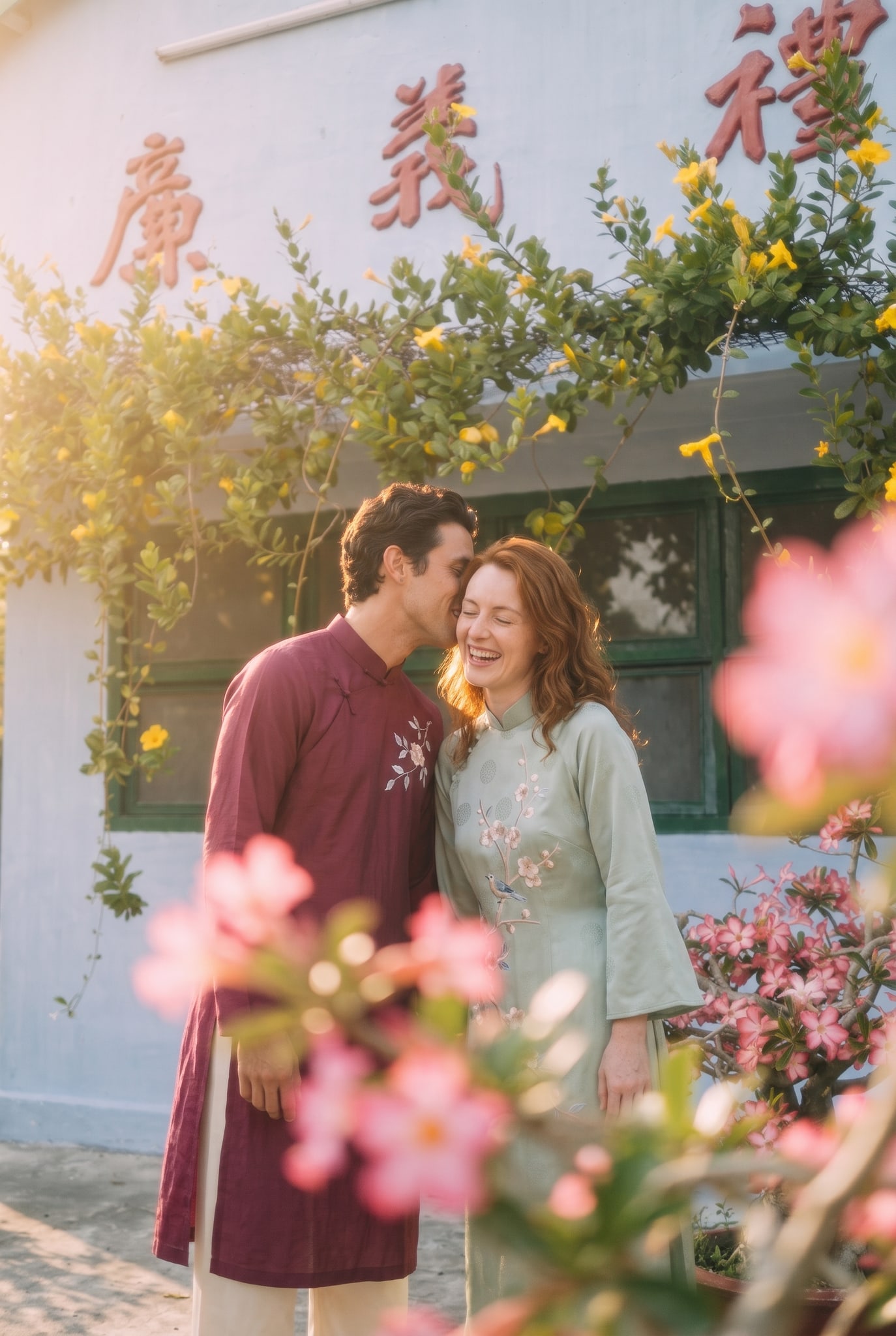
Uneven ground and puddles: The cobblestone riverbank has dips and moss-slicked patches, especially after rain or high tide. We scope it during the walk and recommend non-slip sole shoes; ao dai sleeves can drag in puddles if you're not careful stepping down. We use a cleaner cloth and water bottle on standby.
White balance drift: Lantern light reads as 2700–3000 K, but mercury vapor street lamps beyond the river push 4500 K. If your face is lit by one and your background by another, color shifts between images. We lock white balance manually at 3200 K and bracket exposures.
Crowds and photobombs: October–December, the river sees 500+ tourists per hour between 18:30–19:30. We work fast, use angles that exclude crowds (shooting from low or toward the bridge rather than across), or ask the client if they're open to natural "pedestrians" in the wide shot—some love it, others want isolation. We never ask tourists to move; we move ourselves.
Lantern failures: About 1 in 50 shoots, a lantern section goes dark—usually due to wind or power glitch. The crew restarts it within 10 minutes, but we've learned to shoot earlier in the evening when the full display is guaranteed.
Ao dai hemming: The hem drags in moisture and dye runs if fabric is damp. We keep the ao dai off the ground when walking and have a small towel to dry the bottom before sitting on steps for detail shots.
The common thread: we stay 15 minutes ahead of problems by scouting, asking clients about their comfort level, and keeping backup gear in view. Most nights feel seamless because we've sweat the details.
Comparing night shoot packages: which ao dai option is right for you?
| Package Type | Best For | Session Length | Outfit Changes | Why Choose It |
|---|---|---|---|---|
| Ao dai solo session | Travelers, anniversaries, milestone birthdays | 60 min | 1–2 ao dai | Intimate, personal narrative; river lanterns are the co-star |
| Couple or family shoot | Engagements, vow renewals, multi-generational | 90 min | 2–3 outfits per person | More coverage, multiple angles, storytelling across locations |
| Pre-wedding or elopement | Formal pre-wedding timeline, intimate ceremonies | 120+ min | 3–4 outfits | Anchors a broader wedding day narrative; lanterns are one chapter |
| Concept shoot | Thematic vision (e.g., "dance with lanterns," "prophecy") | 90–120 min | 2–4 ao dai, props | Creative reinterpretation; lanterns become metaphor, not backdrop |
What to check before you book a Hoai River night shoot:
- Your ao dai is fitted: Loose fabric gets wet and heavy; a tailor's adjustment takes 3–5 days in Hoi An. Check the hem length at least two days before the shoot.
- You know the weather: Monsoon season (August–October) brings afternoon rain 60% of days; we work around it, but confirm rescheduling terms upfront.
- Your shoes grip wet stone: Bring slip-resistant soles or go barefoot (we'll provide a cloth to dry feet). High heels are not safe on the riverbank.
- Camera gear is weather-sealed: If you're bringing a camera or drone, it should handle salt spray and humidity. Phone cameras are fine.
- You're okay with crowds during peak season: If solitude matters, book May–July (hot, fewer tourists) or February–March (cool, post-Tet) instead.
- You've discussed the exact time: Sunset times shift 20+ minutes between seasons. Confirm the precise start time one week before.
- Your makeup is waterproof: The combination of humidity, water spray, and facial heat can break down non-waterproof products by the 60-minute mark. Let us know if you're using heavy foundation; our makeup artists use waterproof bases for all night shoots.
Why shoot in Hoi An, and how does Cáo Studio approach this location differently?
Hoi An's UNESCO old town means consistent architectural framing—the river is essentially a stage that doesn't change. We use this stability to focus on storytelling and emotion rather than hunting for backgrounds. Many photographers treat the river as a generic "pretty spot"; we treat it as a lighting laboratory where phase, angle, and timing matter as much as composition. We've logged 200+ shoots here across seasons, so we know which lantern clusters are brightest, which wall shadows eat exposures, and which nearby streets give you a quiet moment when the main riverfront gets thick with foot traffic. We also brief our Hanoi-based clients and Saigon-based clients on what to expect: this isn't your home city's lighting or pace, and that unfamiliarity is often the whole point. A traveler choosing Hoai River is choosing to be a stranger in a beautiful place—our job is to make that strangeness feel intentional and timeless.
FAQ
Can we shoot ao dai at Hoai River during monsoon season?
Yes. Rain is atmospheric and creates mirror reflections on wet ground. We reschedule only if lightning is predicted or river access closes (rare). Pack waterproof shoes and confirm weather conditions one week before.
How many photos do we get from a night shoot?
A 60-minute session yields 150–200 edited final images (after culling and color correction). A 90-minute session yields 250–350. We shoot RAW and deliver in high resolution; your photographer will also show unedited selections in a private gallery.
Should we wear matching ao dai or different colors?
It's your choice. Matching ao dai (e.g., both deep blue) creates visual harmony and is traditionally elegant. Different colors add energy and showcase individual personality. Our stylists can advise in your consultation.
What if we want to avoid crowds?
Book May–July (35°C+, fewer tourists) or February–March (coolest, fewest visitors). Arrive by 17:30 for the earliest light window, before peak foot traffic. We can also scout side alleys and bridges that are less Instagrammed.
Can we include the Japanese Bridge or ancient buildings in the same shoot?
Absolutely. The Japanese Bridge is a 15-minute walk; Tan Ky House and Assembly Halls are nearby. Multi-location sessions cost more time but are standard in pre-wedding and extended couple packages. Discuss with our team on WhatsApp.
Do you offer hair and makeup on the day?
Yes, via hotel makeup and hair service. We arrive at your hotel 60 minutes before the shoot for final touches. Waterproof products are standard for night shoots.
Ao Dai Photoshoot
Inclusions, prices and booking are on our booking site.
FAQ
Can we shoot ao dai at Hoai River during monsoon season?
Yes. Rain is atmospheric and creates mirror reflections on wet ground. We reschedule only if lightning is predicted or river access closes (rare). Pack waterproof shoes and confirm weather conditions one week before.
How many photos do we get from a night shoot?
A 60-minute session yields 150–200 edited final images (after culling and color correction). A 90-minute session yields 250–350. We shoot RAW and deliver in high resolution; your photographer will also show unedited selections in a private gallery.
Should we wear matching ao dai or different colors?
It's your choice. Matching ao dai (e.g., both deep blue) creates visual harmony and is traditionally elegant. Different colors add energy and showcase individual personality. Our stylists can advise in your consultation.
What if we want to avoid crowds?
Book May–July (35°C+, fewer tourists) or February–March (coolest, fewest visitors). Arrive by 17:30 for the earliest light window, before peak foot traffic. We can also scout side alleys and bridges that are less Instagrammed.
Can we include the Japanese Bridge or ancient buildings in the same shoot?
Absolutely. The Japanese Bridge is a 15-minute walk; Tan Ky House and Assembly Halls are nearby. Multi-location sessions cost more time but are standard in [pre-wedding](/go/pre-wedding-photoshoot) and [extended couple packages](/go/couple-photoshoot). Discuss with our team on WhatsApp.
Do you offer hair and makeup on the day?
Yes, via [hotel makeup and hair service](/go/makeup-and-hair). We arrive at your hotel 60 minutes before the shoot for final touches. Waterproof products are standard for night shoots.
More from the team
Ao Dai Photos at Hoi An Lantern Street at Night
Hoi An Lantern Street (Nguyen Hoan) glows at dusk with silk lanterns and reflected light. Our team shoots ao dai here after dark, navigates tight vendor spaces, and handles the low-light challenge with experience from 100+ night sessions.
Ao dai for wedding photos in Quy Nhon: renting, fitting and styling
Quy Nhon's coastal backdrops pair beautifully with traditional ao dai. We walk through rental choices, fitting logistics and how our team coordinates styling on shoot day.
Vietnam Pre-Wedding Photoshoot: What We Book at Cáo Studio
Pre-wedding shoots in Vietnam mean morning light in Hoi An's Old Town, cyclos in Saigon, or terraced fields near Ninh Binh. We walk you through what a session actually costs, how we schedule it, and what goes wrong on the day.