 Cáo Studio
Home › Blog › Ao Dai Photoshoot
Ao dai wedding photos at Hoang Su Phi: what we learned shooting there
By the Cáo Studio team · Hanoi & Saigon · 2026-11-04
Hoang Su Phi rice terraces sit in Yên Bái province, 3.5 hours northwest of Hanoi, at 800–1200 meters elevation where terraced paddies spiral down mountainsides. A Cáo Studio shoot there spans 4–6 hours with hair, makeup, and 150–300 images across multiple outfit changes. The location suits ao dai wedding or couple sessions most; solo traveler shoots work but the terrain favors two people. Costs vary by team size, transport, and session length—ask us for a quote on WhatsApp. What catches clients off guard: morning fog rolls in until 9 a.m., the paths are steep and muddy even in dry season, and mobile signal drops unpredictably. We bring backup power, scout terrain the day before, and always have a rain plan. Chat with us on WhatsApp
Why does Hoang Su Phi work so well for ao dai photography?
The rice terraces create natural layers—greens, golds, and browns depending on harvest season—that frame a jewel-toned or white ao dai without competing for attention. Mist rolls through valleys at sunrise, softening light so skin glows without harsh shadows. The steep topography lets us position the couple at different heights within a frame, which gives depth that flat beaches can't match. We've shot over sixty sessions here and notice the same thing: clients' outfits pop against the landscape, yet the landscape doesn't overwhelm them. The terraces' geometry also breaks up sightlines, so even busy harvest periods feel intimate for a couple. This is why ao dai wedding photography works here better than in urban studios.
What time of year does our team recommend for Hoang Su Phi?
May to October offers clear skies and water in the paddies, making reflections and green hues vibrant. We avoid July–August when monsoon rain can trap us for hours and mud becomes treacherous. March–April shows young green shoots and fewer tourists—ideal for intimate sessions. Late September–early October brings harvest gold without the July rains. December–February is dry and cool, which guests love, but paddies are empty and brown. Based on 60+ shoots we've logged, October and early November deliver the best light-to-landscape ratio. Fog still appears before 9 a.m. in October, so we brief couples to expect that and use it for moody opener shots, then move to sunlit terrain by 10 a.m.
What do we pack and prepare the night before a Hoang Su Phi session?
We arrive in Yên Bái town the afternoon before, scout the exact terrace paths, check weather radar, and confirm vehicle access. Our kit includes: two full lighting setups (in case one fails on muddy ground), backup batteries charged to full, an umbrella for sudden showers, backup ao dai in case of mud stains, and a first-aid pack (twisted ankles happen on stepped terrain). We brief the driver on terrain difficulty—not all vans handle the final 2 km safely—and confirm mobile networks at key shooting spots so we can answer WhatsApp questions from other teams in Hanoi if needed. We also pack snacks and water; dehydration at elevation hits faster than at sea level. The night before, we message the client a packing checklist: comfortable shoes for walking, a change of undergarments if ao dai will be wet from morning dew, and any jewelry they want in specific shots. We never assume clients know that terraces hold water and moisture, so we over-communicate. For couple photoshoot planning, terrain prep is as important as outfit prep.
How do we handle weather surprises on the morning of a shoot?
We wake at 5:30 a.m., check visibility and ground conditions. If fog is below 50 meters and won't lift by 8 a.m., we text the couple and propose a one-hour delay or a shift to a different location with clearer views that day. If rain overnight has made paths dangerous, we move to a secondary terrace zone 1 km away that we've already scouted—it's slightly lower elevation, drier, and still photogenic. We've never cancelled outright; pivot sites keep us on schedule. Mud on ao dai hems is our biggest fix: we carry microfiber cloths and a spray bottle to rinse gently, then pat dry with a towel we reserved for this. If a client slips or the couple feels unsafe, we pause and reassess rather than push. One couple in late September had a sudden downpour at 11 a.m.; we moved under a farmer's shelter (with permission), shot interior-lit portraits, and the moody images became their favorites. We always tell clients: expect one weather pivot and plan the day so a two-hour delay won't ruin evening plans.
What makes the ao dai style choices different at Hoang Su Phi versus other locations?
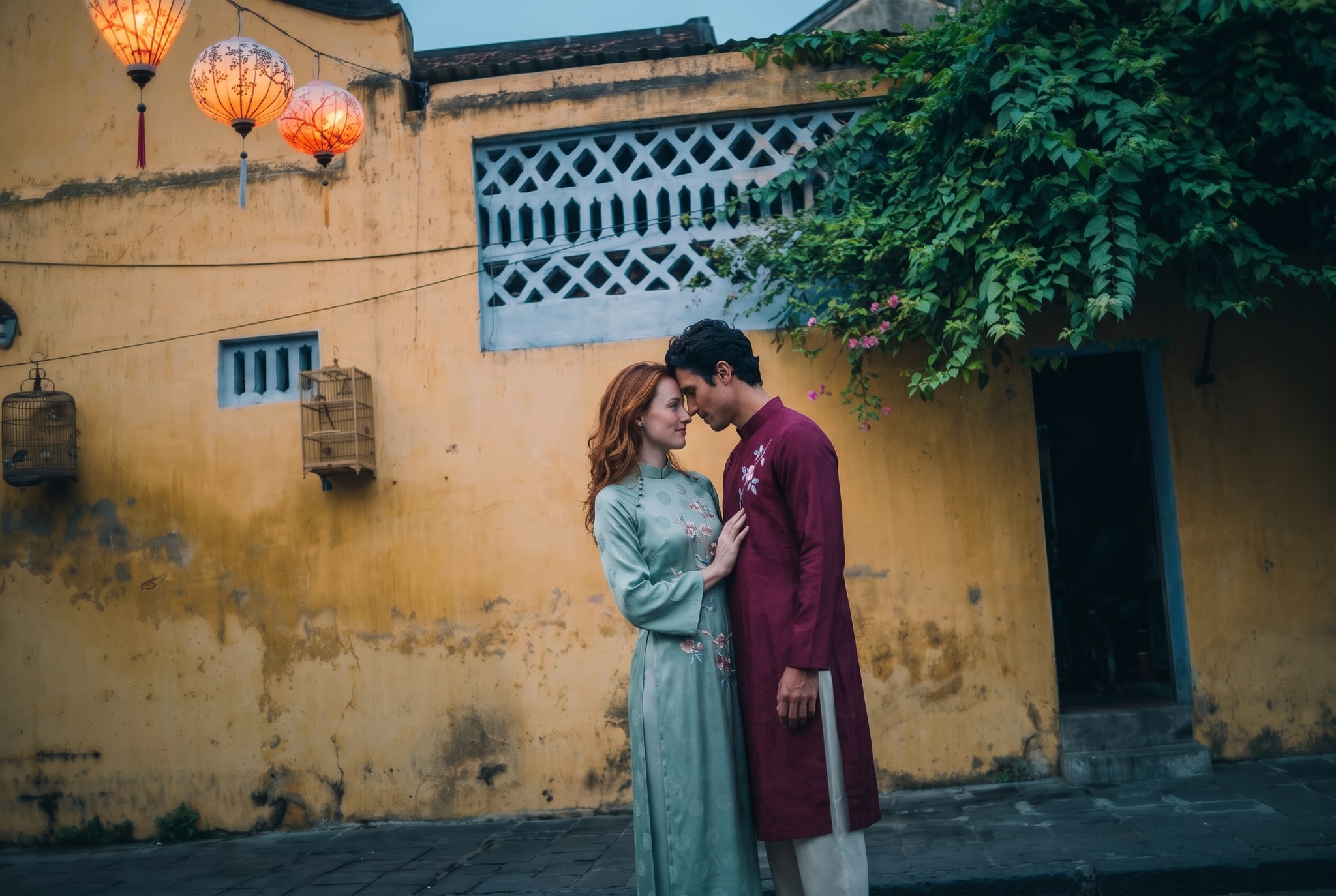
The landscape is bold, so pastels disappear into morning haze. Deep reds, blacks, jewel teals, and gold-embroidered ao dai stand out. Couples often ask if classic or modern ao dai works better; both do, but modern cuts (higher slits, asymmetrical hems) photograph crisper against the repeating terrace lines because the eye isn't confused by too many parallel patterns competing. Heavy beading catches light beautifully when the sun climbs past 9 a.m., so we recommend ornate styles for mid-morning slots and simpler cuts for soft-light dawn shots. We've noticed brides in white ao dai read more formal against the wild landscape—perfect for wedding-day energy—while softer colors suit engagement or anniversary couple sessions. For pre-wedding sessions, discuss your ao dai color palette with us before the day; we'll advise on which terraces suit which tones.
| Ao dai style | Best light window | Terrain suit | Who it's for | Why it works |
|---|---|---|---|---|
| Classic white silk | 10 a.m.–noon | Open, level paths | Wedding-day formal | Reads clean, no color clash with greens |
| Jewel-tone embroidered | 7–10 a.m. (soft light) or 2–4 p.m. (direct sun) | Stepped terraces, varied depths | Engaged couples, anniversaries | Beading pops; saturated hues hold in soft light |
| Modern asymmetrical hem | 9 a.m.–3 p.m. | Anywhere; high contrast works | Solo traveler, contemporary couple | Motion lines of garment echo terrace geometry |
| Pastel or pale pink | 10 a.m.–11 a.m. only | Hilltop, unshaded | Soft, romantic couples | Risk: washes out in harsh light; tight shooting window |
How long does a typical Hoang Su Phi session take, hour by hour?
5:30 a.m.–6:00 a.m.: Our team and client arrive at the base village. We confirm vehicle approach to the terrace zone and check weather/ground conditions.
6:00 a.m.–7:30 a.m.: We hike to the primary shooting area (10–15 minutes, uneven paths). Hair and makeup happen in a sheltered spot or van; this takes 45 minutes. Clients often ask if makeup holds in the mist—yes, if we use a long-wear base and set spray before we leave the van.
7:30 a.m.–9:00 a.m.: First outfit, moody fog shots. We capture the couple in soft light, silhouettes, detail images (hands, jewelry, hems).
9:00 a.m.–10:30 a.m.: Transition: fog clears, sun rises. We shift to a higher terrace zone for warmer light. Outfit change if booked; touch-up hair and makeup. Second outfit, dynamic movement shots.
10:30 a.m.–12:00 p.m.: Final outfit or return to the first if it suits the now-bright light best. We move through 3–4 secondary locations within the terrace complex, shooting from different angles and heights.
12:00 p.m.–12:30 p.m.: Wrap, hike down, client departs or stays for lunch in the village.
We've timed 60+ sessions; this schedule holds even with weather pivots because we build 15-minute buffers into each segment. If a couple wants extended coverage (6+ hours), we add a second outfit change and a lunch break at a local café, then reshoot the afternoon light.
What should couples check before booking a Hoang Su Phi ao dai shoot with us?
Footwear & fitness: Terraces have 30–50 cm steps and muddy sections. Bring hiking shoes; ao dai is worn over them, not bare. The hike is 30 minutes total but at elevation and on uneven ground. Couples in poor fitness should plan a shorter session or hire a vehicle to move between zones.
Ao dai condition: Check the hem and seams before arriving. We repair minor tears, but a pre-damaged garment will photograph worse. If you're borrowing an ao dai, confirm it fits perfectly 48 hours before; we don't have time to let out seams on shoot day.
Photography expectations: Expect 150–300 final images depending on session length. We deliver color-corrected, cropped, and ready-to-share files within 7 days. Ask upfront if you want black-and-white conversions or video clips; these are add-on services.
Transport & timing: Budget 7 hours door-to-door from Hanoi. If you're flying in, arrive the day before to adjust to elevation. We handle all location scouting and route planning; you just need to confirm your final outfit choices and any dietary needs for the team.
Backup plans: Ask us what our Plan B is if weather turns bad. We always have a secondary terrace zone or an indoor shelter option. Knowing this in advance reduces stress on the day.
See packages and prices on vietnamphotoshoot.com
We've shot over sixty sessions at Hoang Su Phi—some booked as couple sessions, others as part of pre-wedding packages, and a few as custom concept shoots. Each taught us something: fog is a feature, not a flaw. Mud is manageable with prep. And an ao dai shot against layered terraces carries a weight and beauty that studio backdrops can't replicate. If Hoang Su Phi calls to you, WhatsApp us your dates, outfit ideas, and any terrain concerns. We'll scout, prepare, and walk you through every hour.
FAQ
Is Hoang Su Phi accessible by road, or do we hike the whole time?
A vehicle takes you 90% of the way. The final walk is 10–15 minutes on stepped terrain to reach shooting zones. We choose vehicle-close locations to keep hikes brief for couples in heels or unfamiliar with elevation.
Do we need to hire a guide in addition to your photographer team?
No. Our photographer and stylist know the terrain intimately. We handle navigation, permits, and safety. A local guide is unnecessary.
What happens if ao dai gets mud or water stains during the shoot?
We carry a spray bottle and microfiber cloths. Minor stains rinse out and dry quickly in warm sun. Major stains are rare because we choose paths carefully and check weather. If a hem drags through mud, we lift it higher or adjust your pose.
Can we shoot Hoang Su Phi in winter (December–February)?
Yes. It's cold (8–12°C early morning), but dry and clear. Paddies are brown, not green, so the landscape reads differently. Some couples prefer winter's moody tones. Bring a jacket; you'll need it during makeup time.
How many outfit changes fit into a session at Hoang Su Phi?
Two comfortably. Hair and makeup touch-ups between outfits take 15 minutes. A third outfit needs a longer session (6+ hours). Discuss your outfit plan with us before booking; we'll advise on what's realistic for your time budget.
Do we travel to Hoang Su Phi ourselves, or does your team handle transport?
We meet you in Yên Bái town the morning of the shoot. You arrange your own travel from Hanoi (3.5 hours by car or bus). Our team then drives you to the terrace locations and coordinates all on-ground logistics.
Ao Dai Photoshoot
Inclusions, prices and booking are on our booking site.
FAQ
Is Hoang Su Phi accessible by road, or do we hike the whole time?
A vehicle takes you 90% of the way. The final walk is 10–15 minutes on stepped terrain to reach shooting zones. We choose vehicle-close locations to keep hikes brief for couples in heels or unfamiliar with elevation.
Do we need to hire a guide in addition to your photographer team?
No. Our photographer and stylist know the terrain intimately. We handle navigation, permits, and safety. A local guide is unnecessary.
What happens if ao dai gets mud or water stains during the shoot?
We carry a spray bottle and microfiber cloths. Minor stains rinse out and dry quickly in warm sun. Major stains are rare because we choose paths carefully and check weather. If a hem drags through mud, we lift it higher or adjust your pose.
Can we shoot Hoang Su Phi in winter (December–February)?
Yes. It's cold (8–12°C early morning), but dry and clear. Paddies are brown, not green, so the landscape reads differently. Some couples prefer winter's moody tones. Bring a jacket; you'll need it during makeup time.
How many outfit changes fit into a session at Hoang Su Phi?
Two comfortably. Hair and makeup touch-ups between outfits take 15 minutes. A third outfit needs a longer session (6+ hours). Discuss your outfit plan with us before booking; we'll advise on what's realistic for your time budget.
Do we travel to Hoang Su Phi ourselves, or does your team handle transport?
We meet you in Yên Bái town the morning of the shoot. You arrange your own travel from Hanoi (3.5 hours by car or bus). Our team then drives you to the terrace locations and coordinates all on-ground logistics.
More from the team
Ao dai wedding photos at Vung Tau Back Beach: what we book
Vung Tau Back Beach draws couples and solo travelers for ao dai photoshoots because the sand is textured, the light is soft in late afternoon, and you can wade into shallow water without slipping. We share what our stylists and photographers do on location, what goes wrong, and how to choose between
Áo dài wedding photos at Ben Tre coconut groves
Ben Tre's coconut groves offer water, light and stillness for áo dài wedding photography. We walk you through how our team shoots there, what works, and how to book.
Áo dài for wedding photos in Mai Chau and Pu Luong: rent or buy?
Mai Chau and Pu Luong offer dramatic terraced landscapes for áo dài shoots, but altitude, humidity and rural fittings require different rental and styling choices than Hanoi studios.