 Cáo Studio
Home › Blog › Ao Dai Photoshoot
Ao Dai Wedding Photos at Kim Bong Carpentry Village
By the Cáo Studio team · Hanoi & Saigon · 2026-11-01
Kim Bong carpentry village, 2 km west of Hoi An town center, is a working woodcarving settlement with century-old timber frames, open workshops, and narrow alleys perfect for ao dai portraits. A session here typically runs 2–4 hours depending on your package. Cáo Studio books access early (6–8 a.m.) to capture side-lit wood textures and avoid crowds; by 10 a.m., tour groups arrive. The village offers natural light on north-facing facades and backlit opportunities in covered walkways—ideal for layered fabrics and embroidery detail. Cost varies by duration, styling changes, and team size; ask us for a quote on our booking site. Most couples pair this with a silk town or riverside session. Check: is your ao dai silk (wrinkles easily in humidity) or cotton-blend (more forgiving)? Do you want makeup touch-ups between locations? Can you arrive by 6:45 a.m.? Chat with us on WhatsApp
Why does Kim Bong's timber light work better early morning?
Wood absorbs and scatters light differently than stone or concrete. Side-lit wooden frames at 6:30–8:00 a.m. create texture and shadow depth that flat noon light flattens. We've shot the same corner at 9 a.m. and 7 a.m.—the morning version has definition in the carved surfaces and ao dai folds; the later one looks washed. Direct sunlight on a timber facade also causes squinting; diffused morning light lets couples relax their eyes. Once we choose the exact shots (embracing, walking, sitting on a carved bench), we plan around shadows moving 15–20 minutes per location. If your shoot starts at 7 a.m., we have roughly three "light windows" before 10 a.m., each 20–25 minutes long—enough for 4–6 outfit or pose changes.
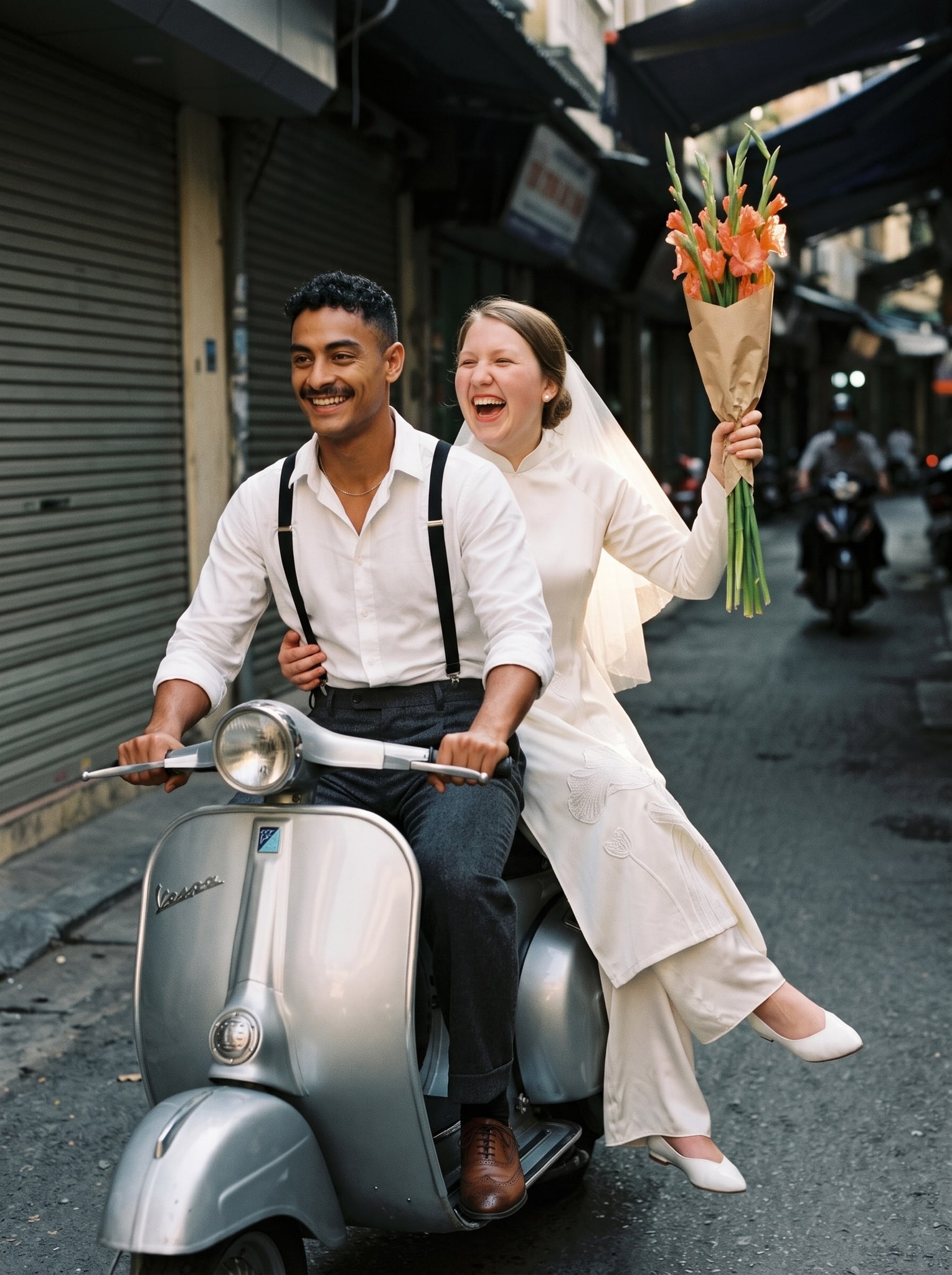
What happens when humidity wrinkles the ao dai between shots?
Silk ao dai crease visibly in Hoi An's 85–90% humidity, especially the back panel and sleeves. Our stylists bring steaming equipment (battery-powered handheld steamer we carry in a studio bag) and cotton pressing cloths. At Kim Bong we've learned to schedule ao dai changes during shaded waits—while the photographer scouts the next corner, the stylist steams and re-pins. Cotton-blend ao dai (more affordable and practical) wrinkles less and tolerate humidity better; we often suggest clients invest in one silk piece for hero shots and wear a backup cotton piece for moving-around sections. If you're planning a proposal or pre-wedding session here, we recommend two ao dai, not one. Setup time costs nothing extra; the stylist is already on your team.
How do you work around Kim Bong's workshop noise and foot traffic?
Carpenters start work around 7:30 a.m.; by 8:30, drilling and planing echo through narrow lanes. We scout locations day-before or early the morning-of to identify quiet corners: the shaded alley behind the main carpentry cooperative, an empty courtyard we've booked with a shop owner, a wooden bridge over the creek that overlooks the village. Tourist groups peak 9:30–11 a.m., so we time our "standstill" shots (close couple embrace, ao dai detail) for 7–8:30 a.m. when noise is low. Moving shots—walking hand-in-hand, turning to camera—work fine with soft background sound; we can ask stray tourists to pause briefly or frame them out. If your group insists on mid-morning light, we pivot to interior workshop shots (artisans at lathes, backlit dust particles) and closer framing. Honest choice: early start = better light and silence; later start = more comfort, fewer magical moments.
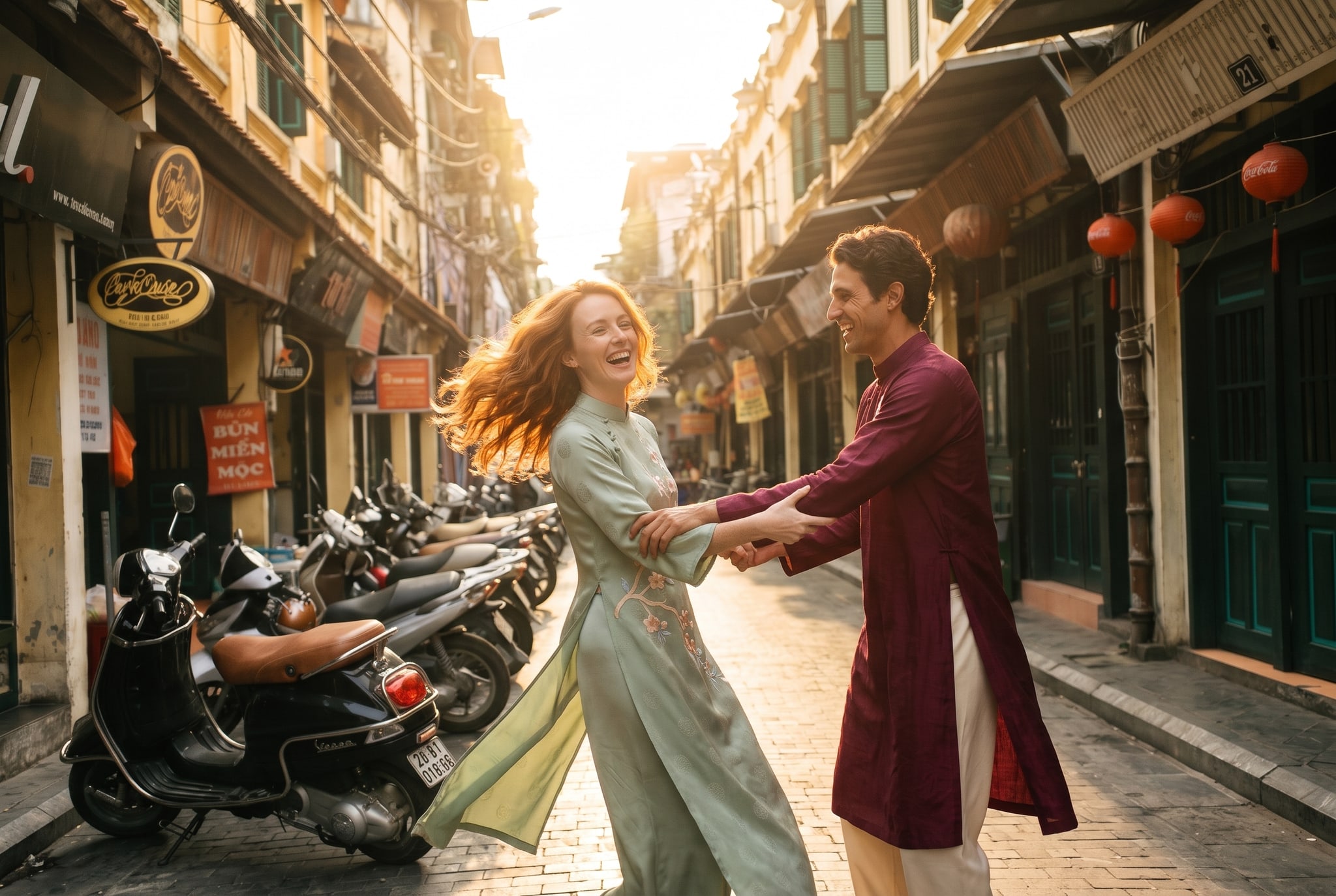
What's the difference between a Kim Bong ao dai shoot and a couple's session?
| Shoot Type | Who It's For | Duration | Key Differences | Best Season |
|---|---|---|---|---|
| Solo ao dai | Individual travelers, before/after weddings | 1.5–2 hours | One outfit, poses focus on you, styling-only | Oct–Nov, Jan–Feb |
| Couple ao dai | Engagements, anniversaries, elopements | 2–3 hours | Matching or complementary ao dai, both styled, interaction shots, often two locations | Oct–Mar |
| Pre-wedding concept | Couples planning a wedding, wanting artistic direction | 3–4 hours | Multiple outfit changes, story arc (first meeting, proposal moment, daily life), directed emotion, two–three villages or sites | Oct–Mar |
Our studio pairs Kim Bong—known for its wooden aesthetic and crafted feel—with either a silk town session (shopping, artisan workshops) or a riverside riverside moment (less crowded, softer light) the same day. Couple shoots at Kim Bong typically begin at 7 a.m., move through 2–3 key spots, include a quiet-time pause (tea or water, ao dai check) around 9 a.m., and wrap by 10 a.m. so you're not rushing. Pre-wedding sessions here often span two days: one morning at Kim Bong (ao dai, heritage feel), one afternoon elsewhere (modern or urban contrast). Solo travelers usually book a 2-hour vacation photoshoot slot and pair Kim Bong with a street or night-market session the same evening.
Which Hoi An location pairs best with Kim Bong for a full-day shoot?
Our team's unwritten rule: if you start at Kim Bong (heritage, textured, quiet), follow with contrasting light or vibe. Riverside near An Bang Beach (4 km east, sandy-toned, open) works if you want a shift from enclosed alleys to open horizon—ao dai ripples in sea breeze, light bounces off water, poses feel less posed. The silk dyeing workshop near Cam Pho Bridge (south of town, industrial-artistic) pairs well if you want a "artisan couple" narrative: wood carvings + natural dyes. Hoi An Ancient Town streets (crowded by 9 a.m.) we avoid after Kim Bong because the energy is already intense; most couples want a quieter second location. Japanese Covered Bridge area works only if you book 1–2 p.m. (fewer crowds, softer angled light, warm tones on red-painted wood). When we plan a full session with couples, we map it as: 7–10 a.m. Kim Bong (crisp, crafted), then travel + setup (15 min), then 10:30 a.m.–1 p.m. at riverside or beach (relaxed, movement-heavy). Ask our team for location pairing advice when you inquiry.
See packages and prices on vietnamphotoshoot.com
What to check before you book a Kim Bong ao dai session
- Ao dai condition: Is it pressed and hemmed correctly? Does it fit comfortably when standing and sitting? Tight waists photograph tensely; we've had clients wear stretch alternatives under traditional outer layers.
- Footwear: Wooden alleys are uneven. Flat shoes or embroidered slippers are safer than heels; we've seen couples slip on worn timber. Check the path the day before with us.
- Stylist + makeup rider: If you're traveling solo, do you want hotel makeup and hair included the morning-of? Our stylists do final touch-ups at Kim Bong; adding a makeup artist means earlier wake time but guaranteed freshness by 7 a.m. shot time.
- Backup outfit: One ao dai is a risk (humidity stains, accidental rips). Bring a second, or ask us about loaning or renting a spare.
- Group size: Kim Bong handles 1–4 people comfortably. Larger groups (8+) require extra logistics; we stage shots in smaller sub-groups to keep posing natural.
- Backup date: Vietnam's October–March season is mostly reliable; July–August humidity and April–May heat are tough on both ao dai and energy. Have a rain date or indoor alternative in mind.
FAQ
Can we shoot Kim Bong in afternoon light without losing quality?
Yes, but differently. We shift to open-air carpentry scenes (artisans at work, golden-hour backlit dust) and avoid tight timber alley framing. Side-lit embraces don't work as well after 11 a.m.; front-lit walking shots and detail photography of embroidery become the focus. Plan for 2–3 fewer "hero" images than a morning session.
Is Kim Bong flooded during rainy season?
The village sits on slightly raised ground, but August–September rain can waterlog lower areas and make timber paths slippery. October onward is safe. If your planned date falls in June–July, ask us about indoor workshop alternatives or a different Hoi An site like the silk workshop.
Do we need permission to photograph inside carpentry shops?
Yes. Cáo Studio handles all site coordination with shop owners and the local committee. We've built relationships over shoots; your shoot fee includes access. Solo travelers or couples who try to photograph without introduction may face polite refusal. Always work through your photographer's local contacts.
Can we do ao dai photos with a newborn baby at Kim Bong?
Technically yes, but challenging. Uneven paths, no air conditioning, limited shaded sitting spots, and loud noise mean a baby sleeps poorly and gets overstimulated. Family shoots at Kim Bong work better with children 3+ years old who can walk and pose. For newborn + ao dai, we recommend studio or a flat, quiet riverside location instead.
How many outfit changes fit into a 3-hour Kim Bong session?
Two ao dai comfortably (25 min per location, steaming and travel built in). Three changes pushes the timeline and risks rushing. Our stylists recommend one silk hero ao dai and one practical cotton-blend second piece for movement shots. Jewelry or sash swaps count as changes and take 2–3 minutes.
If we bring our own photographer, can you provide styling and makeup only?
No. Cáo Studio books as a creative team: photographer, stylist, and location coordination are bundled. If you have an external photographer, we recommend hiring our makeup and hair service separately for the morning, or directing your photographer to partner studios in Hoi An. Mixing services complicates timing and styling coherence on-site.
Ao Dai Photoshoot
Inclusions, prices and booking are on our booking site.
FAQ
Can we shoot Kim Bong in afternoon light without losing quality?
Yes, but differently. We shift to open-air carpentry scenes (artisans at work, golden-hour backlit dust) and avoid tight timber alley framing. Side-lit embraces don't work as well after 11 a.m.; front-lit walking shots and detail photography of embroidery become the focus. Plan for 2–3 fewer "hero" images than a morning session.
Is Kim Bong flooded during rainy season?
The village sits on slightly raised ground, but August–September rain can waterlog lower areas and make timber paths slippery. October onward is safe. If your planned date falls in June–July, ask us about indoor workshop alternatives or a different Hoi An site like the silk workshop.
Do we need permission to photograph inside carpentry shops?
Yes. Cáo Studio handles all site coordination with shop owners and the local committee. We've built relationships over shoots; your shoot fee includes access. Solo travelers or couples who try to photograph without introduction may face polite refusal. Always work through your photographer's local contacts.
Can we do ao dai photos with a newborn baby at Kim Bong?
Technically yes, but challenging. Uneven paths, no air conditioning, limited shaded sitting spots, and loud noise mean a baby sleeps poorly and gets overstimulated. [Family shoots](/go/family-photoshoot) at Kim Bong work better with children 3+ years old who can walk and pose. For newborn + ao dai, we recommend studio or a flat, quiet riverside location instead.
How many outfit changes fit into a 3-hour Kim Bong session?
Two ao dai comfortably (25 min per location, steaming and travel built in). Three changes pushes the timeline and risks rushing. Our stylists recommend one silk hero ao dai and one practical cotton-blend second piece for movement shots. Jewelry or sash swaps count as changes and take 2–3 minutes.
If we bring our own photographer, can you provide styling and makeup only?
No. Cáo Studio books as a creative team: photographer, stylist, and location coordination are bundled. If you have an external photographer, we recommend hiring our [makeup and hair service](/go/makeup-and-hair) separately for the morning, or directing your photographer to partner studios in Hoi An. Mixing services complicates timing and styling coherence on-site.
More from the team
Ao Dai Photos at Hoi An Lantern Street at Night
Hoi An Lantern Street (Nguyen Hoan) glows at dusk with silk lanterns and reflected light. Our team shoots ao dai here after dark, navigates tight vendor spaces, and handles the low-light challenge with experience from 100+ night sessions.
Ao dai for wedding photos in Quy Nhon: renting, fitting and styling
Quy Nhon's coastal backdrops pair beautifully with traditional ao dai. We walk through rental choices, fitting logistics and how our team coordinates styling on shoot day.
Vietnam Pre-Wedding Photoshoot: What We Book at Cáo Studio
Pre-wedding shoots in Vietnam mean morning light in Hoi An's Old Town, cyclos in Saigon, or terraced fields near Ninh Binh. We walk you through what a session actually costs, how we schedule it, and what goes wrong on the day.