 Cáo Studio
Home › Blog › Pre-Wedding & Elopement
Avoid crowds at Japanese Covered Bridge wedding photo shoots
By the Cáo Studio team · Hanoi & Saigon · 2026-11-02
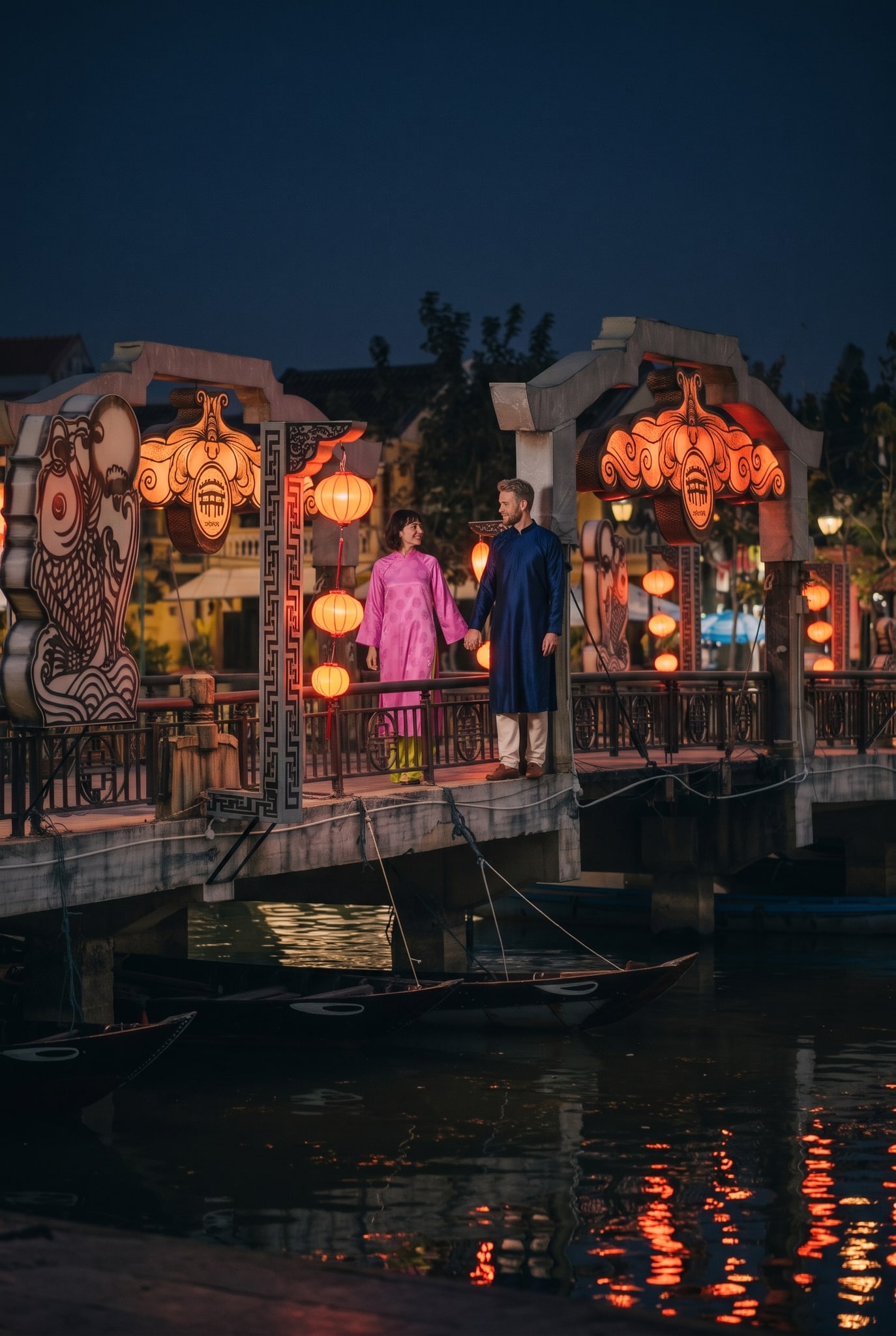
The Japanese Covered Bridge (Cầu Nhật Bản) in Hoi An's Ancient Town draws thousands daily; avoiding crowds means shooting between 6–7 a.m. or after 5 p.m., securing a photo permit from Hoi An authorities (required for commercial work), and booking a skilled guide who knows staff. Cáo Studio books early morning slots paired with pre-wedding photoshoots that include an ao dai session in the Old Town's quieter lanes—this costs more in time but delivers empty-bridge frames. Wind, humidity, and permit delays are real; we scout the site two days before, confirm water levels (monsoon season floods the base), and always have backup angles on nearby Bach Dang Street if the bridge itself feels too busy.
The Japanese Covered Bridge is Hoi An's most-photographed landmark, but "most-photographed" also means "most crowded." We've run over fifty shoots here since 2023, and every session teaches us the same lesson: timing beats luck. A couple arriving at 8 a.m. thinking they'll slip through finds fifty selfie-sticks and tour groups. We don't fight that reality; we plan around it.
Chat with us on WhatsApp | See packages and prices on vietnamphotoshoot.com
Why does the bridge get crowded, and when is it actually quiet?
The Japanese Covered Bridge sits at the junction between Hoi An's main pedestrian zones and the Thu Bon River—foot traffic is constant from 7 a.m. to 9 p.m. Peak hours are 9–11 a.m. and 2–4 p.m., when tour buses unload. Between 5:30–7 a.m., the bridge is nearly empty; after 5 p.m., it empties again as shops close and tour groups return to hotels. We shoot early-morning slots because the light is warm, crowd stress is zero, and the town feels like nobody lives there yet. The trade-off: your team is awake at 5 a.m., makeup and hair must be mobile (we offer hotel makeup and hair services starting at 6 a.m.), and you have roughly 45 minutes before the first buses arrive. Late-afternoon shoots (5–6:30 p.m.) work too, but light fades fast and the bridge gets harder to light evenly.
What permit do you actually need to shoot there legally?
Vietnam's Heritage Site Law requires a photo permit for any commercial or organized photoshoot at protected monuments, including Hoi An Ancient Town. The permit costs a small fee per shoot (paid to Hoi An Cultural Heritage Department) and takes 2–3 working days to process—we file it when you book. Without it, local authorities can stop you and ask you to delete frames; we've seen this happen to unlicensed photographers. The permit also gives us priority access at certain times and lets us work with site staff to briefly close the bridge's pedestrian flow (10–15 minutes) for the ceremony photo or first-kiss shot. If you're booking a couple photoshoot on the bridge, the permit is non-negotiable and included in our planning. Self-booked travelers often skip this and then scramble; we don't.
What does our team do one day before the shoot to guarantee good light?
The day before, our lead photographer returns to the bridge alone (no permit needed for scouting) to check three things: (1) water level—monsoon season (May–September) can flood the bridge's base, making the reflection effect unusable; (2) scaffolding or repairs on the structure; (3) the exact angle of sunset and morning light, measured by phone compass and time-stamp photos. We take notes on shadow patterns at 6:15 a.m., 10 a.m., and 5:30 p.m. to show you where we'll position you. This scouting trip takes one hour and saves hours of on-the-day fumbling. We also confirm the permit with staff, brief the site manager on our timing, and identify three backup poses on the bridge itself (the arch, the side rails, the steps) plus two off-bridge angles on Bach Dang Street (the river view, the vendor-free corner) in case the bridge feels too exposed or crowded that morning.
| Timing | Crowd Level | Light Quality | Permit Needed? | Best For |
|---|---|---|---|---|
| 6–7 a.m. | Empty (5–10 people) | Golden, warm, low shadows | Yes | Ceremony, first-kiss, ao dai close-ups |
| 8–11 a.m. | Heavy (100+) | Bright, overhead, harsh | Yes | Not recommended; only if backup slot unavailable |
| 12–2 p.m. | Very heavy (200+) | Harsh, midday glare | Yes | Avoid—no magic light |
| 3–5 p.m. | Moderate (50–80) | Warm again, long shadows | Yes | Acceptable; better than midday but riskier than early |
| 5:30–6:30 p.m. | Light (10–30) | Golden, very warm, fades fast | Yes | Good, but only ~30 minutes of usable light |
How do we redirect the shoot if the bridge is somehow busier than expected?
It happens—a big tour group arrives early, or a local film crew books the same morning. Our decision tree is: (1) wait 15 minutes and shoot anyway—often the group moves on; (2) shift to the side-rail or arch angle, which feels private even with people passing; (3) move the couple-embrace shots to the nearby Hoi An Artisan Spa steps (same vintage feel, no crowd); (4) pivot to the ao dai photoshoot portion on Nguyen Hue Street or inside the Assembly Halls, which are often empty before 8 a.m. We've never cancelled a shoot, but we've bumped bridge time on five occasions. The permit and early start give us the flexibility to adapt; a walkup shoot at 10 a.m. without planning has no buffer. On-the-day communication is crucial—we message you by 5:30 a.m. with the final plan, and you're part of the go/adjust decision.
What should you pack and wear to a 6 a.m. bridge shoot in Hoi An?
Hoi An's humidity is high even at 6 a.m. (70–80%), so your skin will feel dewy—not bad for photos, but your makeup artist needs to set it with powder and a good primer. Wear a robe or cardigan over your ao dai or bridal dress until the last minute; the morning air is 20–22°C (68–72°F), and you'll get cold waiting between poses. Bring slip-on shoes (the bridge has wet stone steps) and a soft brush to tidy your hair between shots. Your photographer will carry a reflector, diffuser, and LED light if needed—cloud cover is common early morning, so we'll fill shadows manually. If you're doing makeup on-site with a hotel room, book one within walking distance (the Riverside or Vinh Hung Old Town Hotel are 2–3 minutes away). Bring a small bag with phone, ID, and water; we'll hold everything else. Avoid jewelry that catches light unexpectedly—simple, heirloom pieces photograph better on the bridge's dark wood than statement rings.
See packages and prices on vietnamphotoshoot.com
===== DECISION CHECKLIST: BEFORE YOU BOOK A BRIDGE SHOOT =====
- [ ] Confirm your date is not a lunar holiday (Tet, Mid-Autumn Festival) when Hoi An is 3× busier.
- [ ] Choose early morning (6–7 a.m.) or late afternoon (5–6:30 p.m.); avoid 9 a.m.–4 p.m.
- [ ] Verify the permit will be filed by Cáo Studio (non-negotiable for legal, uninterrupted work).
- [ ] Check monsoon season (May–September): water levels may affect bridge base reflections.
- [ ] Book hotel makeup and hair starting at 6 a.m. if you're shooting before 7 a.m.
- [ ] Decide: couple photoshoot, ao dai session, or both (both = less bridge-only time, more location variety).
- [ ] Ask your photographer for the scouting report: light angle, water level, and three backup poses.
- [ ] Plan transportation to Hoi An (2.5 hours from Saigon or Da Nang); arrive the evening before.
===== WHAT TO CHECK BEFORE YOU BOOK =====
Light direction. Our photographer scouts the bridge one day before and sends you a photo showing exactly where the sun will be at your shoot time. Morning shoots have light from the east (behind you if you face the river); late-afternoon shoots have it from the west. Ask to see the scouting photo before confirming your time.
Permit timeline. We need your shoot date 4–5 working days in advance to file the permit. If you're booking within 3 days, confirm with us that expedited filing is possible (it usually is, but it's not automatic).
Water level. If you're shooting during monsoon season, ask us to check the Thu Bon River level the day before. Flooded bridge steps make the photo feel cramped and limit poses.
Backup location. Before you book, ask your photographer which two off-bridge locations they'll move to if crowds spike. Bach Dang Street and the Hoi An Artisan Spa steps are our standard backups, but we confirm this in writing so you know your plan.
FAQ
Do we have to shoot at 6 a.m., or can we do it at a different quiet time?
Late-afternoon (5–6:30 p.m.) is also quiet, but light fades fast—you get 30–45 minutes of usable photos. Early morning gives you 45–60 minutes and light that stays warm. Both need the permit.
What happens if the permit doesn't come through in time?
Very rare, but we'd either delay your shoot by 3 days or move it to a different Hoi An location (Assembly Halls, Artisan Spa, town streets) that doesn't require the permit. We confirm timing with you 7 days out.
Can we do a private bridge closure so only we are on it?
Yes—the permit sometimes allows a 10–15 minute window. It costs extra (small fee to the site) and we arrange it for your ceremony moment or first-kiss shot. Ask when you book.
Is the bridge slippery in the morning or during monsoon?
Yes, especially monsoon season. Wear slip-on shoes with grip. Our photographer carries a small towel to dry the steps before you walk across.
Can we do an ao dai shoot on the bridge and a bridal dress shoot elsewhere?
Absolutely—this is common. The pre-wedding photoshoot typically pairs the bridge (ao dai, early morning) with other Hoi An spots (town streets, Assembly Halls, or riverside in bridal dress). More location variety, same-day coverage.
How far in advance do we need to book a bridge shoot?
At least 10–14 days (to allow permit filing and scouting). Sooner is fine; later than 5 days before requires a quick confirmation with us, but we usually accommodate.
Pre-Wedding & Elopement
Inclusions, prices and booking are on our booking site.
FAQ
Do we have to shoot at 6 a.m., or can we do it at a different quiet time?
Late-afternoon (5–6:30 p.m.) is also quiet, but light fades fast—you get 30–45 minutes of usable photos. Early morning gives you 45–60 minutes and light that stays warm. Both need the permit.
What happens if the permit doesn't come through in time?
Very rare, but we'd either delay your shoot by 3 days or move it to a different Hoi An location (Assembly Halls, Artisan Spa, town streets) that doesn't require the permit. We confirm timing with you 7 days out.
Can we do a private bridge closure so only we are on it?
Yes—the permit sometimes allows a 10–15 minute window. It costs extra (small fee to the site) and we arrange it for your ceremony moment or first-kiss shot. Ask when you book.
Is the bridge slippery in the morning or during monsoon?
Yes, especially monsoon season. Wear slip-on shoes with grip. Our photographer carries a small towel to dry the steps before you walk across.
Can we do an ao dai shoot on the bridge and a bridal dress shoot elsewhere?
Absolutely—this is common. The [pre-wedding photoshoot](/go/pre-wedding-photoshoot) typically pairs the bridge (ao dai, early morning) with other Hoi An spots (town streets, Assembly Halls, or riverside in bridal dress). More location variety, same-day coverage.
How far in advance do we need to book a bridge shoot?
At least 10–14 days (to allow permit filing and scouting). Sooner is fine; later than 5 days before requires a quick confirmation with us, but we usually accommodate.
More from the team
Boho pre-wedding photoshoot in Vietnam: Hanoi, Saigon, Hoi An
Boho pre-wedding shoots mix romantic, free-spirited aesthetics with Vietnam's landscapes and heritage sites. We run full-day sessions in three cities, handling styling, makeup, location scouts and edits.
Avoid crowds at Hoang Su Phi rice terraces: timing for wedding shoots
Hoang Su Phi's terraced landscape draws couples and tour buses in equal measure. We show how to shoot there alone, when to arrive, and what to arrange with us before you go.
Photography rules at Con Dao beaches: permits, drones and what to check
Con Dao's beaches demand prep before you shoot—permits, drone zones and tide timing all affect your day. We share what the Cáo Studio team verifies on every booking.