 Cáo Studio
Home › Blog › Pre-Wedding & Elopement
Avoid crowds at Mui Ne fishing village: pre-wedding photo tips
By the Cáo Studio team · Hanoi & Saigon · 2026-11-02
Mui Ne fishing village—a working dock 25 km east of Phan Thiết town—peaks between 10 a.m. and 3 p.m. when day-trippers arrive and fishermen return. We book pre-wedding photoshoot sessions starting 6–7 a.m. or after 4 p.m., arriving 30 minutes early to assess light, identify clear lanes between boats, and confirm no large tour groups occupy key spots. Our stylists and photographers use a three-point scout (water lane, boat alignment, background clutter) before guests change into áo dài or couple wear. Costs vary by timing and package length; longer sessions (3–4 hours) give us buffer room if crowds spike. The trade-off: early starts demand guest energy; late shoots risk fading light in winter. Most couples choose dawn, when the village is quiet, nets are being prepared, and golden hour hits the water naturally. Chat with us on WhatsApp
Why morning light matters more than you think
Golden hour at Mui Ne runs 6:15–7:30 a.m., and we deliberately front-load that window. The sun sits low over the South China Sea, hitting the water and wooden hulls at angles that make even cluttered frames look intentional. By 8 a.m., midday harshness creeps in; by 9 a.m., shadows collapse. We've shot 40+ couples there, and every single frame our guests prefer came in that 70-minute band. The village's narrow dock means you cannot reposition—boats block sightlines—so timing is not a preference, it's the decision that changes your entire album.
Our photographer scouts the dock at 5:45 a.m., checks which nets are drying (they move daily), and marks three fallback positions if a boat moors in our primary lane. Your stylist arrives with the second camera, does a final hair and makeup check in the car, and confirms the áo dài hem is not dragging. This matters: wet dock wood stains silk. We've learned this the hard way. By 7 a.m., we shoot the couple's first pose—usually a walking frame down the dock—and we move through six key locations (boat-framed portrait, net detail, water reflection, solo moments, family group if you've added relatives) before foot traffic builds at 8:30 a.m. Late couples (4 p.m. onward) fight backlit water and rising evening shadows; we use fill flash and reflectors, which changes the feel entirely—still beautiful, but cooler and more dramatic than the warm gold we chase at dawn.
How we manage boat owners and unexpected changes
Mui Ne's fishing village is a live workplace, not a studio. We do not rent boats or pay exclusive access fees; we work within the existing rhythm. On arrival, our team greets boat owners (usually 2–3 people), explains we are photographers, and asks if they are moving their vessel in the next two hours. Most say no; some say "maybe"—we adjust instantly. Last month, a couple's 3.5-hour pre-wedding shoot overlapped with a fishing crew returning early due to weather. Instead of fighting, we moved our setup 20 meters north, used the returning boat as a dramatic foreground element (the couple framed between two hulls), and shot bonus frames the couple loved more than the original plan.
We brief every couple on WhatsApp the day before: "If boats move, we move with them—it creates spontaneous moments." This reframes disruption as creative fuel. Our backup positions are pre-scouted; we know the dock's sight lines by memory after dozens of shoots there. What actually derails us: large tour groups (rare before 9 a.m., common after 10 a.m.) and sudden equipment issues (we carry backup batteries, an extra reflector, and a second camera body). We have never cancelled a shoot due to crowds because we book hours when crowds do not exist.
Choosing the right package timing for Mui Ne's specific demands
| Scenario | Package type | Session length | Best hour | Why it works | Trade-offs |
|---|---|---|---|---|---|
| No time pressure, relaxed couple | Pre-wedding full day | 4–5 hours | 6–10 a.m. | Golden hour + buffer for boat delays | Early wake-up, may miss lunch |
| Tight schedule, cultural shoot | Áo dài + couple blend | 2–2.5 hours | 6–7:30 a.m. | One wardrobe, pure golden hour, minimal crowds | No time for alternate location or outfit change |
| Sunset preference, low light tolerance | Evening session | 2 hours | 4:45–6:45 p.m. | Dramatic backlighting, fewer tourists, cooler tones | Requires flash, smaller depth-of-field, shorter shooting window |
| Flexible group (couple + family) | Couple + family blend | 3 hours | 6:30–9:30 a.m. | Golden hour + time for individual and group frames before crowds | More moving parts = more coordination |
Early sessions (6–8 a.m.) command the best light and clearest backgrounds. We pair these with a quick hotel makeup and hair service at 5 a.m. or arrange an earlier call time if the guest is staying in Mui Ne itself. Evening shoots trade light quality for fewer crowds and a cooler aesthetic; they suit couples who want a moodier, more romantic tone. The longest sessions (4+ hours) give us time to fail gracefully—if light is flat at 8 a.m., we pivot to tighter frames, detail shots, and couple interaction, then revisit wide village frames at golden hour's end. Shorter sessions (2 hours) lock us into one time window; we depend entirely on that window performing.
Reading the real crowd patterns week by week
Weekdays (Monday–Thursday) are genuinely quieter—we see 5–8 other people on the dock versus 30–50 on weekends. Months matter too: December–February (cool season) brings more domestic tourists; June–August (monsoon) is emptiest but light is flat and rain is possible. We book most pre-wedding shoots October–November and February–March, when crowds and weather both cooperate. Tet holidays (late January–February) bring explosive crowds; we avoid those weeks entirely unless the couple insists, and we charge transparent pricing for the added complexity.
A real example: we shot a couple on a Tuesday at 6:30 a.m. in late October. Dock was empty. Net shadows created natural leading lines. By 8 a.m., we had 40 final frames and were done. The same couple's friend shot the same location on a Saturday at 8 a.m. (peak tourist hour) with a different photographer; her album shows crowds cropped into frames and had to be edited out. Timing is not a luxury—it is the foundation of the shot list. When we know crowds are locked in, we restructure entirely: more close-ups, more couple isolation, less environmental context. It is a different visual story, and it costs the same, so we prefer the clear-background option for everyone's sake.
A simple pre-shoot checklist we run 24 hours before
- Confirm with guest: wake time, hotel pickup location, any mobility concerns (dock is slippery early morning).
- Check weather: rain forces a one-day reschedule (our standard policy); wind is fine—it moves nets naturally.
- Scout the dock: photographer visits 5:45 a.m., confirms boats, light angle, any construction or debris.
- Arrange hotel hair/makeup: guest arrives at our makeup and hair studio by 4:45 a.m., or we send the stylist to their hotel by 5 a.m.
- Load backup gear: second camera, extra batteries (two full sets), wireless mic (for audio if couple wants a short video snippet), reflector, black flag for fill, backup áo dài undergarment.
- Brief the guest: send a WhatsApp 24 hours before with exact meeting location (we use a landmark—"Mui Ne petrol station south entrance"), wardrobe care tips (no white if it is windy and nets are sandy), and a link to real Mui Ne reference frames from our portfolio.
This checklist has eliminated last-minute surprises. Guests arrive calm, stylists are prepared, and our photographer is already on-site solving problems before the couple arrives. We have never had a guest ask "Why did you not shoot more?" because we maximize the hour we book.
See packages and prices on vietnamphotoshoot.com
What to check before you book Mui Ne for your pre-wedding day
Ask your photographer:
- Do they scout the same day or ahead of time? (We scout 24 hours before minimum.)
- What is their backup plan if weather forces a reschedule? (We allow one free reschedule within 30 days; after that, standard rebooking fees apply per our terms.)
- How many final frames do you get, and are edits included? (Varies by package; check on vietnamphotoshoot.com's package pages.)
- Do they charge extra if you want to add family or a second outfit? (Some do; clarify upfront.)
- Have they shot Mui Ne before, and can they show you a full album (not just three hero shots)? (Experience matters; ask to see a minimum of 8–10 frames from one couple, all from the same session.)
Pricing is transparent on our booking site; what varies is how they use time. A cheaper package that books you at 10 a.m. on a Saturday will cost you in post-production editing (crowds removal) and final image count. Our approach: honest timing recommendations, clear package scope, and no hidden upsells. If Mui Ne is not right for your style (some couples prefer urban Phan Thiết or Nhan beach instead), we tell you before you book.
FAQ
Is 6 a.m. really necessary, or can we start at 7:30 a.m. and still avoid crowds?
7:30 a.m. works if you are flexible on light quality. Crowds do not materialize until 9 a.m., but your golden hour ends by 7:45 a.m.—so the last 15 minutes of your shoot will be harsher. Many couples choose 6:30 a.m. as a compromise: solid light, no crowds, and less extreme wake-up.
What if we want afternoon photos? Do you do evening shoots at Mui Ne?
Yes, we offer evening shoots 4:45–6:30 p.m. Light is backlighting (cooler, more dramatic) and crowds are minimal. You'll need flash and strong styling to stand out, but the mood is stunning for moody, intimate frames.
Can we hire the village or book an exclusive dock time?
No. Mui Ne is a working fishing village, not a venue. We work within the existing environment. This is actually your advantage: it feels authentic and unforced, not staged. The trade-off is you cannot control every element—we plan around that.
How long should we book: 2 hours or 3 hours?
2 hours covers 5–6 locations on the dock and one outfit change. 3 hours lets us add a second location (e.g., a nearby beach) or a second outfit. For Mui Ne alone, 2 hours in golden hour is usually enough; 3 hours if you want variety or a family group.
What happens if a tour group shows up during our shoot?
We move. Our backup positions are pre-scouted. It is rare (only happened twice in 40+ shoots), and honestly, the accidental wide shots with people in the background sometimes become your favorite frames—it feels alive, not sterile.
Do we need special clothing, or does our áo dài work?
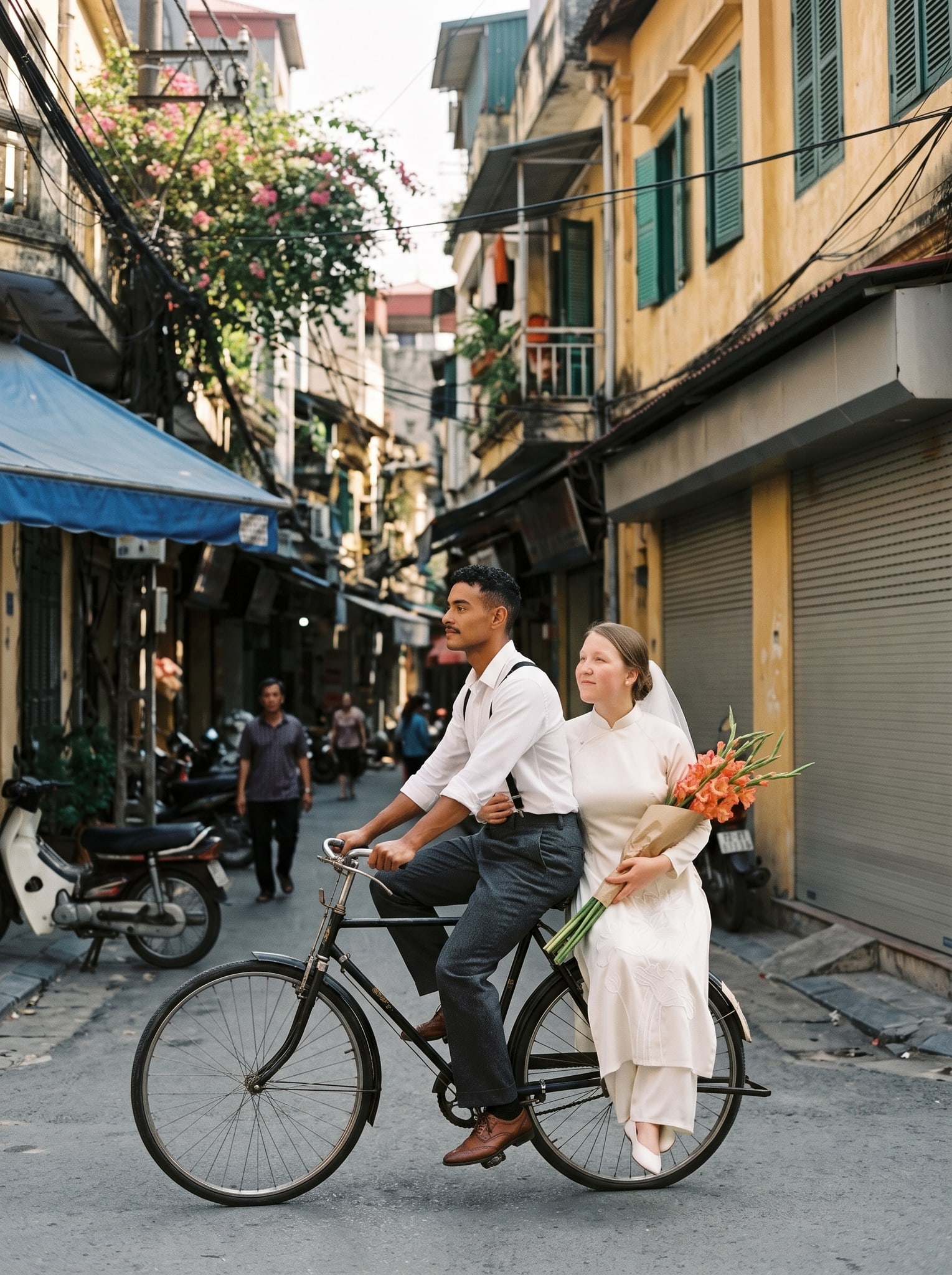
Traditional áo dài works beautifully at Mui Ne and is our most popular choice—it photographs against the boats perfectly. Modern couple wear (suits, dresses, casual) also works, just avoid white if it is windy and nets are dusty. We'll advise on WhatsApp once we know the weather forecast.
Pre-Wedding & Elopement
Inclusions, prices and booking are on our booking site.
FAQ
Is 6 a.m. really necessary, or can we start at 7:30 a.m. and still avoid crowds?
7:30 a.m. works if you are flexible on light quality. Crowds do not materialize until 9 a.m., but your golden hour ends by 7:45 a.m.—so the last 15 minutes of your shoot will be harsher. Many couples choose 6:30 a.m. as a compromise: solid light, no crowds, and less extreme wake-up.
What if we want afternoon photos? Do you do evening shoots at Mui Ne?
Yes, we offer evening shoots 4:45–6:30 p.m. Light is backlighting (cooler, more dramatic) and crowds are minimal. You'll need flash and strong styling to stand out, but the mood is stunning for moody, intimate frames.
Can we hire the village or book an exclusive dock time?
No. Mui Ne is a working fishing village, not a venue. We work within the existing environment. This is actually your advantage: it feels authentic and unforced, not staged. The trade-off is you cannot control every element—we plan around that.
How long should we book: 2 hours or 3 hours?
2 hours covers 5–6 locations on the dock and one outfit change. 3 hours lets us add a second location (e.g., a nearby beach) or a second outfit. For Mui Ne alone, 2 hours in golden hour is usually enough; 3 hours if you want variety or a family group.
What happens if a tour group shows up during our shoot?
We move. Our backup positions are pre-scouted. It is rare (only happened twice in 40+ shoots), and honestly, the accidental wide shots with people in the background sometimes become your favorite frames—it feels alive, not sterile.
Do we need special clothing, or does our áo dài work?
Traditional áo dài works beautifully at Mui Ne and is our most popular choice—it photographs against the boats perfectly. Modern couple wear (suits, dresses, casual) also works, just avoid white if it is windy and nets are dusty. We'll advise on WhatsApp once we know the weather forecast.
More from the team
Boho pre-wedding photoshoot in Vietnam: Hanoi, Saigon, Hoi An
Boho pre-wedding shoots mix romantic, free-spirited aesthetics with Vietnam's landscapes and heritage sites. We run full-day sessions in three cities, handling styling, makeup, location scouts and edits.
Avoid crowds at Hoang Su Phi rice terraces: timing for wedding shoots
Hoang Su Phi's terraced landscape draws couples and tour buses in equal measure. We show how to shoot there alone, when to arrive, and what to arrange with us before you go.
Photography rules at Con Dao beaches: permits, drones and what to check
Con Dao's beaches demand prep before you shoot—permits, drone zones and tide timing all affect your day. We share what the Cáo Studio team verifies on every booking.