 Cáo Studio
Home › Blog › Pre-Wedding & Elopement
Best pre-wedding photo spots in Vung Tau: Where we shoot
By the Cáo Studio team · Hanoi & Saigon · 2026-11-01
Vung Tau's best pre-wedding venues cluster around three zones: the white-sand beaches near Back Beach and Front Beach for golden-hour portraits; the hilltop temples and pagodas (Thích Ca Phát Đà and Linh Sơn) for dramatic backdrops; and the restored villas near Mulberry Tree for intimate, moody shots. Most couples book a pre-wedding photoshoot package that covers 4–6 hours across two or three locations, allowing 1–2 hours per spot for outfit changes and light shifts. Peak season (October to March) offers consistent bright skies but crowds; we schedule 6 a.m. or 4 p.m. starts to avoid midday heat and tourists. Costs depend on crew size (photographer + assistant + stylist) and whether we include hair and makeup at your hotel before the shoot. Always book locations 3–4 weeks ahead; some temples require permission, and villa owners cap weekday shoots. Vung Tau's real challenge isn't location scarcity—it's timing the light and navigating narrow temple stairs in heels while managing reflector wind. Chat with us on WhatsApp
Why do Vung Tau's beaches work best for couple portraits?
Vung Tau's beaches have two big advantages: consistent wide-angle space and natural light that bounces off sand and water. Back Beach (or Bãi Sau) runs 7 km and stays relatively clear before 7 a.m.; Front Beach has moodier rocks and a small pier that frames silhouettes well at dusk. We often start a session at Back Beach at 5:30 a.m., shoot for 45 minutes while the couple is fresh and the sky is peach, then move inland by 8 a.m. before tour groups arrive. The real risk: sand in cameras and lenses fogging from humidity. We bring sensor-cleaning kits and store gear in dry bags between locations. Couples sometimes want to wade into the water in wedding attire—we tell them to change into a cheap second dress for water shots, then switch back dry. Vung Tau's beach light is flattest around noon, so we avoid 11 a.m.–3 p.m. shoots there entirely, even if the couple requests it. The beach works best paired with one temple or villa for contrast.
Which temples give the strongest architectural backdrops?
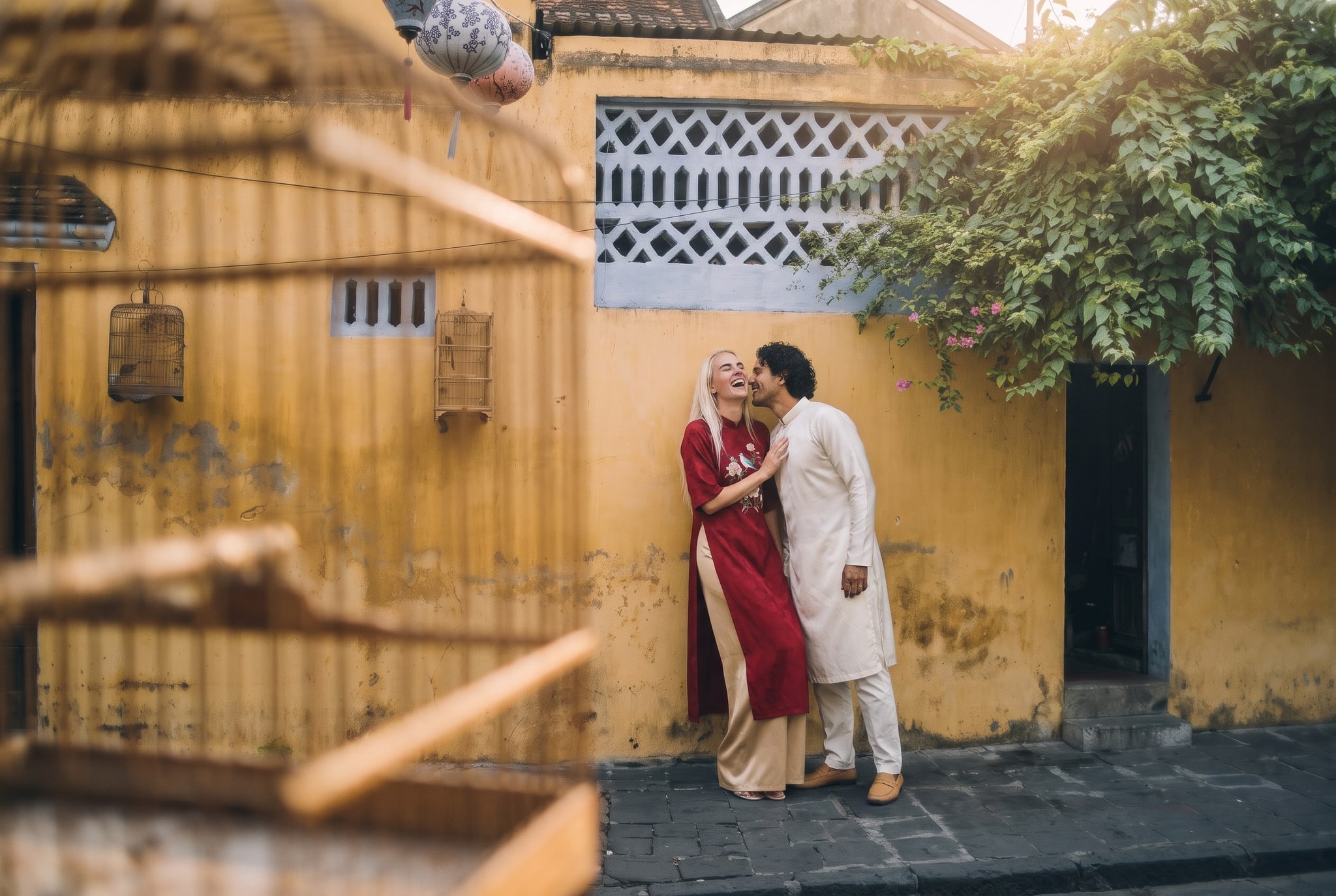
Thích Ca Phát Đà Pagoda sits on Thích Ca Mountain with a 100+ step climb and overlooks the bay; it's golden-hour gold but exhausting in a áo dài. Linh Sơn Tự (also called Linh Sơn Pagoda) has better ground-level geometry and a smaller, shaded entrance perfect for soft-light close-ups. Both require us to contact the temple ahead and usually ask the couple to bow and light incense—we frame this as a cultural moment, not a photo op, which feels more genuine on camera. The challenge: narrow staircases, low doorways, and monks moving through. We scout the location a day or two before if it's a first-time temple, check where direct sun hits at the exact hour we'll shoot, and time it so we're out by 10 a.m. or in by 5 p.m. Thích Ca works better for dramatic silhouettes; Linh Sơn suits couples who want softer, more introspective frames. Both sites forbid tripods in some areas, so we rely on handheld work and posing the couple tightly for sharpness. A full ao dai photoshoot package at these temples costs less than beach + villa because we're stationary longer.
How do colonial villas compare to natural landmarks for mood?
Villas like those near Mulberry Tree and the old French Quarter offer texture: weathered walls, shuttered windows, vintage furniture—things beaches and temples don't have. A villa session lets us control the environment; we can shoot indoors on grey days, use a villa's courtyard as a private second location, and spend more time on styling and posture. Beaches and temples are unpredictable with light and crowds, but villas are, frankly, boring if shot carelessly. We've learned to book villas for 2-hour blocks and shoot across five distinct corners of the space—entrance gate, courtyard, master bedroom, rooftop, garden wall—to avoid the flat "just another couple in an old house" feel. Villa costs (per venue, not per couple) range widely depending on owner; most allow afternoon bookings but not sunrise. A villa works best as a second location after a beach or temple shoot, when the couple is relaxed and the light is softer. Avoid villas in the busy town center near Lê Lợi Street; book those on quieter roads where there's no street noise in audio. The downside: if the owner dislikes having a three-person crew for hours, they may cancel last-minute, so get written confirmation and a contact number 5 days before.
What time of year offers the best light and fewest tourists?
October to March is Vung Tau's sweet spot: stable, cool weather and clear morning skies without the harsh overhead sun of June–August. April and September have occasional rain and humidity that fogs lenses. November to January are peak for pre-wedding bookings because couples aim for Chinese New Year parties and spring ceremonies; book locations 6 weeks out or you'll lose slots to other photographers. Early morning (5:30–8 a.m.) and late afternoon (4–6 p.m.) are always best, but between October and January you get deeper golden tones and softer shadows than summer shots. We've noticed that 11 a.m.–3 p.m. on any beach or open temple site produces flat, white-blown skies even in winter—couples don't realize how bad these look until prints arrive. Weekday shoots (Monday–Thursday) cut foot traffic by 60% compared to weekends; if a couple is flexible, we always recommend a Tuesday or Wednesday beach start. Typhoon season (May–October) brings occasional closures to coastal roads, so confirm access 48 hours before if booking late May or September. Spring (February–March) is warm but less crowded than peak winter.
How should couples prepare their áo dài and formal wear for Vung Tau's conditions?
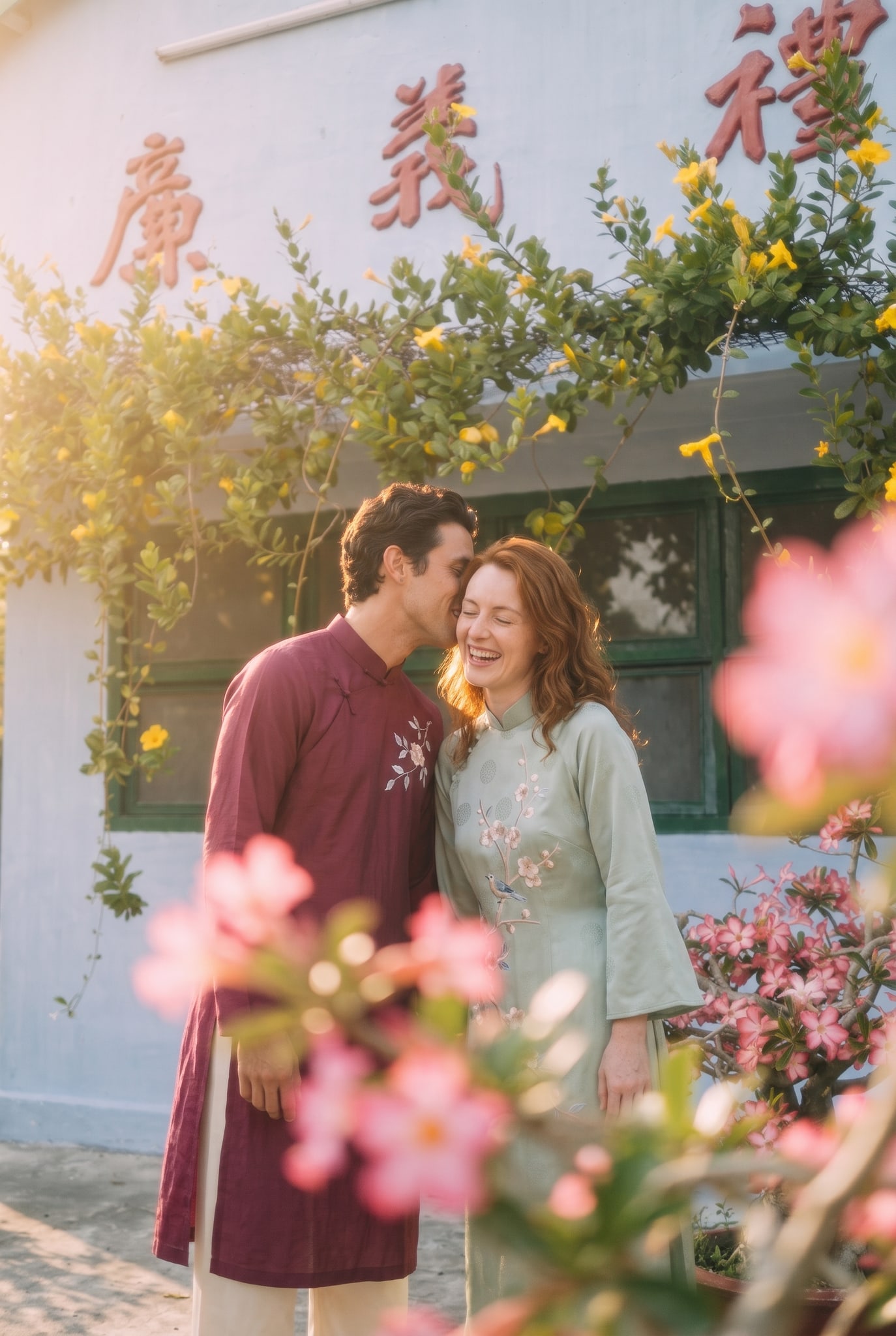
Vung Tau's humidity and salt spray degrade silk and embroidery fast; an áo dài that looks pristine in air-con will show water marks and wrinkles by hour two on a beach. We always tell couples to bring a second set of áo dài or a light backup dress for water shots or if the first gets sand-worn. Stiletto heels sink into sand, so ask the couple to pack flat sandals or gold ballet flats for beach transitions, then change into heels for close-ups on hard ground. For villa shoots, dark or jewel-tone áo dài photograph better than pale ones against weathered walls; couples often choose bright pink or red because they own it, but saturated colors can blow out in bright sun. We bring a backup makeup kit for touch-ups after any beach segment because humidity kills foundation—if the couple booked hair and makeup at the hotel in the morning, we do a 10-minute face refresh on-site around midday. Waterproof mascara is non-negotiable; wind and spray are constant. Hair pinned high holds better than loose waves on Vung Tau beaches; loose styles flatten from humidity by hour one. Most couples don't know this until they see the images, so we guide them via WhatsApp before the shoot.
What mistakes do we actually see couples make, and how do we prevent them?
Common errors we've fixed in 50+ Vung Tau shoots:
| Mistake | Why it fails | How we prevent it |
|---|---|---|
| Booking three locations in 4 hours | Travel time + setup kills good light | We design a tight 2-location route (beach + villa, or temple + beach); 4 hours minimum per shoot |
| Arriving in heavy makeup from home | Humidity + wind = smeared look, redo costs time | We book hotel pickup; stylist does fresh makeup on-site 30 min before start |
| Choosing noon "because it's bright" | Sun overhead flattens faces, creates shadow under nose/chin | We steer to 6–8 a.m. or 4–6 p.m.; show past samples shot at those times |
| Stilettos or tight áo dài | Sand sticks to heels; tight áo dài limits posing and walking stairs | We email a prep checklist 5 days ahead; bring spare footwear; scout temple stairs day-of |
| Forgetting temple etiquette or dress code | Monks ask couple to leave; shoot fails; we lose 1 hour rescheduling | We contact temples 2 weeks out; clarify if áo dài is acceptable; coach couple on bow/incense moments |
| Expecting flat-light villa shots to look dramatic | Overcast afternoons indoors look dull without creative angles | We shoot villas in early light (8–10 a.m.) when side windows cast long shadows; use villa's color palette, not force contrast |
Our playbook: send a one-page prep guide to every couple on booking confirmation. WhatsApp them location photos and a timeline 5 days before. Do a scouting visit or video call with the couple 3 days out if it's their first time in Vung Tau. Pack backup lenses, batteries, and a second camera body because one sand gust can wreck a shoot's workflow.
See packages and prices on vietnamphotoshoot.com
What should couples check before booking a Vung Tau pre-wedding shoot?
Before you commit, ask your photographer:
- Exactly which two or three locations do you recommend, and have you shot them in this month/year? (Vung Tau changes: new villa owners, temple rules, beach erosion.) We name the exact spots and show recent samples.
- Do you include hotel pickup and makeup, or do I arrange it separately? Our couple photoshoot package includes crew travel; makeup is add-on. Some cheaper photographers charge for every minute away from the studio.
- If weather turns bad or a location is inaccessible, what's the backup plan? (We have three villa options and two beach zones; if wind is too strong, we move indoors.) Confirm this in writing.
- How long between locations for outfit change, and do you wait or shoot elsewhere? (We build 30 min into the timeline; if the couple is slow, we compress later spots. Bad photographers get annoyed or rush posing.)
- Does the price change if we add a pre-dawn beach start (earlier than 6 a.m.) or a sunset temple shot? (Some shots require permits or temple coordination.) Ask us on WhatsApp for add-on costs.
- Will you edit/color-grade, and when do I see the final images? (We deliver 80–120 edited images within 2 weeks of a full-day shoot.) Clarify turnaround in your contract.
Book a pre-wedding photoshoot package that includes a location scouting call or video walkthrough. If the photographer can't name one specific detail about Vung Tau's monsoon patterns or temple hours, they haven't shot there much.
FAQ
Is Vung Tau better than Hoi An for pre-wedding shoots?
Vung Tau is coastal and modern; Hoi An is ancient townscape. Vung Tau suits couples who want dramatic light and fewer crowds; Hoi An suits those who want cultural richness and doesn't fade if overcast. Hoi An is 3 hours away, so harder logistics. We book both; neither is objectively "better"—it depends on the couple's aesthetic.
Do we need to pay the temple or villa owner directly, or does the photographer handle it?
We contact and negotiate on the couple's behalf; the cost is included in the package quote we give you on WhatsApp. Some temples ask for small donations (our team handles that). Villa fees vary; we confirm the exact amount 2 weeks ahead so there are no surprises.
Can we shoot at sunset on the same day as a morning beach session?
Yes, if your package covers 6+ hours. Sunset at Back Beach is 5:45 p.m. in winter; we'd shoot beach from 6–7 a.m., then temple or villa 9 a.m.–12 p.m., then return to beach 5–6:30 p.m. It's tight but doable if the couple doesn't change outfits a third time.
What if it rains in Vung Tau on our shoot day?
October–March rarely rains hard; if it does, we move indoors (villa or covered temple area) and adjust the timeline. We don't cancel. If rain makes access unsafe (flooded roads), we reschedule and lose only the location fee, not the full shoot cost.
How many images do we receive, and can we get the raw files?
A 4-hour Vung Tau shoot yields 80–120 edited, color-graded images. Raw files are not included in standard packages (they're for professional retouchers); ask us on WhatsApp if you need them for a specific reason—there's usually an add-on cost and a signed agreement.
Pre-Wedding & Elopement
Inclusions, prices and booking are on our booking site.
FAQ
Is Vung Tau better than Hoi An for pre-wedding shoots?
Vung Tau is coastal and modern; Hoi An is ancient townscape. Vung Tau suits couples who want dramatic light and fewer crowds; Hoi An suits those who want cultural richness and doesn't fade if overcast. Hoi An is 3 hours away, so harder logistics. We book both; neither is objectively "better"—it depends on the couple's aesthetic.
Do we need to pay the temple or villa owner directly, or does the photographer handle it?
We contact and negotiate on the couple's behalf; the cost is included in the package quote we give you on WhatsApp. Some temples ask for small donations (our team handles that). Villa fees vary; we confirm the exact amount 2 weeks ahead so there are no surprises.
Can we shoot at sunset on the same day as a morning beach session?
Yes, if your package covers 6+ hours. Sunset at Back Beach is 5:45 p.m. in winter; we'd shoot beach from 6–7 a.m., then temple or villa 9 a.m.–12 p.m., then return to beach 5–6:30 p.m. It's tight but doable if the couple doesn't change outfits a third time.
What if it rains in Vung Tau on our shoot day?
October–March rarely rains hard; if it does, we move indoors (villa or covered temple area) and adjust the timeline. We don't cancel. If rain makes access unsafe (flooded roads), we reschedule and lose only the location fee, not the full shoot cost.
How many images do we receive, and can we get the raw files?
A 4-hour Vung Tau shoot yields 80–120 edited, color-graded images. Raw files are not included in standard packages (they're for professional retouchers); ask us on WhatsApp if you need them for a specific reason—there's usually an add-on cost and a signed agreement.
More from the team
Boho pre-wedding photoshoot in Vietnam: Hanoi, Saigon, Hoi An
Boho pre-wedding shoots mix romantic, free-spirited aesthetics with Vietnam's landscapes and heritage sites. We run full-day sessions in three cities, handling styling, makeup, location scouts and edits.
Avoid crowds at Hoang Su Phi rice terraces: timing for wedding shoots
Hoang Su Phi's terraced landscape draws couples and tour buses in equal measure. We show how to shoot there alone, when to arrive, and what to arrange with us before you go.
Photography rules at Con Dao beaches: permits, drones and what to check
Con Dao's beaches demand prep before you shoot—permits, drone zones and tide timing all affect your day. We share what the Cáo Studio team verifies on every booking.