 Cáo Studio
Home › Blog › Pre-Wedding & Elopement
Cinematic Pre-Wedding Photos in Hanoi: What to Know
By the Cáo Studio team · Hanoi & Saigon · 2026-11-02
Cinematic pre-wedding photos in Hanoi blend editorial-style composition with documentary pacing—shooting across neighborhoods like the Old Quarter, West Lake, and the Red River dikes to capture light shifts and real emotion, not posed stiffness. At Cáo Studio, a half-day session typically runs 2–3 hours with one photographer and stylist, yielding 150–250 edited frames organized by location or mood. The cost basis varies by package scope (location count, crew size, outfit changes, post-production depth), and our team makes real-time calls on the shoot—shifting timing for golden hour, moving if weather turns, cutting a location if a couple's rhythm feels tired. What ruins these shoots: overshooting without editing rhythm, forcing costume changes that break momentum, or booking in midday flat light. Avoid it by locking sunrise or sunset windows and trusting your photographer's pacing instincts. Chat with us on WhatsApp | See packages and prices on vietnamphotoshoot.com
How Do We Plan the Shot List, and When Do Plans Break?
We build a location roadmap 2–3 days before, marking light angles, 5–10 minute walk zones, and backup spots for each hour. Then we throw half of it away on the day. Last month, a couple's energy peaked during the 15-minute transition walk between the Old Quarter and Hoan Kiem Lake—flat, functional light, but real laughter and hand-holding. We stopped, let the second shooter catch it, skipped a pre-planned temple shot. That sequence became their favorite.
The decision framework we use: Is the couple's emotional state worth more than the location? Yes, always. We watch for fatigue signals—slower walking pace, fewer touches, shorter answers to questions. That's when we move the session. We also kill shots silently: if a location is mobbed with tourists (the Turtle Tower steps in peak summer, for example), we don't compromise the couple's privacy or the frame. We walk to the quieter Thanh Nien Road side instead.
What to check before you book: Ask if the photographer commits to adaptive pacing, not a rigid checklist. A truly cinematic shoot shapes itself to the couple's mood and light, not the other way around.
What Makes Light "Cinematic" in Hanoi's Seasons?
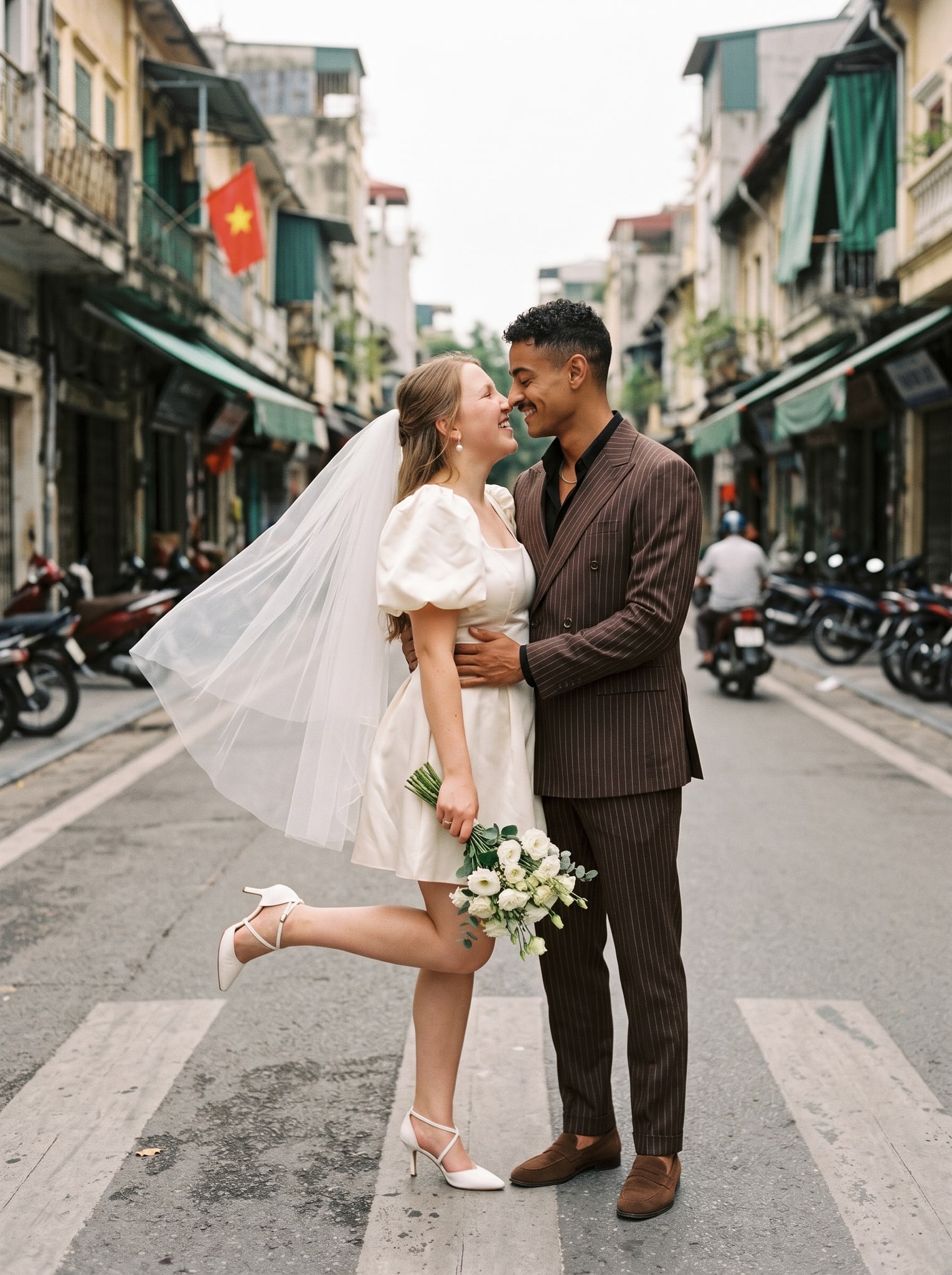
Cinematic light is directional, soft, and tells time—it makes the viewer feel when the story is happening. In Hanoi, winter (November–February) gives us clean, low-angle sun that wraps around faces without harsh shadows; summer (June–August) demands golden-hour precision because midday is blown-out. Spring monsoon season (April–May) is a gamble—cloud cover diffuses everything, which can feel flat, but a break in the clouds over Tran Quoc Pagoda creates moody contrast that reads as intentional on camera.
We schedule shoots in 90-minute windows timed to season and latitude. In January, golden hour lasts from 4:45–5:30 PM. In July, it's 5:15–6:00 PM and you're racing. This is why we ask your wedding date and preferred month when you first inquire—because a December shoot in Hanoi gets a different light strategy than a June one, and a 30-minute light window isn't negotiable.
The mistake we see: couples booking at midday because it "fits the schedule." Cinematic light doesn't fit schedules—schedules fit light. If you must shoot at noon, use shadow play (colonnades, tree patterns) or overexpose intentionally to flatten and bleach the frame, a style that reads as editorial but not "documentary wedding." Either way, you're making a choice, not settling.
How Do Outfit Changes Affect Pacing and Frame Count?
We usually build in 1–2 outfit changes per half-day, and this is where we kill momentum or use it. A 3-minute ao dai change in a hotel bathroom nearby is fast; a 10-minute second dress change at a studio across town is a reset that costs 20–30 frames and often cools the couple's energy. We've learned: if the couple wants multiple looks, plan outfit swaps during natural transition moments—a walk to a new location, a break by the water.
Here's what happens in practice: a couple shoots in casual wear at Tran Quoc Pagoda (60 frames across 45 minutes), we walk slowly to the nearby hotel (8 minutes), change into ao dai (4 minutes), shoot again at a quieter garden gate across the street (40 frames in 25 minutes). Total: two distinct settings, two moods, one flow. Versus: couple shoots at the pagoda, we drive them to a studio, they change, we shoot in a generic backdrop, we drive back to a third location. That's three context switches, lost light, and often a final set that feels rushed because we're racing the sunset.
The comparison table below shows real outcomes from recent shoots:
| Scenario | Outfit Changes | Locations | Frames (typical) | Couple's Energy | Best For |
|---|---|---|---|---|---|
| Single outfit, one neighborhood | 0 | 3–4 | 120–160 | Builds steadily | Editorial depth in fewer places |
| One change, adjacent spots | 1 | 2 | 90–130 | Stays high, peaks twice | Versatility without fatigue |
| Two changes, separate sites | 2 | 3–4 | 150–220 | Dips after each change | Maximum variety (risks flatness in last set) |
| Three-plus changes | 3+ | 4+ | 200–280 | Fragments; final set weak | Needs pro styling team, long window |
What to check before you book: Ask how many outfit changes are included and whether they're part of the same location cluster or require travel. If you want three looks, ask if your package includes stylist coordination or if you're managing changes solo (which costs time and focus).
Why Do We Edit Differently for Cinematic vs. Wedding-Day Looks?
Cinematic edits emphasize mood over accuracy—color grading is intentional (cool shadows, warm highlights, lifted blacks for a filmic look); skin is refined but not plasticized; the frame breathes space rather than filling every corner. Wedding-day edits often prioritize clarity and flattery over atmosphere. Both are valid; they're different products.
We color-grade cinematic pre-wedding work in three passes: first, exposure and white balance to match the light we shot in; second, contrast and crushed blacks to add depth (reducing pure black to 80–95% for that "film stock" feel); third, a subtle color grade that ties all locations into one visual story—cool tones in shade, warm in sun, but shifted so every image feels like it belongs in the same emotional world. This takes 45–90 seconds per frame instead of 15–20.
The result: you flip through the gallery and feel like you're watching a short film, not a collection of portraits. The cost is longer editing time, which factors into package scope. A 120-frame cinematic gallery might take 12–16 hours of editing; a standard wedding preview with basic retouching might take 6–8.
What to check before you book: Request to see samples of the studio's cinematic style and their standard style side by side. Not every photographer values the same edit aesthetic. If the studio's portfolio is bright and detail-sharp, they might not prioritize the moody, atmospheric grade you're imagining.
Which Hanoi Locations Deliver Cinematic Frames, and How Do We Shoot Them?
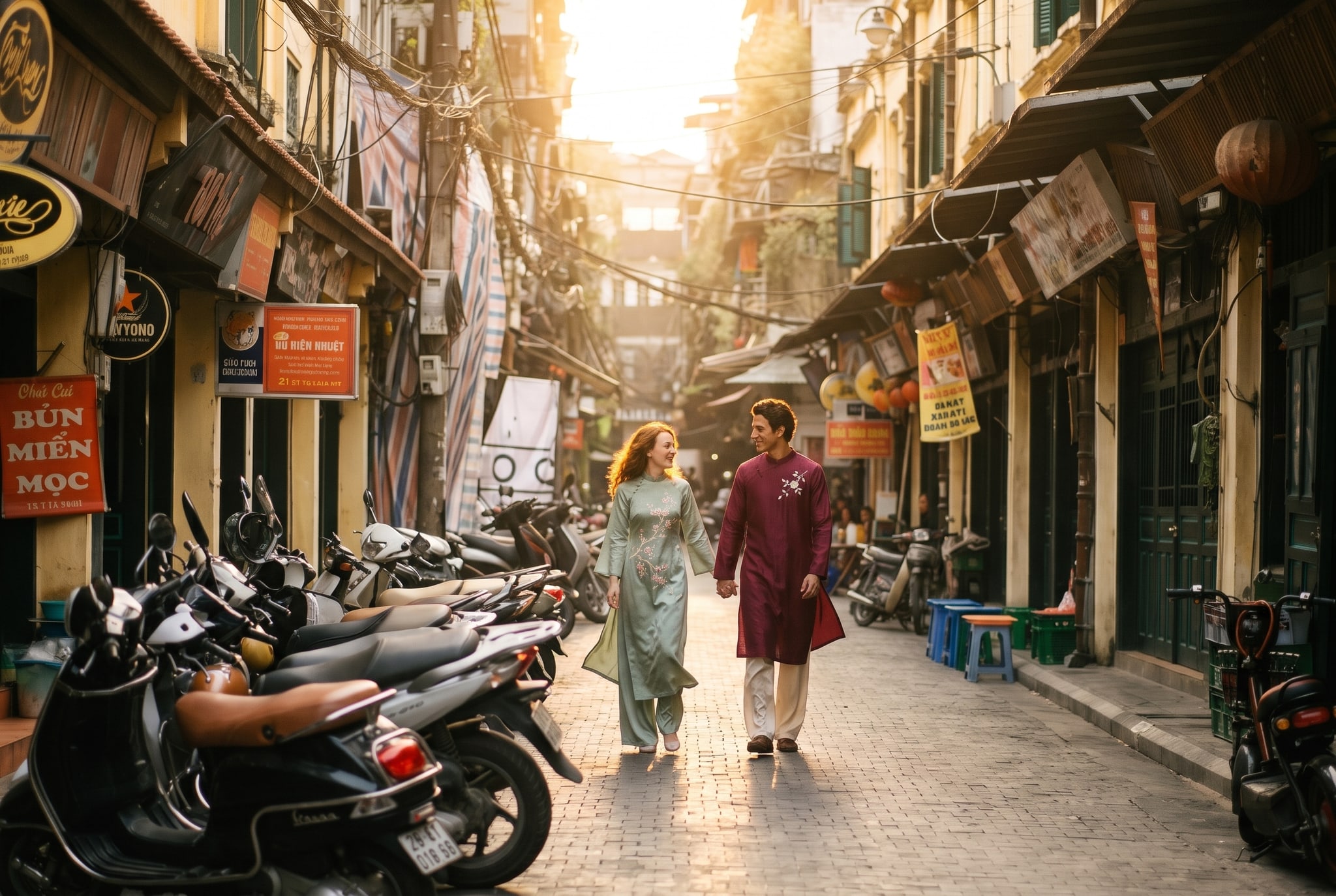
The Red River dikes (especially north of Long Bien Bridge) offer clean, wide horizons and golden-hour backlight; West Lake (Tay Ho) gives us water reflections and tree-lined paths with soft, diffused light; the Old Quarter (around Ta Hien, Hang Dao) offers layered architecture and shadow play, though crowds require early-morning or late-evening timing. Tran Quoc Pagoda and its surrounding grounds work best in morning light (before 9 AM) to catch the angle that silhouettes the structure against the water without tourists mid-frame.
We build routes based on light timing and foot traffic. For a sunset-focused shoot, we start inland (Old Quarter, 3:00 PM) where flat afternoon light still feels moody in narrow streets, then move toward water (Hoan Kiem Lake path, 4:15 PM) as the sun lowers, finishing on the dikes or a western-facing slope by 5:30 PM when gold and pink fill the sky. For a sunrise shoot (rare, but we do them), we meet at West Lake by 5:45 AM, catch first light on the water, then move to pagodas or gardens where shadows are still dramatic.
The mistake: thinking "famous location = cinematic frame." The Turtle Tower at Hoan Kiem is photographed thousands of times daily. For cinematic work, we use it as a foreground element (blurred, layered) while shooting the couple against the water and tree-line beyond. Or we skip it entirely and shoot the quiet Thanh Nien Road promenade 200 meters away, where you get the same lake view without the postcard feel.
What to check before you book: Ask the studio how they avoid crowded-location clichés. Do they scout off-peak times? Do they have permission to shoot in gardens or pagodas? Do they build routes around light, not just landmarks?
What Goes Wrong, and How Do We Fix It on the Day?
Weather: Hanoi's humidity and unexpected rain (April–May, September–October) can fog lenses and kill light. We carry lens cloths and always have a rain backup—shooting under colonnades or market awnings, where overhead structure creates natural diffusion and framing.
Couple nerves: First-time in front of the camera often means stiff posture and forced smiles. We fix this by shooting first without direction—just walking, talking, remembering why they chose each other. Frames 1–15 are usually awkward. By frame 40, bodies relax.
Overshooting without intent: If we're at a location, we shoot it—click, click, click—without asking if the light is moving or the couple is present. This wastes frames and editing time. Now we pause every 20–30 frames, review the back of the camera, and ask: Does this location still have energy? If yes, we shift angle or wait for better light. If no, we move.
Timing miscalculation: We arrive at the dikes planning 45 minutes of golden hour, but the couple's energy is still building—they're not ready to pose, they're still finding their rhythm together. We've learned: bank an extra 15 minutes into each location. If light holds and the couple is warm, we shoot it. If we finish early, we move to the next spot with time to spare.
Forgotten details: We now send a WhatsApp checklist 48 hours before: outfit fabrics (so we know if they'll wrinkle during the shoot), jewelry (we ask them to avoid distracting size), and weather forecast (so we adjust expectations). This pre-conversation saves us mid-shoot surprises.
How to Choose the Right Pre-Wedding Package for Cinematic Work
A cinematic pre-wedding shoot needs: time (minimum 2–3 hours; one hour isn't enough to chase light and rhythm), multiple locations (at least 2–3 distinct settings to build a visual narrative), professional editing (moody grades take longer), and a photographer who prioritizes mood over pose count. Not every package offers this combination.
Our pre-wedding and elopement package is built for couples who want editorial-style work, which means fewer locations than a traditional wedding-day shoot but deeper creative energy per location. We also offer couple photoshoot sessions for those who want shorter, more casual cinematic work.
If you're also planning an ao dai moment, our ao dai photoshoot package pairs well with a pre-wedding package—same crew, coordinated styling, one cohesive visual story. Some couples build a full day with both: ao dai in morning light, casual outfit in evening.
For couples who want makeup and hair to be part of the production, we include styling services; if you're booking hair and makeup only at your hotel, that's a separate service via our makeup and hair at your hotel offering, which you can combine with a photoshoot.
What to check before you book: Does the package include editing samples? How many final frames do you receive? Is the photographer willing to adapt to your energy, or do they shoot a fixed shot list? Can you see a full gallery from a recent shoot (not just highlights)?
See packages and prices on vietnamphotoshoot.com
Checking These Details Before You Commit
Before you choose a studio, ask yourself:
- What's included in the package? Hours, locations, outfit changes, crew size, edited frames, revision rounds.
- Do you see a full gallery, not just best-of? This shows you the real consistency and style.
- Is the photography style actually cinematic? Color grading, mood, composition—or is it bright and flattering?
- How does the studio handle timing? Do they lock sunrise/golden hour, or do they adapt to your schedule?
- What happens if weather changes? Ask for the backup plan.
- How many edits do you receive, and in what format? High-res digital files, prints, albums—know what you're getting.
- Can you communicate directly with the photographer before the day? Not just the studio coordinator—a real conversation about your vision.
FAQ
How long does a cinematic pre-wedding shoot in Hanoi take?
Half-day shoots run 2–3 hours, typically covering 2–3 locations with one outfit change. Full-day runs 4–5 hours, allowing deeper time per location and more wardrobe variety. Light windows determine start and end times, not clocks.
Can we do a cinematic pre-wedding shoot indoors or in bad weather?
Yes, but it requires different strategy. Indoor work uses available window light and practise posing; rainy weather uses reflections, wet pavement texture, and covered spaces as diffusion. Both can look cinematic, but they're different visual stories. Budget extra planning time.
What's the difference between cinematic and traditional wedding-day photography?
Cinematic work emphasizes editorial mood, color grading, and narrative flow—like a short film. Wedding-day photography prioritizes coverage, clarity, and flattery. Cinematic is slower, deeper; wedding-day is wider, faster. You can blend both styles in one package.
Do we need to hire a separate stylist for outfit choices?
Not required, but helpful. Our team advises on fabric, color, and silhouette during planning. If you're unsure about two outfits or want ao dai styling, professional guidance prevents mid-shoot hesitation and ensures frames feel intentional.
How many frames will we receive, and when?
Depends on package scope. Typically 120–200 final edited frames delivered within 2–3 weeks. We deliver high-res digital files, organized by location or mood. Albums, prints, or video edits are available via separate options.
Can we shoot at locations that require permission, like temples or private gardens?
Yes. We scout permission and fees beforehand. Tran Quoc Pagoda charges a small entrance fee; some private gardens have restrictions on commercial shoots. We handle this during booking and include it in planning.
Pre-Wedding & Elopement
Inclusions, prices and booking are on our booking site.
FAQ
How long does a cinematic pre-wedding shoot in Hanoi take?
Half-day shoots run 2–3 hours, typically covering 2–3 locations with one outfit change. Full-day runs 4–5 hours, allowing deeper time per location and more wardrobe variety. Light windows determine start and end times, not clocks.
Can we do a cinematic pre-wedding shoot indoors or in bad weather?
Yes, but it requires different strategy. Indoor work uses available window light and practise posing; rainy weather uses reflections, wet pavement texture, and covered spaces as diffusion. Both can look cinematic, but they're different visual stories. Budget extra planning time.
What's the difference between cinematic and traditional wedding-day photography?
Cinematic work emphasizes editorial mood, color grading, and narrative flow—like a short film. Wedding-day photography prioritizes coverage, clarity, and flattery. Cinematic is slower, deeper; wedding-day is wider, faster. You can blend both styles in one package.
Do we need to hire a separate stylist for outfit choices?
Not required, but helpful. Our team advises on fabric, color, and silhouette during planning. If you're unsure about two outfits or want ao dai styling, professional guidance prevents mid-shoot hesitation and ensures frames feel intentional.
How many frames will we receive, and when?
Depends on package scope. Typically 120–200 final edited frames delivered within 2–3 weeks. We deliver high-res digital files, organized by location or mood. Albums, prints, or video edits are available via separate options.
Can we shoot at locations that require permission, like temples or private gardens?
Yes. We scout permission and fees beforehand. Tran Quoc Pagoda charges a small entrance fee; some private gardens have restrictions on commercial shoots. We handle this during booking and include it in planning.
More from the team
Boho pre-wedding photoshoot in Vietnam: Hanoi, Saigon, Hoi An
Boho pre-wedding shoots mix romantic, free-spirited aesthetics with Vietnam's landscapes and heritage sites. We run full-day sessions in three cities, handling styling, makeup, location scouts and edits.
Avoid crowds at Hoang Su Phi rice terraces: timing for wedding shoots
Hoang Su Phi's terraced landscape draws couples and tour buses in equal measure. We show how to shoot there alone, when to arrive, and what to arrange with us before you go.
Photography rules at Con Dao beaches: permits, drones and what to check
Con Dao's beaches demand prep before you shoot—permits, drone zones and tide timing all affect your day. We share what the Cáo Studio team verifies on every booking.