 Cáo Studio
Home › Blog › Pre-Wedding & Elopement
Colonial Architecture Pre-Wedding Photoshoot in Vietnam
By the Cáo Studio team · Hanoi & Saigon · 2026-11-01
A colonial architecture pre-wedding shoot captures couples against French-era facades, tile work and shuttered windows that age gracefully on film. In Vietnam, Cáo Studio stages these in Hanoi (the Old Quarter and around Hoàn Kiếm Lake), Hoi An (riverside townhouses and Assembly Hall courtyards), and Saigon (Reunification Palace gardens, Opera House exteriors, and Ben Thanh Market district). Sessions run 4–6 hours with two outfit changes, hair and makeup touch-ups on location, and typically involve 15–25 edited frames per hour. Costs depend on location (some colonial sites require permits or guide fees), team size and post-production depth. Expect colonial shoots to demand early morning starts (5–6 a.m. in Hoi An to avoid crowds) and flexibility around tourist access. Cáo Studio handles location scouting, permits and architectural framing; you bring the outfit (áo dài pairs well with colonial geometry) and a backup plan for weather.
Why does colonial architecture suit pre-wedding couples more than modern venues?
Colonial buildings frame bodies symmetrically without competing visually. A shuttered window behind your shoulders doesn't distract; ornate brickwork stops at shoulder height. Modern glass and steel create harsh reflections and competing lines. When we shoot at a colonial townhouse in Hoi An's Ancient Town, the peeling plaster and weathered beams draw the eye inward to the couple, not outward to logo signage or glass endpoints. The patina reads as story—it says "this couple exists in time," not "this couple rented a backdrop." Our photographers choose colonial sites because the geometry is forgiving: arches frame faces, columns align spines, doorways create natural depth. By contrast, a concrete hotel lobby requires heavier posing and tighter crops. Colonial architecture does the compositional work for us.
Which Hanoi colonial locations work best for couples who want authentic texture?
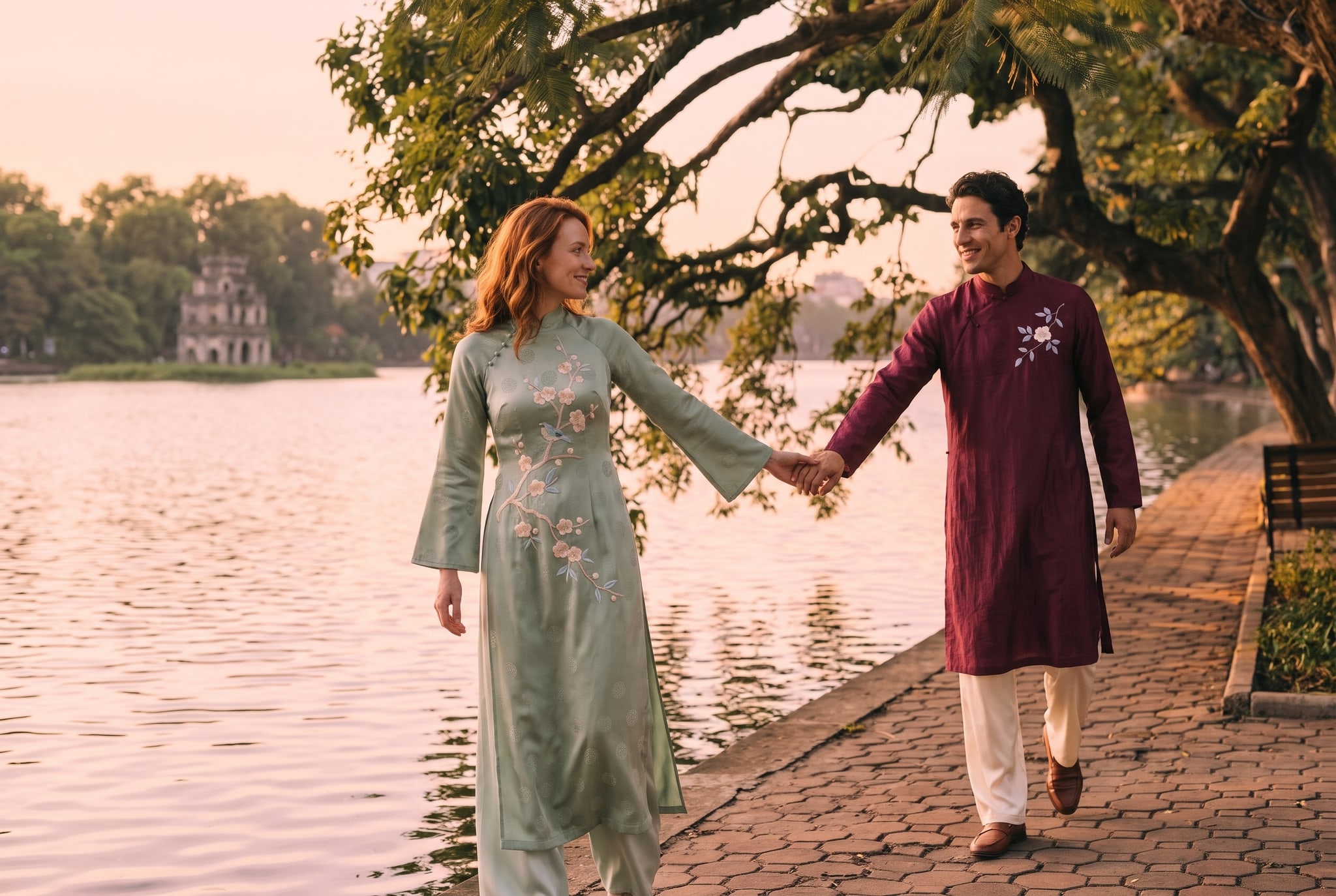
Hanoi's Old Quarter (around Hàng Buồm, Hàng Ngang streets) offers narrow shophouses with weathered shutters and hanging signs; tourist flow peaks 10 a.m.–4 p.m., so we book sunrise slots at 5:30–7 a.m. Hoàn Kiếm Lake's eastern shore has French colonial villas (now government buildings) with open courtyard access and lower foot traffic. French Quarter (Pháp Văn district) contains Embassy row—wrought-iron gates, tile roofs, tree-lined streets—but requires scouting for public courtyards. Hanoi Citadel's outer walls offer dramatic shadow play in evening light. We've learned that shooting before 7 a.m. in the Old Quarter nets clear-sky frames without crowds; after 8 a.m., scooters and tourists fill the streets. Early starts also mean cooler temperatures—crucial in Hanoi's humid summers. Book Cáo Studio Hanoi location scouting 1–2 weeks ahead to confirm access.
How do Hoi An's ancient buildings differ from Hanoi's for pre-wedding photography?
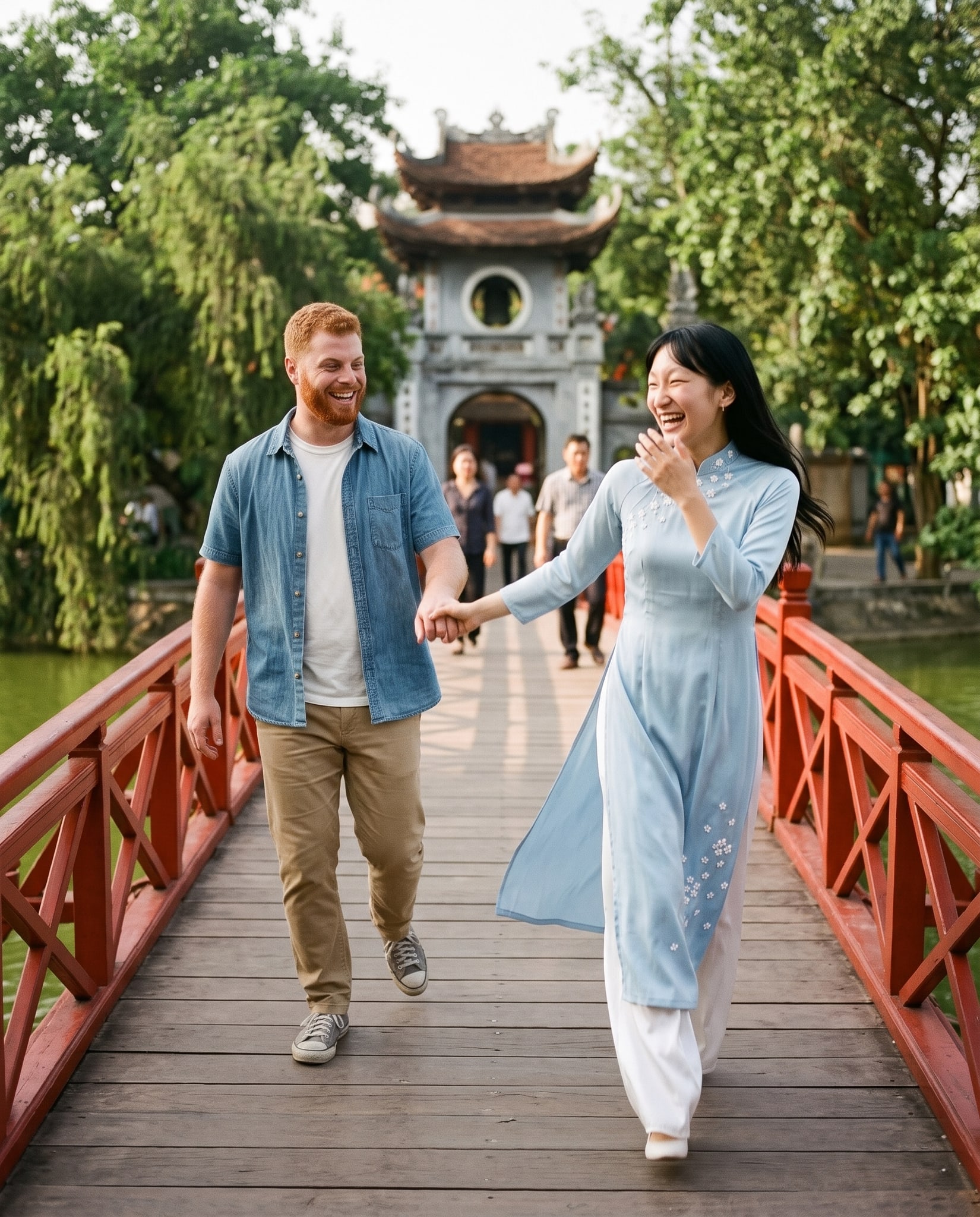
Hoi An's Ancient Town (UNESCO-listed) has uniform architectural vocabulary—yellow-ochre walls, dark timber shopfronts, lanterns—that creates visual coherence across frames. Hanoi mixes eras (Modernist apartment blocks shadow French townhouses), so framing requires tighter crops. Hoi An's river, temple courtyards and bridge offer natural depth layering; a couple silhouetted on the Japanese Covered Bridge reads instantly iconic. Tourist density is higher (30,000+ visitors daily), so sunrise shoots (5–6 a.m.) are essential—we often start before the town opens to foot traffic. Hoi An's humidity rivals Hanoi but temperature is cooler year-round due to proximity to the coast. Narrow streets limit crew and equipment; we work with two-person teams (photographer + assistant) rather than full styling staff, doing hair touch-ups in a nearby coffee shop. The town's lantern decor suits evening/dusk golden-hour shoots (4–6 p.m.) better than bright midday. Hoi An shoots cost slightly more due to permit fees and early-start logistics.
What should couples choose for Saigon colonial shoots—District 1 landmarks or quieter French Quarter enclaves?
| Location | Character | Crowd level | Best time | Length |
|---|---|---|---|---|
| Reunification Palace gardens | Formal grounds, wide lawns, symmetry | Moderate, gates close 5 p.m. | 7–9 a.m. or 3–4 p.m. | 2–3 hours |
| Opera House (exterior) | Art Deco facade, street-level framing | Heavy, downtown foot traffic | Early morning or dusk | 1–2 hours |
| Ben Thanh Market district | Brick facade, colonial shopfronts, alley depth | Variable, alley access restricted | Weekday midmorning | 2–3 hours |
| French Quarter (Tao Đàn Park area) | Quiet villas, tree-lined streets, gates | Low, residential feel | Anytime (morning softer light) | 3–4 hours |
| Bitexco tower (lower plaza) | Modern glass with colonial fragments | Heavy daytime, quiet evenings | Sunset onwards | 1–2 hours |
Couples wanting "landmark" visuals choose Reunification Palace or Opera House exteriors—instantly recognizable, but expect 15–20 minute holds for security scans and limited indoor access. Quieter couples prefer French Quarter tree-lined streets and residential courtyards—less iconic, more intimate, and allows longer outfit changes without time pressure. We often blend both: 2 hours in Palace gardens, then 2 hours in a French Quarter villa courtyard. Saigon's heat (28–32°C in most seasons) demands afternoon shoots that end by 5 p.m. to avoid sun exhaustion. Permits for Palace gardens cost extra; we handle that on your behalf.
See packages and prices on vietnamphotoshoot.com
What gear and team setup does Cáo Studio deploy for colonial architecture shoots?
We bring one primary camera (Canon R5 or Nikon Z9), 3–4 lenses (24mm f/1.4 for wide architectural context, 35mm and 85mm for couple close-ups, 70–200mm for compressed backgrounds), a second camera as backup, and a gimbal or monopod for video reels. For colonial shoots, we avoid wide-angle distortion (>20mm) because it warps shutters and makes symmetry look off. Lighting: three small strobes with diffusers and reflectors for fill-flash in shadow passages (common in Hoi An's narrow lanes and Old Quarter alleys). We rely on existing light 70% of the time—colonial architecture's directional sun creates natural rim-light that flatters couples. Hair and makeup setup requires a small bag (not a full kit truck—colonial sites lack parking). One stylist does touch-ups every 45 minutes; couples keep a portable mirror and powder compact for self-checks. We always carry an umbrella (not a diffuser, a physical umbrella) because midday sun in Hanoi and Saigon forces us to create shade on exposed facades. No couple wants harsh shadows across the face at the Reunification Palace.
How do we handle permit, access and crowding issues on the day?
Hanoi Old Quarter: we arrive with a printed ID letter (prepared a week prior) showing your names, shoot date, and Cáo Studio contact—police checkpoints are rare but exist. Hoi An Ancient Town: entry is ticketed (paid once, allows 3-day access); we book at 5:30 a.m. when gates open and staff are still checking systems—fewer tourists. Saigon Reunification Palace: we contact the gate office 48 hours before to pre-notify a "guided photoshoot"—no permit required, but 20-minute processing happens at entry. If access is denied on the day (rare, but we've had a wedding event occupy the Citadel in Hanoi), we pivot to a backup location within 30 minutes—we maintain a list of 4–5 Plan-B colonial sites for each city. Bad weather (rain, heavy fog in Hoi An) rarely cancels; we shoot anyway and desaturate frames in post for a moody aesthetic. Midday heat exhaustion is real; we schedule breaks in air-conditioned cafes (we scout these in advance), provide water and electrolyte powder, and shorten the final hour if either spouse is flagging. Scooters and tourists in frame? We wait 60–90 seconds for the street to clear rather than asking people to move—more authentic and less confrontational.
What outcome should couples expect in terms of image count, editing and timeline?
A 4-hour colonial shoot yields 120–180 raw frames (based on our standard 30–45 frames per hour rate). We deliver 60–90 edited images within 14 days of shoot (all color-corrected, white-balance adjusted, blemish removal and architectural perspective correction if needed). Couples receive full-resolution JPEG and RAW files for personal printing; no watermarks or usage restrictions. If a couple books makeup and hair at your hotel as an add-on, that happens 90 minutes before we leave your accommodation—the photographer arrives 30 minutes early to capture pre-shoot energy and outfits in natural light. Printed albums or canvas prints are not included in the base package but can be ordered separately through vietnamphotoshoot.com (those are produced by a third-party printer with 7–10 day lead times). Couples often ask: "Do you color-grade to match my mood?" Yes—if a couple wants moody/desaturated (suits colonial patina) versus bright/saturated (wedding-magazine style), we apply one grade to 100% of finals and call that the "look." Changing the look after delivery costs extra processing time; we recommend one phone call to settle on aesthetic before the shoot.
How should couples decide between áo dài, Western dress, and mixed outfits for colonial settings?
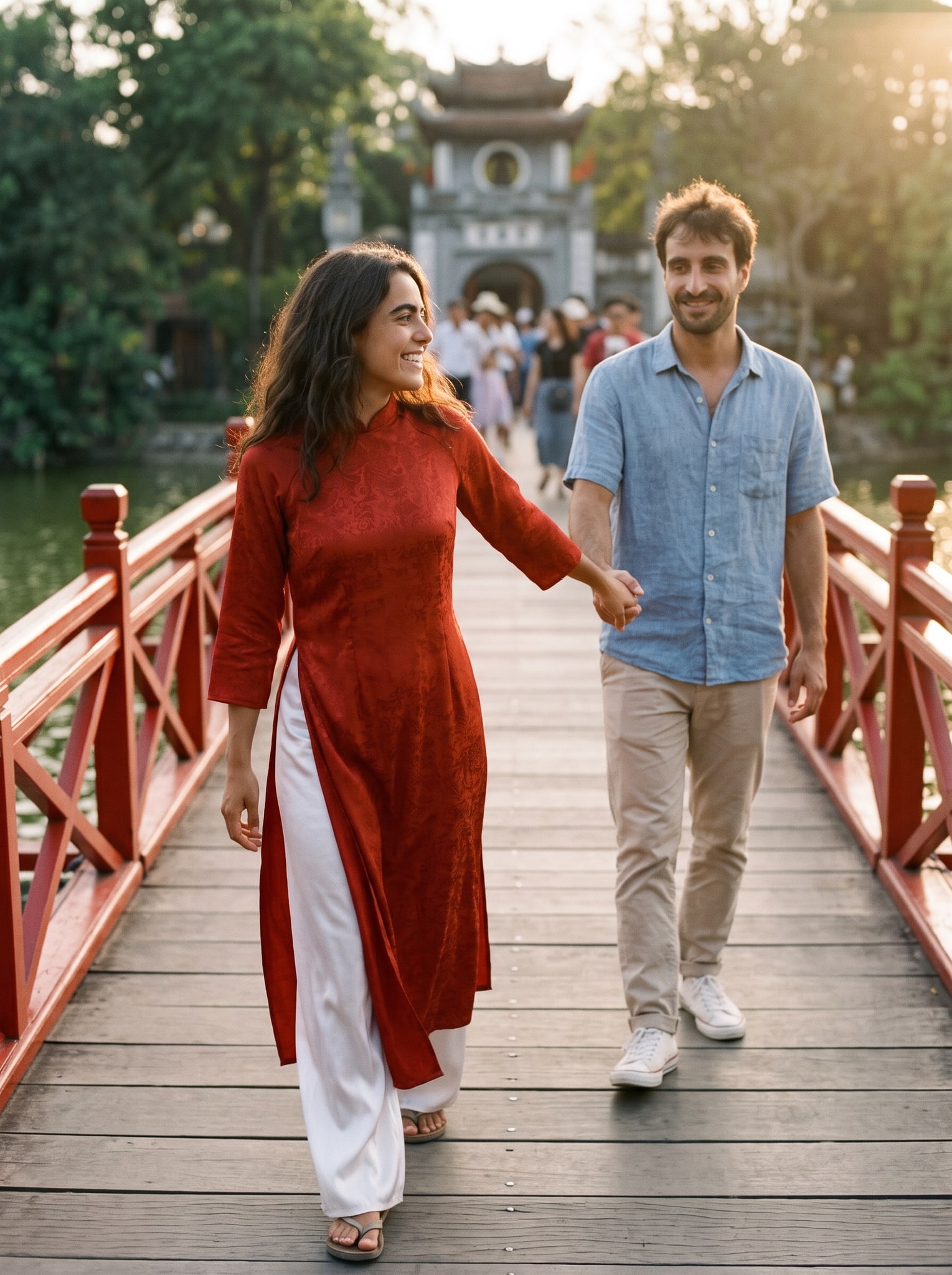
Áo dài (traditional tunic dress) creates the strongest visual narrative in colonial venues—the contrast between Vietnamese heritage and French architecture tells a cultural story. Sleek lines of áo dài also respect colonial geometry (symmetry, vertical shutters) without clashing. White or pastels photograph best because colonial walls are often muted (ochre, grey, weathered beige). Western wedding gowns work if they're fitted, not ballroom-full (full skirts fight narrow Hoi An alleys and doorways). We've shot couples in groom suit + áo dài bride (most common), both in Western formal, and both in áo dài—all three read well depending on the couple's cultural identity. Avoid loud patterns or neon colors; colonial palettes are natural tones. One couple wore a blush mermaid gown in the Old Quarter—the dress fought the peeling plaster backdrop for attention. We suggested a second outfit (a pastel áo dài borrowed from a rental shop for 30 minutes); the áo dài frames completely shifted the energy. Shoes: wear comfortable flats or soft soles for standing on old tile and cobblestone for 4–6 hours. Stilettos catch on Hoi An's uneven street tiles. Book an áo dài photoshoot package if outfit rental or styling is your first priority; couple photoshoot packages focus on the session itself and trust your outfit choice.
What to check before you book a colonial architecture pre-wedding shoot:
- Confirm your must-have location. Email Cáo Studio with your top 3 colonial sites (Hoi An's Assembly Hall? Hanoi's Citadel? Saigon's Opera House?). We'll reply within 24 hours with feasibility, optimal timing, and any fees or restrictions.
- Lock your shoot date and season. Hanoi's best light is October–March (cool, clear). Hoi An's best is also October–February (less fog). Saigon works year-round but book March–May for lower humidity. Monsoon season (May–September) means afternoon thunderstorms and cancelled shoots; we offer date rescheduling at no cost.
- Budget for a 4–6 hour block, not 2 hours. Colonial venues require travel between sites, access waiting, and outfit changes. A 2-hour session in the Old Quarter feels rushed; 4 hours lets you move through 3–4 locations.
- Choose your outfit strategy. Will you bring garments, rent locally, or have Cáo Studio connect you with a rental vendor? Communicated this upfront so we allocate styling time.
- Request a location scout photo call. Ask Cáo Studio for 5–10 reference images from your chosen site taken by our team in similar light conditions (e.g., "spring sunrise in Hoi An"). This prevents day-of surprises about how tall the walls look or where shadows fall.
- Understand the editing timeline. We deliver 60–90 images within 14 days. If you need a rush (e.g., for a wedding website or announcement), confirm that 3 days before the shoot and expect a small expedited fee.
- Plan a backup shoot date. Weather, access restrictions, or personal illness can force rescheduling. Book flexibility into your calendar or have a second preferred date in mind.
FAQ
Do we need a photography permit for colonial sites in Vietnam?
Most public colonial streets (Hanoi Old Quarter, Hoi An streets, Saigon Opera House exterior) don't require permits for personal use. Hoi An charges a town-entry ticket (~USD 5 per person per day); Reunification Palace gates perform a security check but don't demand advance permits. Cáo Studio handles all pre-notification and can provide an ID letter if asked. Private colonial villas require owner consent, which we arrange.
What's the earliest we can start a shoot in Hoi An to avoid crowds?
Gates open at 5 a.m.; we can be set up by 5:30 a.m. Tourist foot traffic is virtually zero until 7–8 a.m., so a sunrise session captures empty streets and golden light simultaneously. By 9 a.m., hundreds of visitors fill the Ancient Town, making long-exposure frames harder.
Can we mix multiple colonial neighborhoods in one day (e.g., Hanoi Old Quarter + French Quarter + Citadel)?
Yes, but it requires careful planning. Travel time between Old Quarter and Citadel is 20–30 minutes via scooter; French Quarter adds another 15 minutes. A 6-hour session might cover two locations comfortably (2–3 hours each) plus 1 hour for transitions and outfit changes. A third location squeezes timing and light quality. We recommend two-location shoots for coherent editing and couple energy.
Does Saigon's heat make afternoon colonial shoots impossible?
Afternoon shoots (2–5 p.m.) are difficult June–September when heat climbs above 32°C. October–May is manageable. We manage heat with water breaks in air-conditioned cafes every 60–90 minutes, shorter final hour, and a preference for shaded alleys or courtyards. A couple who insists on a midday shoot in August should expect reduced frame count and may need a post-shoot recovery hour.
Are colonial sites in Vietnam wheelchair-accessible for couple shoots?
No. Hanoi Old Quarter, Hoi An Ancient Town, and French Quarter feature narrow lanes, uneven tile, and tall curbs. Reunification Palace grounds are paved and flat but long walks between spots. If mobility is a concern, we recommend Reunification Palace gardens or a quieter French Quarter villa courtyard (fewer stairs). Discuss accessibility needs with Cáo Studio when booking; we'll scout a suitable location.
Can we shoot both Western formal and áo dài in one session without doubling the cost?
Yes—changing outfits mid-shoot (e.g., first 2 hours Western, second 2 hours áo dài) is standard in our pre-wedding packages. We allocate 15–20 minutes per outfit change for hair, makeup touch-ups, and location transition. Most couples book a 4-hour session expecting two outfits; we don't charge extra for the second set unless it requires unplanned styling or rental coordination.
How far in advance should we book a colonial architecture pre-wedding shoot?
4–8 weeks is ideal, especially if your preferred date is October–December (peak wedding season) or if you need specific Hoi An weekend slots. For off-season shoots (June–August), 2–3 weeks is often enough. Communicate your must-have date early; if it's fully booked, we'll offer adjacent days. Location scouting and permits are easier with 6+ weeks lead time. ===BUTTON CTA=== Chat with us on WhatsApp | See packages and prices on vietnamphotoshoot.com
Pre-Wedding & Elopement
Inclusions, prices and booking are on our booking site.
FAQ
Do we need a photography permit for colonial sites in Vietnam?
Most public colonial streets (Hanoi Old Quarter, Hoi An streets, Saigon Opera House exterior) don't require permits for personal use. Hoi An charges a town-entry ticket (~USD 5 per person per day); Reunification Palace gates perform a security check but don't demand advance permits. Cáo Studio handles all pre-notification and can provide an ID letter if asked. Private colonial villas require owner consent, which we arrange.
What's the earliest we can start a shoot in Hoi An to avoid crowds?
Gates open at 5 a.m.; we can be set up by 5:30 a.m. Tourist foot traffic is virtually zero until 7–8 a.m., so a sunrise session captures empty streets and golden light simultaneously. By 9 a.m., hundreds of visitors fill the Ancient Town, making long-exposure frames harder.
Can we mix multiple colonial neighborhoods in one day (e.g., Hanoi Old Quarter + French Quarter + Citadel)?
Yes, but it requires careful planning. Travel time between Old Quarter and Citadel is 20–30 minutes via scooter; French Quarter adds another 15 minutes. A 6-hour session might cover two locations comfortably (2–3 hours each) plus 1 hour for transitions and outfit changes. A third location squeezes timing and light quality. We recommend two-location shoots for coherent editing and couple energy.
Does Saigon's heat make afternoon colonial shoots impossible?
Afternoon shoots (2–5 p.m.) are difficult June–September when heat climbs above 32°C. October–May is manageable. We manage heat with water breaks in air-conditioned cafes every 60–90 minutes, shorter final hour, and a preference for shaded alleys or courtyards. A couple who insists on a midday shoot in August should expect reduced frame count and may need a post-shoot recovery hour.
Are colonial sites in Vietnam wheelchair-accessible for couple shoots?
No. Hanoi Old Quarter, Hoi An Ancient Town, and French Quarter feature narrow lanes, uneven tile, and tall curbs. Reunification Palace grounds are paved and flat but long walks between spots. If mobility is a concern, we recommend Reunification Palace gardens or a quieter French Quarter villa courtyard (fewer stairs). Discuss accessibility needs with Cáo Studio when booking; we'll scout a suitable location.
Can we shoot both Western formal and áo dài in one session without doubling the cost?
Yes—changing outfits mid-shoot (e.g., first 2 hours Western, second 2 hours áo dài) is standard in our [pre-wedding packages](/go/pre-wedding-photoshoot). We allocate 15–20 minutes per outfit change for hair, makeup touch-ups, and location transition. Most couples book a 4-hour session expecting two outfits; we don't charge extra for the second set unless it requires unplanned styling or rental coordination.
How far in advance should we book a colonial architecture pre-wedding shoot?
4–8 weeks is ideal, especially if your preferred date is October–December (peak wedding season) or if you need specific Hoi An weekend slots. For off-season shoots (June–August), 2–3 weeks is often enough. Communicate your must-have date early; if it's fully booked, we'll offer adjacent days. Location scouting and permits are easier with 6+ weeks lead time. ===BUTTON CTA=== [📸 Chat with us on WhatsApp](https://wa.me/84338762340) | [✨ See packages and prices on vietnamphotoshoot.com](/go/)
More from the team
Boho pre-wedding photoshoot in Vietnam: Hanoi, Saigon, Hoi An
Boho pre-wedding shoots mix romantic, free-spirited aesthetics with Vietnam's landscapes and heritage sites. We run full-day sessions in three cities, handling styling, makeup, location scouts and edits.
Avoid crowds at Hoang Su Phi rice terraces: timing for wedding shoots
Hoang Su Phi's terraced landscape draws couples and tour buses in equal measure. We show how to shoot there alone, when to arrive, and what to arrange with us before you go.
Photography rules at Con Dao beaches: permits, drones and what to check
Con Dao's beaches demand prep before you shoot—permits, drone zones and tide timing all affect your day. We share what the Cáo Studio team verifies on every booking.