 Cáo Studio
Home › Blog › Pre-Wedding & Elopement
Elopement Photos at Bat Trang Ceramic Village
By the Cáo Studio team · Hanoi & Saigon · 2026-11-01
Bat Trang ceramic village, 15 km southeast of central Hanoi, is a working pottery community where wheelhouses, kilns, and clay-dusted artisans create authentic, tactile backdrops for elopement photography. Sessions typically run 2–4 hours, starting early morning when light is soft and foot traffic light. Cáo Studio pairs the location with a dedicated photographer and stylist; couples arrive in wedding attire or casual dress and we weave them through active studios, kiln yards, and narrow lanes lined with ceramic wares. Cost varies by package length and styling. What to avoid: shooting mid-day (harsh shadows on clay), ignoring the monsoon season (June–August floods access roads), or assuming all pottery shops welcome photography—we scout and coordinate entry beforehand.
We chose Bat Trang for elopement work because it breaks the mold. Most couples think "Hanoi backdrop" and picture Old Quarter temples or Hoan Kiem Lake. Bat Trang is different—it's alive with labor. You see hands at wheels, wood smoke from kilns, clay dust in air. The village has shot the same way for 500 years. That texture doesn't feel staged.
Our first Bat Trang elopement taught us the pace. The couple arrived expecting a quiet stroll. Instead, they found themselves sitting on a kiln edge while a ceramicist trimmed bowl rims three feet away. That moment—genuine surprise, real smile—is what we hunt for now. We don't direct much. We watch and frame.
Why does Bat Trang work better in early morning?
Light at Bat Trang peaks between 6:30 and 9:00 a.m. Kilns face east; studio doorways catch side-light that sculpts faces without harsh shadow lines. By 11 a.m., the sun climbs high and clay walls bounce flat, hot glare that flattens skin tone. We've learned to brief couples: arrive by 6:45 a.m., plan to finish by 9:30 a.m. Humidity is lower, fewer tourists roam the lanes, and shop owners are more open to spontaneous photography when they're setting up. One session ran past 10 a.m. because the couple moved slowly for portraits; the images softened but lost the crispness we promise. Early start is not negotiable for Bat Trang.
Which season avoids flooding and keeps roads passable?
September through May is safe. June through August brings monsoon rains that soak the clay pathways, flood lower studios, and make wheel-work impossible—potters shut down half the day. We once scheduled a session in late June; three days before, we messaged the couple to reschedule because the main lane was a brown stream. October through November is ideal: dry, cool mornings, low tourist load. December stays dry but attracts day-trippers; January–February is Lunar New Year quiet. March–May grows humid but remains shootable. Base your elopement date on this window if Bat Trang is your heart's choice.
How do we coordinate with potters so they allow photography?
We scout three days before. Our team walks the village, introduces ourselves to kiln masters and shop owners, explains the couple's story, and asks permission for specific studio spaces and exteriors. Most say yes—especially to morning shoots—because we're respectful and don't disrupt work. One potter invited us back specifically because we gifted a print of the couple standing beside his wheel. We never assume access. We never photograph faces of artisans without asking. And we bring a small gift: a calendar, a print, sometimes just good energy. Word spreads. By year three, several potters recognize our car and wave us in. That goodwill is the backbone of Bat Trang work.
What clothing and styling choices suit the clay-dust environment?
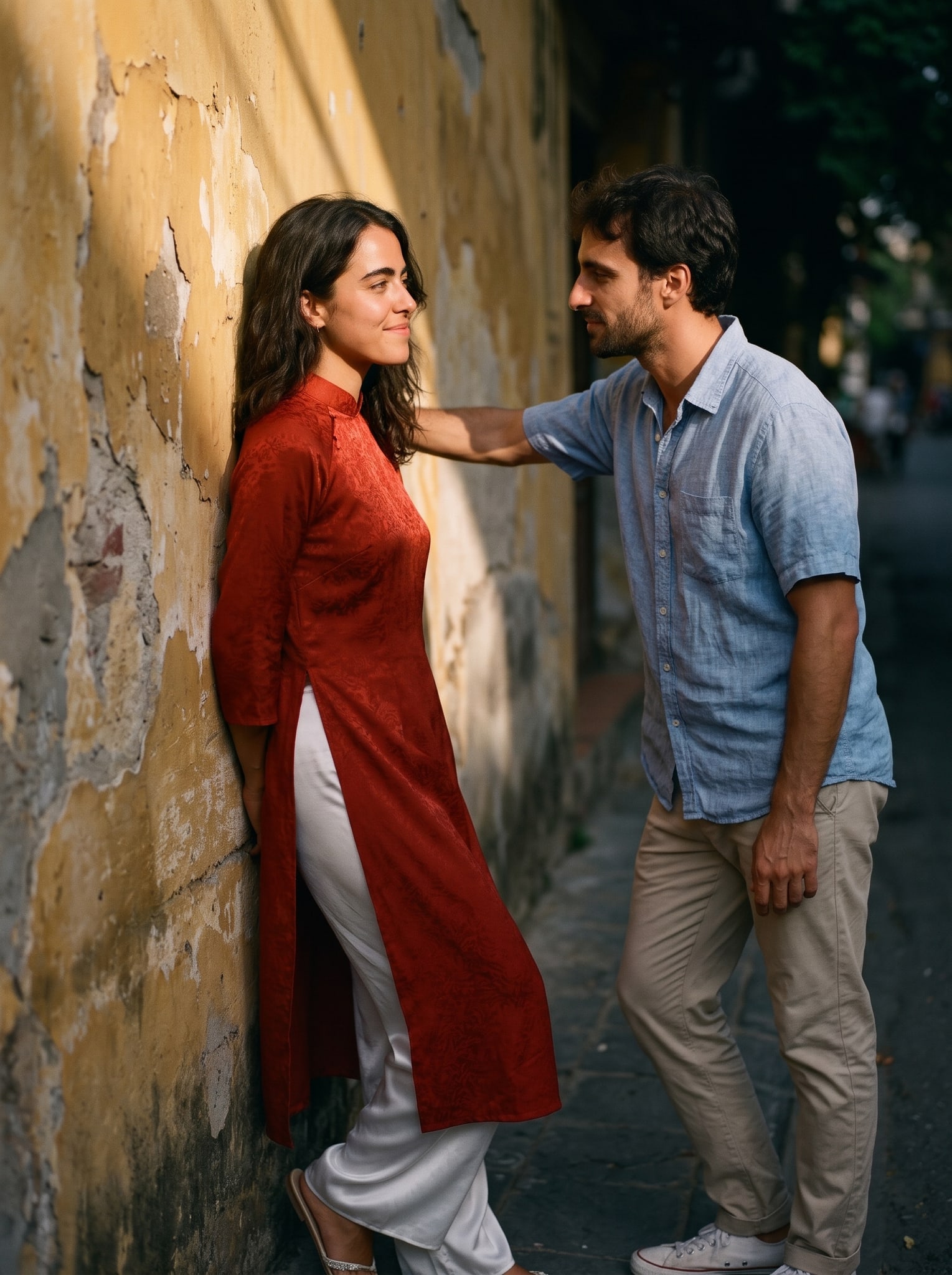
This is where we differ from typical pre-wedding shoots. A white ao dai will grey by the end of a morning at Bat Trang; that's intentional for some couples, a deal-breaker for others. We discuss outfit strategy at the booking call.
| Outfit Type | Who It's For | What Happens | Why It Works |
|---|---|---|---|
| White or cream ao dai | Couples wanting "pure" contrast | Dust settles on hem and sleeves; adds grit and authenticity to images | The softness plays against hardness of clay—emotional storytelling |
| Neutral linen (unstructured) | Couples wanting movement and ease | Wrinkles deepen character; dust blends; fabric flows through kiln yards | Looks natural, pairs with clay tones, no laundry regret |
| Dark or deep jewel tones | Couples wanting boldness | Stands out against pale clay; dust invisible; formal feel remains crisp | Professional, timeless, dust-proof |
| Casual street clothes (jeans, shirt) | Couples skipping "wedding" framing | Blends into daily life; you look like artists visiting artists | Intimate, no costume, pure connection |
We prep couples: "Bat Trang will touch your clothes. That's not a flaw; it's proof you were there." One bride wore white and loved the dust stains—she framed a photo unedited. Another brought two outfits and changed halfway. A third wore borrowed work clothes and danced on clay. There's no wrong call if you know the consequence.
We also hire stylists from our makeup and hair team for couples wanting formal look. Touch-ups happen in our car between location shifts. Humidity and dust mean makeup needs setting powder and brow hold; we use extra spray. One stylist learned to keep tissues and blotting pads in the front seat after a 90% humidity morning left the bride's foundation soft. Now it's routine.

What happens when a session goes wrong—and how do we salvage it?
Reality: it rains, a kiln shuts down, someone gets uncomfortable, the car won't start.
Last October, a couple arrived and the boyfriend's family called asking him home for lunch—a surprise visit. We were 30 minutes in. Instead of canceling, we moved fast, shot their best hour at the kiln entrance (golden light, intimate framing), and wrapped by 10:30 a.m. The images are some of our strongest from Bat Trang—urgency and realness came through.
We also keep a wet-weather backup: a pottery shop owner let us use his covered studio space during a surprise downpour. The couple sat among finished ceramics, and we shot their quiet moment together. It felt less "wedding" and more "two people in a space they loved." We've returned to that shop four times since.
The protocol we follow now: brief contingencies at the WhatsApp call. Ask about family obligations, weather anxiety, mobility concerns. Have backup locations scouted. Bring towels and a jacket. Carry extra memory cards—dust damages electronics if you're not careful. Confirm pottery access the morning of. Keep the couple's phone number live. If something breaks, we adapt in real-time rather than force the original plan.
How long should you book, and what package covers Bat Trang?
Most couples choose 2–4 hour sessions. Two hours moves you through 2–3 pottery studios and gets the morning-light window. Four hours adds variety—different clay zones, kiln variety, a wardrobe change, a meal break at a nearby cafe. Our pre-wedding and elopement package scales to both. If you're combining Bat Trang with city shots (Old Quarter, Hoan Kiem), add another half-day. One couple booked a full-day split: Bat Trang morning, Hanoi Temple evening. That's not typical, but it works if you want range. Most elopement couples choose location focus—one place, one story, depth over breadth.
See packages and prices on vietnamphotoshoot.com
Travel time from central Hanoi is 30–45 minutes depending on traffic. We leave early, arrive early, shoot early, and finish before the village gets loud. Couples often ask: "Can we explore on our own after?" Yes. We give you recommendations—a pottery workshop where you can throw clay together, a lunch spot run by a retired potter, a small museum. Some couples book a half-day and return to the village on their own later; others treat the shoot as their Bat Trang moment and leave satisfied. Both patterns work.
What to check before you book Bat Trang for your elopement
- Dates: Confirm dry season (Sept–May). Avoid monsoon and peak-tourist months.
- Mobility: The village has steep lanes, uneven clay pathways, and narrow studio doorways. Wear flat shoes; inform us of mobility concerns.
- Clothing backup: Bring a second outfit or accept clay dust as part of the story.
- Timing flexibility: Early morning (6:45 a.m. arrival) is non-negotiable for light quality.
- Permission comfort: We handle potter coordination, but confirm you're okay being photographed near working artisans.
- Budget clarity: Package length (2 vs. 4 hours) and styling add-ons determine final cost. Discuss these on your booking call.
- Weather backup: Know your plan if it rains. We scout alternatives; you choose boldness or caution.
We recommend Bat Trang for couples who want their elopement to feel earned—not choreographed. If you're coming to Vietnam specifically to elope, if clay and craft matter to your story, if morning light and quiet energy excite you, this village delivers. It asks for intention and early rising. It rewards both.
For destination couples combining Bat Trang with other shoots, browse our couple photoshoot options to add a formal session or special concept shoot if you want a second location or thematic day. Many pairs choose Bat Trang for intimacy and book a studio session in Saigon or elsewhere for variety.
FAQ
Can we hire a stylist just for Bat Trang, or do we need a full wedding-day package?
We offer standalone makeup and hair services for elopements. Most couples book a quick touch-up (30 min) on the morning of Bat Trang rather than full glamour. Humidity and dust make heavy makeup less practical; a stylist focuses on skin prep, brow shape, and setting spray so you look fresh but natural.
Is Bat Trang safe for foreign couples unfamiliar with Hanoi?
Yes. The village is walkable, potters are accustomed to visitors, and we drive you there and walk with you. We handle pottery permissions and logistics. Stick with our planned route and timing, and there are no safety concerns. Many international couples shoot there annually.
What if it rains on our Bat Trang elopement morning?
Light rain is shootable—it darkens clay colors and creates moody drama. Heavy rain shuts down kiln work and floods lanes. We monitor weather closely and message you 2 days before with a forecast. If rain is severe, we reschedule or pivot to a covered studio space we've pre-arranged with a potter contact.
Can we combine Bat Trang with other Hanoi locations in one elopement day?
Yes, but we don't recommend it. Bat Trang demands early arrival and captures best in 2–4 hours. Adding the Old Quarter or Hoan Kiem later is possible but feels rushed. Most couples choose Bat Trang as their single elopement moment and book a separate day if they want formal city shots.
How many final edited images do we receive from a Bat Trang session?
That depends on your package length. A 2-hour shoot typically yields 60–100 edited images; a 4-hour session, 120–180. We deliver all selects edited in our house style (warm, film-like tones that suit clay). Previews arrive within 7 days; full gallery within two weeks.
Do we need to bring anything special for a Bat Trang elopement shoot?
Wear flat, closed shoes (clay is rough). Bring a light jacket (mornings are cool). If you're in a white ao dai or formal dress, bring a second casual outfit or accept dust. We provide a jacket and towel if needed. Beyond that, bring yourselves and your story.
Pre-Wedding & Elopement
Inclusions, prices and booking are on our booking site.
FAQ
Can we hire a stylist just for Bat Trang, or do we need a full wedding-day package?
We offer standalone [makeup and hair services](/go/makeup-and-hair) for elopements. Most couples book a quick touch-up (30 min) on the morning of Bat Trang rather than full glamour. Humidity and dust make heavy makeup less practical; a stylist focuses on skin prep, brow shape, and setting spray so you look fresh but natural.
Is Bat Trang safe for foreign couples unfamiliar with Hanoi?
Yes. The village is walkable, potters are accustomed to visitors, and we drive you there and walk with you. We handle pottery permissions and logistics. Stick with our planned route and timing, and there are no safety concerns. Many international couples shoot there annually.
What if it rains on our Bat Trang elopement morning?
Light rain is shootable—it darkens clay colors and creates moody drama. Heavy rain shuts down kiln work and floods lanes. We monitor weather closely and message you 2 days before with a forecast. If rain is severe, we reschedule or pivot to a covered studio space we've pre-arranged with a potter contact.
Can we combine Bat Trang with other Hanoi locations in one elopement day?
Yes, but we don't recommend it. Bat Trang demands early arrival and captures best in 2–4 hours. Adding the Old Quarter or Hoan Kiem later is possible but feels rushed. Most couples choose Bat Trang as their single elopement moment and book a separate day if they want formal city shots.
How many final edited images do we receive from a Bat Trang session?
That depends on your package length. A 2-hour shoot typically yields 60–100 edited images; a 4-hour session, 120–180. We deliver all selects edited in our house style (warm, film-like tones that suit clay). Previews arrive within 7 days; full gallery within two weeks.
Do we need to bring anything special for a Bat Trang elopement shoot?
Wear flat, closed shoes (clay is rough). Bring a light jacket (mornings are cool). If you're in a white ao dai or formal dress, bring a second casual outfit or accept dust. We provide a jacket and towel if needed. Beyond that, bring yourselves and your story.
More from the team
Boho pre-wedding photoshoot in Vietnam: Hanoi, Saigon, Hoi An
Boho pre-wedding shoots mix romantic, free-spirited aesthetics with Vietnam's landscapes and heritage sites. We run full-day sessions in three cities, handling styling, makeup, location scouts and edits.
Avoid crowds at Hoang Su Phi rice terraces: timing for wedding shoots
Hoang Su Phi's terraced landscape draws couples and tour buses in equal measure. We show how to shoot there alone, when to arrive, and what to arrange with us before you go.
Photography rules at Con Dao beaches: permits, drones and what to check
Con Dao's beaches demand prep before you shoot—permits, drone zones and tide timing all affect your day. We share what the Cáo Studio team verifies on every booking.