 Cáo Studio
Home › Blog › Pre-Wedding & Elopement
Elopement photos at Kim Bong carpentry village
By the Cáo Studio team · Hanoi & Saigon · 2026-11-04
Kim Bong is a 200-year-old carpentry village on the Thu Bon riverbank where artisans still hand-carve furniture and architectural details. Elopement couples choose it for heritage backdrops without the crowded tourist footfall of Ancient Town. A typical session with Cáo Studio runs 3–4 hours: meet at sunrise or late afternoon, walk the narrow lanes between workshop yards, capture quiet moments by the river, and finish with golden-hour portraits near wood-stacked courtyards. You'll need an áo dài or Western elopement dress (we can arrange styling), comfortable walking shoes, and a WhatsApp call 48 hours before to confirm your story and light preferences. Ask us for a quote on WhatsApp—elopement sessions usually bundle photography, album design, and edited galleries. Main risk: midday heat and harsh shadows; we always scout by 3 p.m. or move the session earlier. Avoid rainy season (September–November) unless you want moody weather frames—many couples do. Chat with us on WhatsApp
What makes Kim Bong different from other Hoi An shoot spots?
Ancient Town feels like a postcard rack by 9 a.m.; Kim Bong stays quiet. We've shot in both, and the carpentry village gives us 40 minutes of uninterrupted golden hour without school groups or vendor carts in frame. Artisans are accustomed to photographers—they'll wave, carve while you pose, or step aside. The wood sawdust and half-finished chairs create texture; the river provides breathing room. For elopement couples seeking intimate rather than grandiose, this is the move.
How do we time a Kim Bong session to avoid heat and crowds?
We start at 5:30–6 a.m. for sunrise frames, or we wait until 4 p.m. and shoot into dusk. Morning light feels softer on wooden surfaces; afternoon gives warmer, directional amber on the river. Midday (11 a.m.–3 p.m.) is a dead zone—we've abandoned shoots that started then and repositioned couples' schedules. Rainy season (September–November) can surprise you; we check forecasts and suggest May–August or January–March as sweet spots. Never assume "bright = good"—harsh noon sun flattens faces and casts black eye shadows. Our photographers will text you a time proposal based on that week's weather.
See packages and prices on vietnamphotoshoot.com
Do we need to book the village or get permits?
No formal permit is needed—Kim Bong is a living, working village, not a gated heritage site. However, we always visit 24 hours before and greet workshop owners where we plan to shoot. They appreciate it, and they'll let us hang around longer. A few workshops are private family spaces; we never trespass. If you dream of a specific artisan's yard (a furniture maker or lacquer studio), we scout it and ask permission directly—success rate is 95%. Consider a small gift (fruit, coffee) for workshop owners who let you use their space as a backdrop; it costs little and opens doors.
What outfit choice works best for Kim Bong's wooden aesthetic?
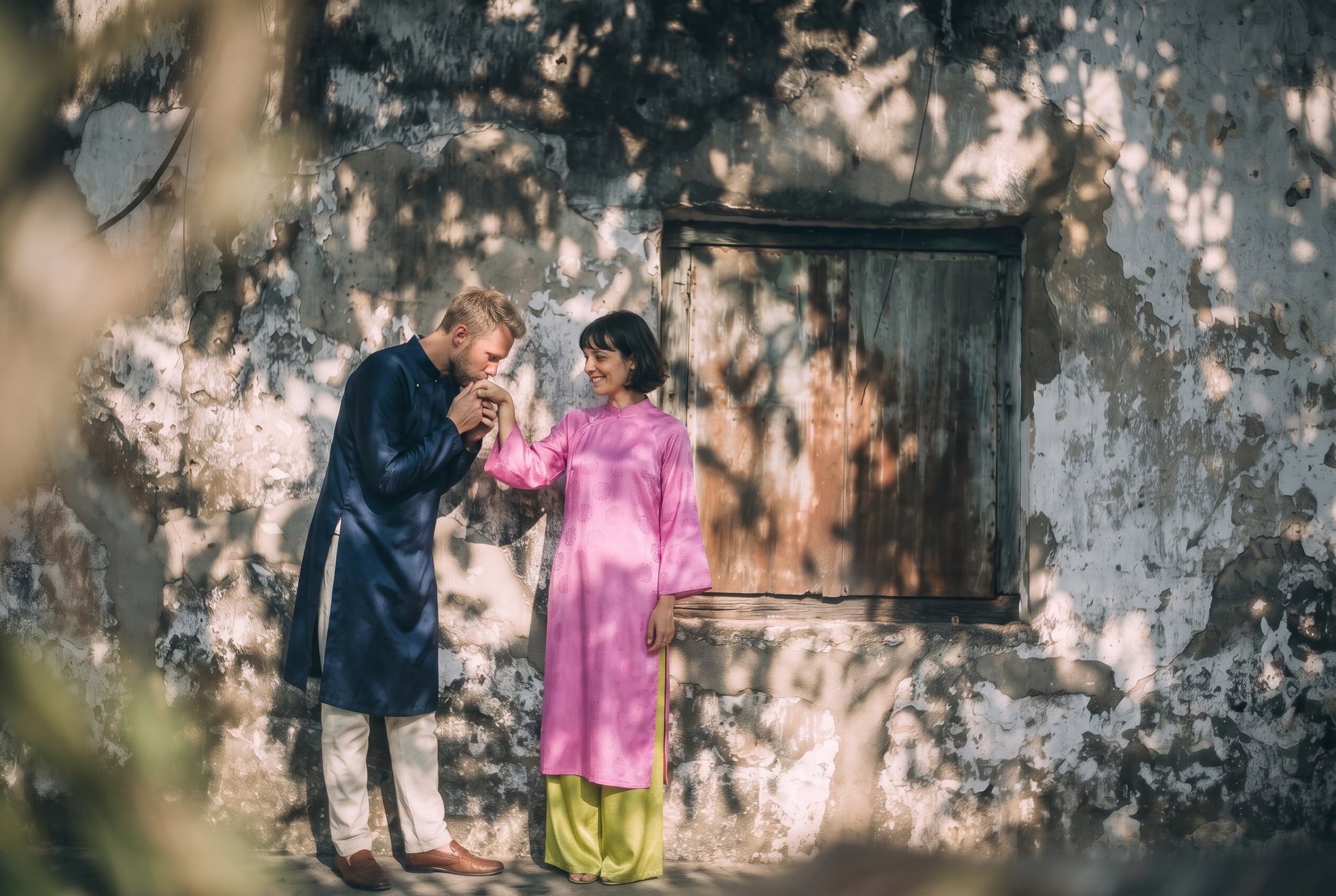
Áo dài photographs beautifully against raw wood—the silk contrast pops without overpowering the heritage setting. If you're doing a Western elopement dress, choose jewel tones (emerald, burgundy, navy) or ivory; pastels disappear into the weathered timber. We've seen couples wear cream linen suits too—that works if the fit is sharp. Avoid neon or logos. Grooms: dark linen or tailored shirts, no graphic prints. Accessories matter: a simple gold chain, vintage watch, or simple jewelry reads well. Shoes—this is crucial—must be walkable through uneven dirt lanes and wooden ramps. We've had brides arrive in stilettos and spent 30 minutes finding a car to step down from; sneakers or flat sandals are honest and look fine in close-ups.
How does our team structure a typical Kim Bong elopement day?
Hour 1 (5:30–6:30 a.m. or 4:00–5:00 p.m.): We meet at a landmark (usually the entrance sign), review your story and preferred shot list, and take solo portraits while light is fresh. Hour 2: Walk the lanes together, pause at chosen workshop yards, capture candid moments (hand-holding, laughing near carving benches). Hour 3: River and architectural detail shots—wooden boats, reflections, close-ups of texture. Hour 4: Dress change (if you want it), final couple frames, and a sunset or twilight wind-down. We bring a portable ring light and reflector to fill shadows. Rain mid-shoot? We pivot to covered workshop interiors and keep momentum. One photographer + one stylist/assistant is our standard Kim Bong team. If you want makeup and hair at your hotel before the session, add an hour—we come to you in Hoi An town.
Comparing Kim Bong to other elopement backdrops near Hoi An
| Location | Best for | Light quality | Crowds (peak hours) | Walking difficulty |
|---|---|---|---|---|
| Kim Bong village | Heritage + intimate | Golden hour, soft shadows | Low | Moderate (dirt/ramps) |
| Ancient Town streets | Postcard aesthetic | Harsh noon (avoid), soft early | Very high | Easy (paved) |
| Thu Bon riverbank | Romance, water reflections | Excellent at dusk | Low–medium | Easy (paths) |
| An Bang Beach | Modern, sand + sea | Brilliant afternoon | High (summer) | Easy |
| Thanh Ha pottery | Rustic, clay kilns | Best sunrise | Low–medium | Moderate (climbing) |
Kim Bong wins on heritage + solitude. Ancient Town is iconic but crowded. If you're choosing between them, ask yourself: do you want a famous postcard or a quiet story? We always advise first-time visitors to Hoi An to do one Heritage (Ancient Town) + one Artisan (Kim Bong) to get the full picture.
What do we pack and what goes wrong on location?
We bring: two camera bodies, four lenses, backup batteries (crucial—humidity drains them fast), a reflector, ring light, tripod, water, snacks, insect repellent, and a portable phone charger. You bring: comfortable shoes, a hat or umbrella (sun or unexpected rain), your áo dài or dress in a garment bag, a phone for last-minute WhatsApp updates. What goes wrong: artisans sometimes block a perfect shot by moving their work; we pivot and frame them into the story instead. Humidity fogs lenses—we carry lens cloths and wait 2 minutes before resuming. A couple's hair product melts in June heat; we carry blotting spray. One groom's tie came loose; we rewound and shot without it (looked better). A tourist photo bomb happens every other session; we reshoot that frame 30 seconds later. Always have a Plan B: if a workshop we scouted closes that day, we move 50 meters upriver or into a neighboring family's yard.
What to check before you book a Kim Bong elopement session
- Season & weather: Confirm the weeks you're traveling. Rainy season feels moody but risky; dry season (May–August, January–March) is safest.
- Outfit clarity: Send us photos of your áo dài or dress so we can advise on colors and styling. If renting an áo dài, rent it from a Hoi An tailor—we can refer you.
- Mobility: Kim Bong has uneven ground. If you have injury or mobility concerns, let us know; we'll scope a wheelchair-accessible route or adjust the itinerary.
- Time window: Are you an early-bird or late-day person? We'll lock in your preferred hours so you're not surprised by harsh light.
- Album & delivery: Ask about our editing turnaround and how we deliver files (digital gallery, USB, or printed album). Different packages have different timelines.
- Backup plan: If rain or heat forces a cancellation, confirm our rescheduling policy via WhatsApp before you pay a deposit.
Why couples choose Kim Bong elopement sessions with Cáo Studio
We're local. We know which workshops close on Mondays, which artisans smile at cameras, and where the light pools at 5:47 a.m. on a May morning. We speak Vietnamese and can chat with workshop owners, negotiate gentle access, and explain what you're doing there. Most importantly, we don't treat Kim Bong as a museum backdrop—we see it as a living workspace, and we coach couples to honor that. Elopements are about your two-person story, not a performance for 200 guests. Kim Bong's quiet amplifies intimacy. Our couple photoshoot package includes a full narrative edit—not just pretty stills, but a sequence that tells the day. If you're planning to also do an áo dài photoshoot or a proposal and anniversary session in Vietnam, we can bundle those and build a multi-day story across Hoi An, Ninh Binh, or even Hanoi.
See packages and prices on vietnamphotoshoot.com
FAQ
Can we bring our own videographer to Kim Bong, or do you have a preferred partner?
Yes, bring your videographer. We'll coordinate timeline and positioning so you're not tangled in shots. We've worked with video teams dozens of times; let us know their name beforehand via WhatsApp, and we'll brief them on the schedule.
What happens if it rains on our Kim Bong elopement day?
Light rain adds mood and texture—we stay and reshoot under workshop eaves. Heavy downpour (>20 mm/hour)? We pivot indoors to a family workshop or pause and reschedule. Our cancellation policy covers this; ask us on WhatsApp before booking.
How many edited photos do we get from a Kim Bong session?
Depends on your package. Ask us for a quote on WhatsApp; we'll specify the edit count, turnaround time, and delivery format. Typical elopement packages include 80–150 edited frames plus a curated album design.
Can we do a same-day wedding ceremony and Kim Bong shoot?
Absolutely. If you marry at a temple or hotel in Hoi An town in the morning, we can pick you up after and shoot Kim Bong in golden hour. Build 5 hours into your schedule (ceremony prep, vows, travel, shooting, debrief). Reach out on WhatsApp to structure the day.
Is Kim Bong safe and clean for wearing a wedding dress or áo dài?
Yes. Lanes are swept daily, and workshops respect visitors. Wooden dust settles; an áo dài can brush lightly against it. Wear shoes (not barefoot), and avoid kneeling on unfinished wood. We'll guide you through safe poses and step-by-step movement. Dress hems: if ankle-length, consider a cloth bag for the drive; we'll manage it on-location.
How far is Kim Bong from Hoi An town, and do we need a car?
3 km northeast, 10–15 minutes by motorbike or car. Most hotels arrange pickups. We can also meet you in central Hoi An and travel together. Book transport in advance—taxis fill up during festival season (January–February, August).
Pre-Wedding & Elopement
Inclusions, prices and booking are on our booking site.
FAQ
Can we bring our own videographer to Kim Bong, or do you have a preferred partner?
Yes, bring your videographer. We'll coordinate timeline and positioning so you're not tangled in shots. We've worked with video teams dozens of times; let us know their name beforehand via WhatsApp, and we'll brief them on the schedule.
What happens if it rains on our Kim Bong elopement day?
Light rain adds mood and texture—we stay and reshoot under workshop eaves. Heavy downpour (>20 mm/hour)? We pivot indoors to a family workshop or pause and reschedule. Our cancellation policy covers this; ask us on WhatsApp before booking.
How many edited photos do we get from a Kim Bong session?
Depends on your package. Ask us for a quote on WhatsApp; we'll specify the edit count, turnaround time, and delivery format. Typical elopement packages include 80–150 edited frames plus a curated album design.
Can we do a same-day wedding ceremony and Kim Bong shoot?
Absolutely. If you marry at a temple or hotel in Hoi An town in the morning, we can pick you up after and shoot Kim Bong in golden hour. Build 5 hours into your schedule (ceremony prep, vows, travel, shooting, debrief). [Reach out on WhatsApp](/go/) to structure the day.
Is Kim Bong safe and clean for wearing a wedding dress or áo dài?
Yes. Lanes are swept daily, and workshops respect visitors. Wooden dust settles; an áo dài can brush lightly against it. Wear shoes (not barefoot), and avoid kneeling on unfinished wood. We'll guide you through safe poses and step-by-step movement. Dress hems: if ankle-length, consider a cloth bag for the drive; we'll manage it on-location.
How far is Kim Bong from Hoi An town, and do we need a car?
3 km northeast, 10–15 minutes by motorbike or car. Most hotels arrange pickups. We can also meet you in central Hoi An and travel together. Book transport in advance—taxis fill up during festival season (January–February, August).
More from the team
Elopement Photos at Mui Ne Fishing Village: What We Shoot
Mui Ne fishing village offers intimate sand dunes, colourful boats, and golden-hour light that feel timeless for elopement photography. We've shot dozens of couples there—here's what we learned.
Pre-wedding photoshoot in Hue in November: weather, light and crowds
November in Hue is one of Vietnam's most predictable months for outdoor photography. We've run dozens of sessions there and want to share what actually happens on the ground—the light, the crowds, and the decisions we make hour by hour.
Pre-wedding photoshoot in Hue in August: weather, light and crowds
August in Hue brings intense heat and unpredictable afternoon rain. We've run dozens of pre-wedding shoots there and learned what time of day works, which locations stay dry longest, and how to keep your hair and makeup perfect in the humidity.