 Cáo Studio
Home › Blog › Pre-Wedding & Elopement
Getting to Hanoi Train Street on photoshoot day: transport, timing and logistics
By the Cáo Studio team · Hanoi & Saigon · 2026-11-01
Hanoi Train Street (Phố Ga) lies in the Old Quarter, 3–5 km from central hotels depending on where you stay. Reaching it takes 15–25 minutes by taxi, 20–35 minutes by ride-app, or 45+ minutes on foot with equipment. The street sits at track level with narrow alleys; trucks and motorbikes share the lane. We typically arrive 90 minutes before the first shot to scout light, position gear, and brief the model on movement near rails. Timing matters: morning light (6–8 a.m.) means fewer trains and crowds; afternoon (3–5 p.m.) brings commuter chaos and hard shadows. With Cáo Studio, your session includes location scouting and a hair/makeup touch-up before the shoot—all coordinated from your hotel or our studio. Transport and timing are built into the package plan; we handle the route and logistics so you focus on poses. Chat with us on WhatsApp
How do we choose the right transport method for your shoot day?
We assess three factors: group size, how much gear we're moving, and the timing window. A solo traveler with us (just camera, one stylist, one makeup artist) fits a single taxi or ride-app—fast, simple. A couple shoot or pre-wedding session often needs two vehicles: one for the model and assistant, one for the photographer and reflectors. If we're running hotel makeup and hair before the shoot, we leave from your accommodation, not our studio, so we avoid backtracking. We've learned that ride-apps (Grab, Be) work better than street taxis because the driver has the exact address and we can message; hand signals at the curb cost us 10–15 minutes and risk miscommunication. Our conclusion: book transport through an app 15 minutes before leaving the hotel, confirm the driver location via chat.
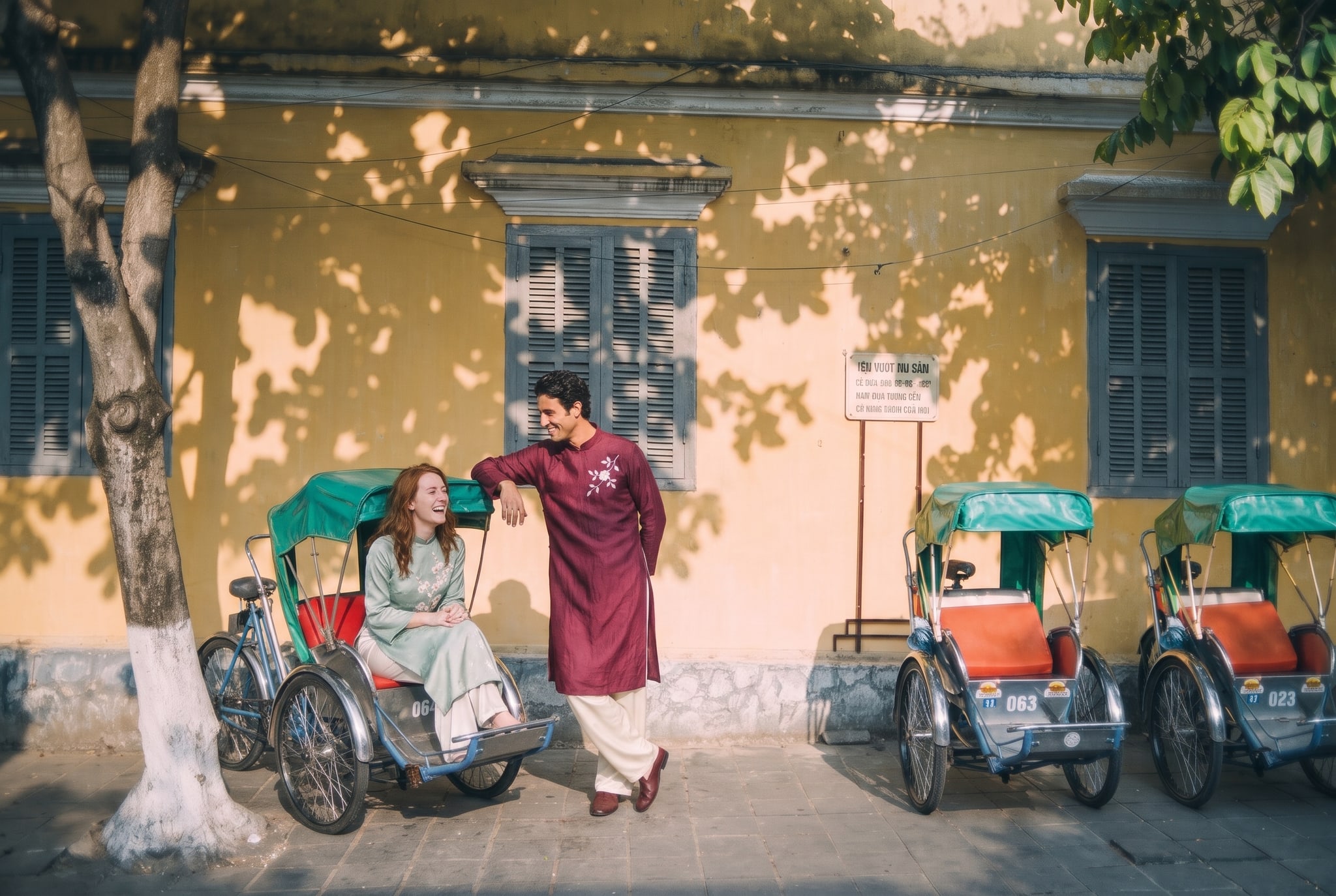
Why does timing matter more than you'd think at Train Street?
The street has three distinct windows: 5:30–7:30 a.m. (golden light, no crowds, trains quiet), 9 a.m.–1 p.m. (harsh overhead light, tourist foot traffic builds), and 3–5 p.m. (cool side light returns, but commuter trains and motorbike taxis flood the lane). We've shot at all three. Early morning delivers the clean, soft look people want in couple photoshoots—but requires your hotel breakfast at 5 a.m. Midday is worst: shadows cut faces in half, vendors block sightlines, and kids crowd the rails. Late afternoon works if clouds move through, but we can't rely on weather. We check the train schedule (publicly available at Hanoi Railway Station) the night before and tell you exactly when locomotives will pass near our frame. Our conclusion: 6:30–7:30 a.m. is the Cáo Studio default for Train Street; we book transport at 6 a.m. and arrive by 6:20 a.m.
| Transport Method | Best For | Time to Arrive | What to Check | Our Notes |
|---|---|---|---|---|
| Taxi (street hail) | Last-minute, no phone prep | 20–30 min but unpredictable | Driver English, meter working | Slow, hard to confirm address, we avoid |
| Grab/Be ride-app | Groups, fixed routes, pricing | 15–20 min with live tracking | App has your hotel pinned, driver rating ≥4.5 | Our go-to; driver can message |
| Hotel car service | Groups of 4+, luggage | 15–25 min, pre-booked | Hotel arranges day before, fixed time | Reliable but pricier; good if you're pre-wedding |
| Walking + motorbike taxi for gear | Budget conscious, short distance | 45+ min, very slow with reflectors | Lane crowded, no helmet law enforced, risky | We never do this; gear gets damaged |
| Cáo Studio pickup (Hanoi studio) | Full shoot package clients | 20 min from our Hanoi studio | Included in package, driver knows route | Simplest; we handle all logistics |
What gear logistics do we plan for on the morning of the shoot?
Our Hanoi studio is 8 km from Train Street. For a morning shoot, we either send our assistant by ride-app with reflectors and backup lens the evening before (stored at your hotel), or we carry it in two trips: one vehicle with the model and makeup artist, another with the photographer and main bag. We've learned that one person carrying a 15 kg camera bag plus a folding 5-kg reflector on a motorbike taxi ends badly—we dropped a diffuser panel last year. Now we use a roller bag (2.5 kg empty) that fits in any taxi and doesn't tip. We pack: main camera, backup body, three lenses, circular polarizer, ND filter, wireless trigger set, phone charger, water bottles, wet wipes for sweat touch-ups, a small parasol for model sun protection, and a sweat-absorbent powder for makeup. The makeup artist carries a separate pouch (foundation, blush, setting spray, bobby pins, tissues). Both bags fit in one taxi trunk. Our conclusion: we never split gear across more than two vehicles; more splits mean lost items and missed shots.
See packages and prices on vietnamphotoshoot.com
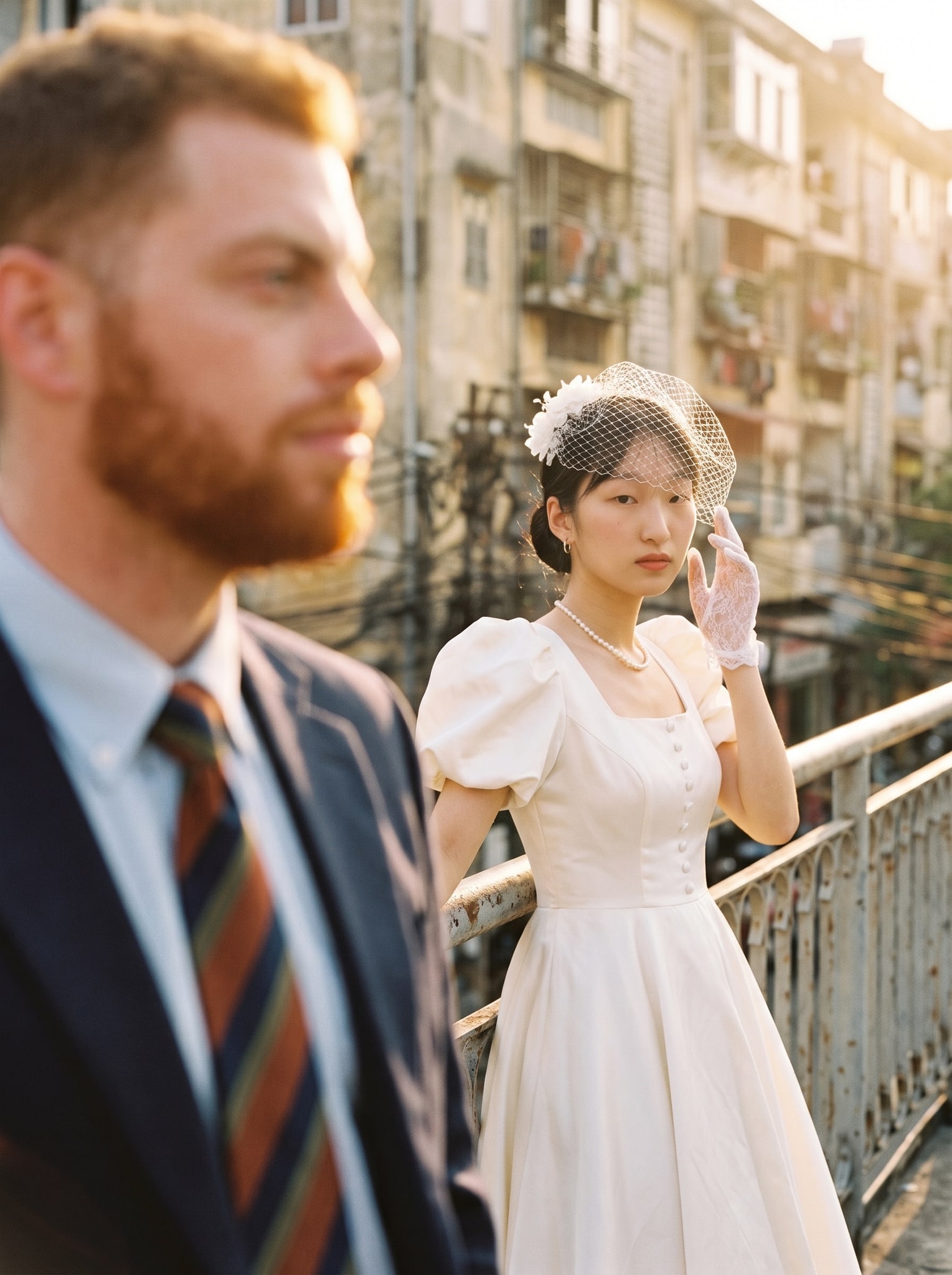
What happens if a train arrives while we're framing a shot?
It happens roughly once per hour, and it's not always a problem—sometimes a passing locomotive adds drama to the background. We scout the tracks the night before, check the station's posted schedule (or ask the station staff), and tell the model: "When you hear a whistle, pause for 15 seconds." Most trains run on a predictable rhythm; the 7 a.m. passenger express always passes between 7:02 and 7:08 a.m. If a freight train surprises us (they're not on the public schedule), we use it as a cue to reposition downtrack, away from the engine noise, and capture a different angle. We've learned that the sound comes before the sight—we listen for the horn and move 10 seconds early. Crowds gather to film trains; we position the model away from the spectator zone and use the crowd as a natural backdrop if they're far enough. Our conclusion: we plan shots between trains using the station schedule, not against it.
How do we handle permit, safety and local questions before we arrive?
Train Street sits on active railway property; Hanoi Railway Station has stated that photography is permitted from the street surface (not on the tracks) and that casual visitors are common. We brief every client 24 hours before: no stepping onto rails, no blocking the lane for more than 60 seconds, no loud music or drones. We've never had a security issue because we're respectful, quiet, and we look professional—the staff recognizes us. We carry our ID and a business card in case anyone asks questions; we've never been stopped. Local vendors and residents watch us, but they're used to photo groups. The main safety issue is motorbikes: they come fast and without warning around the tight corners. We position the model with her back to traffic, and the photographer stands between her and the lane, spotting oncoming bikes. We've had close calls—a delivery motorbike clipped our reflector once—so now we anchor all gear to the wall side, never the lane side. For proposal or anniversary sessions at Train Street, we add an extra spotter (third team member) who watches traffic and holds a small "Photo in Progress" sign (in Vietnamese). Our conclusion: safety beats the shot; if a bike comes, we pause and reset.
What to check before you book your Train Street shoot
- Transport app installed and working: Download Grab or Be to your phone, add your hotel address as a saved location, verify your payment method works. Test it the day you arrive in Hanoi.
- Wake-up time confirmed: If we're proposing 6:30 a.m. arrival, you need to leave the hotel at 5:50 a.m. Confirm with Cáo Studio on WhatsApp that this fits your energy level.
- Backup plan in mind: If it rains heavily on shoot day, Train Street becomes slippery and the light dies. We reschedule to a covered concept shoot or a nearby pagoda. Check our weather policy 48 hours before.
- Outfit and shoes tested: Train Street has uneven cobblestones and rail gaps. Wear shoes you can move in fast; stilettos or heavy dresses slow you down and increase risk. Walk the area the day before if possible.
- Communication channel open: We message on WhatsApp from the night before through the end of the shoot. Keep your phone charged and have the Cáo Studio number saved.
- Package scope clear: Pre-wedding packages, couple sessions, and special concept shoots may include Train Street as one location of several. Confirm how many hours and how many locations are in your session.
FAQ
Can we do a Train Street shoot in the afternoon instead of early morning?
Yes, but light quality drops between 11 a.m. and 3 p.m. (harsh shadows, blown-out sky). Late afternoon (4–5 p.m.) works if clouds soften the sun. We recommend morning, but afternoon sessions cost the same and can look good in overcast weather.
Do we need a permit to photograph at Train Street?
No formal permit is required for casual photography from the street. The railway station permits photography on the public lane. We brief you on safety (stay off tracks, watch for motorbikes) before we arrive. Large commercial crews (20+ people, drones) may need to coordinate with the station, but we don't.
How long does a Train Street shoot typically take?
90 minutes total: 20 minutes arrival and light scouting, 60 minutes active shooting with outfit changes, 10 minutes breakdown and transport back. It's one location in a pre-wedding package (which often includes 2–3 locations) or a standalone couple session.
What if it rains on our scheduled shoot day?
We reschedule to an indoor or covered location—usually a concept shoot at a nearby pagoda, colonial villa, or our studio. Heavy rain makes the cobblestones slippery and kills the light. Check our weather policy 48 hours before your session for final confirmation.
Can our hotel arrange a car to pick us up and bring us to Train Street?
Yes. Most 3-star and above hotels offer car service (often 20–30 USD/hour). Book the night before and ask for a pickup time 15 minutes before you leave. We can also arrange a ride-app or coordinate a pickup from our Hanoi studio if you prefer.
Pre-Wedding & Elopement
Inclusions, prices and booking are on our booking site.
FAQ
Can we do a Train Street shoot in the afternoon instead of early morning?
Yes, but light quality drops between 11 a.m. and 3 p.m. (harsh shadows, blown-out sky). Late afternoon (4–5 p.m.) works if clouds soften the sun. We recommend morning, but afternoon sessions cost the same and can look good in overcast weather.
Do we need a permit to photograph at Train Street?
No formal permit is required for casual photography from the street. The railway station permits photography on the public lane. We brief you on safety (stay off tracks, watch for motorbikes) before we arrive. Large commercial crews (20+ people, drones) may need to coordinate with the station, but we don't.
How long does a Train Street shoot typically take?
90 minutes total: 20 minutes arrival and light scouting, 60 minutes active shooting with outfit changes, 10 minutes breakdown and transport back. It's one location in a [pre-wedding package](/go/pre-wedding-photoshoot) (which often includes 2–3 locations) or a standalone [couple session](/go/couple-photoshoot).
What if it rains on our scheduled shoot day?
We reschedule to an indoor or covered location—usually a concept shoot at a nearby pagoda, colonial villa, or our studio. Heavy rain makes the cobblestones slippery and kills the light. Check our weather policy 48 hours before your session for final confirmation.
Can our hotel arrange a car to pick us up and bring us to Train Street?
Yes. Most 3-star and above hotels offer car service (often 20–30 USD/hour). Book the night before and ask for a pickup time 15 minutes before you leave. We can also arrange a ride-app or coordinate a pickup from our Hanoi studio if you prefer.
More from the team
Boho pre-wedding photoshoot in Vietnam: Hanoi, Saigon, Hoi An
Boho pre-wedding shoots mix romantic, free-spirited aesthetics with Vietnam's landscapes and heritage sites. We run full-day sessions in three cities, handling styling, makeup, location scouts and edits.
Avoid crowds at Hoang Su Phi rice terraces: timing for wedding shoots
Hoang Su Phi's terraced landscape draws couples and tour buses in equal measure. We show how to shoot there alone, when to arrive, and what to arrange with us before you go.
Photography rules at Con Dao beaches: permits, drones and what to check
Con Dao's beaches demand prep before you shoot—permits, drone zones and tide timing all affect your day. We share what the Cáo Studio team verifies on every booking.