 Cáo Studio
Home › Blog › Pre-Wedding & Elopement
Golden hour times in Vietnam by season
By the Cáo Studio team · Hanoi & Saigon · 2026-11-02
Golden hour in Vietnam runs from 40 to 90 minutes before sunset, depending on season and latitude. In winter (November–January), it peaks around 4:30–5:30 p.m. in Hanoi; in summer (May–August), it stretches to 6:30–7:30 p.m. or later. Saigon (Southern Vietnam) sees less seasonal shift than Hanoi because it sits closer to the equator. Hoi An and Ninh Binh, popular for pre-wedding shoots, each have distinct windows based on their geography. The best light arrives 30–60 minutes before sunset, when the sun sits 6° below the horizon—warm, directional, and free of harsh shadows. We plan couple photoshoots around these windows because the light quality often makes or breaks the final frame. Overcast days shift the window earlier; haze (common in spring) pushes it later. Always book a shoot that gives your photographer a full 90 minutes in golden hour, never just 30. Chat with us on WhatsApp
When does golden hour actually start in Hanoi across the year?
Hanoi's golden hour window swings widest of any city we shoot in. December and January see sunset around 4:45 p.m., so golden hour starts near 3:45 p.m.—tight for busy schedules. By June and July, sunset reaches 7:30 p.m., pushing golden hour to 6:15 p.m. or later. We've noticed guests often underestimate how late summer light lasts; we've finished full pre-wedding sessions at 7:45 p.m. in July with usable sky still above the horizon. Spring (March–April) sits in the middle, around 5:45–6:15 p.m., but atmospheric haze from agricultural burning can flatten color and shift the magic window 15–20 minutes. This is when we tell clients on WhatsApp to book an hour earlier than the calendar suggests. Winter offers shorter golden hour (often 40 minutes, not 90), so we tighten shot lists and move faster. The conclusion: in Hanoi, winter shoots demand early booking; summer offers flexibility but requires evening availability.
What's the golden hour timing in Saigon, and does it change much month to month?
Saigon sits 8° closer to the equator than Hanoi, so its sunset time barely moves. Year-round, sunset hovers between 5:50 p.m. (winter) and 6:50 p.m. (summer)—a 60-minute swing, not 150. Golden hour typically runs 5:00–6:00 p.m. in winter and 5:50–7:00 p.m. in summer. This consistency is why we recommend Saigon for guests who can't reschedule; the light behaves predictably. However, humid air and urban haze can scatter light unpredictably, especially between 4:30–5:00 p.m. We've shot couple shoots in District 1 and District 7, and we've learned to arrive 15 minutes earlier than we'd expect because the haze eats 10–15 minutes of usable time. Monsoon season (May–September) brings cloud cover that can diffuse golden hour entirely or extend it, depending on cloud height. The takeaway: Saigon's timing is reliable, but humidity and haze demand buffer time and flexible light management.
How much does location matter: Hoi An versus Ninh Binh golden hour?
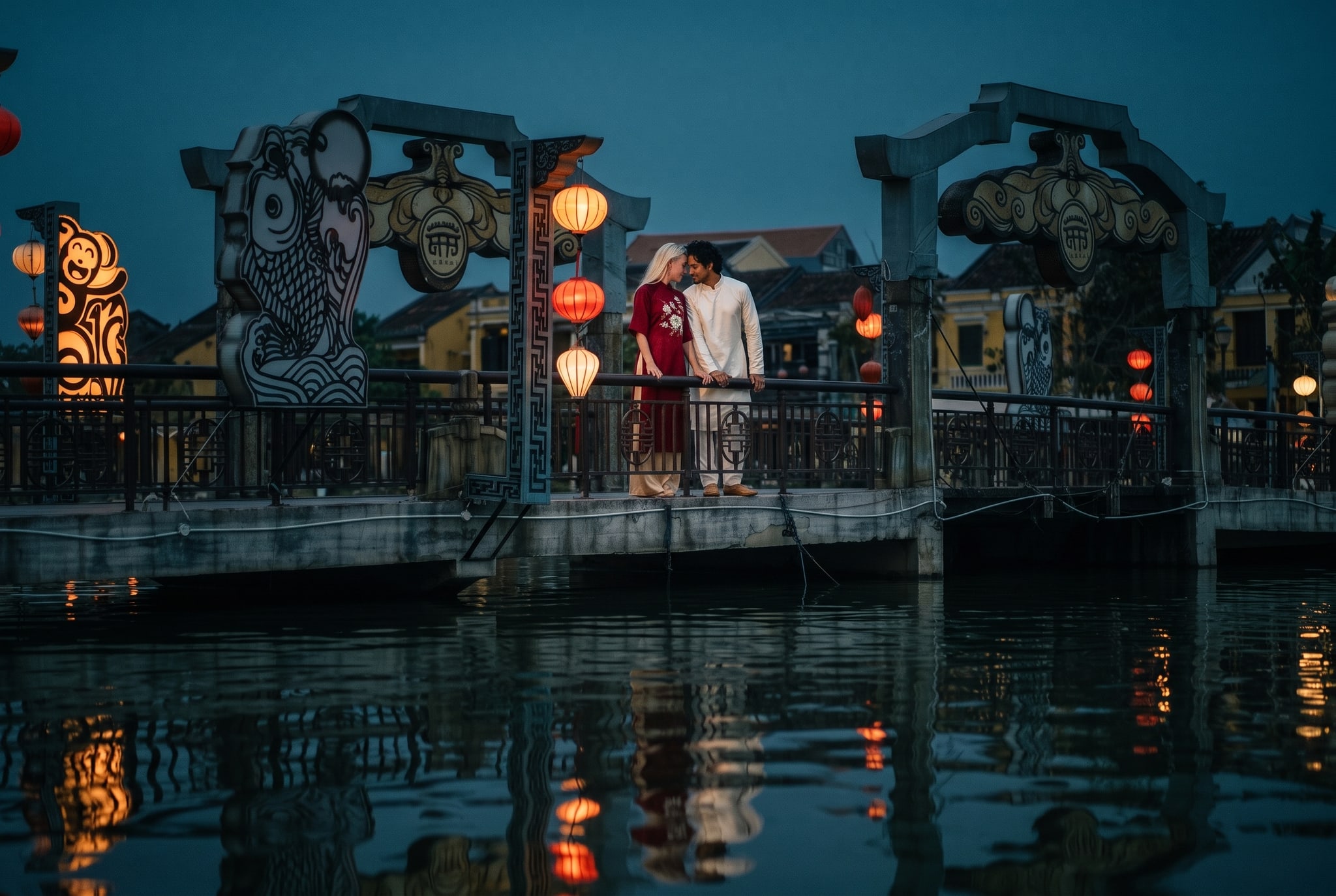
Hoi An and Ninh Binh are our most-booked shoot locations, and golden hour there behaves differently than the cities. Hoi An, on the coast near Da Nang, catches sea breezes that clear haze faster than inland sites; golden hour often feels sharper and earlier (by 10–15 minutes) than Saigon's timing. We've shot riverside here at 5:15 p.m. in March and caught light that wouldn't arrive in the city until 5:35 p.m. Ninh Binh, 90 km south of Hanoi, sits inland among limestone mountains that block direct sunlight earlier. Golden hour there can compress to 50 minutes because the sun dips behind peaks; we plan pre-wedding shoots to finish by 6:15 p.m. in winter, or we chase the light toward open valleys. Spring and autumn (September–November) are ideal in both places: consistent light, low haze, long windows. We've noticed that Hoi An suits soft-focus, romantic work (couples, proposals), while Ninh Binh's dramatic shadows favor bold editorial styles. Pick the location first; the golden hour window follows the geography.
What time should we actually schedule a pre-wedding shoot to catch peak golden hour?
We book every pre-wedding session with a 90-minute window minimum, and we tell clients to arrive 30 minutes before our calculated golden hour start. This buffer accounts for travel delays, makeup touch-ups, and location changes. If golden hour is 5:30–6:45 p.m., we say "arrive by 4:30 p.m., shoot 5:00–6:45 p.m." On the ground, we watch the light constantly. At 4:45 p.m., if shadow direction looks right, we shoot. If the sky is still too bright at 5:30 p.m., we move to shade or wait. In summer, we've delayed starts by 20 minutes because afternoon light was still too harsh. In winter, we've shot earlier than planned because golden light appeared at 4:15 p.m. instead of 4:45 p.m. Rain, cloud cover, and humidity shift everything; we stay flexible. Our makeup and hair team arrives early to work without time pressure—we've had sessions where a styling touch-up at 4:50 p.m. was worth the rush. The key decision: never squeeze golden hour into the last 45 minutes of your booking. Time it so the best light arrives mid-session, not at the end.
How do we plan around Vietnam's seasons when booking a shoot months ahead?
We use historical sunset data (from timeanddate.com) to calculate golden hour windows 4–6 months out, then adjust 2 weeks before the shoot based on weather forecasts. Here's our framework: for winter (November–January), book afternoon shoots or accept earlier sessions; for spring (February–April), add 15 minutes to standard golden hour time if haze is forecast; for summer (May–August), book after 5:30 p.m. and keep evening availability; for autumn (September–October), lock the booking early—it's prime season and our schedule fills fast.
| Season | Hanoi Golden Hour | Saigon Golden Hour | Hoi An Notes | Ninh Binh Notes |
|---|---|---|---|---|
| Nov–Jan | 3:45–4:45 p.m. | 5:00–5:50 p.m. | Cooler, sharp light | Sharp shadows, short window |
| Feb–Apr | 4:45–5:45 p.m. | 5:20–6:15 p.m. | Haze likely; add 10 min. | Haze + humidity; flexible timing |
| May–Aug | 6:15–7:15 p.m. | 5:50–7:00 p.m. | Cloud cover unpredictable | Extended window, monsoon risk |
| Sep–Oct | 5:15–6:15 p.m. | 5:25–6:20 p.m. | Peak clarity and bookings | Perfect light, book 6+ weeks ahead |
When we confirm a booking on WhatsApp, we send a season-specific note: "For your August shoot in Saigon, plan to start at 5:45 p.m. The light will peak around 6:30–7:00 p.m. Bring a light wrap—it can cool down after 7 p.m." Guests appreciate specifics over generic advice. We also flag weather risks: monsoon (May–Sept) can cancel or reshape a shoot, so we build rescheduling flexibility into contracts. For autumn bookings, demand is highest; we ask clients to confirm dates 8–10 weeks out, not 4.
See packages and prices on vietnamphotoshoot.com
What goes wrong when guests ignore golden hour timing, and how do we fix it?
We've had guests book noon shoots in July because they thought daylight lasted until 8 p.m. We've had winter shoots scheduled for 5:45 p.m. when golden hour had already peaked at 4:30 p.m. Here's what happens: harsh shadows, blown-out skies, flat color. We've salvaged shots by moving indoors, shooting in shade, or underexposing and recovering in post—but we always tell the truth: "We'll make it work, but peak light has passed."
To prevent this, we send a pre-shoot message with exact timing: "Golden hour today is 5:15–6:30 p.m. Arrive by 4:45 p.m. so we're ready to shoot the moment the light turns." We also include a photo of the sky taken at the exact same time the day before, so clients feel the difference. If a guest insists on a midday shoot (we've done a few for specific concepts), we charge appropriately and deliver artistic work—but we do not pretend the light is ideal.
For couple shoots and proposal sessions, timing is non-negotiable. We build in buffer time. For vacation and solo shoots, we're flexible because the client may have limited days in Vietnam. We work with what we have and communicate clearly.
FAQ
Does the golden hour start at the same time every day in Vietnam?
No. Sunset time shifts 2–3 minutes daily and can change 2–3 hours across seasons. Use timeanddate.com for your exact date and location, or message us and we'll calculate it for you.
Can we shoot golden hour in the morning instead of evening?
Yes—sunrise golden hour is shorter (30–50 minutes) but equally beautiful. We book fewer sunrise shoots because most guests prefer evening sessions. Message us if you're interested; we schedule sunrise shoots in Ninh Bihn and Hoi An regularly.
Will clouds ruin golden hour light?
Clouds can diffuse light beautifully or block it entirely. High, thin clouds often improve golden hour by softening harsh rays. Low, dense clouds flatten the scene. We watch the sky constantly and adjust composition if needed.
What if the weather forecast predicts rain on our shoot day?
We reschedule with 48 hours' notice if heavy rain is forecast. Light rain often clears before golden hour; we've shot successfully in drizzle because the clouds actually soften the light. We always offer an alternative date with no penalty.
Is it worth paying extra to guarantee a "prime golden hour" slot?
There is no premium fee for golden hour timing. Every pre-wedding and couple shoot is scheduled around it as standard. Off-peak slots (midday, early afternoon) cost the same because the light work is harder, not easier.
Can we do a full shoot in Vietnam across multiple seasons and locations?
Absolutely. Couples often book shoots in Hanoi in autumn, Ninh Binh in winter, and Hoi An in spring. Each has distinct golden hour behavior and aesthetic. Message us to plan a multi-location itinerary.
Pre-Wedding & Elopement
Inclusions, prices and booking are on our booking site.
FAQ
Does the golden hour start at the same time every day in Vietnam?
No. Sunset time shifts 2–3 minutes daily and can change 2–3 hours across seasons. Use timeanddate.com for your exact date and location, or message us and we'll calculate it for you.
Can we shoot golden hour in the morning instead of evening?
Yes—sunrise golden hour is shorter (30–50 minutes) but equally beautiful. We book fewer sunrise shoots because most guests prefer evening sessions. Message us if you're interested; we schedule sunrise shoots in Ninh Bihn and Hoi An regularly.
Will clouds ruin golden hour light?
Clouds can diffuse light beautifully or block it entirely. High, thin clouds often improve golden hour by softening harsh rays. Low, dense clouds flatten the scene. We watch the sky constantly and adjust composition if needed.
What if the weather forecast predicts rain on our shoot day?
We reschedule with 48 hours' notice if heavy rain is forecast. Light rain often clears before golden hour; we've shot successfully in drizzle because the clouds actually soften the light. We always offer an alternative date with no penalty.
Is it worth paying extra to guarantee a "prime golden hour" slot?
There is no premium fee for golden hour timing. Every [pre-wedding](/go/pre-wedding-photoshoot) and [couple shoot](/go/couple-photoshoot) is scheduled around it as standard. Off-peak slots (midday, early afternoon) cost the same because the light work is harder, not easier.
Can we do a full shoot in Vietnam across multiple seasons and locations?
Absolutely. Couples often book shoots in Hanoi in autumn, Ninh Binh in winter, and Hoi An in spring. Each has distinct golden hour behavior and aesthetic. Message us to plan a multi-location itinerary.
More from the team
Boho pre-wedding photoshoot in Vietnam: Hanoi, Saigon, Hoi An
Boho pre-wedding shoots mix romantic, free-spirited aesthetics with Vietnam's landscapes and heritage sites. We run full-day sessions in three cities, handling styling, makeup, location scouts and edits.
Avoid crowds at Hoang Su Phi rice terraces: timing for wedding shoots
Hoang Su Phi's terraced landscape draws couples and tour buses in equal measure. We show how to shoot there alone, when to arrive, and what to arrange with us before you go.
Photography rules at Con Dao beaches: permits, drones and what to check
Con Dao's beaches demand prep before you shoot—permits, drone zones and tide timing all affect your day. We share what the Cáo Studio team verifies on every booking.