 Cáo Studio
Home › Blog › Vacation & Solo Photoshoot
Hanoi Ceramic Mosaic Mural Photoshoot: What We Learned Behind the Camera
By the Cáo Studio team · Hanoi & Saigon · 2026-11-02
A ceramic mosaic mural photoshoot in Hanoi uses the city's hand-painted tile and glass-work walls as dynamic backdrops. These murals appear in the French Quarter (Tây Hồ), around Hồ Tây, in trendy Bà Đình cafés, and inside boutique hotels. Sessions typically run 2–4 hours depending on vacation photoshoot packages, include travel between 2–3 locations, and cost varies by shoot type—solo, couple, or family—and editing level. We recommend booking in cool morning hours (6–9 am) to avoid harsh shadows and crowds. Bring a light jacket; even summer shoots cool down mid-session. Avoid scheduling after 3 pm when murals face direct sun. Cáo Studio includes scout location guides on WhatsApp before your date. Chat with us on WhatsApp
Why Do Ceramic Murals Work So Well for Photos in Hanoi?
Ceramic tiles catch light differently than flat paint—they refract and reflect, adding depth that single-tone backgrounds lack. We've noticed murals with gloss finishes (common in restored colonial walls near Hoàn Kiếm Lake) create natural highlights on skin without harsh reflectors. Matte ceramic mosaics, often found in new café interiors around Trần Hưng Đạo, absorb flash and let clothing colors pop. The irregular grout lines break visual monotony; your eye naturally traces patterns without the subject feeling flat. Murals range from 3×2 meters to full wall-sized, so we can step back for full-body shots or zoom tight for detail portraits. This variety means one location yields 4–6 distinct composition options in under 30 minutes. The mosaic texture is also forgiving—small skin imperfections disappear against busy backgrounds, which speeds up retouching.
Where Are the Best Ceramic Mosaics for Photoshoots Around Hanoi?
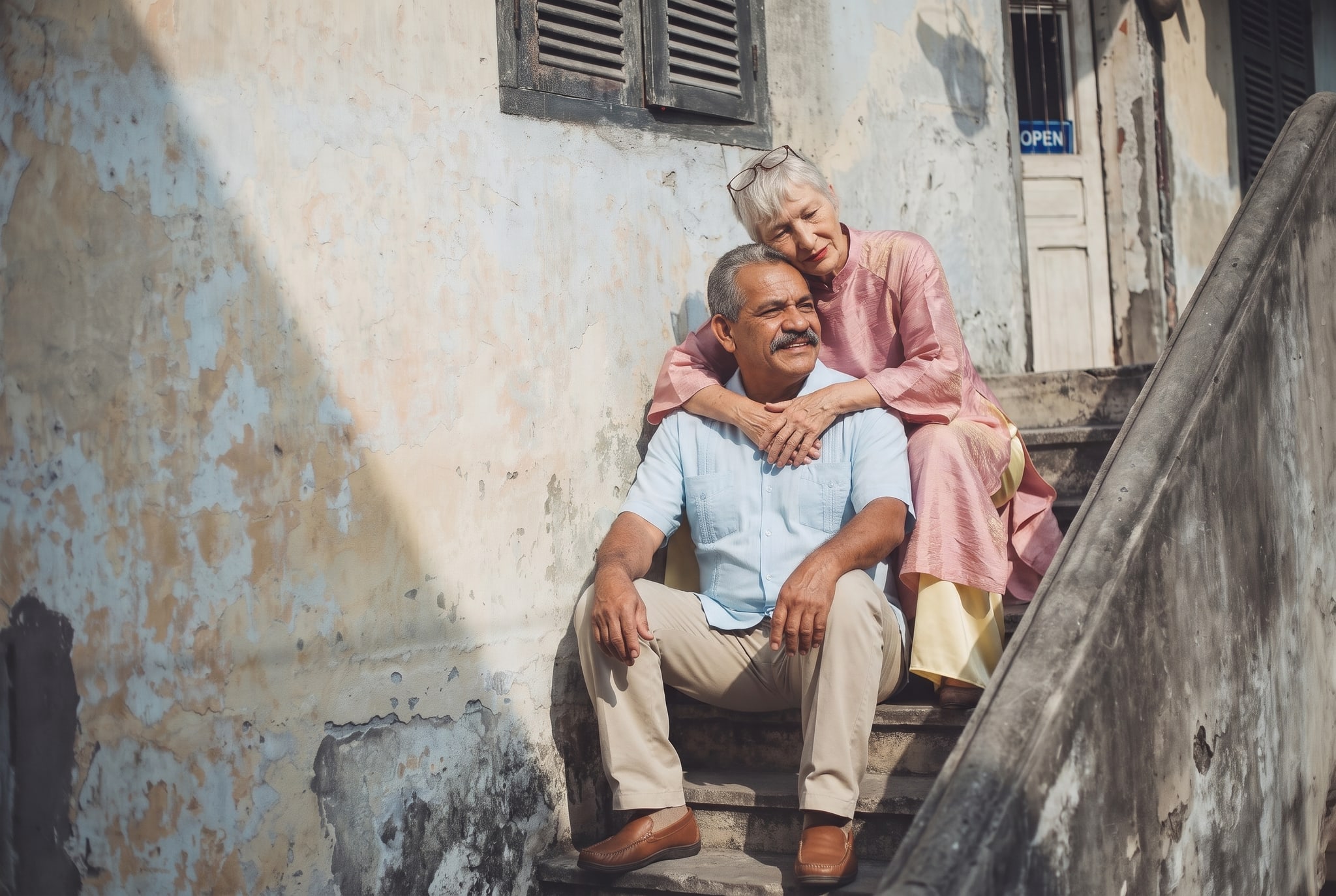
We've scouted and shot at three reliable zones. The French Quarter (Tây Hồ district, near Thanh Nên Street and Cửa Bắc) has inherited colonial-era tile work; many walls were restored 2019–2023 with authentic ceramic patterns. Murals here tend toward jewel tones (deep blues, terracottas) and geometric motifs. Hồ Tây cafés (especially the strip near Thảo Điền) feature contemporary ceramic art—abstract designs, hand-painted tile scenes, and gradient mosaics. These are newer, more Instagram-ready, but crowds peak 10 am–2 pm. Bà Đình's boutique hotels (near Hàng Cơm Street) display modern mosaic installations specifically designed for photos; owners often grant access if you've booked a session with us. We avoid tourist trap alleys where selfie crowds work murals to death by midday. Scout timing matters: the same mural photographed at 7 am versus 2 pm yields completely different light, shadow, and crowd conditions.
See packages and prices on vietnamphotoshoot.com
What Happens When Light Hits a Ceramic Mural at Different Times?
Early morning (6–8 am): soft golden sidelight, warm on skin, shadows are soft and directional—ideal for detail shots and close-ups. Gloss ceramic tiles reflect early sun gently; no harsh blown highlights. Our team brings minimal reflectors. By 9–10 am, light hardens; direct sun creates strong rim lighting on tile edges. This is excellent for silhouettes or moody contrast. Noon–2 pm: direct overhead light flattens ceramic texture; mosaics lose their dimensionality. We rarely shoot murals at this window unless the mural faces north. Late afternoon (3–5 pm) brings warm but competing shadows from nearby buildings. Matte ceramics hold color well, but gloss surfaces glare unpredictably. We test exposure on-site because ceramic reflectivity varies by tile age and glaze. Faded, older murals absorb light and need ISO bumps or wider apertures. Newly sealed tiles can overexpose in 1–2 zones; we use ND filters or shift subject position slightly. The takeaway: book your vacation photoshoot for sunrise or golden hour, not midday.
How Do We Pose Couples and Solo Subjects on Ceramic Backdrops?
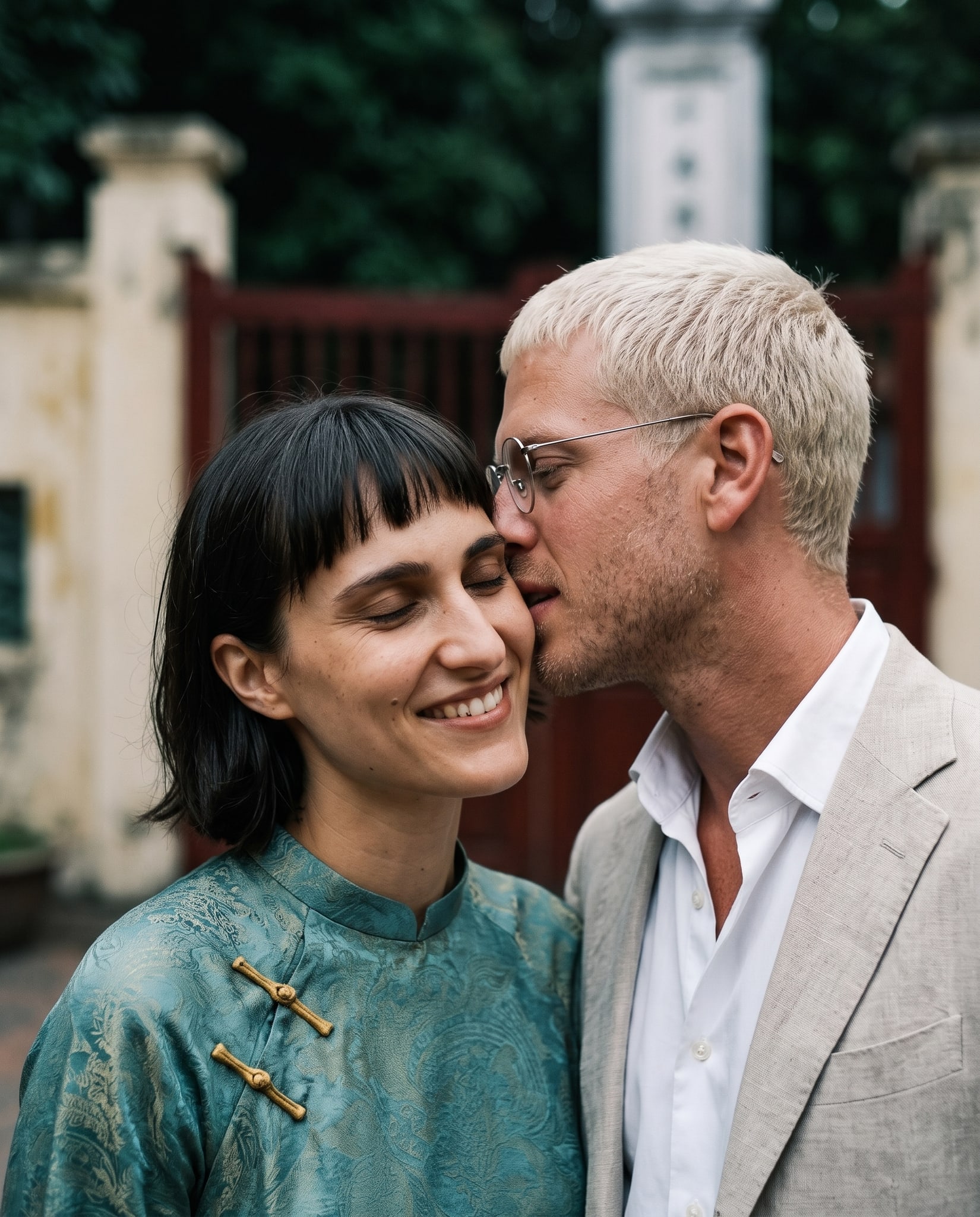
Busy mosaic patterns demand clear subject-background separation. We angle subjects 30–45 degrees to the mural wall rather than dead-on, so the subject's form reads clearly against tile lines. For couples, we position one person slightly forward and turned; this creates depth and prevents the mural from visually "flattening" the two into one silhouette. With solo subjects, we frame tight (waist-up) to let the mural's color dominate, or full-body with side-positioning so the mosaic pattern doesn't bisect the subject's torso. We never center subjects unless the mural is radially symmetric (rare in Hanoi). Hands matter on ceramic backdrops—mosaics draw the eye, so idle hands read as awkward. We ask subjects to touch the wall lightly, hold a light jacket draped over one forearm, or keep hands in pocket with thumbs out. We also watch fabric—solid, saturated colors (jewel tones, warm blacks, deep reds) separate from ceramic better than pastels or whites. After dozens of shoots, we've learned that couple photoshoots on ceramic murals benefit most from movement: walking, laughing, adjusting each other's clothing. Static poses feel stiff because the backdrop is so textured.
What Do You Need to Check Before Booking a Ceramic Mural Session?
| Aspect | What We Check | Why It Matters | Your Action |
|---|---|---|---|
| Mural Access | Owner permission, operating hours, foot traffic | Some cafés close 10–11 am; some forbid commercial shoots | Ask us to confirm location 3 days before; we handle permission |
| Lighting Direction | Wall orientation (north, south, east, west) | South-facing murals get harsh noon sun; north-facing stay soft | Tell us your preferred time; we recommend matching mural exposure |
| Ceramic Age/Condition | Gloss vs. matte, cracks, fading, algae on outdoor tiles | Faded murals need extra retouching; cracked tiles look broken in close-ups | We scout and exclude degraded murals unless you want "gritty" aesthetic |
| Weather & Crowds | Season (dry Oct–Mar vs. wet May–Sep), weekday vs. weekend | Rain cancels outdoor shoots; weekends mean 50+ tourists at popular murals | Book Tuesday–Thursday, 6–9 am, dry season for clearest light and crowd-free walls |
| Color Matching | Your outfit against mural palette | Clashing colors (bright yellow outfit on saturated blue mural) compete visually | Bring 2–3 outfit options; our stylists advise on set |
Booking early (2–3 weeks ahead) lets us lock in the best mural location and time slot. Last-minute bookings (under 1 week) may force substitution to backup murals if your first choice is unavailable or overbooked.
What Goes Wrong on Ceramic Mural Shoots—and How We Fix It?
Glare on glossy tiles. Solution: we shift the subject's position 1–2 steps, or angle them away from the direct reflection. We also use a circular polarizer on the lens to cut glare without darkening skin tone.
Crowds of tourists. Solution: we book early morning sessions (6–7 am) when murals are empty, or we change location within 10 minutes to a less-known mosaic wall we've pre-scouted. Our team keeps a rotating list of backup murals.
Color clash between outfit and mosaic. Solution: we ask subjects to bring 2–3 changes before the shoot; on-site, our stylists review the mural and advise immediately. We've learned to keep neutral scarves, jackets, and accessories on hand to neutralize conflicts.
Uneven exposure (bright tiles, dark subject). Solution: we bracket exposures and recover shadow detail in post-processing, or we use fill flash at low power to even out the light. Ceramic tiles bounce flash back harshly, so we bounce the flash off a reflector card instead of direct-on.
Mural condition issues. Example: a beloved mural we used in 2024 was partially repainted in 2025 with different ceramic tiles; the old and new sections now clash. Solution: we visited and adjusted our location list. We tour Hanoi every 3 months to catch restoration work and new murals. The honest truth: not every session goes smoothly. But early scouting, flexible timing, and backup locations mean we deliver results even when the first plan changes.
What to Check Before You Book
- Confirm your preferred mural location is accessible 2–3 weeks ahead. (New murals appear; old ones get renovated or removed.) We verify this on your behalf.
- Choose a time window aligned with Hanoi's light direction and your schedule. Early morning and golden hour are best; avoid 11 am–3 pm.
- Pick an outfit color that complements the mural's palette. Bring photos of the mural and your outfit to discuss with us on WhatsApp before the shoot.
- Plan for 1–2 backup locations in case crowds are heavy or light fails. We always have a secondary mural location ready.
- Allow 30 minutes buffer time. Travel, crowd wait, setup—ceramic mural shoots need flexibility.
Pages from our team you may need
FAQ
Can we shoot on multiple ceramic murals in one session?
Yes. Our vacation photoshoot and couple photoshoot packages typically cover 2–3 locations. Ceramic murals are spread across Hanoi, so travel time is 10–20 minutes between shoots. We plan a route to follow the sun; you'll move from a morning location (backlit, soft) to a midday location (side-lit) to a late-afternoon location (warm, golden).
What if it rains the morning of our ceramic mural shoot?
We reschedule to the next dry day within 10 days, free of charge. Rain on ceramic creates slick surfaces and weak, flat light. However, wet tiles photograph beautifully for moody, artistic shots if you want that aesthetic—tell us beforehand and we'll plan accordingly.
Do we need to wear specific colors to look good against ceramic mosaics?
No, but saturation and tone matter. Deep jewel tones (emerald, sapphire, burgundy), warm blacks, and earth tones (rust, ochre) separate cleanly from most murals. Pastel pinks and pale yellows blend into light-colored tile backgrounds. Our stylists advise on outfit matching during your WhatsApp consultation—bring photos of your outfit options.
How long does a ceramic mural photoshoot take?
Sessions range from 2–4 hours depending on your package. Vacation photoshoots typically run 2–3 hours covering 2 locations; couple photoshoots often run 3–4 hours to allow multiple mural sites and outfit changes. Extra time means more poses, expressions, and candid moments per location.
Are ceramic murals only for tourists, or do Hanoi locals book them?
Both. Many locals book murals for engagement photos, milestone portraits, and family sessions. Murals feel fresh and locally rooted—less generic than standard studio backdrops. Our team works with proposal and anniversary packages and family photoshoots on murals regularly.
Can you recommend a ceramic mural if we're not sure which location to choose?
Absolutely. Tell us your style (colorful, geometric, abstract, vintage), your time preference (early or late), and we'll suggest 2–3 murals and send photos. We then confirm access and light conditions before your shoot date. Chat with us on WhatsApp with your preferences.
Vacation & Solo Photoshoot
Inclusions, prices and booking are on our booking site.
FAQ
Can we shoot on multiple ceramic murals in one session?
Yes. Our [vacation photoshoot](/go/vacation-photoshoot) and [couple photoshoot](/go/couple-photoshoot) packages typically cover 2–3 locations. Ceramic murals are spread across Hanoi, so travel time is 10–20 minutes between shoots. We plan a route to follow the sun; you'll move from a morning location (backlit, soft) to a midday location (side-lit) to a late-afternoon location (warm, golden).
What if it rains the morning of our ceramic mural shoot?
We reschedule to the next dry day within 10 days, free of charge. Rain on ceramic creates slick surfaces and weak, flat light. However, wet tiles photograph beautifully for moody, artistic shots if you want that aesthetic—tell us beforehand and we'll plan accordingly.
Do we need to wear specific colors to look good against ceramic mosaics?
No, but saturation and tone matter. Deep jewel tones (emerald, sapphire, burgundy), warm blacks, and earth tones (rust, ochre) separate cleanly from most murals. Pastel pinks and pale yellows blend into light-colored tile backgrounds. Our stylists advise on outfit matching during your WhatsApp consultation—bring photos of your outfit options.
How long does a ceramic mural photoshoot take?
Sessions range from 2–4 hours depending on your package. [Vacation photoshoots](/go/vacation-photoshoot) typically run 2–3 hours covering 2 locations; [couple photoshoots](/go/couple-photoshoot) often run 3–4 hours to allow multiple mural sites and outfit changes. Extra time means more poses, expressions, and candid moments per location.
Are ceramic murals only for tourists, or do Hanoi locals book them?
Both. Many locals book murals for engagement photos, milestone portraits, and family sessions. Murals feel fresh and locally rooted—less generic than standard studio backdrops. Our team works with [proposal and anniversary packages](/go/proposal-and-anniversary) and [family photoshoots](/go/family-photoshoot) on murals regularly.
Can you recommend a ceramic mural if we're not sure which location to choose?
Absolutely. Tell us your style (colorful, geometric, abstract, vintage), your time preference (early or late), and we'll suggest 2–3 murals and send photos. We then confirm access and light conditions before your shoot date. [Chat with us on WhatsApp](https://wa.me/84338762340) with your preferences.
More from the team
Honeymoon Photoshoot in Hoi An: What Our Team Sees on Set
Hoi An draws newlyweds for its lantern-lit old town and riverbank light. We've shot hundreds of couples there—here's what actually happens during your session, hour by hour, and how to choose between what we offer.
Nhat Tan Peach Blossom Gardens Photoshoot: What We Book
Nhat Tan peach blossoms peak for just three weeks each January–February. We run morning sessions there to beat tourist crowds and capture soft light—here's how our studio plans them and what actually happens on the ground.
Truc Bach Lake Photoshoot: What to Book at Cáo Studio
Truc Bach Lake is one of Hanoi's most photographed water landmarks. We run sessions there 3–4 times weekly, and share how to get the best light, what to wear, and what actually happens during a shoot.