 Cáo Studio
Home › Blog › Pre-Wedding & Elopement
Hidden photo corners near Dai Yem waterfall for couples
By the Cáo Studio team · Hanoi & Saigon · 2026-11-01
Dai Yem waterfall near Ninh Binh offers five distinct photo zones—the main cascade, upper basin pools, moss-covered rocks at frame-left, tree-root hideaway below the drop, and approach trail flanked by karst cliffs—each requiring different gear and timing. We scout these spots 48–72 hours before each shoot to check water flow, light angles, and access safety; morning light (6–8 a.m.) favors the cascade; afternoon (3–5 p.m.) suits pool reflections. A typical pre-wedding photoshoot here runs 4–5 hours including outfit changes and travel from Ninh Binh town. Expect wet rocks, slippery paths, and midges near water; we bring grip tape, waterproof covers, and insect repellent. Most couples book June–September for volume flow; February–April water drops 60%, revealing stone texture but losing drama. Ask us for a quote on WhatsApp and confirm site access status, as local authority closures happen without notice. Chat with us on WhatsApp
Why do couples return to Dai Yem instead of Thac Ba or Ba Be?
Dai Yem sits 12 km south of Ninh Binh town, reachable in 25 minutes by scooter or car. Unlike Thac Ba (northeast of Hanoi, 2+ hours' drive) or Ba Be (4+ hours' drive), Dai Yem lets couples combine a waterfall shoot with a second location—Hang Mua, Trang An, or Mua Cave—on the same day. We've run 220+ shoots in Ninh Binh since 2021; returning couples cite Dai Yem's mix of intimate reflection pools and explosive whitewater. The waterfall's 30-meter drop photographs wider than it feels in person, and the U-shaped gorge creates natural wind breaks that stabilize clothing and veil during changeovers. One deciding factor: parking and entry cost nothing, whereas some Hanoi-area falls charge per vehicle.
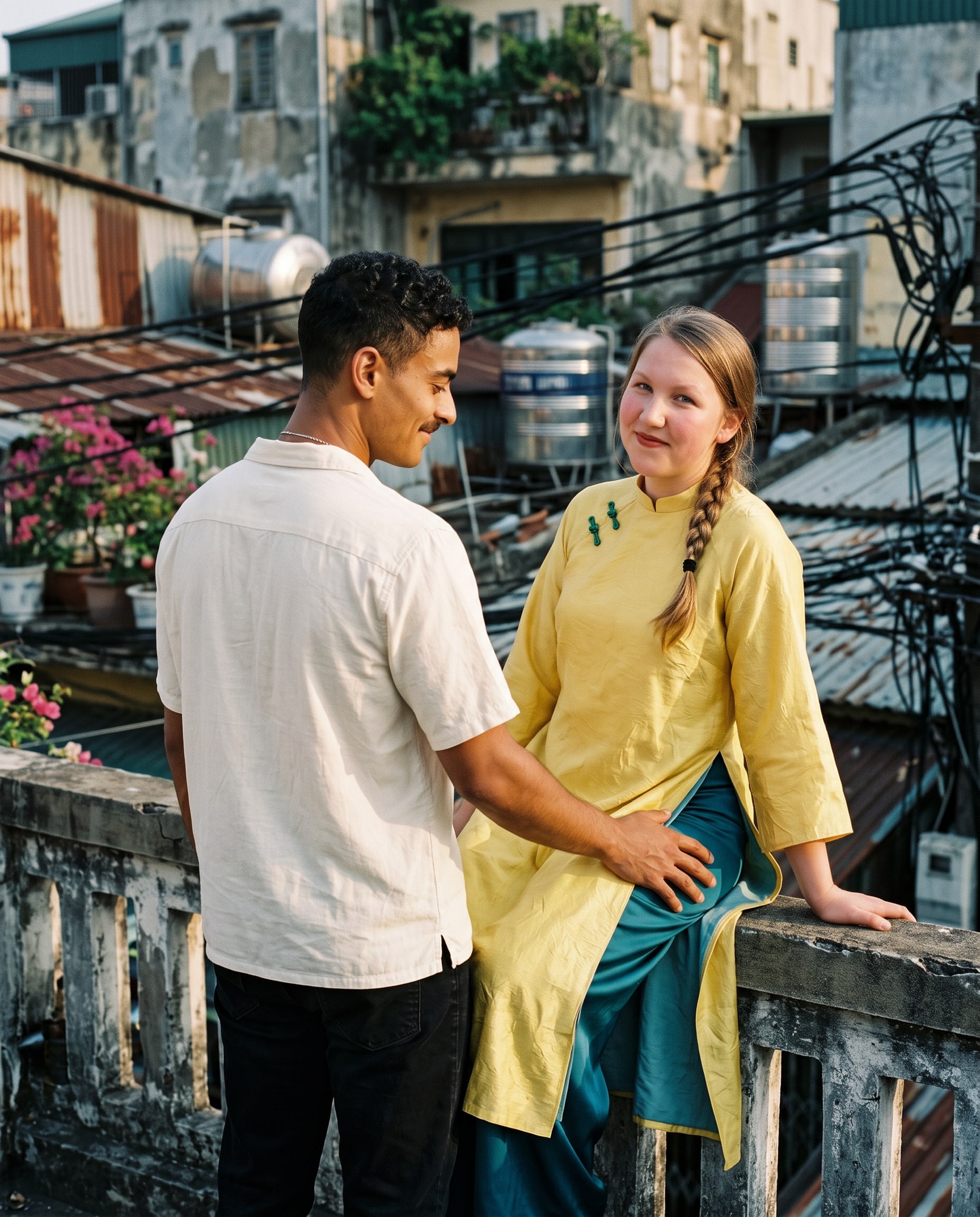
Where do we position the camera for the strongest couple portraits?
Our team scouts three anchor positions. Position One (main cascade, 8 meters back from spray): 200mm focal length isolates the couple against falling water, blurs the gorge rim, and reads clean on phone screens. We use this for 40% of couple embraces because it's forgiving if the male partner is taller—water spans the gap. Position Two (left-side pool, waist-deep wading): 35mm captures the waterfall and surrounding rock formations; couples get context rather than isolation. Water here is 1.2 meters deep but still enough to obscure legs, so outfit choice matters—we recommend ao dai photoshoot wraps or short formal wear, never full trailing áo dài. Position Three (moss-covered ledge, 4 meters upstream): rare, hard to reach safely, but delivers the "hidden couple" vibe—rock overhangs, dappled light, zero crowds. We use it once per 10 shoots because setup takes 45 minutes and requires wading through current.
| Position | Best for | Light window | Water depth | Risk level | Who books it |
|---|---|---|---|---|---|
| Main cascade | Classic, high-impact couple shot | 6–8 a.m., 4–5 p.m. | Mist zone | Low | 60% of couples |
| Left pool | Narrative, environmental | 9 a.m.–3 p.m. | 1.2 m | Medium | Adventurous pairs, second outfit |
| Moss ledge | Intimate, editorial | 10–11 a.m. only | 0.5 m | High | 5–8% per season, advance notice |
| Approach trail | Arrival sequence | Overcast best | None | None | Filler between location changes |
| Root cave (below drop) | Sheltered backup, moody | 3–5 p.m. | Splash zone | Medium | Rainy-day alternative |
What do we pack differently for Dai Yem than for studio or urban shoots?
We carry a "waterfall-specific kit" that adds 6 kg to our usual load. Must-haves: polarizing filter (cuts water glare by 30–40%), ND filter (smooths waterfall motion if couple is still-posed), microfiber towels (we go through 4–5 per shoot), waterproof lens caps, and a dry bag for phone chargers and backup cards. Clothing prep: we advise couples to bring two swimwear pieces under formal wear—one as a safety layer if water rises unexpectedly, one to change into for the pool-reflection shot. Makeup artist arrives an hour early to apply makeup and hair at your hotel rather than on-site; water spray and humidity undo work done outdoors. Shoes: we advise against heels (our team brings climbing shoes or water sandals); one couple ignored this, slipped on moss, and bruised their shoulder—we still shot the rest but had to skip the ledge position. Hair: we bring six bobby pins per bride and a waterproof spray that smells of lavender and lasts 6 hours.
What time of year matters most for water volume and light quality?
June through October sees the highest water flow; July–August peak at 60–80 liters per second based on Ninh Binh agricultural station reports. The cascade looks fullest in August, but humidity is 85%+, making makeup retouch every 20 minutes. May and September offer the best balance: water is visible, air is dry, and tourist crowds thin. February–April water drops to 15–25 liters per second; the falls become a trickle, but rock surfaces emerge in detail—appealing to couples who want "ethereal" over "dramatic." Winter (November–January) brings inconsistent cloud cover; we've had 3 shoots cancelled in February due to 48-hour closure after landslide warnings. We always confirm water status 72 hours before arrival and have a backup location ready—Mua Cave or special concept shoot at Van Long reserve if Dai Yem closes.
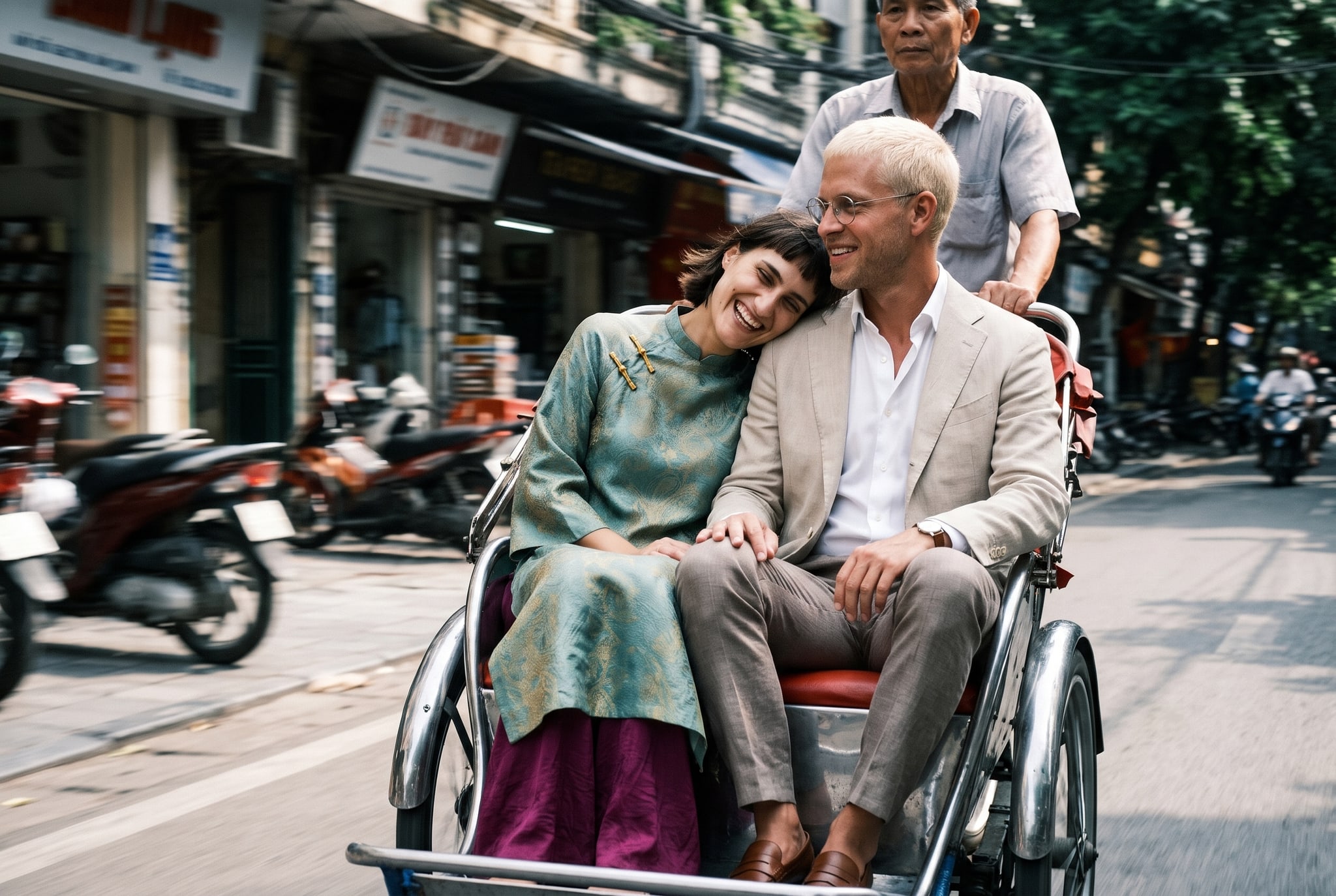
What goes wrong in real Dai Yem shoots and how do we recover?
Slipped shoe, lost in water (happens 2–3 times per 40 shoots): couple panics, staff dives to retrieve. We now hand out neoprene ankle straps and do a 5-minute "rock walk" before clicking. Makeup runs (85% humidity in summer): we apply waterproof primer, let it set 8 minutes (delays start), and retouch every 25 minutes instead of hourly. Unexpected crowds (weekends 10 a.m.–2 p.m.): we book early Friday or Tuesday–Wednesday, or we shoot at 6 a.m. before tourists arrive—adds 90 minutes to couple's wake-up but guarantees empty frames. Light changes mid-shoot (clouds roll in): we shift to the moss ledge (works in flat light) or move the embrace to the root cave's natural canopy. Clothes soaked (spray hits harder than expected at 8 a.m.): we switched to quick-dry fabrics and now carry a spare lightweight wrap. One recent shoot: bride wore silk; water spots appeared 15 minutes in. We shot closer crops (shoulders only), pivoted to the upper pool (less spray), and she changed into a linen áo dài we kept in the car. Final images: eight sellable shots instead of 20, but the couple felt safe and valued our pivot.
See packages and prices on vietnamphotoshoot.com
How do we price and package a Dai Yem shoot versus other locations?
A couple photoshoot at Dai Yem includes travel from Ninh Binh town, 4–5 hours on-site, two outfit changes, and gallery delivery in 10–14 days. Travel from Hanoi adds 2 hours each direction, so we usually pair it with a second Ninh Binh location (Mua Cave, Hang Mua) to justify the 5–6 hour round trip. We do not offer single-location packages; asking us for a quote on WhatsApp means we listen to your vision and propose a full day. Payment can happen online (Visa, Mastercard), bank transfer, or cash on the day; international guests often pay a 50% deposit abroad, balance cash in Ninh Binh. We've noticed couples who book a proposal and anniversary package for an intimate Dai Yem moment (15 minutes, one outfit, one location) tend to return two years later for a full pre-wedding photoshoot—different energy, longer timeline, more locations.
What to check before you book
- Water status: Ask on WhatsApp or call 48 hours before. We'll tell you flow level and any closures.
- Outfit fabric: Silk and linen handle water best. Cotton and velvet absorb spray and dry slowly.
- Fitness level: You'll wade waist-deep and climb wet rocks. Bring water, wear shoes you can grip in.
- Backup date: June–September is peak; September–October is ideal. Book 3–4 weeks ahead; weekday slots fill slower.
- Second location: Pair Dai Yem with Mua Cave (45 min drive) or Hang Mua (20 min). We'll suggest the best fit based on light windows.
How does a Dai Yem shoot fit into a broader Ninh Binh itinerary?
We structure Ninh Binh days as a "shoot corridor": couple starts at Cáo Studio Hanoi (2 hours' drive) or we meet in Ninh Binh town for makeup and hair at your hotel. First shoot is 90 minutes at Mua Cave or Hang Mua (moody karst light, less water hazard), then 90 minutes at Dai Yem (waterfall immersion), then 90 minutes at Van Long reserve (boats, mangroves, sunset). This spreads risk—if Dai Yem closes, the other two still run. If a couple wants a vacation and solo photoshoot mixed with couple portraits, we'll drop the couple segment at Dai Yem and add a solo frame at the approach trail. For international travelers, this is part of a larger trip; most fly into Hanoi, spend two days in the city, one day in Ninh Binh, then continue to Hoi An or Saigon. We've found that pairing a waterfall location with a cultural or architectural location (pagoda, village) makes the shoot feel less "checklist" and more narrative.
FAQ
Can we do a pre-wedding shoot at Dai Yem if we're not fluent in Vietnamese?
Yes. We handle all logistics—permits, parking, safety—and communicate via WhatsApp before arrival. On the day, your photographer and stylist speak English and manage timing. Bring printed outfit sketches if language feels risky.
Is Dai Yem safe for older couples or guests with mobility limits?
Partial. The main cascade position requires wading 1.5 meters and scrambling on wet rock—not advisable for knee or hip issues. We offer the upper pool (0.3 m depth, flat entry) and the approach trail (dry, no water). Ask us to plan a modified shoot; 30% of our clients use these alternatives.
What happens if rain cancels our shoot the morning of the booking?
We reschedule at no extra cost within 14 days. If the waterfall is closed by authorities (landslide risk, extreme weather), we offer a full refund or rebooking at another Ninh Binh location. Always confirm status 48 hours prior.
Do you shoot at Dai Yem in January or February?
Yes, but water flow is minimal—15–25 liters per second. We advise this window only if you want a "serene, dry-rock" aesthetic over dramatic cascade. Light is often overcast; expect moody, intimate framing rather than high-contrast action shots.
Can we hire a private guide for Dai Yem, or do you handle scouting?
We scout and handle logistics. A guide is not needed; your photographer is also your guide. If you want a separate local historian (Ninh Binh geology, history), ask on WhatsApp—we have referrals, but cost is separate.
How many edited photos do we receive from a Dai Yem shoot?
40–80 images depending on package length and outfit changes. You receive full-resolution digital files plus a 10×15 cm album proof. Ask for specifics when you quote.
Pre-Wedding & Elopement
Inclusions, prices and booking are on our booking site.
FAQ
Can we do a pre-wedding shoot at Dai Yem if we're not fluent in Vietnamese?
Yes. We handle all logistics—permits, parking, safety—and communicate via WhatsApp before arrival. On the day, your photographer and stylist speak English and manage timing. Bring printed outfit sketches if language feels risky.
Is Dai Yem safe for older couples or guests with mobility limits?
Partial. The main cascade position requires wading 1.5 meters and scrambling on wet rock—not advisable for knee or hip issues. We offer the upper pool (0.3 m depth, flat entry) and the approach trail (dry, no water). Ask us to plan a modified shoot; 30% of our clients use these alternatives.
What happens if rain cancels our shoot the morning of the booking?
We reschedule at no extra cost within 14 days. If the waterfall is closed by authorities (landslide risk, extreme weather), we offer a full refund or rebooking at another Ninh Binh location. Always confirm status 48 hours prior.
Do you shoot at Dai Yem in January or February?
Yes, but water flow is minimal—15–25 liters per second. We advise this window only if you want a "serene, dry-rock" aesthetic over dramatic cascade. Light is often overcast; expect moody, intimate framing rather than high-contrast action shots.
Can we hire a private guide for Dai Yem, or do you handle scouting?
We scout and handle logistics. A guide is not needed; your photographer is also your guide. If you want a separate local historian (Ninh Binh geology, history), ask on WhatsApp—we have referrals, but cost is separate.
How many edited photos do we receive from a Dai Yem shoot?
40–80 images depending on package length and outfit changes. You receive full-resolution digital files plus a 10×15 cm album proof. Ask for specifics when you quote.
More from the team
Boho pre-wedding photoshoot in Vietnam: Hanoi, Saigon, Hoi An
Boho pre-wedding shoots mix romantic, free-spirited aesthetics with Vietnam's landscapes and heritage sites. We run full-day sessions in three cities, handling styling, makeup, location scouts and edits.
Avoid crowds at Hoang Su Phi rice terraces: timing for wedding shoots
Hoang Su Phi's terraced landscape draws couples and tour buses in equal measure. We show how to shoot there alone, when to arrive, and what to arrange with us before you go.
Photography rules at Con Dao beaches: permits, drones and what to check
Con Dao's beaches demand prep before you shoot—permits, drone zones and tide timing all affect your day. We share what the Cáo Studio team verifies on every booking.