 Cáo Studio
Home › Blog › Pre-Wedding & Elopement
Hidden photo corners near Hoi An yellow wall streets for couples
By the Cáo Studio team · Hanoi & Saigon · 2026-11-01
Most couples arrive in Hoi An imagining the iconic yellow-walled French colonial streets—and those do work for one or two frames during dawn. But by 7 a.m. tour groups fill every shot. We've built our couple photoshoot package around five specific pockets where we can shoot for 30–45 minutes uninterrupted: narrow laneways between Trần Phú and Nguyễn Huệ where morning light hits ochre plaster at a 40° angle; the warehouse district south of Phạm Hồng Thái where weathered timber frames jade-coloured doorways; a restored merchant's garden off Bạch Đằng that locals don't photograph; and two tiled alleyways in the Japanese covered bridge quarter where we control foot traffic by timing. Each requires a 4 a.m. start and advance permission from landowners—something we handle. A couple session runs 3–4 hours including makeup, outfit changes, and travel between sites. Chat with us on WhatsApp
Why the yellow-wall streets alone won't hold a story?
We've shot hundreds of couples in Hoi An. The main French colonial streetscape—Trần Phú and Nguyễn Huệ—photographs the same way every time: flattened midday light, crowds, or blue-hour shadows that look similar in every Instagram feed. A single frame works as a souvenir. A narrative needs contrast. We move couples to adjacent lanes where the light behaves differently, the architecture reads as texture rather than landmark, and the story feels personal rather than "we were here."
That shift—from landmark tourism to intimate narrative—is what separates a pre-wedding photoshoot from a vacation snapshot. Our stylists choose outfits that play against weathered plaster, not shiny postcards.
What time do we actually arrive, and what's in the first hour?
We brief couples on WhatsApp: "4 a.m. pickup from your hotel." We arrive at the laneway entrance by 4:45 a.m. with a stylist, photographer, and lighting kit. First 15 minutes: we walk the lane alone, check for overnight changes (a vendor's new stand, wet concrete, a locked gate we'd opened yesterday). Then the stylist does touch-ups—the 45-minute drive in a van rattles makeup. Photographer does a meter read on the emerging light; we check the white balance against the actual plaster tone (yellows shift blue in pre-dawn). By 5:15, the couple is ready to walk, and we've got 90 unbroken minutes before the first motorbike courier runs through.
That's the math: we buy silence with an alarm clock, not luck.
How do we choose which alleyway for which couple?
We ask three things on the WhatsApp call before the shoot:
What kind of mood? Playful-and-close calls for the Japanese bridge quarter, where narrow tile passages make physical proximity the whole aesthetic. Romantic-and-reflective = the merchant garden, where there's a 60-year-old wall covered in faded hand-painted shop signs. Architectural-and-bold = the warehouse lanes, where we use industrial timber and shadow as much as the couple's presence.
How do you move together? Couples who walk slowly and look at each other, not the camera, suit long-sight-line alleys. Couples who're energetic and jump need corners where we can catch mid-motion against a solid background. We've learned not to force geometry on a couple's actual rhythm.
What's your timeline? We have five locations within a 2 km radius. A 3-hour session might hit two. A 4-hour session hits three. Each requires 15 minutes of moving and 20 of setup-and-shooting. We build the route based on light-path first (east-facing lanes at 5:30 a.m., north-facing at 6:45 a.m.), couple mood second.
One couple last October: they wanted quiet, reflective. We chose the merchant garden and one warehouse alley. Sun came up behind a low cloud bank, and the light stayed soft for 2.5 hours—a gift we couldn't have guaranteed. We shot for the full time and used all three angles: wide architectural shots, mid-range couple-in-place, and close detail work on her dress against the painted wall.
What goes wrong, and how do we fix it on the day?
The stylist's steamer doesn't heat up fast enough. We now arrive with two steamers, one prepped during the van ride. Backup is non-negotiable in Hoi An humidity.
A side lane is flooded. The night before, we walk the route. Rainy season (May–September), we have two alternate routes mapped for every core location. We text the couple at 10 p.m. if the plan shifts.
A vendor opens their shop earlier than expected. Last month, a pho stand we'd checked at 4:30 a.m. had a customer by 5:10 a.m., blocking our sightline. We spotted it, walked the couple 40 metres to a parallel alley we'd scouted, and never broke pace. Redundancy in location knowledge is how we stay flexible.
The couple is tired or emotional. A pre-wedding shoot carries weight—families, timelines, the magnitude of the decision. We've had couples freeze or cry. Our photographer steps back, the stylist finds water and a moment to sit, and we restart when the couple's ready. No rushing. That pause often becomes the best frame of the day.
Which Hoi An neighborhoods hold light the longest?
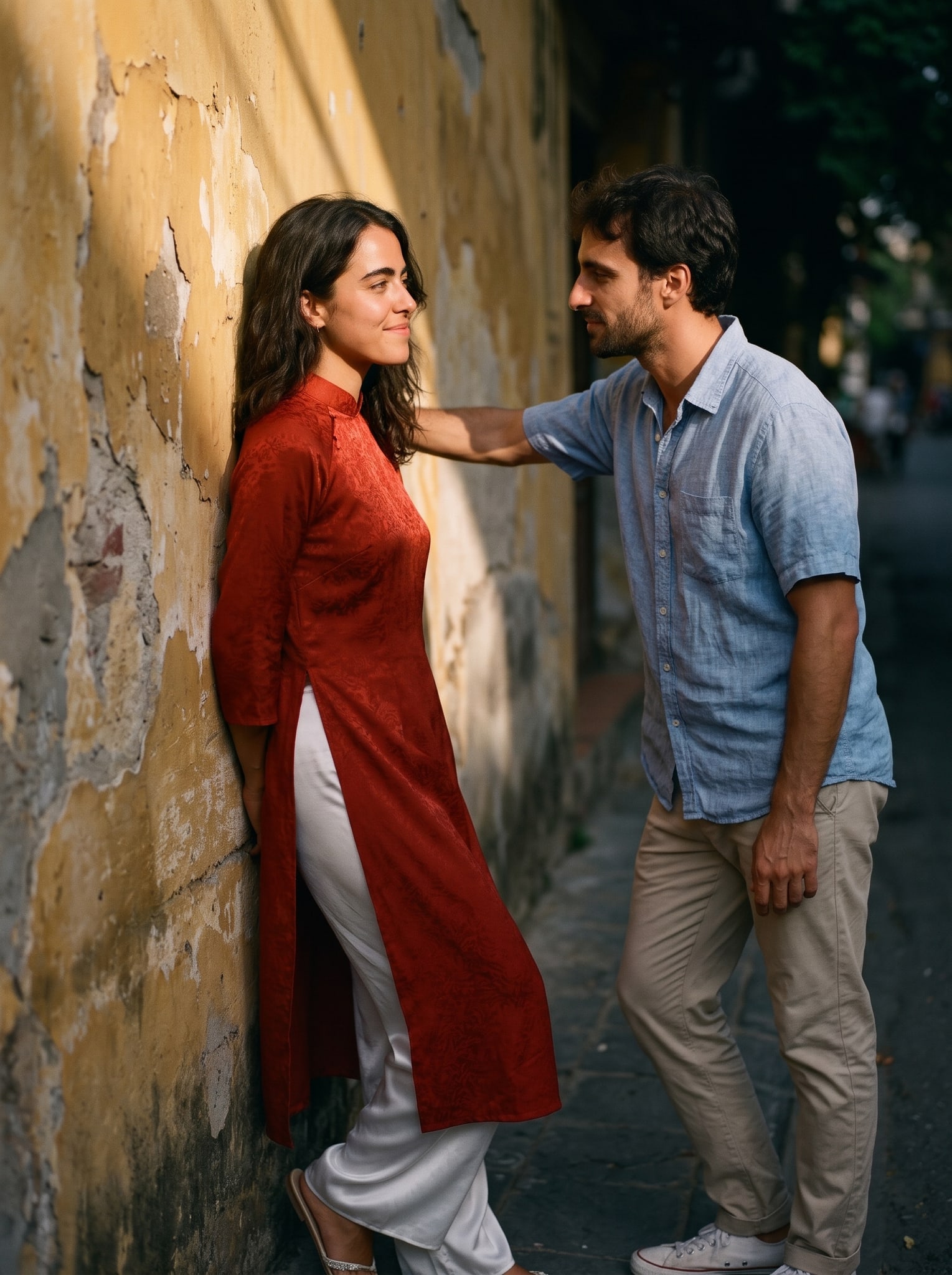
We've tracked the shadow patterns for three years. Here's what the light tells us:
| Neighborhood | Best time | Why | Couple type | Session length |
|---|---|---|---|---|
| Merchant garden (south of Bạch Đằng) | 5:30–7:00 a.m. | East wall catches first sun, plaster glows amber | Romantic, close-ups | 1.5–2 hrs |
| Warehouse district (Phạm Hồng Thái south) | 6:00–8:00 a.m. | North-facing timber gets side-light, texture reads | Architectural, movement | 2–2.5 hrs |
| Japanese bridge quarter (tiles north-east) | 5:45–7:15 a.m. | Narrow passage bounces light between walls | Playful, framing | 1.5–2 hrs |
| Trần Phú eastern edge | 6:45–8:00 a.m. | Golden hour on renovated colonial, fewer crowds | Traditional, statement | 1–1.5 hrs |
| Nguyễn Huệ side-street (pottery lane) | 6:00–7:30 a.m. | Warm terracotta tones, shaded by second-storey overhang | Warm, intimate | 1.5–2 hrs |
These times are based on our shoot log from January–April 2026 (dry season, clearest light). Times shift 30–45 minutes later May–September. We lock the time with you at booking.
Our team builds a route map tailored to your mood and timeline. Most couples book a 3-hour couple photoshoot or combine it with makeup and hair at your hotel to include prep time without time pressure on the morning of shooting.
See packages and prices on vietnamphotoshoot.com
How do we decide if you should shoot Hoi An or another location?
Hoi An works best if: you want intimate architectural framing, you're comfortable with a 4 a.m. start, you're not trying to capture both the yellow streets and rural rice paddies in one session. The light and geometry here are specific. You'll get frames no other Hoi An couple got, not because the place is secret, but because we've built a repeatable process for capturing it well.
Hoi An doesn't work if: you want a high-energy, sun-flare, golden-hour "running through a field" aesthetic—Ninh Binh rice fields serve that better. You want multiple iconic landmarks in one session—Hoi An is detail-focused, not a checklist tour.
Over two years, we've learned that couples who value mood and light over landmark collection leave Hoi An feeling like they own the place. That's the difference a hidden corner makes.
What to check before you book a couple session in Hoi An
- Confirm the 4 a.m. start time works with your hotel pickup and jet lag. Most hotels in Hoi An town centre can arrange early checkout from your room; confirm this directly, not through us.
- Ask us whether your outfit choices work for the specific alleyways. Bright white dresses and dark warehouse lanes need thoughtful framing. We'll text you a photo of the lane before booking so you see the backdrop. Long skirts catch water on wet tile; we need to know if you're wearing one.
- Check the season. Dry season (December–April) = predictable light, no flooding, no humidity haze. Wet season (May–September) = deeper colours, softer light, but flash floods possible in certain lanes. We still shoot in wet season; just manage expectations differently.
- Ask about outfit changes and the number of locations. Each location change costs 15 minutes travel time. A 3-hour session = two outfits, two locations. A 4-hour session = two or three outfits, three locations. Be clear on what you want.
- Request the advance location scout. We can send photos of the specific lanes and light conditions at the time you're booking. This lets you decide if the aesthetic matches your vision.
FAQ
Do we need a permit to shoot in these alleyways?
For commercial couple shoots, we obtain permission from landowners and local authorities. We handle this; you don't. Tourist couples can shoot freely, but for a couple photoshoot session, we secure access in advance so we can work without interruption.
What if it rains the morning of the shoot?
Hoi An rain is usually brief in early morning (30–45 minutes). We monitor weather the night before and confirm timing by 10 p.m. the previous day. If heavy rain locks in, we shift the session to the next viable morning or offer another location (warehouse interior, covered market). Rainy light can be gorgeous; we plan for it.
Can we shoot sunset instead of sunrise?
Sunset (5:30–6:45 p.m.) is crowded year-round in Hoi An's main streets. We can design a sunset session in the quieter warehouse lanes, but light is weaker and the window shorter. Sunrise gives us 90 minutes of stable, directional light. We recommend sunrise for the best outcome.
How many outfit changes can we fit in a 3-hour session?
Realistically, two outfit changes—one at the start, one mid-session. Each change takes 20–25 minutes (our stylist adjusts hair, makeup, accessories; you change). That leaves about 50 minutes of shooting per outfit. More changes mean less shooting time per look.
Are the yellow-wall streets in these hidden corners, or do we see the famous colonial architecture?
The hidden corners are colonial architecture—just the residential and merchant quarters, not the tourist postcard streets. You'll see yellow, cream, and terracotta plaster, weathered wooden shutters, and French tile work, but without crowds. It's the same era, different quiet perspective.
What should we wear to shoot in these alleys?
Flowing fabrics photograph well in narrow spaces because light wraps around them. Avoid very bright white or neon (reads as blown-out in shadows). Tones that complement terracotta and ochre—blush, sage, cream, dusty rose, charcoal—work with the actual colours of the lanes. Our stylist will advise on your outfit once you tell us which alley and time.
Pre-Wedding & Elopement
Inclusions, prices and booking are on our booking site.
FAQ
Do we need a permit to shoot in these alleyways?
For commercial couple shoots, we obtain permission from landowners and local authorities. We handle this; you don't. Tourist couples can shoot freely, but for a [couple photoshoot](/go/couple-photoshoot) session, we secure access in advance so we can work without interruption.
What if it rains the morning of the shoot?
Hoi An rain is usually brief in early morning (30–45 minutes). We monitor weather the night before and confirm timing by 10 p.m. the previous day. If heavy rain locks in, we shift the session to the next viable morning or offer another location (warehouse interior, covered market). Rainy light can be gorgeous; we plan for it.
Can we shoot sunset instead of sunrise?
Sunset (5:30–6:45 p.m.) is crowded year-round in Hoi An's main streets. We can design a sunset session in the quieter warehouse lanes, but light is weaker and the window shorter. Sunrise gives us 90 minutes of stable, directional light. We recommend sunrise for the best outcome.
How many outfit changes can we fit in a 3-hour session?
Realistically, two outfit changes—one at the start, one mid-session. Each change takes 20–25 minutes (our stylist adjusts hair, makeup, accessories; you change). That leaves about 50 minutes of shooting per outfit. More changes mean less shooting time per look.
Are the yellow-wall streets in these hidden corners, or do we see the famous colonial architecture?
The hidden corners *are* colonial architecture—just the residential and merchant quarters, not the tourist postcard streets. You'll see yellow, cream, and terracotta plaster, weathered wooden shutters, and French tile work, but without crowds. It's the same era, different quiet perspective.
What should we wear to shoot in these alleys?
Flowing fabrics photograph well in narrow spaces because light wraps around them. Avoid very bright white or neon (reads as blown-out in shadows). Tones that complement terracotta and ochre—blush, sage, cream, dusty rose, charcoal—work with the actual colours of the lanes. Our stylist will advise on your outfit once you tell us which alley and time.
More from the team
Boho pre-wedding photoshoot in Vietnam: Hanoi, Saigon, Hoi An
Boho pre-wedding shoots mix romantic, free-spirited aesthetics with Vietnam's landscapes and heritage sites. We run full-day sessions in three cities, handling styling, makeup, location scouts and edits.
Avoid crowds at Hoang Su Phi rice terraces: timing for wedding shoots
Hoang Su Phi's terraced landscape draws couples and tour buses in equal measure. We show how to shoot there alone, when to arrive, and what to arrange with us before you go.
Photography rules at Con Dao beaches: permits, drones and what to check
Con Dao's beaches demand prep before you shoot—permits, drone zones and tide timing all affect your day. We share what the Cáo Studio team verifies on every booking.