 Cáo Studio
Home › Blog › Pre-Wedding & Elopement
Hidden photo corners near Ta Van village for couples
By the Cáo Studio team · Hanoi & Saigon · 2026-11-02
Ta Van village itself (near Sapa, Lao Cai province) offers tight alleys between wooden houses, water channels reflecting sky, and the valley opening suddenly where paths drop toward terraces. Most couples arrive expecting wide landscape shots; we find the best frames in small, overlooked details—a doorway at 7 a.m., a stream crossing at 4 p.m., fences where morning mist clings. We book pre-wedding and elopement sessions here year-round; couples spend 3–4 hours on foot. In wet months (May–Sept), mud ruins shoes fast and light turns flat; Oct–March brings clearer skies and sharper shadows. Neither season is "best"—each demands different pacing and lens choices. Cost basis: ask us for a quote on WhatsApp for a full day in Ta Van, including stylist support and travel from Sapa town. --- Chat with us on WhatsApp
What time of day matters most at Ta Van?
We shoot Ta Van in two windows: 6–8 a.m. (mist in valleys, soft light on stone walls) and 3:30–5:30 p.m. (gold catching the western ridge, long shadows across alleys). Midday is flat and harsh; couples regret pushing us to shoot 11 a.m.–2 p.m. We always warn on the morning WhatsApp: "We leave your hotel at 5:15, expect cold, bring water." Early wake-ups pay off. We've never had a couple regret the 5 a.m. pickup; most regret the sessions booked at noon.
The mist burns off by 8:30 a.m., so all drama happens in that narrow window. Clouds roll in after 5:45 p.m. in winter. Our team moves fast—we photograph one corner intensely (20 min), walk 10 min to the next, shoot again (20 min), and rest (10 min). By 1 p.m., we eat lunch at a homestay and regroup. Light is gone until 3:30 p.m.
What to check before booking: Ask us whether your date is in monsoon season (May–Sept) and whether the forecast shows heavy rain (shoots happen, but paths become slippery and clothes mud fast). Bring shoes you don't mind losing; offer them to a local kid after if you're wearing something rare.
Which corners do our stylists choose most?
We scout Ta Van in blocks: Upper Alleys (homestay cluster, narrow wooden gates, morning light), Water Channel (irrigation stream crossing, rocks, reflections), Terrace Edge (where village drops to fields, golden hour, long sightlines), Stone Stairs (steep descent, dappled shade, emotional tone), and the Viewpoint Path (wider, less crowded, best for movement shots). Our stylist typically picks one or two and lives in them for 30 minutes rather than racing through five. Couples feel less rushed, and light doesn't scatter.
The Upper Alleys win in early morning (6:30–7:30 a.m.) because east-facing walls catch first sun and homestay owners haven't emerged. The Water Channel is underrated—mist hangs longer there, and reflections on wet rocks carry emotion most couples miss in phone snapshots. The Terrace Edge works 4–5 p.m. if sky stays clear; clouds kill it fast.
Our photographer notices: couples who've never walked mountain paths move slower and tire earlier. We pace accordingly. Local kids appear in upper alleys by 8 a.m.; we decide in real-time whether to include them or move. No rule applies to every shoot.
What clothing works in these tight spaces?
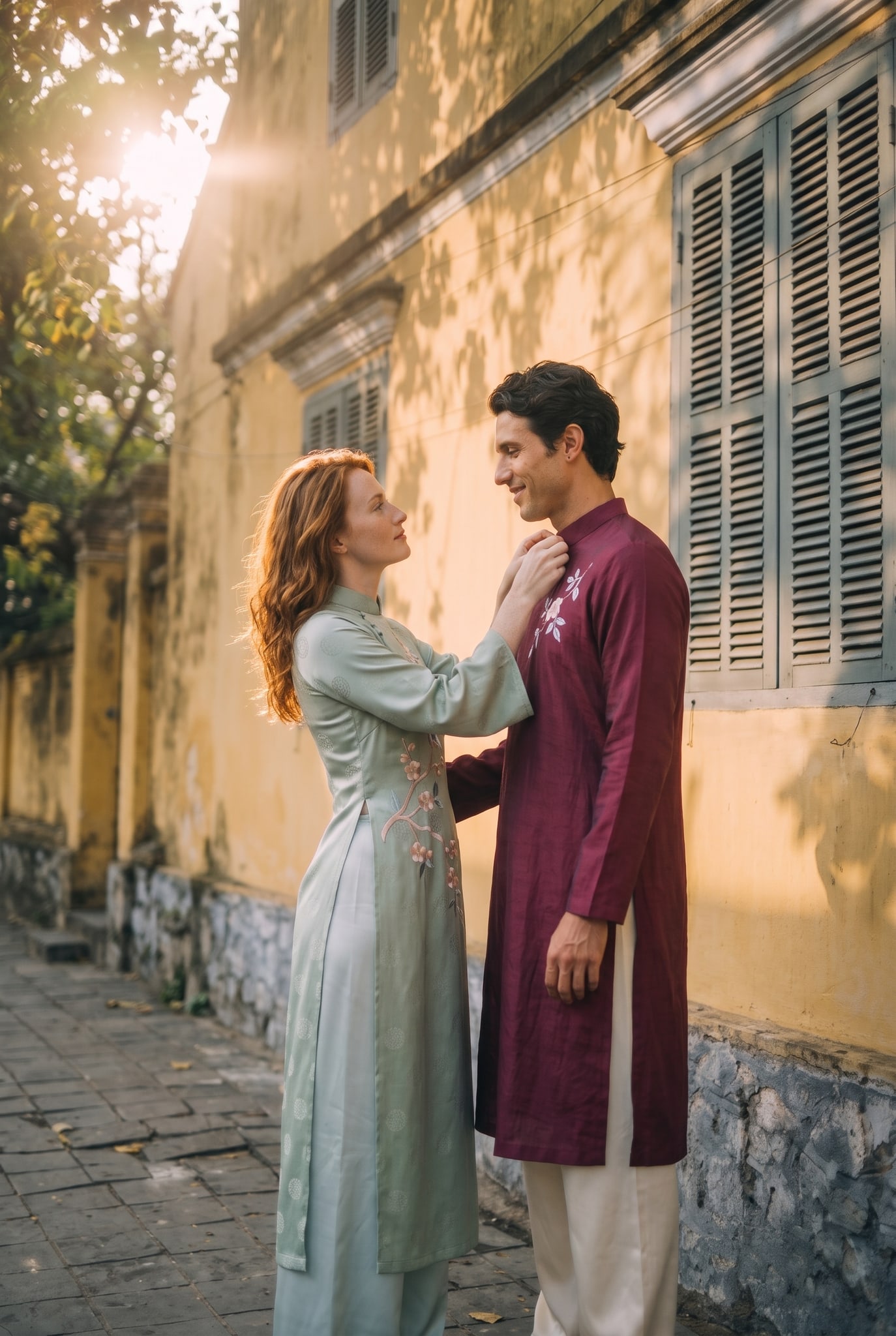
Áo dài flows beautifully in Ta Van because stone walls are dark and the fabric catches light. We book ao dai photoshoot sessions here often, and long skirts drape across stairs and water without tangling—tailors in Sapa make custom áo dài fast if your couple wants one for the day. Modern dress (dress, shirt, jeans) works fine; heels don't. Couples in sandals slip. Waterproof jackets for monsoon look clunky; we ask guests to wear them to the spot, leave them with a local guide, and photograph in the layers underneath.
Color matters: jewel tones (emerald, sapphire, burgundy) read against gray stone and green terraces. Pastels fade into mist. We've asked couples wearing beige to add a scarf in a contrasting tone—it saved the shots. Matching outfits (both in white, both in black) work. Mismatched couple looks fail on steep paths where you're separated by 10 feet for half the shoot.
We always ask on WhatsApp: "What colors are you wearing?" and, if they're wrong, we pause and offer an honest take: "That shade will vanish in morning mist. Can we reschedule 30 minutes later when sun is higher?" Good couples say yes.
How do we navigate the rain-versus-clarity trade-off?
October through March brings clearer skies, but it's cold (8–12°C at 8 a.m.), paths frost, and mist lingers later. Couples like the mood; we like the light. May through September is warm and green, but rain comes most afternoons (2–4 p.m.), clouds hang low, and we shoot under gray light that feels sad unless we lean into it. We don't skip monsoon; we change our shot list.
In dry season (Oct–March), we shoot wide landscape, detail (hands on a wall, feet on stone), and movement (walking through alleys). In wet season (May–Sept), we focus on close-ups (faces, couple embrace under an eave), reflections in puddles, and the emotional weight of mist. Both seasons deliver different but real images.
On a rainy day two years ago, we shot a couple under a homestay roof overhang, rain on the alley behind them, their faces lit by an open doorway. It's one of our most-shown frames. Rain isn't failure; it's a decision. We ask: "Do you want to postpone or embrace the weather?" Most choose embrace.
How do we handle physical strain and keep couples happy?
Ta Van is 3–4 hours on foot across uneven terrain. We scout a 90-minute route, but couples walk it at different speeds. We learn fast: does your couple hike regularly? Are they wearing new shoes? Have they eaten breakfast? On WhatsApp before the day, we send: "Eat a full breakfast. Bring water. Shoes should be worn-in. This is a hike disguised as a photoshoot." It stops regrets.
Our team moves with one photographer, one stylist/guide, and one makeup artist (if booked). The makeup artist carries water and a small mirror; the stylist offers a hand on steep bits and knows where to rest. We stop every 45 minutes for 10 minutes. By 1 p.m., we're done and eat at a homestay. Couples who expected to be photographed continuously often apologize: "We thought we'd be standing all day." We laugh and say, "Standing all day gives bad images and angry couples. This is better."
The Terrace Edge is the hardest part—a 10-minute descent with loose stone. We hold hands and move slow. No rushed couple has slipped; rushed couples have twisted ankles. Pace is safety.
See packages and prices on vietnamphotoshoot.com
Comparison: Ta Van vs. Other Sapa Locations
| Location | Best For | Pacing | Physical Demand | Light Quality | When to Book |
|---|---|---|---|---|---|
| Ta Van Upper Alleys | Close-ups, intimate mood, áo dài | Slow, 30 min per corner | Moderate (flat, narrow) | Gold early morning | Oct–March for clarity; May–Sept for mood |
| Ta Van Terraces | Wide landscape, couple silhouettes, movement | Medium (walking, some descents) | High (steep, loose stone) | Golden hour (4–5 p.m.) | Oct–March (dry paths) |
| Sapa Town Center | Quick couple shots, urban backdrop | Fast, multiple spots per hour | Low (paved, busy) | Depends on cloud cover | Any season, same-day booking possible |
| Fansipan Base (cable car area) | Epic scale, high-altitude feel | Medium (5–10 min walks, rest frequent) | Moderate (elevation, wind) | Clearer at altitude | Oct–March (lower mist) |
Our pre-wedding photoshoot teams choose Ta Van when couples want depth and mood over scope. Sapa Town works when time is short (2 hours). Fansipan works if couples want "we climbed a mountain" in the frame. Ask us which fits your date, time, and energy.
What to Check Before You Book a Ta Van Session
Season and forecast: Ask us the current weather pattern for your date. If monsoon and forecast shows rain, decide now whether you want to reschedule or embrace it. No guessing on the morning.
Fitness level: Be honest. If you've never hiked, tell us. We adjust pacing, route difficulty, and shoot duration. "Weekend hiking" is different from "never walked uphill for an hour." Both are fine; we need to know.
Clothing and shoes: Confirm outfit colors with us on WhatsApp at least one week ahead. Bring worn-in shoes (not new, not fancy, not heels). Waterproof jackets if monsoon season. We'll advise.
Transport and timing: Confirm pickup time, location, and how many people are coming. If you're bringing family or extra friends, tell us; it changes how we move and what we can do. Ta Van is intimate for a couple or small group, crowded and awkward with 10 people.
Budget and duration: Ask us for a quote on WhatsApp for a full Ta Van day. It's longer than a city shoot and requires a guide and possibly a local helper. Pricing reflects that. Know the cost before you arrive.
Backup plan: Ask us: "If it rains heavily, do we postpone or reschedule to nearby Sapa town?" Agree now so there's no friction on the day.
Why Couples Pick Ta Van Over Other Mountain Shoots
We run couple sessions across Sapa, Ninh Binh, and Hanoi. Ta Van isn't the biggest or most famous. It wins because it's small enough to be intimate, old enough to have character, and hard enough to walk that couples feel they did something together. The shots look earned.
Most couples arrive expecting Instagram-famous views (cliff-edge, wide sky, themselves tiny in landscape). Ta Van gives them something better: walls that hold their faces, light that finds them in alleys, a place where being together matters more than being visible. The village doesn't care if they're there; that humility translates to real emotion in images. We've shot Ta Van 40+ times across seasons, and the couples who book with us again often say: "That shoot changed how we see those photos. We weren't posing for the camera. We were just there."
Pages from our team you may need
FAQ
What time should we arrive at our hotel in Sapa before a Ta Van shoot?
Arrive the day before if possible. The morning pickup is 5:15 a.m.; if you're jetlagged or tired, you'll resent it. One night in Sapa means you sleep, eat breakfast, and show up rested. We've seen couples fly in on shoot day and regret the energy loss.
Can we bring a family member or friend to watch?
Yes, but it changes the shoot. Couples feel watched and pose more. If a friend comes, ask them to stay 10 meters back or wait at the homestay during 1–3 p.m. lunch. Their presence shifts the mood; be intentional about it.
What's the weather risk in monsoon season (May–September)?
Rain is likely 2–4 p.m., paths get muddy, light stays gray, and clothes soil fast. We shoot, but the look is different—moodier, tighter, reflections-heavy. Dry season (Oct–March) is safer for classic couple shots. Ask us to compare images from both seasons on WhatsApp.
Can we do áo dài photos in Ta Van?
Yes, and they look stunning on stone and in alleys. We book ao dai photoshoot sessions here regularly. Áo dài flows across stairs without tangling, catches light beautifully, and feels respectful in a local village. Confirm with us if you want custom áo dài; Sapa tailors can make one in 5–7 days.
How much should we budget for a full Ta Van day?
Ask us for a quote on WhatsApp—cost includes photographer, stylist guide, transport from Sapa town, and use of a homestay for lunch/rest. Makeup and hair service is separate; we offer hotel makeup and hair in Sapa the morning before if you want to arrive camera-ready.
Will my feet hurt after Ta Van?
Almost certainly yes if you don't hike regularly. Worn-in shoes help. We rest every 45 minutes. Bring blister supplies, and don't schedule a long walk the next day. One couple hiked to Fansipan the day after Ta Van and regretted both days. Space them out.
What if we hate being in alleys and want wide-open landscape instead?
Ta Van isn't for you—it's intimate and tight. Sapa Fansipan base or Muong Hoa Valley offer wider views and less climbing. Or ask us about pre-wedding sessions in Ninh Binh (Mua cave, Hang Mua) or Hanoi (French Quarter, Tay Ho). Each spot suits different couples.
Pre-Wedding & Elopement
Inclusions, prices and booking are on our booking site.
FAQ
What time should we arrive at our hotel in Sapa before a Ta Van shoot?
Arrive the day before if possible. The morning pickup is 5:15 a.m.; if you're jetlagged or tired, you'll resent it. One night in Sapa means you sleep, eat breakfast, and show up rested. We've seen couples fly in on shoot day and regret the energy loss.
Can we bring a family member or friend to watch?
Yes, but it changes the shoot. Couples feel watched and pose more. If a friend comes, ask them to stay 10 meters back or wait at the homestay during 1–3 p.m. lunch. Their presence shifts the mood; be intentional about it.
What's the weather risk in monsoon season (May–September)?
Rain is likely 2–4 p.m., paths get muddy, light stays gray, and clothes soil fast. We shoot, but the look is different—moodier, tighter, reflections-heavy. Dry season (Oct–March) is safer for classic couple shots. Ask us to compare images from both seasons on WhatsApp.
Can we do áo dài photos in Ta Van?
Yes, and they look stunning on stone and in alleys. We book [ao dai photoshoot sessions](/go/ao-dai-photoshoot) here regularly. Áo dài flows across stairs without tangling, catches light beautifully, and feels respectful in a local village. Confirm with us if you want custom áo dài; Sapa tailors can make one in 5–7 days.
How much should we budget for a full Ta Van day?
Ask us for a quote on WhatsApp—cost includes photographer, stylist guide, transport from Sapa town, and use of a homestay for lunch/rest. Makeup and hair service is separate; we offer [hotel makeup and hair](/go/makeup-and-hair) in Sapa the morning before if you want to arrive camera-ready.
Will my feet hurt after Ta Van?
Almost certainly yes if you don't hike regularly. Worn-in shoes help. We rest every 45 minutes. Bring blister supplies, and don't schedule a long walk the next day. One couple hiked to Fansipan the day after Ta Van and regretted both days. Space them out.
What if we hate being in alleys and want wide-open landscape instead?
Ta Van isn't for you—it's intimate and tight. Sapa Fansipan base or Muong Hoa Valley offer wider views and less climbing. Or ask us about [pre-wedding sessions](/go/pre-wedding-photoshoot) in Ninh Binh (Mua cave, Hang Mua) or Hanoi (French Quarter, Tay Ho). Each spot suits different couples.
More from the team
Boho pre-wedding photoshoot in Vietnam: Hanoi, Saigon, Hoi An
Boho pre-wedding shoots mix romantic, free-spirited aesthetics with Vietnam's landscapes and heritage sites. We run full-day sessions in three cities, handling styling, makeup, location scouts and edits.
Avoid crowds at Hoang Su Phi rice terraces: timing for wedding shoots
Hoang Su Phi's terraced landscape draws couples and tour buses in equal measure. We show how to shoot there alone, when to arrive, and what to arrange with us before you go.
Photography rules at Con Dao beaches: permits, drones and what to check
Con Dao's beaches demand prep before you shoot—permits, drone zones and tide timing all affect your day. We share what the Cáo Studio team verifies on every booking.