 Cáo Studio
Home › Blog › Pre-Wedding & Elopement
Hoi An or Da Lat for pre-wedding photos: which fits your vision?
By the Cáo Studio team · Hanoi & Saigon · 2026-11-04
Hoi An suits couples who want intimate, golden-hour storytelling in UNESCO-listed streets, ancient wooden houses, and riverside paths—best April to September. Da Lat works for those seeking moody, mountain landscapes, cooler weather, and solitude; ideal September to November. Both demand early-morning shoots to dodge crowds and harsh midday sun. Cáo Studio runs full-day pre-wedding sessions in both towns with local stylists and makeup teams. Budget differently: Hoi An shoots pack tighter location changes; Da Lat requires longer travel between sites. Choose Hoi An if you love color, history, and people; Da Lat if you crave mist, silence, and scale. Neither is objectively "best"—your timeline, weather preference, and Áo Dài color matter most. Chat with us on WhatsApp
Why does timing matter so much in each location?
Hoi An's lantern light peaks 6–8 a.m., before tour groups flood the Ancient Town. We arrive at 5:30 a.m., shoot the couple walking solo past shuttered shops, and by 7:45 a.m. the streets fill. After 9 a.m., every frame risks photobombs. Da Lat's misty mornings—6–7 a.m.—create ethereal, soft-focus moments; by noon, the mist burns off and light flattens. Humidity drops sharply after October, so we recommend couples shoot then if they dislike sweat on makeup.
The rule we follow: Hoi An shoots must start before 6 a.m.; Da Lat before 7 a.m. Spring and early summer in Hoi An bring haze; autumn in Da Lat (September–November) offers the clearest skies.
What does an actual Hoi An shoot day look like for us?
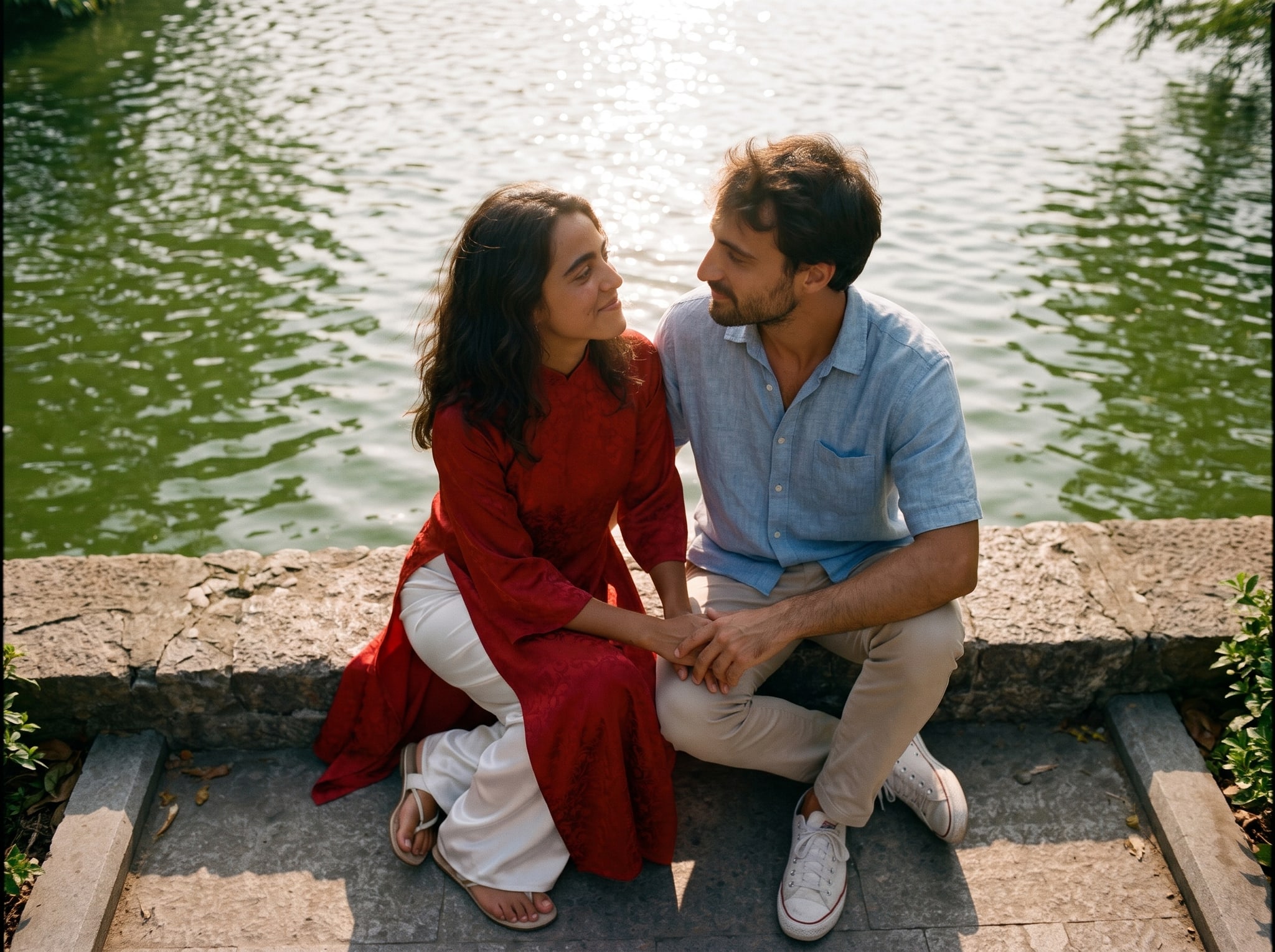
We collect the couple from their hotel at 5:15 a.m., Áo Dài already fitted. Hair and makeup happened at the hotel—our makeup team arrived at 3:30 a.m.—so we're ready to shoot immediately. First hour: Assembly Hall, empty ancient square, morning light raking across their faces. 6:45 a.m., we move to the riverside for reflection shots; water is calmest then. By 7:30 a.m., we shift to Japanese Bridge—still quiet, but stalls are opening. We pause 8–9 a.m. for a break; the couple rests in a café, we scout angles for the afternoon session. 10 a.m. onwards, we shoot lifestyle moments—eating bánh mì, walking through markets—where crowds actually add authenticity instead of breaking the frame.
What goes wrong: Áo Dài sleeves catch on ancient doorframes. We carry safety pins. Hair clips slip in the humidity. We brought a backup stylist's kit. The couple's shoes rub blisters after 4 hours on stone. We suggest they bring slip-on flats for walking, formal shoes for posed shots—change them in the van.
How is Da Lat different on the ground?
Da Lat shoots sprawl across 40–60 km of mountain roads. We spend 2–3 hours driving between Pine Forest, the Flower Gardens, Lake Tuyền Lâm, and Valley of Love. This means fewer location changes but longer drive times. Light is softer all day because of altitude and cloud cover—we can shoot 6 a.m. to 4 p.m. without harsh shadows, unlike Hoi An's narrow window. The couple doesn't rush as much.
But: roads are winding, the couple gets carsick easily (we've seen it twice). We carry motion sickness tablets. Cold creeps in by 3 p.m., so makeup needs extra setting spray—waterproof formulas hold better. Cell signal drops near Valley of Love; we preload maps and backup plans offline. And Da Lat draws fewer international tourists, so the couple feels more private—no crowd energy, but also less spontaneous street color.
Which Áo Dài colors photograph best in each place?
In Hoi An, jewel tones—deep red, burgundy, teal, purple—glow against ochre walls and lantern-lit alleys. Pastels fade and wash out. Gold trim catches morning sun beautifully. We've noticed white or cream Áo Dài work only if the silk is heavy and saturated; cheap cotton whites look flat.
In Da Lat, soft colors—blush, cream, sage, dusty rose—sit better in misty, cool light. Bright reds turn muddy in overcast conditions. Navy works everywhere. We steer couples toward jewel tones if they shoot Hoi An, pastels or cool neutrals for Da Lat—it's a real difference in the final edit, not a preference.
| Áo Dài Color | Hoi An Light | Da Lat Light | Our Note |
|---|---|---|---|
| Deep red | Glows | Dark | Ancient Town favorite |
| Blush/cream | Fades | Luminous | Mountain magic |
| Navy | Solid | Safe | Works both places |
| Gold trim | Catches sun | Hides in mist | Morning light key |
| White | Washes out | Better | Needs heavy silk |
See packages and prices on vietnamphotoshoot.com
What does the couple actually decide on before booking?
On WhatsApp, we ask four things:
- Do you dislike crowds? Hoi An is famous; Da Lat is quiet. Non-negotiable.
- Weather: heat or cold? Hoi An peaks at 32–35°C April–August; Da Lat stays 18–22°C year-round.
- Áo Dài color chosen? Once they tell us, we confirm it suits their location.
- How many locations? Hoi An: 4–5 spots in a tight 3 km. Da Lat: 3–4 spots across wider terrain.
Then we discuss whether they want a couple photoshoot style (poses, romance, connection) or documentary (walking, candid, storytelling). Hoi An favors posed romance because the architecture is so strong. Da Lat favors documentary because the landscape overwhelms posed moments—let the couple just be there.
Some couples ask: can we do both? Technically yes, but it's an 8-hour shoot, costs more, and the couple is exhausted by afternoon. We rarely recommend it.
What to check before you book
- Season: Ask us current weather (typhoon season October–November affects Da Lat; extreme heat peaks June–July in Hoi An).
- Mobility: Da Lat requires 3+ hours in a van over winding roads. If motion sickness or back pain is an issue, Hoi An's compact walking routes suit better.
- Áo Dài fit: Confirm with our stylists 2 weeks ahead. Rushed fittings cause wrinkles and binding on shoot day.
- Backup date: Hoi An rarely rains; Da Lat mist can be thick (we still shoot, but light differs). Have a rain date ready if you're inflexible.
- Hotel makeup: If you're not based in Hoi An or Da Lat, we can arrange makeup and hair at your hotel the morning of the shoot—saves travel time and keeps the couple calm.
Pages from our team you may need
FAQ
Can we do a Hoi An and Da Lat shoot on the same trip?
Yes, but we recommend two separate full-day shoots (different locations, different moods, different Áo Dài colors). One in each town, 3–5 days apart, lets you recover and see edited photos before the second shoot. Many couples do this over a 10-day Vietnam visit.
Which location is better for an elopement or proposal?
Hoi An works for proposals because the Ancient Town has romantic, intimate corners (Japanese Bridge at sunset, riverside lantern-lit paths). Da Lat suits elopements—fewer witnesses, more solitude, natural drama. See our proposal and anniversary packages to discuss which fits your moment.
Does Hoi An photography work well indoors—in shops or homes?
Rarely. Hoi An's magic is outdoors: streets, water, lanterns. Indoor light is orange and uneven. We occasionally shoot in a traditional wooden house courtyard, but the couple pays a location fee (ask us for details on WhatsApp). Outdoor Hoi An shots are always stronger.
What's the coolest part of Da Lat for pre-wedding shots?
Valley of Love and Lake Tuyền Lâm deliver scale and isolation. Pine Forest is moody but crowded with Vietnamese tourists on weekends. Flower Gardens (seasonal) add color. We scout all four and rotate based on the couple's vibe and the season—no single "best" spot.
Do we need to hire a local guide in Hoi An or Da Lat?
No. Our photographer and stylist know the locations, timing, permits, and light. We navigate, set up, and handle logistics. You just show up to the hotel and enjoy the session. Hiring a separate guide creates confusion and slows us down—we don't recommend it.
Pre-Wedding & Elopement
Inclusions, prices and booking are on our booking site.
FAQ
Can we do a Hoi An and Da Lat shoot on the same trip?
Yes, but we recommend two separate full-day shoots (different locations, different moods, different Áo Dài colors). One in each town, 3–5 days apart, lets you recover and see edited photos before the second shoot. Many couples do this over a 10-day Vietnam visit.
Which location is better for an elopement or proposal?
Hoi An works for proposals because the Ancient Town has romantic, intimate corners (Japanese Bridge at sunset, riverside lantern-lit paths). Da Lat suits elopements—fewer witnesses, more solitude, natural drama. See our [proposal and anniversary packages](/go/proposal-and-anniversary) to discuss which fits your moment.
Does Hoi An photography work well indoors—in shops or homes?
Rarely. Hoi An's magic is outdoors: streets, water, lanterns. Indoor light is orange and uneven. We occasionally shoot in a traditional wooden house courtyard, but the couple pays a location fee (ask us for details on WhatsApp). Outdoor Hoi An shots are always stronger.
What's the coolest part of Da Lat for pre-wedding shots?
Valley of Love and Lake Tuyền Lâm deliver scale and isolation. Pine Forest is moody but crowded with Vietnamese tourists on weekends. Flower Gardens (seasonal) add color. We scout all four and rotate based on the couple's vibe and the season—no single "best" spot.
Do we need to hire a local guide in Hoi An or Da Lat?
No. Our photographer and stylist know the locations, timing, permits, and light. We navigate, set up, and handle logistics. You just show up to the hotel and enjoy the session. Hiring a separate guide creates confusion and slows us down—we don't recommend it.
More from the team
Photography rules at Ta Phin village: permits, drones and what to check
Ta Phin village in Sapa draws photographers for its Hmong culture and layered mountain light. We've shot dozens of sessions there—here's what actually works and what stops shoots cold.
Pre-Wedding Photo Ideas and Poses at O Quy Ho Pass
O Quy Ho Pass sits on the Hanoi–Sapa border at 1,200 metres. Our couples shoot there for its curves, mist and isolation—but the weather and logistics demand a different approach than valley shoots.
Is O Quy Ho Pass Good for Pre-Wedding Photos? Pros, Cons, Alternatives
O Quy Ho pass in Sapa draws couples seeking high-altitude drama, but tight timelines, unpredictable fog, and logistics make it risky for pre-wedding shoots. We've scouted it; here's what actually works. #