 Cáo Studio
Home › Blog › Pre-Wedding & Elopement
How many outfits to bring for a pre-wedding shoot in Vietnam
By the Cáo Studio team · Hanoi & Saigon · 2026-11-04
Couples typically bring 3–5 outfits for a pre-wedding shoot in Vietnam—one ao dai or traditional dress, two to three modern looks (casual, romantic, formal), and optionally a swimwear or concept piece. A half-day session (4–5 hours) usually covers two locations and two outfit changes comfortably; full-day shoots (8+ hours) justify four to five. At Cáo Studio, we shoot in Hanoi, Saigon, Hoi An, and Ninh Binh, so backdrop variety means fewer outfit swaps feel repetitive. Overpacking causes decision paralysis on the morning; underpacking means reshooting unloved looks. The real variable is weather (rain halts hair/makeup touch-ups) and your personal style confidence. Bring one outfit you've worn before and love—that translates to camera ease. Ask us for a quote on WhatsApp and share your location and vision so we can advise on outfit count together. Chat with us on WhatsApp | See packages and prices on vietnamphotoshoot.com
What does a typical pre-wedding shoot timeline actually look like?
We usually block 5–6 hours for a half-day session in Hanoi or Saigon. Guests arrive by 7 am, hair and makeup happen at the studio or hotel (60–90 minutes), then we move to location one. By 9:30 am we've shot outfit one; by 10:45 am the couple changes and we start outfit two. Lunch break sits between hours 3 and 4. Most couples swap outfits twice in that window—once before location change, once at the new spot. Rain costs us 20–30 minutes of touch-up time on makeup and hair. If Ninh Binh is the location, travel from Hanoi eats 90 minutes each way, so we compress shooting or extend the package. What matters: outfit changes happen between locations, not within one, to save setup time and keep momentum alive.
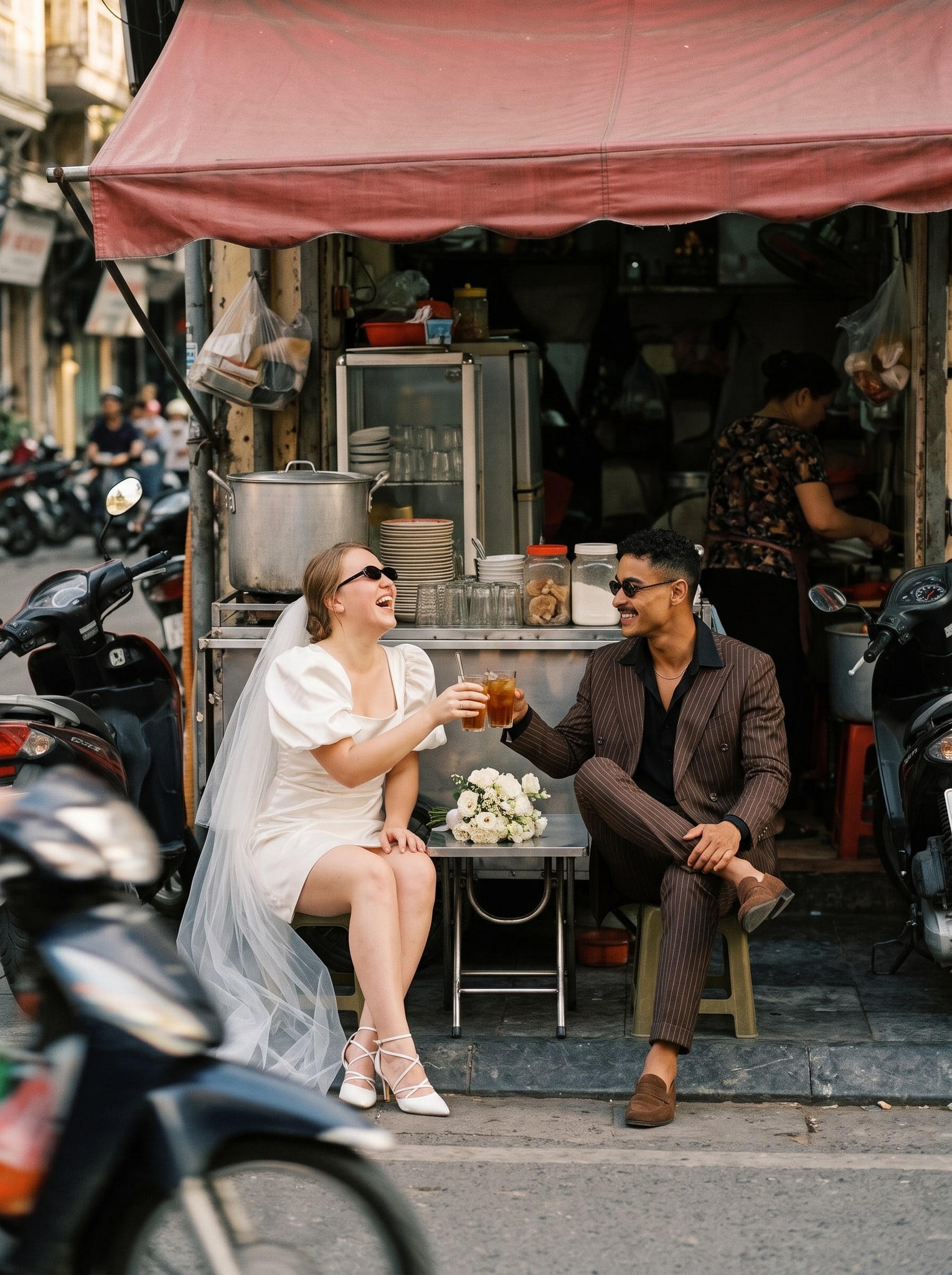
How does location affect how many outfits you actually need?
We scout locations by season, light angle, and backdrop colour. A half-day shoot covering Tay Ho lakeside (Hanoi) and the Old Quarter uses dramatically different backgrounds—sky reflections, colonial walls, narrow streets. Two outfit changes feel like two shoots. Compare that to a single venue like a resort in Saigon: same light angle, same backdrop, so a fourth outfit becomes almost invisible in editing. Per our shoots in Hoi An, ancient town walls pair best with ao dai (warm ochre tones); modern hotels need brighter, simpler cuts to pop. If your package spans Ninh Bing's rice fields and stone karsts, outfit one (earthy tones, loose fit) suits the fields; outfit two (contrast colour, tailored) reads better against grey limestone. The rule we follow: assume each new location "uses up" one outfit. Three locations = plan for three outfits minimum. One location = two outfits often suffice.
See our couple photoshoot package
Should every outfit be completely different, or can you repeat a top?
We see this hesitation often. Couples assume every outfit must be unrecognizable. In reality, our selects show: changing the bottom while keeping the same top (or vice versa) reads as fresh in different locations, especially if hair or posing shifts. One bride wore a white top with two skirts (one flowing, one tailored); editing produced 40+ keeper shots, 20 from the same top. Cost savings: pack 3 tops and 3 bottoms instead of 5 full outfits. Texture and fit matter more than novelty. A silk blouse photographs differently in morning Hanoi light than evening Saigon light. What fails: repeating the exact outfit at two locations—that confuses the narrative. What works: mixing pieces. If you're packing a small carry-on, this approach cuts stress and luggage weight significantly. Ask us on WhatsApp whether your piece combinations read cohesively; our stylists review photos before shoots.
What's the honest mistake we see most often with outfit count?
Couples underdress (bring one outfit), assuming the location speaks for itself. We've driven to the Old Quarter with a couple in jeans and a printed tee, planned three hours, and by hour two their energy dropped because they felt neither formal nor casual. Outfits anchor confidence. Second mistake: overpacking (seven outfits), creating decision fatigue on the morning. The photographer and stylist waste 15 minutes curating your choices instead of preparing light meters and poses. Third: ignoring our advice about weather. Monsoon season (May–Sept in Hanoi, Sept–Nov in Saigon) means humidity swells fabrics and makeup runs; lighter colours and breathable fabric aren't optional, they're practical. Fourth: formal outfits that don't move. A dress that looks stunning standing still can bind when you walk or sit on steps. We recommend trying a full outfit on, walking around your home, and asking: could I sit cross-legged on wet grass in this? Fourth mistake: bringing prints that clash with backdrops. Hoi An's lantern light (warm, yellow) overwhelms busy patterns; solids and subtle textures win. The fix: share outfit photos with us 2 weeks before the shoot. We'll flag anything that won't read well in your chosen locations.
| Outfit role | When to wear it | Fabric/fit notes | Why it matters |
|---|---|---|---|
| Ao dai or cultural dress | Location 1 or 2 | Breathable silk-blend, fitted bodice | Connects to setting, photographs timeless |
| Casual romantic (flowing dress, linen shirt) | Daytime, open locations | Natural fibres, movement | Reads lighter, works in outdoor light |
| Modern formal (tailored suit, cocktail dress) | Mid-session or final | Structured, solid colour | Photo contrast, energy shift |
| Concept or swimwear (optional) | Full-day only, if planned | Comfort + styling brief match | Justifies extra hour, adds variety |
| Backup outfit (not worn) | Pack only if luggage fits | Similar vibe to main two | Solves outfit-day regret, not always needed |
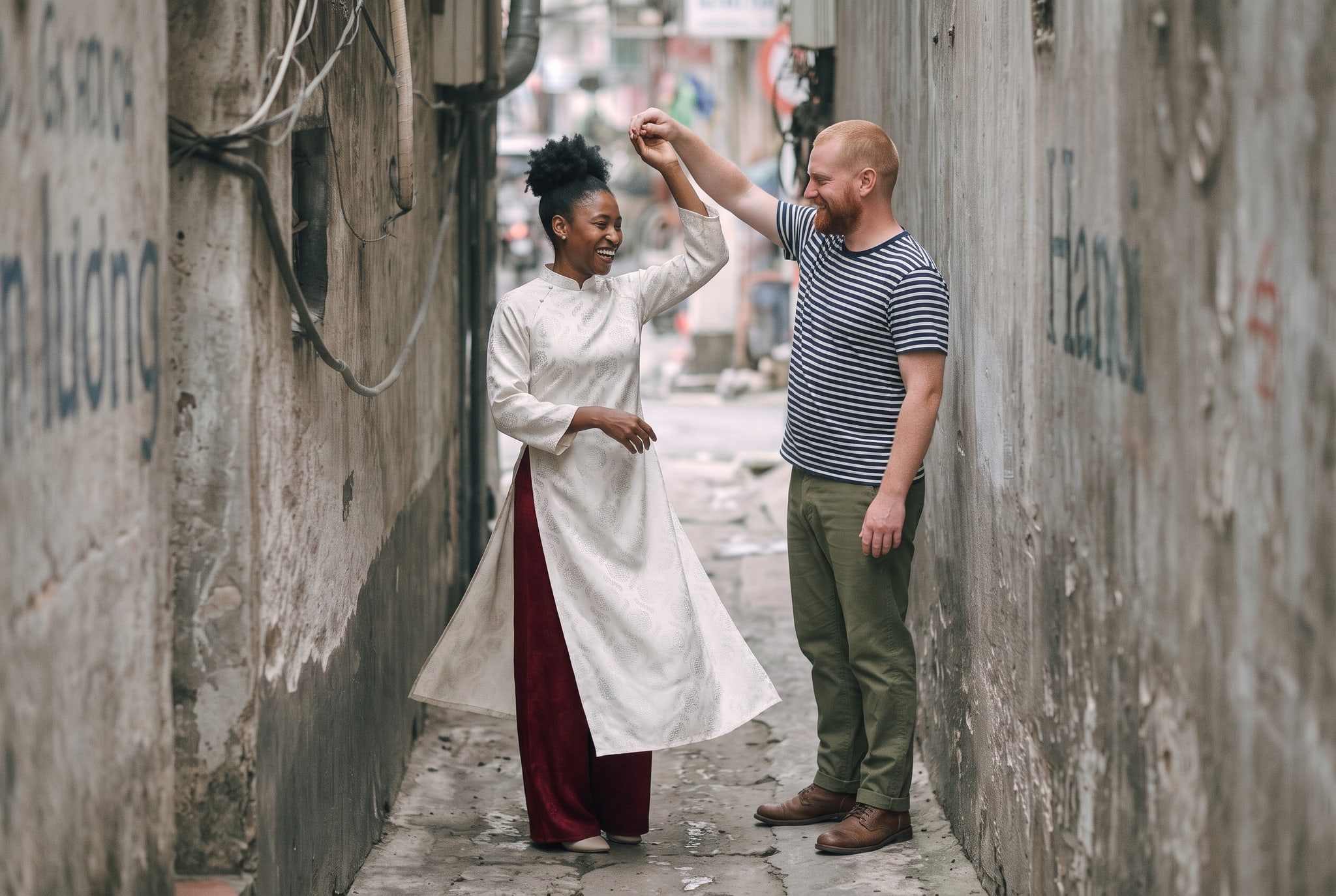
How do we actually prepare you on the morning-of?
We text on WhatsApp the night before: location, weather, what to bring. Morning message includes ETA at hotel for makeup pickup or studio arrival. We ask: which two outfits do you feel most confident in right now? That answer tells us energy and fit reality. We examine each outfit on the couple, spot seams that might show under certain light, check zipper function, tuck tags. Hair and makeup happens while the stylist steams any wrinkles and preps a small garment bag with safety pins, blotting papers, and a lint roller. We time outfit change one for 10:45 am (usually after 90 minutes of shooting, when hair/makeup touch is minimal). Between location one and two, the couple changes in the studio, a private room, or vehicle (we shield if needed). We've learned: never schedule an outfit change during harsh midday light (11 am–2 pm in Saigon); quality drops, touch-ups double. By 1 pm we're at a new location with outfit two, fresh energy, different backdrop angle. If it's a full-day shoot, a third change lands around 4 pm, before golden hour light. This rhythm keeps both couple and crew momentum high. The question we ask around hour 4: do you feel like changing, or does this outfit still feel good? We've cut a third outfit before when the couple was glowing in outfit two.
Explore our pre-wedding package options
What if you hate an outfit mid-shoot—can you change faster?
Yes. We've had a bride ask for a swap at hour 3. Unplanned changes cost 15–20 minutes (the couple redresses, we adjust lighting and hair pins, photographer resets posing cues). If you have a gut feeling on the morning-of that an outfit isn't right, swap it for backup clothing before the shoot starts. This is free and fast. Mid-shoot changes hurt pacing but aren't forbidden. We'd rather you feel confident than grit through discomfort. The compromise: if you're uncertain about one outfit, leave it at the studio and bring a backup to the location. This avoids carrying three bags and reduces on-the-fly decisions. Also: wear the outfit you're most insecure about first—by hour 3, camera ease overrides outfit doubt. Our photographer notices posture shifts after 90 minutes of shooting. You'll stand taller, move smoother, and the outfit that felt stiff will suddenly feel natural.
What to check before you finalize your outfit plan
- Fit test: Wear the full outfit (including shoes) and sit, stand, and walk for 10 minutes. Any pinching, gapping, or riding up? Fix it now, not in Hanoi.
- Lighting check: Photo each outfit in your home's natural light and in artificial light. Do the colours pop or fade?
- Fabric reality: Will it wrinkle in a suitcase? Is it breathable (Hanoi summer heat = 35°C+, humidity 90%)?
- Emotion check: Do you feel like yourself in each outfit, or performing? The camera reads the difference.
- Backup rule: If luggage allows, pack one extra top/bottom combo. Don't stress if you don't—two outfit changes are entirely sufficient.
Chat with us on WhatsApp — share your outfit photos and we'll confirm they work for your location.
Pages from our team you may need
FAQ
Can I wear the same outfit at two different locations?
Yes, if backdrops are visually distinct—Tay Ho lakeside versus Old Quarter will feel like two outfits. Same venue twice? The couple and audience notice. Better: swap one key piece (top or bottom) between locations.
What if I'm flying into Hanoi and don't want to pack much?
Bring two solid outfits (one casual, one formal) plus one ao dai. Our stylists in Hanoi can source a third outfit locally if you want that option—ask us on WhatsApp. This keeps luggage minimal and reduces luggage-related stress.
Do I need matching outfits with my partner, or should they be different?
Different reads better in edits. Matching formal-wear suits ceremony moments, not pre-wedding shoots. We often pose one partner leading (bolder colour, tailored fit) and the other complementing (softer tone, looser silhouette). This creates visual balance and narrative.
How does weather change the outfit count?
Rain or humidity shortens outfit comfort windows (makeup touch-ups take 10+ minutes). Pack one extra lightweight, fast-drying option if monsoon season is your date. Per our Saigon shoots in October, we always advise one backup casual outfit in case formal fabrics wilt.
Should I bring costume or concept outfits if the package doesn't mention them?
Only if you love the idea and the package duration supports it (full-day shoots, 8+ hours). A concept outfit usually replaces one standard look, not adds to the count. Discuss with us first on WhatsApp—we've done vintage 1950s, modern streetwear, and themed shoots; some work beautifully, some feel forced in a generic location.
What if I'm unsure whether to book a half-day or full-day package—does outfit count decide?
Outfit count is one signal, not the decider. Half-day (two outfits, two locations) suits couples wanting one cohesive story fast. Full-day (three to four outfits, three to four locations) suits those wanting editorial variety and time to breathe between shots. Budget and travel distance to Ninh Binh or Hoi An matter more. See our pre-wedding package options to compare. --- See our pre-wedding and elopement packages — chat with the Cáo Studio team on WhatsApp to finalize your outfit plan.
Pre-Wedding & Elopement
Inclusions, prices and booking are on our booking site.
FAQ
Can I wear the same outfit at two different locations?
Yes, if backdrops are visually distinct—Tay Ho lakeside versus Old Quarter will feel like two outfits. Same venue twice? The couple and audience notice. Better: swap one key piece (top or bottom) between locations.
What if I'm flying into Hanoi and don't want to pack much?
Bring two solid outfits (one casual, one formal) plus one ao dai. Our stylists in Hanoi can source a third outfit locally if you want that option—ask us on WhatsApp. This keeps luggage minimal and reduces luggage-related stress.
Do I need matching outfits with my partner, or should they be different?
Different reads better in edits. Matching formal-wear suits ceremony moments, not pre-wedding shoots. We often pose one partner leading (bolder colour, tailored fit) and the other complementing (softer tone, looser silhouette). This creates visual balance and narrative.
How does weather change the outfit count?
Rain or humidity shortens outfit comfort windows (makeup touch-ups take 10+ minutes). Pack one extra lightweight, fast-drying option if monsoon season is your date. Per our Saigon shoots in October, we always advise one backup casual outfit in case formal fabrics wilt.
Should I bring costume or concept outfits if the package doesn't mention them?
Only if you love the idea and the package duration supports it (full-day shoots, 8+ hours). A concept outfit usually replaces one standard look, not adds to the count. Discuss with us first on WhatsApp—we've done vintage 1950s, modern streetwear, and themed shoots; some work beautifully, some feel forced in a generic location.
What if I'm unsure whether to book a half-day or full-day package—does outfit count decide?
Outfit count is one signal, not the decider. Half-day (two outfits, two locations) suits couples wanting one cohesive story fast. Full-day (three to four outfits, three to four locations) suits those wanting editorial variety and time to breathe between shots. Budget and travel distance to Ninh Binh or Hoi An matter more. [See our pre-wedding package options](/go/pre-wedding-photoshoot) to compare. --- [✨ See our pre-wedding and elopement packages](/go/pre-wedding-photoshoot) — chat with the Cáo Studio team on WhatsApp to finalize your outfit plan.
More from the team
Elopement photos at Ha Long Bay cruise: what we book on shoot day
Ha Long Bay elopements demand fast decisions: boat schedules, tides, light windows shift by the hour. We share how our team coordinates with cruise operators, what goes wrong, and the real workflow from WhatsApp to final images.
Planning a Ha Long Bay pre-wedding shoot remotely from overseas
Booking a Ha Long Bay pre-wedding shoot from abroad means planning five weeks ahead, syncing across time zones, and trusting your team on the water. Here's how we run it.
One-day pre-wedding photoshoot itinerary in Ha Long Bay
A one-day Ha Long Bay pre-wedding shoot combines limestone karsts, emerald water and tight timing. We share how our team runs it hour by hour.