 Cáo Studio
Home › Blog › Pre-Wedding & Elopement
Is Hanoi French Quarter good for pre-wedding photos?
By the Cáo Studio team · Hanoi & Saigon · 2026-11-02
Yes, the French Quarter (Hoàn Kiếm district) delivers colonial elegance and natural shade under century-old trees, ideal for timeless couple portraits. We shoot there 6–8 times yearly, typically 7–9 a.m. before crowds peak at 10 a.m. The trade-off: narrow sidewalks force us to position subjects close to traffic; midday sun creates harsh shadows between buildings; and permit-sensitive cafés sometimes ask us to move. Cost depends on your full pre-wedding package, not location alone. We recommend pairing one 1–2 hour morning block there with a second location (Old Quarter, Long Biên Bridge, or West Lake) to avoid monotony and maximize light windows. At Cáo Studio, we scout locations weekly and adjust based on renovation work and festival closures. Chat with us on WhatsApp | See packages and prices on vietnamphotoshoot.com
Why does the French Quarter feel different at 7 a.m. versus 11 a.m.?
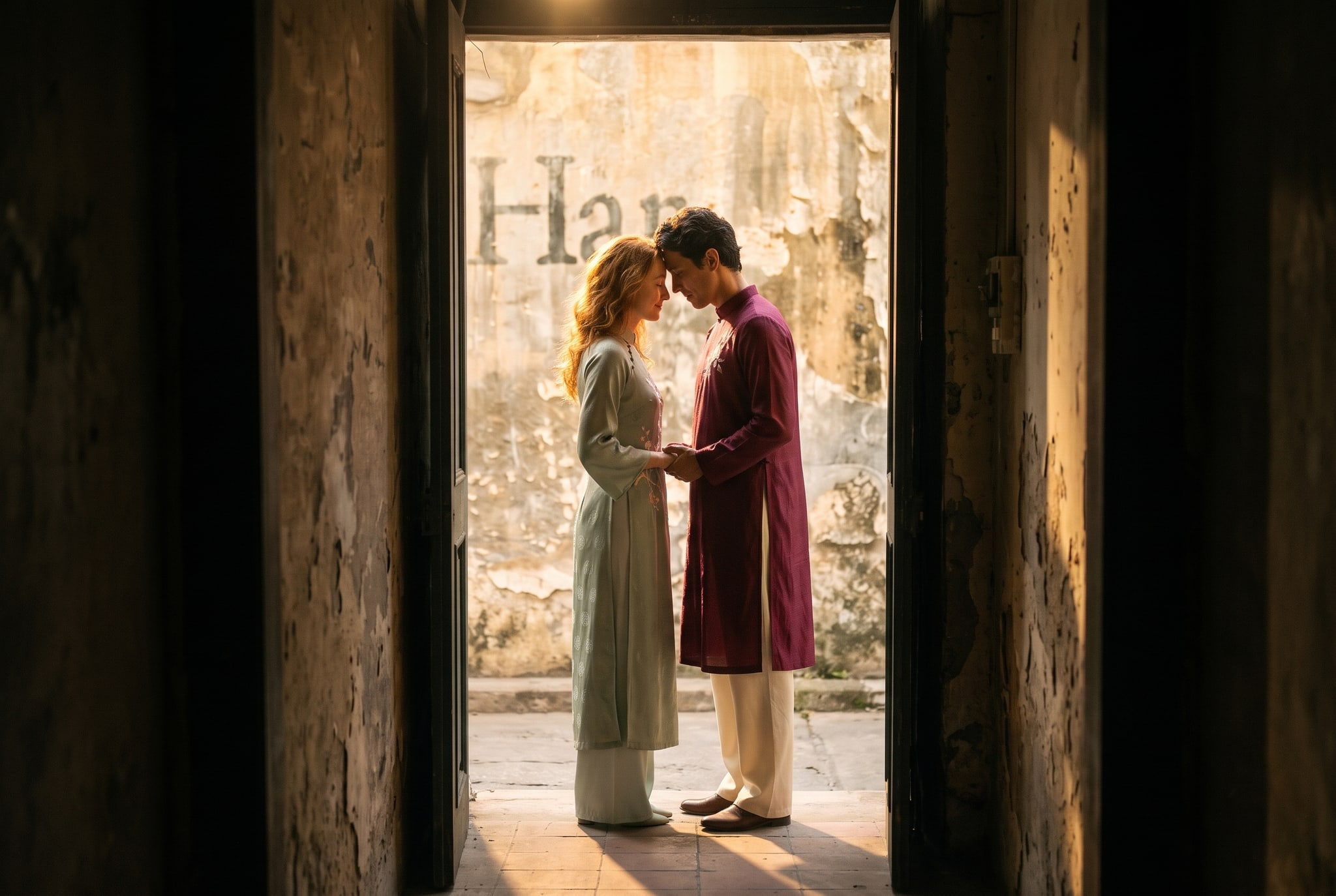
Light quality is the core reason. At 7–8 a.m., soft directional sun comes from the east, raking across limestone facades and casting long shadows that sculpt the couple's profiles. By 10 a.m., sun rises higher; shadows shrink; and hard midday contrast makes skin tones difficult to expose evenly. We've photographed the same staircase at Thanh Hương Café at both times and the 7 a.m. frames feel painterly; 11 a.m. frames look flat. Additionally, foot traffic at dawn is sparse—mostly locals on motorbikes, not tourist groups with selfie sticks. The trade-off is cold shadows under the trees; we adjust by positioning couples near reflective white walls or asking them to step into a doorway's soft backlight. Conclusion: book a dawn French Quarter shoot only; avoid midday entirely.
What exactly goes wrong on-location that guides don't mention?
Three real obstacles we navigate every French Quarter shoot. First, sidewalk width: Camera lane at Trang Tien Street near the Opera House is barely 2 meters wide. One parked motorbike blocks framing. We've learned to carry a lightweight reflector (not a tripod) to work faster. Second, cafe closures: three of the four "Instagram-worthy" cafés lock gates until 8 a.m., and staff sometimes object to photographs if you're not a paying customer—even though the street is public. We pre-call the manager the night before and offer to buy an espresso. Third, intermittent renovation: the staircase on Nha Tho Street was blocked off for two weeks in March 2026. Our styling assistant checks Google Maps and the district Facebook page 48 hours before every shoot. Conclusion: French Quarter requires logistics and phone calls; spontaneity doesn't work.
Should we compare French Quarter to three other Hanoi pre-wedding spots side-by-side?
| Location | Best light window | Crowd density | Permit needed? | Outfit versatility | Why we pick it |
|---|---|---|---|---|---|
| French Quarter | 7–9 a.m. | Moderate (tourists) | No | 2–3 looks | Colonial arches, natural shade |
| Old Quarter Backstreets | 6–8 a.m., 4–5 p.m. | Low (locals) | No | 3–4 looks | Narrow lanes, rough brick, lanterns |
| Long Biên Bridge | 6–7:30 a.m., 5–6:30 p.m. | Very low | No | 1–2 looks | Golden hour, steel beams, epic scale |
| West Lake (Tây Hồ) | 6–7 a.m., 4–6 p.m. | Low (joggers) | No | 4–5 looks | Soft water reflection, grassy banks, sunrise |
We choose French Quarter when couples want a quintessential Hanoi aesthetic in a compact, walkable zone—useful if they're on a tight schedule or already downtown. We choose Long Biên if they want drama and a one-of-a-kind landmark. We choose West Lake if they want romantic, soft tones and don't mind a longer drive from District 1. Conclusion: location choice depends on aesthetic priority and available daylight, not hype.
How do we actually plan a French Quarter shoot inside a multi-location day?
Our 4-hour pre-wedding session typically breaks down like this: 6:45–7 a.m. we meet at Pháp Xá (the heart of the Quarter); brief wardrobe check and camera test. 7–8:15 a.m., we shoot around Thanh Hương Café and the Opera House exterior (roughly 15–20 keepers). 8:15–8:45 a.m., we reposition for a walking sequence through Nha Tho Street and Trang Tien—this captures the "strolling couple" narrative. 8:45–9 a.m., we debrief, review images on the back of the camera, and the couple decides: stay for a second round at a nearby lake, or pack up early. If they choose a second location (which we recommend), we're wheels-up by 9:15 a.m. to hit West Lake golden hour or Old Quarter afternoon side-light. This sequencing avoids the tourist surge and gives us two distinct aesthetics on the same outfit. Conclusion: tightly scheduled shoots yield variety and avoid buyer's remorse about "all photos look the same."
What should couples confirm before booking a French Quarter shoot?
Outfit strategy is the biggest pre-booking conversation. French Quarter's colonial palette (cream, limestone gray, rust iron) suits neutral and jewel-tone áo dài, white or cream Western bridal wear, and muted suits. Bright neon or all-black looks can feel jarring against the pastels. We send a mood-board WhatsApp link showing similar shoots; if the couple insists on a look that doesn't harmonize, we often pivot to Old Quarter or West Lake instead. Mobility and comfort: walking the French Quarter is flat but involves turning, standing for detail shots, and climbing one or two short staircases. We ask if either partner has joint pain or prefers seated / leaning poses, then brief our photographer to cluster those requests into one 20-minute block. Backup plan: if it rains heavily (rare in peak season but possible), we don't reschedule to noon; instead, we pivot to an indoor concept like a hotel-lobby shoot or propose an evening makeover-and-mini-shoot at Cáo Studio Hanoi itself—included in our rainy-day rider. Couples who confirm these three points feel in control and rarely second-guess. Conclusion: a 10-minute WhatsApp call with our coordinator prevents shoot-day friction.
Chat with us on WhatsApp | See packages and prices on vietnamphotoshoot.com
What's the honest difference between a French Quarter DIY shot and a Cáo Studio shoot?
Couples who DIY often use a phone tripod, one simple outfit, and a 45-minute session. They capture 20–30 frames; maybe 3–5 are in-focus and flattering. They then spend hours editing in a mobile app. Our approach is different: we arrive with two camera bodies, four lenses, and a reflector; we guide posture, timing, and micro-adjustments in real-time; we shoot 150–200 frames in the same location; and we deliver edited, color-graded images within 7 days. The difference isn't just camera gear—it's the experience and the outcome. On WhatsApp, we send a pre-shoot mood board and a detailed itinerary, so the couple knows exactly where and what time. If light changes unexpectedly, our photographer pivots; a DIY couple with a tripod cannot. We've also trained stylists who manage outfit changes, hair, and makeup touch-ups between locations. When it rains or crowds surge, we text alternatives within 10 minutes, not cancel. Conclusion: our model trades convenience for expertise; French Quarter's charm then becomes an asset, not a lottery.
Chat with us on WhatsApp | See packages and prices on vietnamphotoshoot.com
What's actually inside a pre-wedding package that includes a French Quarter block?
Our full pre-wedding package covers a half-day or full-day session, two locations, hair and makeup (at your hotel or our studio), outfit changes, and a post-shoot edit turnaround. If French Quarter is your first location, we build in 2 hours there and 2 hours elsewhere (or 3+3 for a full day). The package includes a private WhatsApp album link to download originals, a printed album proof (so you can mark favorites for prints), and a final gallery link to share with family. Add-ons like a makeup and hair at your hotel block, an áo dài rental, or a special concept shoot (e.g., sunrise proposal moment or elopement vow renewal) stack onto the base price. Payment is handled online (Visa, Mastercard, bank transfer, or cash on the day); international guests can pay via the link before arrival. All rates and tiers are live on vietnamphotoshoot.com—we avoid quoting over WhatsApp to prevent confusion. Conclusion: a French Quarter block is one module of a broader storytelling experience, not an isolated transaction.
What does "scouting" actually mean in practice for our team?
One of our stylists or photographers visits each location monthly—ideally twice during your intended season—to photograph current conditions: Are the benches still there? Is the staircase blocked? Which cafés are reliably open early? Are there new banners or construction fences? We keep a shared spreadsheet (updated weekly) noting renovation windows, festival dates, and staff-permission status at three landmark cafés. If a location changes overnight, our coordinator texts any couple booked there within 24 hours with a pivot plan. This prevents the scenario where a couple flies to Hanoi, arrives at their shoot location, and finds it fenced off. We've caught three such scenarios in 2026 alone and rerouted to Old Quarter or West Lake with zero disappointment. Conclusion: location scouting is operational hygiene, not luxury; it's how we promise reliability.
How do we position couples to avoid traffic and stay in-frame safely?
Safety is non-negotiable. French Quarter's Trang Tien Street has light motorbike and delivery traffic. We never position a couple in the center of the street, even for one "daring" shot. Instead, we use café doorways, sidewalk corners, and the Opera House's wide stone plaza to create natural boundaries. Our photographer stays in a spot where they can see both the couple and approaching traffic; the styling assistant acts as a "spotter" who signals if a vehicle approaches, allowing the couple to step back. We avoid shooting during the 8:30–9 a.m. window when deliveries ramp up. For seated poses on benches (common in French Quarter's courtyards), we photograph from an elevated angle using nearby steps or a very low lens angle to create depth without placing the couple near curbs. Conclusion: beautiful framing always respects geometry and traffic flow; we don't ask for risky moments.
Which outfits actually photograph best in the French Quarter itself?
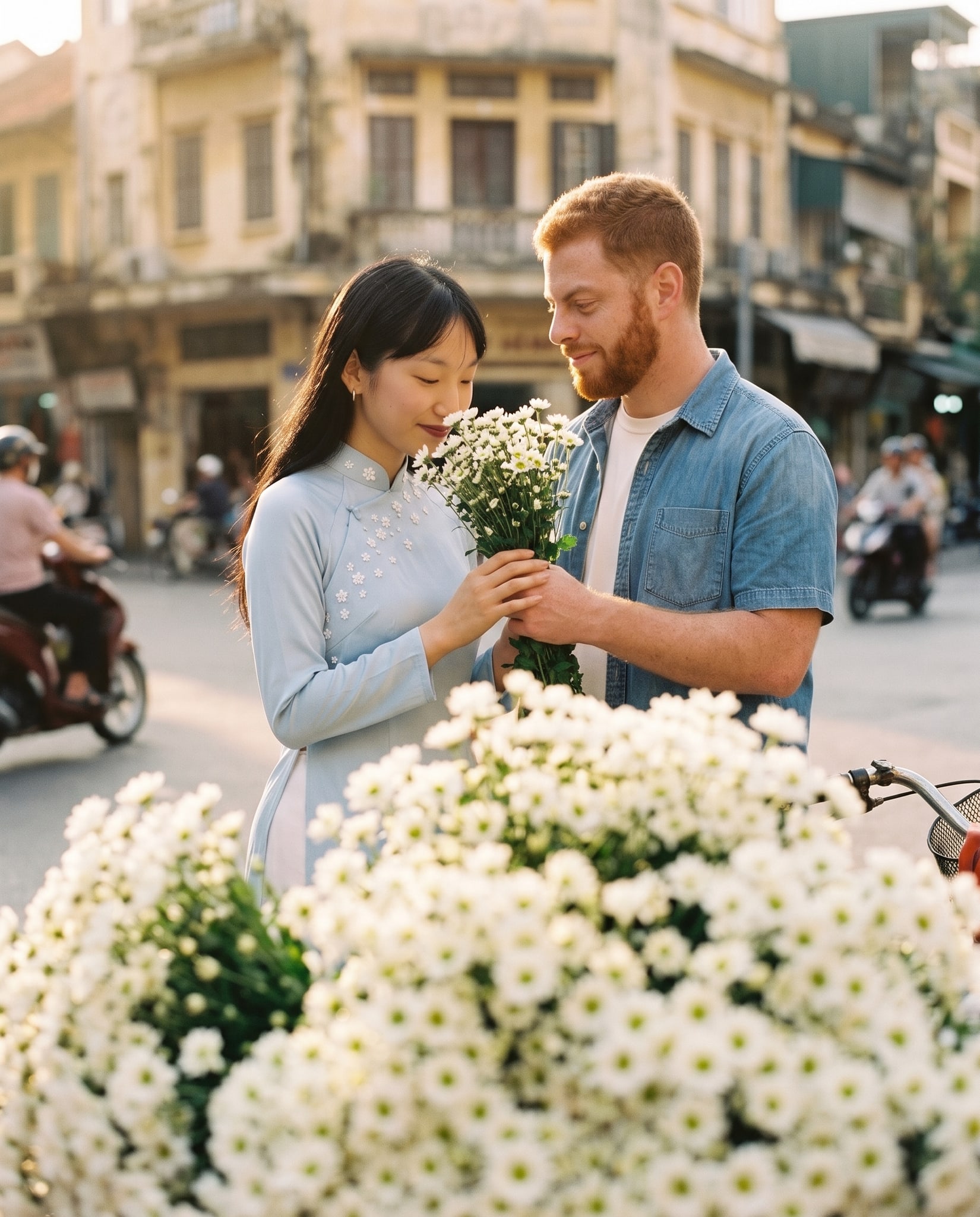
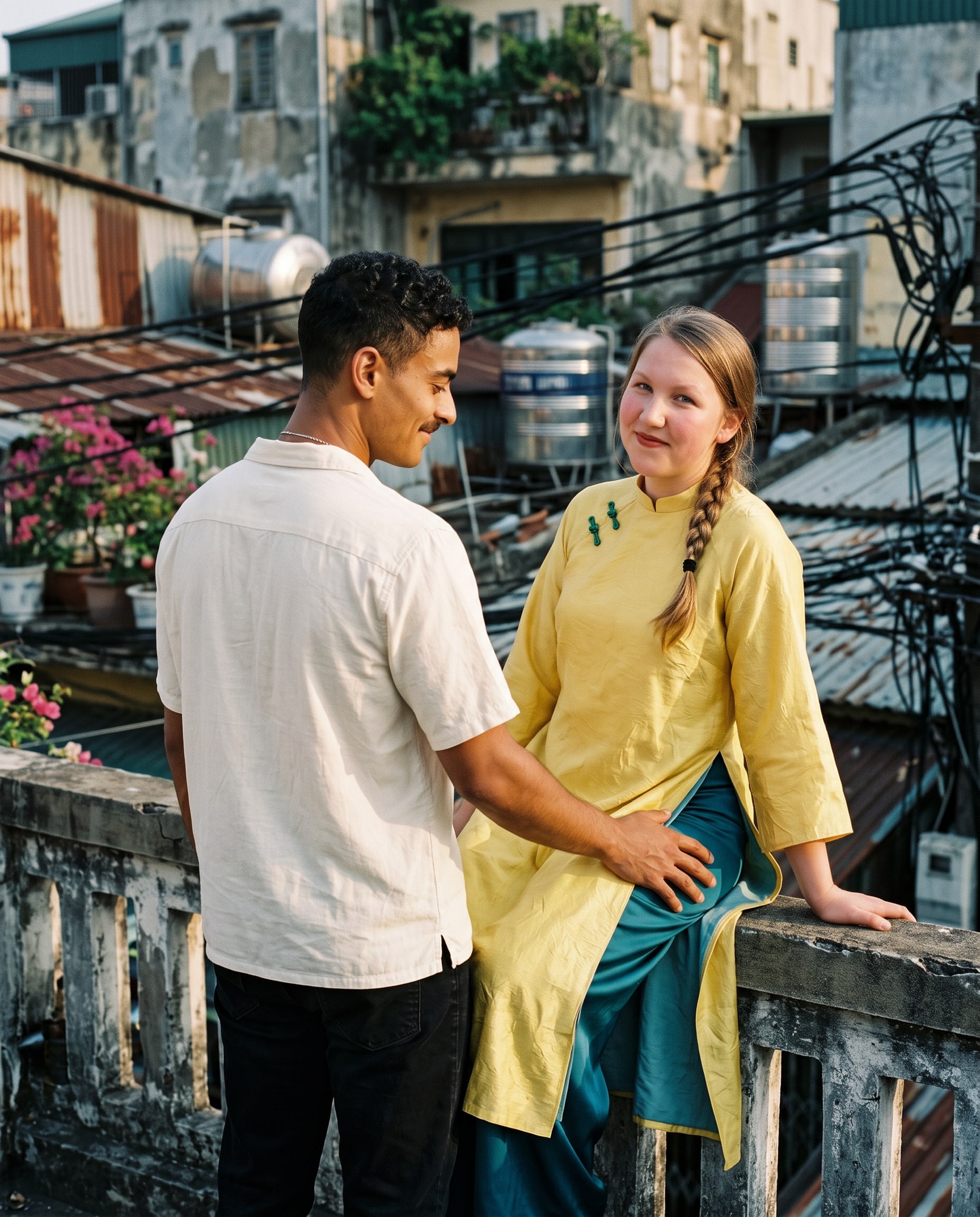
We've shot roughly 40 couples in the French Quarter over 18 months. The outfit winners: Western white or cream bridal gown (the limestone facades and cream building trim create a monochromatic elegance), áo dài in jewel tones—emerald, sapphire, burgundy (neutral backgrounds make these pop without clashing), tailored suit in charcoal or navy with a pale shirt (matches the cool tones of colonial architecture), and pastel áo dài in soft pink or lavender (harmonizes with sunrise light and aged building textures). The outfit misses: neon colors, all-black looks (too heavy against pale backdrops), and busy patterns (the Quarter's wrought iron, arches, and signage are already visually complex). If a couple insists on a bright outfit, we usually suggest shooting it at West Lake or Old Quarter instead, where chaos reads as energy. Conclusion: outfit choice should match location mood; French Quarter rewards elegance and restraint.
Chat with us on WhatsApp | See packages and prices on vietnamphotoshoot.com
FAQ
What time should we actually arrive for a French Quarter shoot?
We ask couples to meet us by 6:45 a.m. at the Opera House or Pháp Xá area. Shooting starts by 7 a.m. when light is softest and streets are empty. Arriving later pushes you into the 9–10 a.m. window when crowds and harsh light degrade frames. WhatsApp reminders go out the night before with the exact meeting point.
Can we do a French Quarter shoot in the afternoon or evening instead?
Yes, but with caveats. Late afternoon (4–5 p.m.) offers a second golden-hour window, though it's shorter and crowds are still moderate. Evening (after 6 p.m.) requires flash fill-light, which our photographer can provide, but the Quarter loses its colonial luminosity. We typically reserve afternoon/evening for couples who can't do dawn or who want a second French Quarter block as a bonus add-on.
How many outfit changes can we fit into a French Quarter shoot?
Two to three, depending on session length. A 2-hour block allows one outfit change (usually at the 1-hour mark); a 4-hour block accommodates two outfit changes plus potential touch-ups. More than three changes in 4 hours creates logistical strain. Our stylists manage outfit logistics; we always brief couples on timing beforehand.
What if it rains on our French Quarter shoot day?
Light rain (drizzle) is okay—it wets the stone and adds mood. Heavy rain or thunderstorms prompt a pivot: we move to a rainy-day backup (hotel interior, covered arcade, or rescheduled for the next dawn window). The choice is yours; we don't charge extra for backup shoots. Our rainy-day contingency is included in the full pre-wedding package.
Do we need a permit to photograph in the French Quarter commercially?
No permit is required for couple or pre-wedding shoots on public streets. If we're blocking sidewalks or placing reflectors in front of businesses, we ask permission from shop owners (usually a quick chat; no formal paperwork). Cafés sometimes request that we buy a drink if we're using their doorway or outdoor seating—standard courtesy, not a cost to the couple.
How do we handle outfit changes and hair touch-ups between locations?
Our stylists are on-site the whole time. Minor touch-ups (hair pins, makeup blot, wrinkle smoothing) happen between shots, often in a café or nearby park. If an outfit change is needed before moving to location two, we use a private café bathroom or your hotel room (if it's close). All timing is pre-planned so no one is waiting around in full makeup for 30 minutes.
Can we hire a makeup artist separately if we want more glam?
Yes. Our makeup and hair at your hotel service pairs with any location shoot. If you want professional glam makeup, we coordinate a stylist to arrive 1–1.5 hours before the shoot, work at your hotel, and join us on-location. Timing and rates are discussed upfront via WhatsApp; no surprises on the day.
Pre-Wedding & Elopement
Inclusions, prices and booking are on our booking site.
FAQ
What time should we actually arrive for a French Quarter shoot?
We ask couples to meet us by 6:45 a.m. at the Opera House or Pháp Xá area. Shooting starts by 7 a.m. when light is softest and streets are empty. Arriving later pushes you into the 9–10 a.m. window when crowds and harsh light degrade frames. WhatsApp reminders go out the night before with the exact meeting point.
Can we do a French Quarter shoot in the afternoon or evening instead?
Yes, but with caveats. Late afternoon (4–5 p.m.) offers a second golden-hour window, though it's shorter and crowds are still moderate. Evening (after 6 p.m.) requires flash fill-light, which our photographer can provide, but the Quarter loses its colonial luminosity. We typically reserve afternoon/evening for couples who can't do dawn or who want a second French Quarter block as a bonus add-on.
How many outfit changes can we fit into a French Quarter shoot?
Two to three, depending on session length. A 2-hour block allows one outfit change (usually at the 1-hour mark); a 4-hour block accommodates two outfit changes plus potential touch-ups. More than three changes in 4 hours creates logistical strain. Our stylists manage outfit logistics; we always brief couples on timing beforehand.
What if it rains on our French Quarter shoot day?
Light rain (drizzle) is okay—it wets the stone and adds mood. Heavy rain or thunderstorms prompt a pivot: we move to a rainy-day backup (hotel interior, covered arcade, or rescheduled for the next dawn window). The choice is yours; we don't charge extra for backup shoots. Our rainy-day contingency is included in the full pre-wedding package.
Do we need a permit to photograph in the French Quarter commercially?
No permit is required for couple or pre-wedding shoots on public streets. If we're blocking sidewalks or placing reflectors in front of businesses, we ask permission from shop owners (usually a quick chat; no formal paperwork). Cafés sometimes request that we buy a drink if we're using their doorway or outdoor seating—standard courtesy, not a cost to the couple.
How do we handle outfit changes and hair touch-ups between locations?
Our stylists are on-site the whole time. Minor touch-ups (hair pins, makeup blot, wrinkle smoothing) happen between shots, often in a café or nearby park. If an outfit change is needed before moving to location two, we use a private café bathroom or your hotel room (if it's close). All timing is pre-planned so no one is waiting around in full makeup for 30 minutes.
Can we hire a makeup artist separately if we want more glam?
Yes. Our [makeup and hair at your hotel](/go/makeup-and-hair) service pairs with any location shoot. If you want professional glam makeup, we coordinate a stylist to arrive 1–1.5 hours before the shoot, work at your hotel, and join us on-location. Timing and rates are discussed upfront via WhatsApp; no surprises on the day.
More from the team
Boho pre-wedding photoshoot in Vietnam: Hanoi, Saigon, Hoi An
Boho pre-wedding shoots mix romantic, free-spirited aesthetics with Vietnam's landscapes and heritage sites. We run full-day sessions in three cities, handling styling, makeup, location scouts and edits.
Avoid crowds at Hoang Su Phi rice terraces: timing for wedding shoots
Hoang Su Phi's terraced landscape draws couples and tour buses in equal measure. We show how to shoot there alone, when to arrive, and what to arrange with us before you go.
Photography rules at Con Dao beaches: permits, drones and what to check
Con Dao's beaches demand prep before you shoot—permits, drone zones and tide timing all affect your day. We share what the Cáo Studio team verifies on every booking.