 Cáo Studio
Home › Blog › Ao Dai Photoshoot
Matching Ao Dai for Couples: What We Learn on Set
By the Cáo Studio team · Hanoi & Saigon · 2026-11-02
Matching ao dai for couples means choosing a design theme—same colour family, complementary cuts, or mirror silhouettes—rather than wearing identical garments. At Cáo Studio, we help couples select pieces that photograph well together while honouring the groom's simpler, tailored line and the bride's elaborate embroidery or fabric drape. Most couples in Hanoi, Saigon, Hoi An and Ninh Binh choose from coordinated solid-colour pairs (often red, navy or blush) or patterns that echo across both pieces. The choice depends on your skin tone, body shape, and whether you want to look formal (wedding-style) or relaxed (couple's photoshoot). We advise booking a fitting consultation before the session so we can see the pieces on both of you, check the hem length, and adjust styling. Costs vary widely by tailor and fabric—ask us for a quote on WhatsApp and we'll guide you through what works best for your shoot dates. Chat with us on WhatsApp
What does "matching" actually mean in a couple's ao dai shoot?
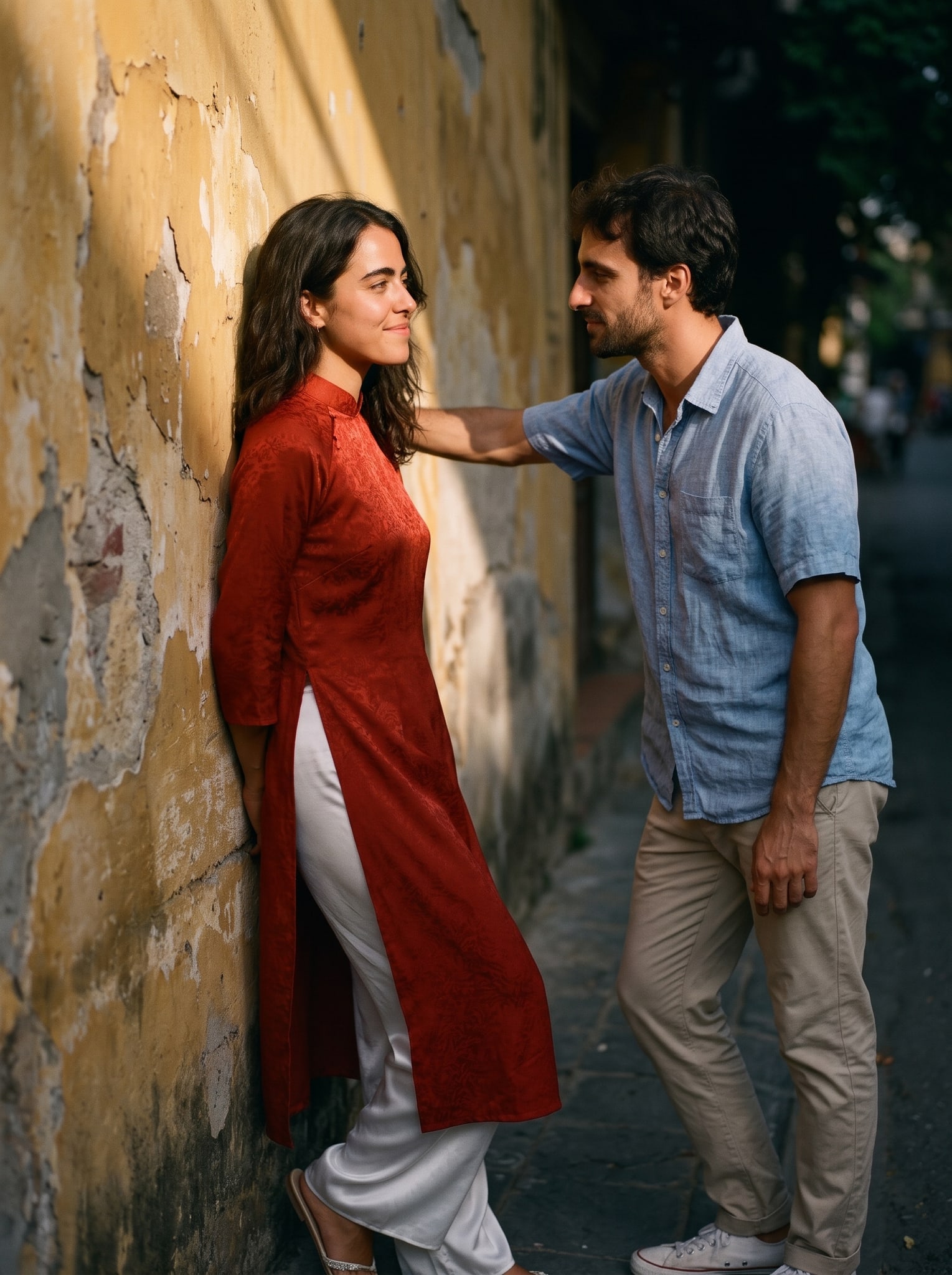
Most Western couples assume matching means identical. It doesn't. In Vietnamese tradition, the groom's ao dai is almost always darker, simpler, and slimmer-cut than the bride's. We match them by harmony, not duplication: same colour palette, or colours that sit opposite each other on the wheel (navy bride, cream groom; burgundy couple with gold accents). Some couples choose a theme—"autumn tones" across two completely different pieces. Others do mirror symmetry: bride in red with gold embroidery, groom in the same red with a gold-threaded border. The photograph reads as unified without looking costume-y. We've learned that couples who try to force identical silhouettes often regret it on set—the groom looks cramped, the bride looks oversized. Honour the cut; coordinate the colour.
See packages and prices on vietnamphotoshoot.com
Which colour combinations photograph best together?
We've shot enough couples across all four seasons and times of day to have strong opinions here. Red and cream is timeless; it photographs the same in studio light and golden-hour outdoor shoots in Hoi An's Ancient Town. Navy on both works beautifully if the bride's piece has shimmer or embroidery that lifts her silhouette—without texture, the couple can look flat. Blush or mauve pairs suit spring and autumn shoots; in Hanoi's softer light, these pastels read well. Burgundy is forgiving across all skin tones and works year-round. We've seen couples try to match in jewel tones (emerald, sapphire) and the saturation can overwhelm the face on camera—they end up retouching more. Avoid matching in black unless it's a very formal proposal or anniversary renewal; in candid shots, black can age both partners. One mistake we see often: couples pick a colour they love in the shop under fluorescent light, then arrive on shoot day and it clashes with the background or their skin tone under sunlight. Book a video call with us before you order—send us a photo of the fabric in natural light, and we'll tell you honestly whether it'll sing on camera.
How do we style and fit matching ao dai on shoot day?
Here's what an actual couple shoot looks like at our Saigon or Hanoi studio. Guests arrive 45 minutes early with their ao dai already fitted by a tailor. Our stylist inspects the hem length (bride's ao dai should just graze the floor when standing straight; groom's slightly shorter), checks the sleeve seam sits at the shoulder bone, and looks for puckering at the armpit or back—these issues are hard to hide in close-up shots. If something is off, we have a needle and thread; we've fixed minor issues in 10 minutes many times. Then we drape a undergarment (slip or white shorts depending on the fabric weight) and help the guest into the ao dai. We check the buttons (do they sit flat, or do they gap?), adjust the side seams so they sit centre-line on the body, and ensure the collar lies flush against the neck. For the bride, we may adjust the hair side-part or add a small pin to prevent the áo from sliding if she's moving a lot. For the groom, we tuck the áo slightly tighter at the waist and cuff the sleeves if they're long. This takes 15 minutes. Then we do a test shoot—usually a simple standing shot—to see how the colours interact, whether any wrinkles appear when the couple poses together, and if the fabrics catch light differently. Often we'll adjust the groom's position slightly so he's not in the bride's shadow, or ask them to angle toward each other so the pieces aren't visually separate. It's tactical, not mystical. By the time we move to your chosen location (Old Quarter in Hanoi, District 1 gardens in Saigon, lantern-lit streets in Hoi An), the fit is locked and we're shooting.
Should we order from a tailor or buy ready-made matching ao dai?
This is the question that splits couples. Ready-made pieces from mass-market shops in Hanoi's Hàng Ngoài street or Saigon's downtown malls are fast (3–7 days), and you can see the exact colour and embroidery before you pay. The fit is often loose, especially in the shoulders and sleeves, so you'll still need a tailor to adjust. The fabric is sometimes lighter or thinner than traditional ao dai—it photographs OK but feels less substantial on skin. A custom tailor (we work with trusted makers in all four cities we shoot) takes 2–3 weeks, costs more, and gives you exact sizing and fabric choice. You can also specify details: the width of the side seam slit, the depth of the armhole, the weight of the fabric. Couples doing a pre-wedding or proposal shoot almost always choose custom because these are one-time garments, and the fit shows in every frame. For a casual couple's session, ready-made is fine if you adjust it. We've seen both work beautifully on camera—it's not the cost, it's whether the fit honours your body. A rule of thumb: if you have broad shoulders or a tall frame, custom tailoring is worth it. If you're standard sizing and patient enough to wait 3 weeks, custom also looks richer in close-ups.
| Choice | Best for | Timeline | Fit on camera |
|---|---|---|---|
| Ready-made | Quick bookings, indecisive couples, first-time wearers | 3–7 days | Works with tailoring adjustments |
| Custom tailor | Precise sizing, one-time events, detail lovers | 2–3 weeks | Typically sharper, more refined |
| Hybrid | Budget-conscious, moderate timeline | 1–2 weeks | Good if tailor is skilled |
What details should we check before ordering matching ao dai?
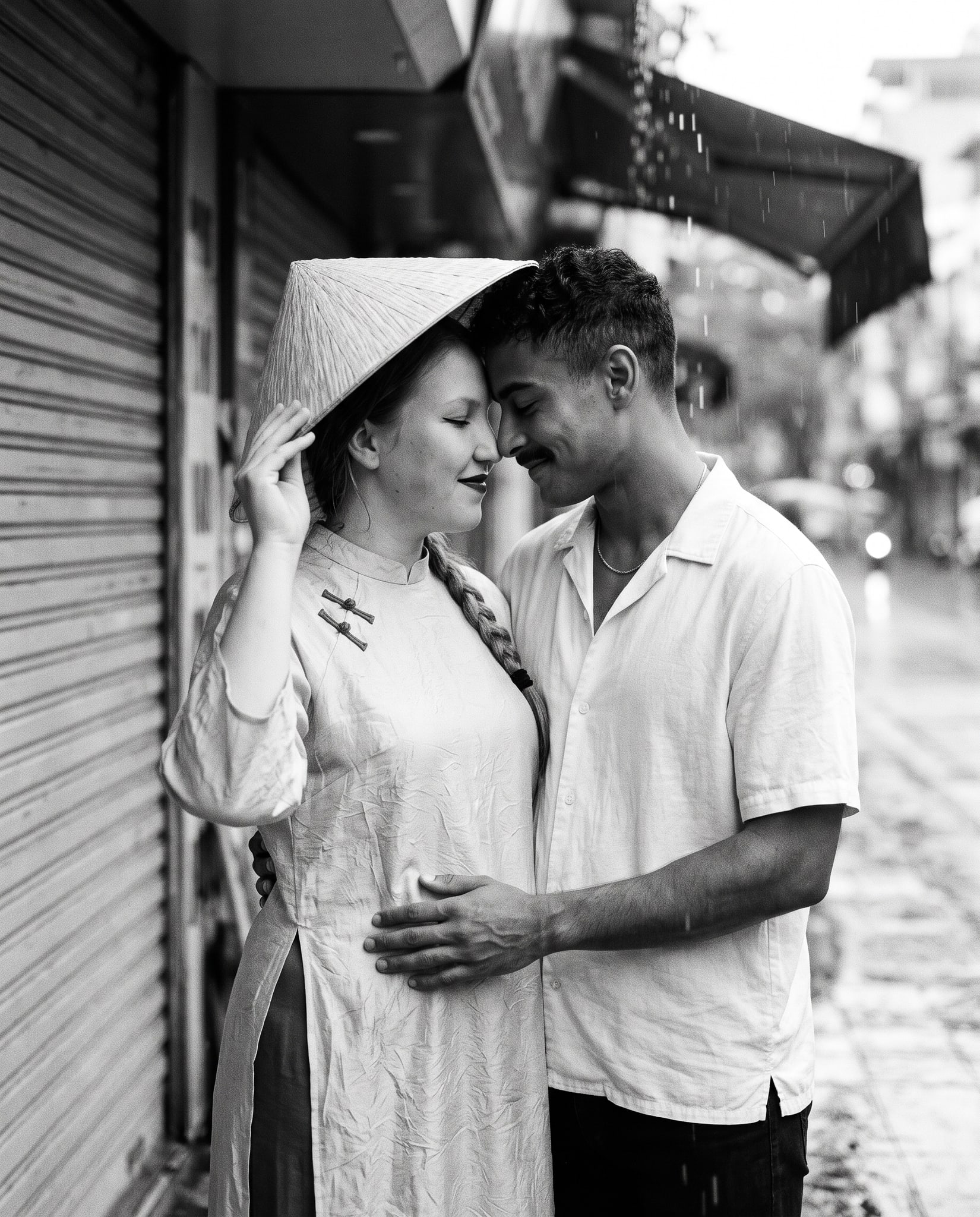
Before you commit to a pair—whether custom or ready-made—run through this checklist with your partner:
Fit check:
- Does the shoulder seam sit at the edge of your shoulder bone (not on your neck, not halfway down your arm)?
- Can you move your arms freely without the fabric bunching at the armpit?
- Is the side seam positioned centre-line on your ribcage, not creeping forward or back?
- Does the hem sit at ankle height (bride) without pooling or dragging?
Colour and fabric:
- Does the colour look the same in daylight, studio light, and dim indoor light?
- Is the fabric weight appropriate for the season (heavier cotton for winter, lighter silk for summer shoots)?
- If there's embroidery, is it secure and non-shedding?
Coordination:
- Do both pieces read as intentional together, or does one overpower the other visually?
- If you're doing a location shoot (like in Hoi An's Ancient Town or Ninh Binh's riverside), does the colour complement the background?
Practical:
- Can you sit comfortably in the ao dai without the buttons gaping?
- Is there a undergarment (slip or shorts) included, or do you need to buy one separately?
- Does the tailor offer alterations after you first wear it?
We always recommend sending us a photo of your planned outfit on WhatsApp before the shoot date. We'll spot potential issues you might miss.
Do matching ao dai work for other events besides weddings?
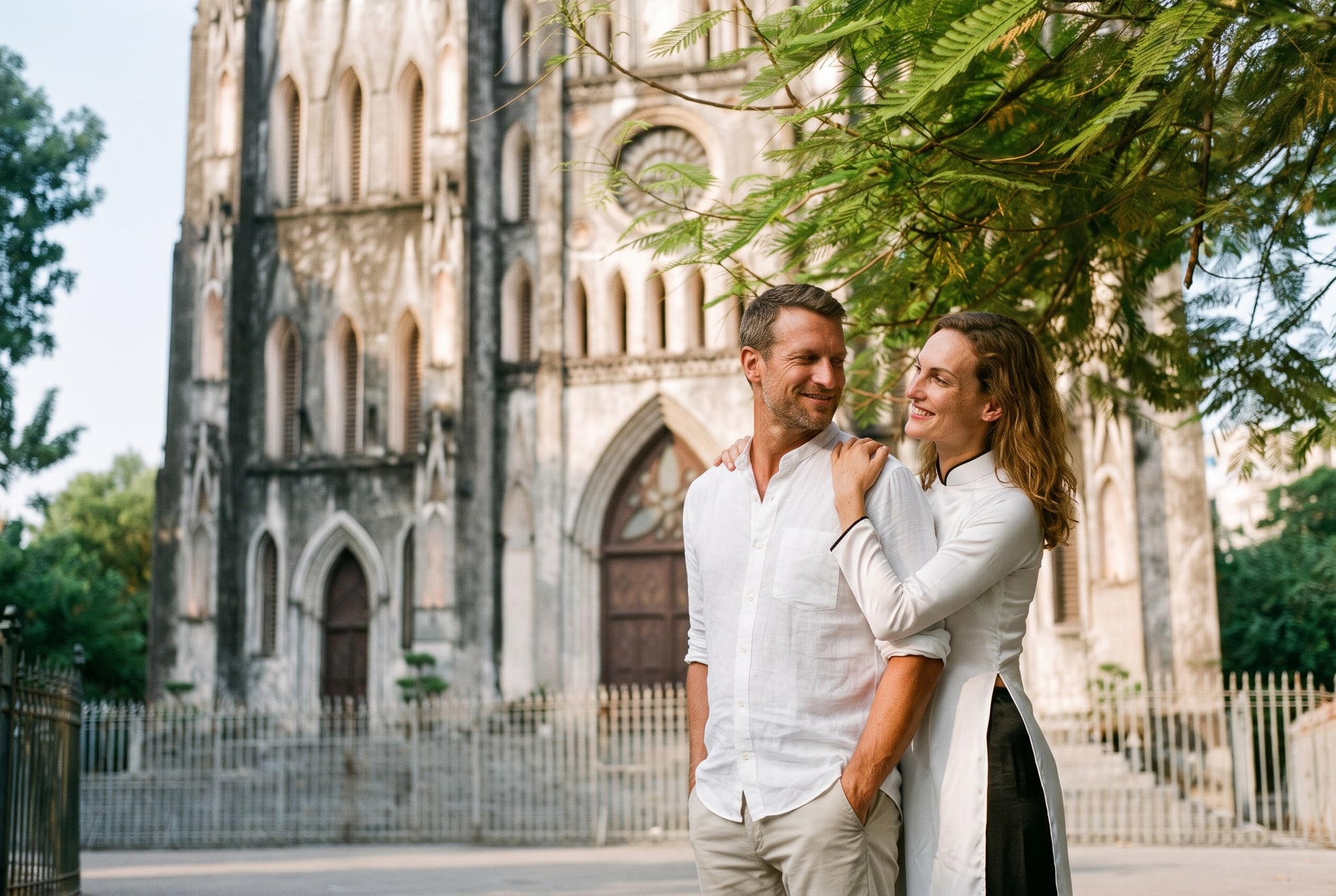
Absolutely. We style matching ao dai for anniversaries, renewals, couple proposal shoots, family photoshoots where multiple generations wear ao dai, and casual couple sessions during holidays. For an anniversary in Hanoi, we shot a couple who'd worn matching red and cream ao dai at their wedding 20 years earlier—they ordered the same colour combination but in modern, slightly looser cuts, and the shoot felt both nostalgic and fresh. For a proposal in Saigon, we worked with the groom's family to coordinate his ao dai with the bride's in advance; he proposed in the gardens near Bitexco, and the matching pieces made the moment feel ceremonial without looking staged. We've also donefamily shoots where the whole family—grandparents, parents, children—wore coordinated ao dai in the same colour palette, each piece tailored to the person's age and body. The rule is the same: unity through colour and theme, not through sameness. It works for any event where you want to mark a moment and honor Vietnamese tradition together.
How far in advance should we book matching ao dai and the photoshoot?
We recommend starting 4–6 weeks before your planned shoot date. Here's why: if you're custom-tailoring, the tailor needs 2–3 weeks, leaving you 1–2 weeks to do a fitting with us and make final adjustments. If you're buying ready-made, you still want time to get alterations done locally and test the pieces in different lighting. On our end, our ao dai photoshoot package books fastest during spring and autumn (March–April, September–October), when the light and weather are ideal in all four cities. Summer shoots in Hanoi or Saigon are hot, and winter in Ninh Binh can be cold and misty—both are doable but require different styling. Once you've chosen your date and location, we'll send you a detailed WhatsApp message with a checklist: fabric swatches to bring, fitting notes, a rundown of what happens hour by hour on the day. Most couples who book us ask about makeup and hair at your hotel as well, since the ao dai deserves a complete look; if that's your plan, we coordinate the whole timeline so you're not rushed.
See packages and prices on vietnamphotoshoot.com
What mistakes do couples make when choosing matching ao dai?
We've seen the same errors repeatedly, and they usually show up in the final shots. One: couples choose a colour they love in isolation without checking how it sits against their skin tone under different light. A jewel green might look stunning on the hanger but muddy on camera if your undertone doesn't match. Two: they buy pieces without a fitting, assuming "medium" or "standard" will work. Ao dai cuts vary wildly between tailors; a "medium" from one maker might be two sizes off from another. Three: they match in fabric weight without thinking about the season. A heavy brocade ao dai in summer heat looks stiff and uncomfortable on the person—it reads as stiff on camera too. Four: they underestimate how much a poorly fitted side seam affects the silhouette. If the seam is off-centre or loose, your torso looks wider than it is, and no amount of posing or retouching fixes it. Five: they don't book makeup and hair support early enough, then scramble on the morning of the shoot. Our stylists always recommend booking hair and makeup at the same time as the photoshoot package—it ensures everyone's on the same schedule and your look is cohesive. The fix for all of these: communicate early with your tailor and with us. Send photos, ask questions, do a test session if possible.
FAQ
Can we wear matching ao dai if we're not getting married?
Yes. Couples wearing matching ao dai for anniversary shoots, couple portraits, or holiday photos are common. The pieces don't have to be formal or ornate—simple coordinated colours work just as well for a casual couple's session.
How much should we budget for custom-made matching ao dai?
Pricing varies by tailor and fabric choice. Ask us for a quote on WhatsApp and we'll connect you with makers we trust in your city. Provide fabric preferences and we'll give you a realistic timeline and budget range.
What if one of us is much taller or has a very different body shape?
Custom tailoring is the best option. A skilled tailor can adjust proportions so both pieces flatter the wearer. We've worked with couples where one partner is petite and the other is tall—custom ao dai made both feel confident on camera.
Do we need to break in the ao dai before the shoot?
Yes, if possible. Wear it around your home for an hour or two to check the fit and comfort. New ao dai can feel stiff; wearing it briefly beforeens the fabric and helps you move naturally in front of the camera.
Can we mix ready-made and custom ao dai if we're a couple?
Absolutely. One partner might wear a ready-made piece that fits well off-the-rack, while the other gets a custom piece adjusted. As long as the colours and themes coordinate, it works. We've styled many couples this way.
What's the difference between an ao dai for a photoshoot and one for everyday wear?
Photoshoot ao dai often feature richer colours, more detailed embroidery, and heavier fabrics that photograph well. Everyday ao dai can be simpler and lighter. For a couple's shoot, we usually recommend pieces with some visual interest (embroidery, texture, shimmer) so the camera captures detail and dimension.
Ao Dai Photoshoot
Inclusions, prices and booking are on our booking site.
FAQ
Can we wear matching ao dai if we're not getting married?
Yes. Couples wearing matching ao dai for anniversary shoots, couple portraits, or holiday photos are common. The pieces don't have to be formal or ornate—simple coordinated colours work just as well for a casual couple's session.
How much should we budget for custom-made matching ao dai?
Pricing varies by tailor and fabric choice. Ask us for a quote on WhatsApp and we'll connect you with makers we trust in your city. Provide fabric preferences and we'll give you a realistic timeline and budget range.
What if one of us is much taller or has a very different body shape?
Custom tailoring is the best option. A skilled tailor can adjust proportions so both pieces flatter the wearer. We've worked with couples where one partner is petite and the other is tall—custom ao dai made both feel confident on camera.
Do we need to break in the ao dai before the shoot?
Yes, if possible. Wear it around your home for an hour or two to check the fit and comfort. New ao dai can feel stiff; wearing it briefly beforeens the fabric and helps you move naturally in front of the camera.
Can we mix ready-made and custom ao dai if we're a couple?
Absolutely. One partner might wear a ready-made piece that fits well off-the-rack, while the other gets a custom piece adjusted. As long as the colours and themes coordinate, it works. We've styled many couples this way.
What's the difference between an ao dai for a photoshoot and one for everyday wear?
Photoshoot ao dai often feature richer colours, more detailed embroidery, and heavier fabrics that photograph well. Everyday ao dai can be simpler and lighter. For a couple's shoot, we usually recommend pieces with some visual interest (embroidery, texture, shimmer) so the camera captures detail and dimension.
More from the team
Ao Dai Photos at Hoi An Lantern Street at Night
Hoi An Lantern Street (Nguyen Hoan) glows at dusk with silk lanterns and reflected light. Our team shoots ao dai here after dark, navigates tight vendor spaces, and handles the low-light challenge with experience from 100+ night sessions.
Ao dai for wedding photos in Quy Nhon: renting, fitting and styling
Quy Nhon's coastal backdrops pair beautifully with traditional ao dai. We walk through rental choices, fitting logistics and how our team coordinates styling on shoot day.
Vietnam Pre-Wedding Photoshoot: What We Book at Cáo Studio
Pre-wedding shoots in Vietnam mean morning light in Hoi An's Old Town, cyclos in Saigon, or terraced fields near Ninh Binh. We walk you through what a session actually costs, how we schedule it, and what goes wrong on the day.