 Cáo Studio
Home › Blog › Pre-Wedding & Elopement
Mu Cang Chai Rice Terraces Wedding Photos: Best Light & Timing
By the Cáo Studio team · Hanoi & Saigon · 2026-11-04
Mu Cang Chai rice terraces near Yên Bái province, northern Vietnam, photograph best during golden hour—one hour before sunset and one hour after sunrise—when low-angled sun turns paddies bronze and gold. Light changes every 15 minutes; we plan pre-wedding shoots for 4–6 hours to capture multiple looks: soft morning mist, bright mid-day contrast, and warm evening glow. Terrain is steep, muddy in rain, and crowds peak 09:00–11:00, so we arrive 06:30 or shoot 15:00–18:00. Cáo Studio books sessions with a local guide, portable makeup kit, and backup outfits. Cost depends on team size and hotel pickup; ask us for a quote on WhatsApp. Chat with us on WhatsApp
Mu Cang Chai's rice terraces sit 1,000 meters above sea level and photograph like nowhere else in Southeast Asia. We've shot there in every season and learned that light—not just the location—makes the image. Timing, weather, and what you wear all shift how the camera sees those curves. This is what happens on our shoots there, hour by hour.
Why does morning light look so different from afternoon light here?
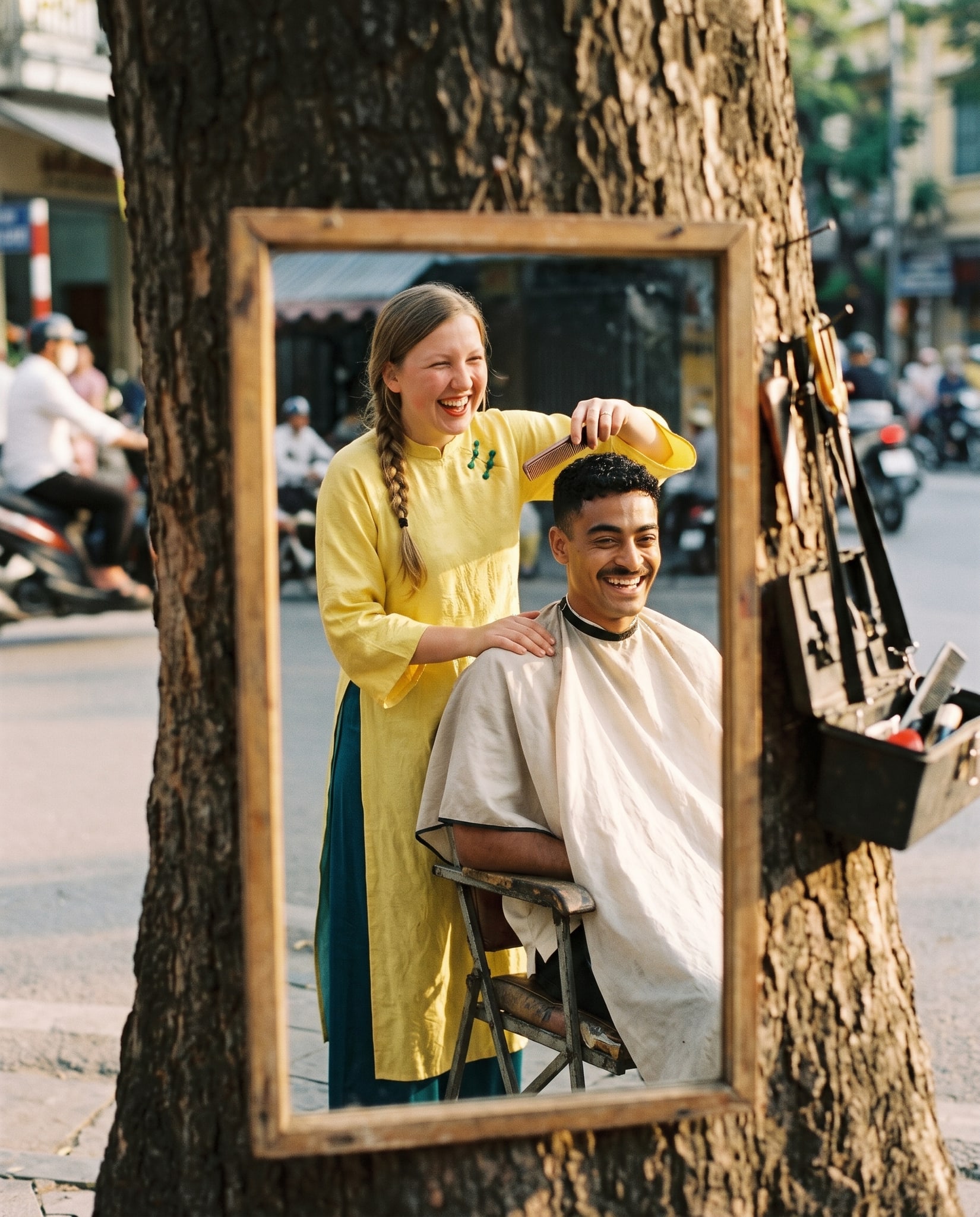
Sunrise hits the eastern terraces first, creating soft silhouettes and mist in valleys. By 07:30, side-lit beams define each paddy edge without washing out skin tones. At midday (11:00–14:00), sun sits high overhead, flattening depth; we avoid this window. Afternoon light (15:00 onward) swings west, throwing long shadows across the paddies and warming greens to gold. We choose morning for dreamy, intimate shots and late afternoon for bold, saturated color. Skin tones hold detail better in golden hour than in bright noon sun—the physics of angled light versus overhead rays.
What does the 15-minute light rule mean for our shot list?
We map a shot sequence knowing light shifts every 15 minutes. At 06:45, mist rises and backlights a couple near water. By 07:00, the same spot has crisp sidelighting. By 07:15, shadows lengthen. We move positions deliberately, shooting 3–4 setups per light phase. This prevents wasted time and lets us deliver variety: soft portrait, dramatic silhouette, lush landscape. Many couples ask if they can "just shoot one hour." One hour gives maybe two complete looks. Pre-wedding sessions that book 4–5 hours capture the full story Mu Cang Chai tells across daylight.
When do we actually arrive, and why does crowd timing matter?
We arrive 05:30–06:00 for sunrise shoots. Tourist buses arrive 09:00–11:00, filling viewpoints with 50+ people. By 15:00, crowds thin. We either shoot before 08:30 or after 16:00 to avoid photo-bombing. Muddy paths are worst after rain; we check weather 48 hours prior and reschedule if forecast shows heavy storm. We also scout access points the day before to know which terraces drain fast and which stay wet. One couple came in August after overnight rain; we pivoted to wider shots that hid puddles and found a secondary ridge they liked even more.
How do outfits and makeup choices shift under different light?
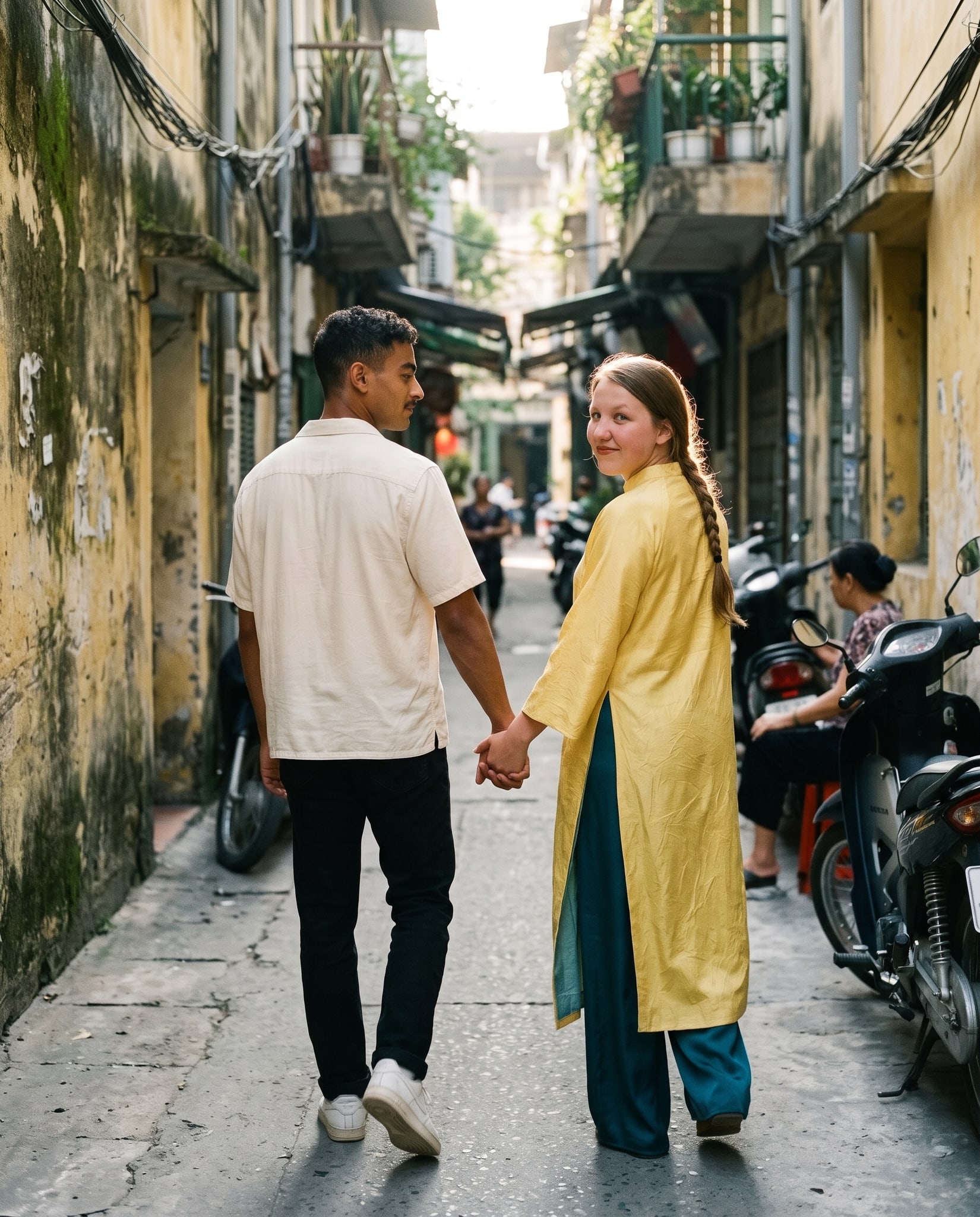
Golden hour is forgiving; jewel tones (deep blues, burgundies) and metallics look rich. Midday requires bright, saturated colors to pop against blown-out sky. Skin makeup runs in humidity; we use setting spray and powder religiously and touch up every 45 minutes. Red lips fade fastest in strong sun; peachy or nude tones last longer and photograph truer at distance. White áo dài glows beautifully in soft morning light but can overexpose in noon sun; we meter off fabric and adjust exposure. We advise couples to bring a light shawl for early morning—mist makes 1,000 meters cold—and a hat for afternoon to keep sun off face between shots. Our makeup and hair at your hotel service prepares you; we retouch on-site as needed.
What's the practical choice between sunrise and sunset at Mu Cang Chai?
| Timing | Light color | Crowd level | Mist? | Fatigue | Wear what |
|---|---|---|---|---|---|
| Sunrise (05:30–08:00) | Soft pink, gold, blue | Very low | Yes, thick | Low | Layer + jacket |
| Late afternoon (15:00–18:00) | Bronze, warm amber | Low–medium | No | Higher | Light layers |
| Sunset (17:30–19:00) | Deep gold, pink, purple | Low | No | Moderate | Jacket for dusk chill |
Sunrise offers mist drama and solitude but requires early wake. Late afternoon avoids mist but gives clearer, warmer tones. Sunset stretches shooting but ends in twilight dimness—we finish by 18:30. We ask couples their energy level; night owls prefer afternoon, early risers love sunrise. We also run couple photoshoots that pair one pre-dawn location with an afternoon shift elsewhere, giving two distinct light stories in one day.
What do we actually tell couples on WhatsApp before the shoot?
"Wear layers. 06:00 start means 05:15 pickup. Paths are muddy; bring old shoes. We'll have makeup done by 06:00, so 04:45 hair/dress time. Mist clears by 08:00, so first shots have atmosphere. Bring water—altitude makes you thirsty. Phone battery dies fast in cold; keep it in a pocket. We'll do portraits on one terrace, walking shots on the ridge, and sit-down shots by the water. If you're cold, say so; we can move or take a break. Light changes every 15 minutes, so we move fast. No phone time; you'll see images the next day." Honest detail prevents surprises.
See packages and prices on vietnamphotoshoot.com
How does altitude and terrain affect what we plan?
Mu Cang Chai sits 1,000 meters up; couples from sea-level Hanoi or Saigon feel it. Steep slopes tire legs. We factor in 10–15 minutes to walk to a prime terrace and tell couples to wear supportive shoes, not heels or flip-flops. We also scout paths beforehand; during one shoot in July, our usual route was blocked by a landslip. We found a secondary ridge two terraces over in 10 minutes, but preparation saved panic. In dry season (September–November), terrain is firm. In wet season (May–August), we choose wider, shallower paths and avoid edges. We also bring a small medical kit—one groom rolled an ankle on a root; we wrapped it, sat him down, and shot sitting poses for an hour while his fiancée did walking solo shots.
What backup lighting or gear do we bring?
Natural light is our first choice. We occasionally bring a small reflector to lift shadow on faces during golden hour—especially useful if a couple is backlit and we want to see their eyes. We avoid artificial flash; it kills the dream-like mood Mu Cang Chai offers. If clouds roll in suddenly, we adapt: overcast gives even, soft light ideal for intimate portraits. One April shoot went gray at 16:00; instead of canceling, we shot couples in a covered pavilion and used the muted light for close-ups. Lenses matter: we use 35mm and 50mm primes for intimate shots and 85mm for compressed landscapes. Ultra-wide (16–24mm) flattens terraces; we use it sparingly for dramatic silhouettes only.
How do we decide: one full day at Mu Cang Chai or split across two locations?
Mu Cang Chai alone can feel repetitive if you shoot more than 5 hours. Many couples pair it with a second location—a nearby village market in the early morning, then Mu Cang Chai afternoon, or vice versa. This gives two distinct moods in one day. Our special concept shoot packages let us customize: sunrise in a small village, afternoon at terraces, sunset back in town. Travel time between Yên Bái and Hanoi is 3–4 hours; we factor this into day planning. Some couples do a dedicated Mu Cang Chai half-day and book a separate session in Hanoi or Saigon for urban contrast. Ask us for a quote on WhatsApp; we'll map the best rhythm for your story.
What to check before you book
- Season: Check 10-day weather forecast before finalizing. Avoid peak tourist season (July–August) unless you want crowds. Dry season (September–November) is ideal.
- Fitness: Mu Cang Chai is steep. If either partner has knee or ankle issues, tell us; we'll adjust terrain or pace.
- Áo dài vs. Western wear: Both photograph well. Áo dài flows beautifully on slopes; Western dress needs pockets or secure hems. We style both daily; ask which suits your vision.
- Sunrise readiness: If booking sunrise, confirm you'll be ready 05:15. Late wake-ups mean late sun—no mist, weaker light.
- Backup date: Book with a rain date 3–7 days later. If weather looks bad 48 hours prior, we reschedule, no penalty.
- Mobile signal: Mu Cang Chai has patchy 4G. We work offline and upload images after returning to town.
FAQ
Do we really need 5 hours, or can we shoot Mu Cang Chai in 2 hours?
Two hours captures one light phase well (either sunrise or golden afternoon). Five hours gives multiple moods and a backup if light changes unexpectedly. Couples who travel far usually book longer to maximize the location. We do offer half-day sessions; ask us for a quote on WhatsApp.
What's the difference between shooting Mu Cang Chai and other rice terrace spots in Vietnam?
Mu Cang Chai's terraces are wider, older, and more photogenic than Sapa's. They photograph across a wider tonal range—greens, golds, browns depending on harvest. Sapa is flatter and more touristy. For pure photography drama, Mu Cang Chai wins. For cultural story-telling, Sapa has more minority villages nearby. We've shot both; Mu Cang Chai is our pre-wedding photoshoot go-to.
Can we do Mu Cang Chai and another location in one day?
Yes. Nearby options: Yên Bái town market (30 min), Thác Bạc waterfall (45 min), or village homestays. We typically do early market or waterfall, then Mu Cang Chai for golden hour. This pairs urban energy with pastoral beauty. Book a special concept shoot to custom-plan the route.
What if one of us doesn't want to wake up for sunrise?
We shoot afternoon (15:00–18:00) instead. You lose mist but gain warmth and solitude. Light is rich and forgiving. Some couples prefer this—less rush, less cold, less exhaustion. Tell us your preference; we plan around it.
Do you provide transportation to Mu Cang Chai?
We coordinate pickup from your hotel in Hanoi (typically 03:30–04:00 for sunrise) or book a private car you pay directly. On your bill: only our photography, styling, and makeup. Transport is arranged separately. We recommend a driver familiar with mountain roads. Ask us for a quote on WhatsApp; we can suggest trusted drivers.
What if weather is bad on shoot day?
We reschedule to your backup date (3–7 days later). If forecast is poor 48 hours before, we offer to move proactively—no penalty, no rescheduling fee. In rare cases, we shoot in overcast light (it's soft and even) or pivot to an indoor or village location. Your images come first; we never force a bad-light shoot.
Pre-Wedding & Elopement
Inclusions, prices and booking are on our booking site.
FAQ
Do we really need 5 hours, or can we shoot Mu Cang Chai in 2 hours?
Two hours captures one light phase well (either sunrise or golden afternoon). Five hours gives multiple moods and a backup if light changes unexpectedly. Couples who travel far usually book longer to maximize the location. We do offer half-day sessions; ask us for a quote on WhatsApp.
What's the difference between shooting Mu Cang Chai and other rice terrace spots in Vietnam?
Mu Cang Chai's terraces are wider, older, and more photogenic than Sapa's. They photograph across a wider tonal range—greens, golds, browns depending on harvest. Sapa is flatter and more touristy. For pure photography drama, Mu Cang Chai wins. For cultural story-telling, Sapa has more minority villages nearby. We've shot both; Mu Cang Chai is our [pre-wedding photoshoot](/go/pre-wedding-photoshoot) go-to.
Can we do Mu Cang Chai and another location in one day?
Yes. Nearby options: Yên Bái town market (30 min), Thác Bạc waterfall (45 min), or village homestays. We typically do early market or waterfall, then Mu Cang Chai for golden hour. This pairs urban energy with pastoral beauty. Book a [special concept shoot](/go/special-concept) to custom-plan the route.
What if one of us doesn't want to wake up for sunrise?
We shoot afternoon (15:00–18:00) instead. You lose mist but gain warmth and solitude. Light is rich and forgiving. Some couples prefer this—less rush, less cold, less exhaustion. Tell us your preference; we plan around it.
Do you provide transportation to Mu Cang Chai?
We coordinate pickup from your hotel in Hanoi (typically 03:30–04:00 for sunrise) or book a private car you pay directly. On your bill: only our photography, styling, and makeup. Transport is arranged separately. We recommend a driver familiar with mountain roads. Ask us for a quote on WhatsApp; we can suggest trusted drivers.
What if weather is bad on shoot day?
We reschedule to your backup date (3–7 days later). If forecast is poor 48 hours before, we offer to move proactively—no penalty, no rescheduling fee. In rare cases, we shoot in overcast light (it's soft and even) or pivot to an indoor or village location. Your images come first; we never force a bad-light shoot.
More from the team
Pre-wedding photoshoot in Phu Quoc June: weather, light, crowds
June is Phu Quoc's monsoon season. Our studio has shot dozens of couples there in early summer—here's what weather and crowds really mean for your pre-wedding day.
Pre-wedding photoshoot in Phu Quoc July: weather, light, crowds
July is Phu Quoc's wet season, but it opens creative possibilities: moody skies, empty beaches after storms, and dramatic backlighting. We'll walk you through what happens on the ground.
Pre-wedding photoshoot in Phu Quoc November: weather, light, crowds
November is peak season for pre-wedding shoots in Phu Quoc: weather is stable, light is soft, but crowds peak mid-month. We share what our team sees on the ground.