 Cáo Studio
Home › Blog › Pre-Wedding & Elopement
Pre-wedding photo ideas and poses at Hanoi Old Quarter
By the Cáo Studio team · Hanoi & Saigon · 2026-11-02
The Hanoi Old Quarter is one of Southeast Asia's most photographed pre-wedding backdrops: 36 ancient streets, tube houses with weathered facades, lantern-lit intersections, and low morning light that renders skin tones warm. A typical pre-wedding photoshoot here runs 3–4 hours with our Cáo Studio team scouting 2–3 prime locations—usually Trang Tien, Dinh Lẻ, or Hang Gai streets. We position couples to frame architecture behind them, not compete with it, and shoot during 06:00–08:00 or 16:30–18:30 to avoid hard midday shadows and tourist crowds. Common mistakes: standing dead-center in alley bottlenecks, ignoring weathered walls that look rich on camera but feel cramped in-person, and choosing peak-hour times. Cáo Studio books narrow time windows with local guides and repositions if foot traffic spikes. Budget, packages, and availability depend on season and your vision—discuss specifics on our booking site to lock dates early. Chat with us on WhatsApp | See packages and prices on vietnamphotoshoot.com
What angles actually work on those narrow streets?
We've shot hundreds of frames on Dinh Lẻ, Trang Tien, and Hang Gai. The tube-house layout—wide street facing, deep narrow interior—favors side-on framing: groom's hand on bride's lower back, both facing the camera, a weathered shutter or shop sign in sharp focus behind. Frontal poses flatten the 1.2-meter-wide walls. Instead, we turn couples 45° toward the light source (usually east-facing alleys at dawn), which separates their silhouette from the stonework and lengthens the bride's profile. Hanoi's yellow and green heritage-house paint reads well in soft light; in harsh noon sun, it desaturates to beige. We also favor mid-frame cropping—waist-up or knee-up—because street clutter (motorcycles, power lines, shop buckets) multiplies when we back up. A single uncluttered wall segment, 2–3 meters wide, is our baseline. The Old Quarter's tourist density means we scout 06:00–07:00 or 18:00–19:00; by 09:00, the streets are impassable. Couples who insist on peak-hour shoots often wait 30+ minutes between frames, which kills energy and light.
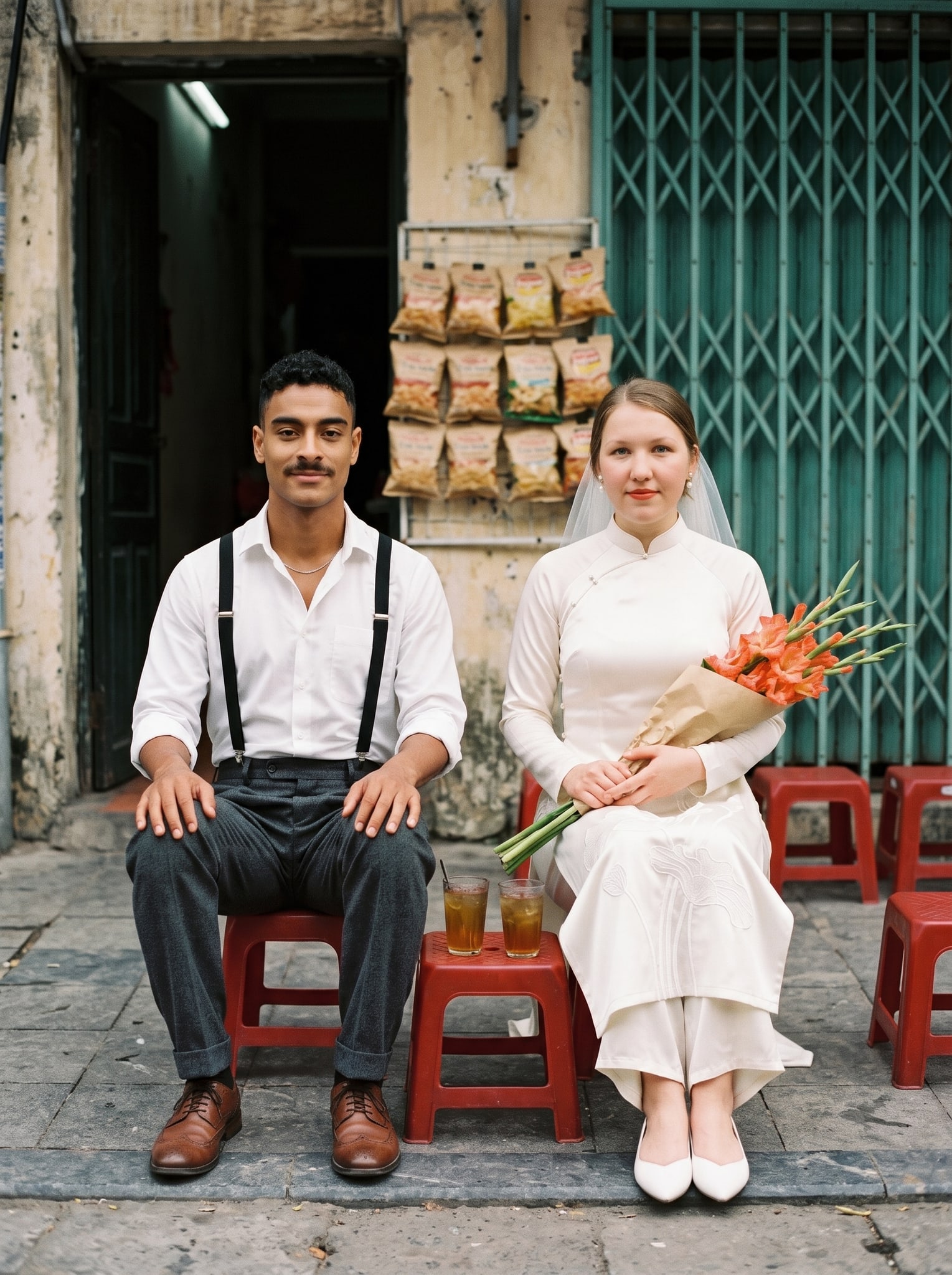
How do we frame the lanterns and shutters without looking like every other couple's album?
Lanterns and shutters are iconic, but shooting them head-on produces clichéd, flat results. We use them as framing devices, not subjects. A couple standing under a Hoi An–style lantern, with a shutter edge on the left and weathered stone on the right, reads as layered. We never put the lantern directly above the couple's heads—it creates harsh overhead shadow on the bride's eyes. Instead, we position them so the lantern sits at frame-right, slightly out of focus, guiding the viewer's eye to the couple's embrace. Shutters work the same way: we leave them slightly ajar (if the storefront allows), backlit, so they frame the couple but don't compete. A common error: shooting with the shutter closed and parallel to the camera—it becomes a flat graphic, not a storytelling element. We also shoot through elements: bride in the foreground, groom slightly back, a shutter slat crossing her shoulder, creating depth. This takes 2–3 extra angles to get right, which is why the full session—not just a quick stop—matters. Our team tries 4–5 framings per location; couples see the difference when we review on-site.
Which Hanoi Old Quarter streets should we avoid, and which make the best backdrops?
| Street | Why We Use It | Light Quality | Crowds (Peak Hour) | Best Time | Notes |
|---|---|---|---|---|---|
| Trang Tien | East-facing, long straight stretch, heritage cafes | Warm, directional dawn | Heavy 09:00–17:00 | 06:30–07:30 | Motorcycles frequent; ask locals for blocked times |
| Dinh Lẻ | Narrow alley, fewer shops, old wooden facades | Soft, diffused (shade) | Light–medium | 07:00–08:00 | Best for intimate poses; limited space for wide shots |
| Hang Gai | Silk shops, mixed heritage and modern, broader street | Variable (some sun) | Very heavy 10:00–18:00 | 06:00–07:00, 18:30–19:30 | Sunset option; morning cleaner |
| Hang Dao | Red lanterns, tourist hub, narrow chaos | Dappled, unpredictable | Extreme, all day | Avoid | Too congested; we rarely book here |
| Ma May | Restored facades, less touristy, quieter | Good, north-facing | Medium, mornings best | 07:00–08:30 | Emerging favorite; fewer tourist photos |
We avoid Hang Dao entirely—it's a pedestrian funnel, especially weekends. Trang Tien works if we start at 06:30; by 08:00, buses and motorbike taxis clog the frame. Dinh Lẻ and Ma May are quieter and feel more intimate; couples often prefer the smaller audience. Light direction matters: east-facing streets (Trang Tien, Hang Gai) deliver warm morning side-light; north-facing alleys (Dinh Lẻ) offer soft, even illumination but feel cooler in color. We match the couple's energy to the street: energetic, laughing couples thrive on Trang Tien's openness; quiet, tender moments suit Dinh Lẻ's alley intimacy.
What outfit and styling choices work best in the Old Quarter's light and setting?
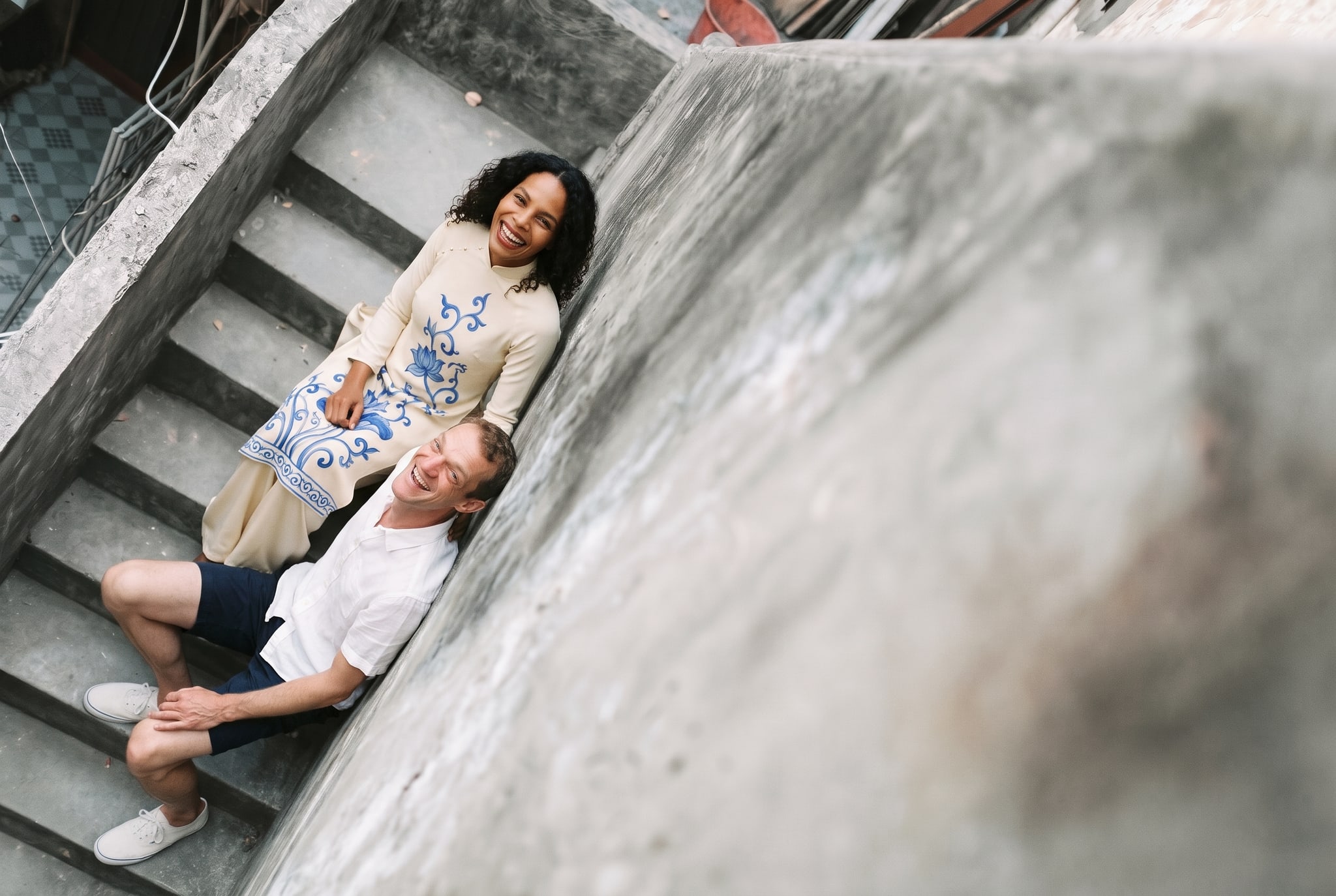
Our stylists notice that jewel tones and deep neutrals (emerald, burgundy, charcoal, ivory) read richly against weathered stone; pastels wash out in the Old Quarter's yellow-ochre color palette. The bride's áo dài, if chosen, should contrast the background—white or cream stands out against dark wooden shutters; deep blue or jade blends with heritage paint. We avoid metallic or shiny fabrics that create hot spots in soft morning light. Hair and makeup are lighter, fresher: the Old Quarter's romantic aesthetic pairs with minimal makeup, loose waves, or a sleek bun. Heavy contouring and bold lipstick feel disconnected from the setting's intimacy. The groom's suit works, but linen or cotton breathes better in Hanoi's humidity; by hour 2, standard wool looks creased and tired. We also advise couples to bring a lightweight shawl or jacket—the Old Quarter's narrow alley shade feels cool, and the bride may be cold after 30+ minutes of standing still. Footwear matters: closed-toe heels navigate cobblestones without catching; we've seen brides twist ankles on uneven alley floors. Thong sandals or flip-flops look casual in-frame and risk injuries. We suggest rehearsing the couple's walk together beforehand; one false step breaks the momentum and mood.
How do we handle the logistics and timing on the actual shoot day?
We meet the couple at a coffee shop on the Old Quarter's edge (usually near Hoan Kiem Lake)—never at the shoot location, where time is precious and light is fleeting. We do a 10-minute walk-through: discuss which streets are open, point out where motorcycles pile up, and identify 3–4 specific poses and framings the couple prefers. If they've booked a makeup and hair session, that happens at their hotel or our studio 90 minutes prior; they arrive camera-ready. We carry a small reflector, a telephoto lens for compressed background detail, and a wide-angle lens for environmental shots that include the alley's entire span. The couple carries water, phone, and a simple changing bag—nothing that slows movement. We shoot in 20-minute blocks: 5 minutes of walking and finding light, 12 minutes of posing and angles, 3 minutes for the couple to breathe, check phones, reset energy. If foot traffic spikes (a delivery van arrives, tourist group gathers), we pause and chat—we never rush the couple into a shot they didn't sign up for. By hour 3, light hardens or tourists peak; we wrap. We never stay beyond 08:30 in the morning or past 19:00 at dusk; light changes too fast to compensate. We review 20–30 culled frames on-site; couples see immediate proof and feel secure. This is why the pre-wedding photoshoot runs 3–4 hours: 1.5 hours of actual shooting, 1.5 hours of movement, scouting, and regrouping.
See packages and prices on vietnamphotoshoot.com | Chat with us on WhatsApp
What to check before you book an Old Quarter session
Confirm the exact streets your photographer will use—not "Old Quarter," which is vague. Ask for the 2–3 primary streets and backup locations. Verify the time window and light quality. 06:00–08:00 and 17:30–19:00 are optimal; noon sessions are usually compromises. Check the maximum hour duration. Three hours allows movement and rests; 2 hours feels rushed. Ask about crowd management. How does the photographer handle peak-hour foot traffic? Will they reposition or pause? Confirm styling expectations. What color palette, outfit changes, and makeup intensity does the photographer recommend? Request a walk-through or location photos beforehand so you see the exact spots and facades. Discuss the number of final images you'll receive; 50–100 edited frames is standard for a 3–4 hour session. Ask what's included: reflectors, location scouting, hotel pickup, digital proofs, and so on.
Our pre-wedding photoshoot package includes all of the above; we outline specifics during the WhatsApp consultation.
See packages and prices on vietnamphotoshoot.com | Chat with us on WhatsApp
Related Sessions and Packages
Couples often combine an Old Quarter shoot with other Hanoi experiences. A couple photoshoot in the Old Quarter pairs well with a vacation and solo photoshoot if you want images from both as a pair and as individuals. Some couples add ao dai photoshoot to their pre-wedding day—traditional dress in heritage streets deepens the cultural narrative. For a more relaxed vibe, a special concept shoot in the Old Quarter (e.g., a scavenger hunt through the streets, a "first meeting" reenactment) blends photography with storytelling. If you're planning from abroad, Cáo Studio Hanoi is based in the Old Quarter's neighboring district; we handle airport pickup, makeup and hair coordination, and weather pivots on the day. More details are on our studio blog.
FAQ
Is the Hanoi Old Quarter too crowded for pre-wedding photos in 2026?
Peak hours (09:00–17:00) are congested; early dawn (06:00–07:30) and evening (17:30–19:00) are quieter. We scout 48 hours before to identify open windows. Crowds spike weekends; weekday mornings are ideal.
Can we shoot indoors in a heritage café or shop in the Old Quarter?
Yes, if the owner permits. We arrange permission beforehand; some shops charge a small courtesy fee. Indoor shoots offer shelter and intimate framing but require higher ISO and slower shutter speeds.
What's the difference between an Old Quarter shoot and a temple or park shoot in Hanoi?
The Old Quarter emphasizes architecture, texture, and urban intimacy; temples offer ornate detail and stillness; parks provide open light and nature. Each suits different couple energies. We recommend a conversation to match your vibe to the location.
Should we wear traditional áo dài or Western wedding attire for the Old Quarter?
Both work, depending on the narrative you want. Áo dài complements heritage streets; Western suits and gowns create contrast. Some couples change outfits mid-session for variety. Discuss with your photographer beforehand.
How many location changes can we fit into a 3-hour pre-wedding session?
Two locations (e.g., Trang Tien and Dinh Lẻ) are realistic; three is tight. Movement between spots eats 15–20 minutes; light changes require repositioning. Quality at two locations beats rushed coverage of four.
What if it rains during our Old Quarter shoot?
Hanoi's alleys offer shelter under eaves and covered shopfronts. Rain creates moody, reflective frames. We always have weather-contingent dates and reschedule if visibility is poor. Discuss backup dates during booking.
Pre-Wedding & Elopement
Inclusions, prices and booking are on our booking site.
FAQ
Is the Hanoi Old Quarter too crowded for pre-wedding photos in 2026?
Peak hours (09:00–17:00) are congested; early dawn (06:00–07:30) and evening (17:30–19:00) are quieter. We scout 48 hours before to identify open windows. Crowds spike weekends; weekday mornings are ideal.
Can we shoot indoors in a heritage café or shop in the Old Quarter?
Yes, if the owner permits. We arrange permission beforehand; some shops charge a small courtesy fee. Indoor shoots offer shelter and intimate framing but require higher ISO and slower shutter speeds.
What's the difference between an Old Quarter shoot and a temple or park shoot in Hanoi?
The Old Quarter emphasizes architecture, texture, and urban intimacy; temples offer ornate detail and stillness; parks provide open light and nature. Each suits different couple energies. We recommend a conversation to match your vibe to the location.
Should we wear traditional áo dài or Western wedding attire for the Old Quarter?
Both work, depending on the narrative you want. Áo dài complements heritage streets; Western suits and gowns create contrast. Some couples change outfits mid-session for variety. Discuss with your photographer beforehand.
How many location changes can we fit into a 3-hour pre-wedding session?
Two locations (e.g., Trang Tien and Dinh Lẻ) are realistic; three is tight. Movement between spots eats 15–20 minutes; light changes require repositioning. Quality at two locations beats rushed coverage of four.
What if it rains during our Old Quarter shoot?
Hanoi's alleys offer shelter under eaves and covered shopfronts. Rain creates moody, reflective frames. We always have weather-contingent dates and reschedule if visibility is poor. Discuss backup dates during booking.
More from the team
Boho pre-wedding photoshoot in Vietnam: Hanoi, Saigon, Hoi An
Boho pre-wedding shoots mix romantic, free-spirited aesthetics with Vietnam's landscapes and heritage sites. We run full-day sessions in three cities, handling styling, makeup, location scouts and edits.
Avoid crowds at Hoang Su Phi rice terraces: timing for wedding shoots
Hoang Su Phi's terraced landscape draws couples and tour buses in equal measure. We show how to shoot there alone, when to arrive, and what to arrange with us before you go.
Photography rules at Con Dao beaches: permits, drones and what to check
Con Dao's beaches demand prep before you shoot—permits, drone zones and tide timing all affect your day. We share what the Cáo Studio team verifies on every booking.