 Cáo Studio
Home › Blog › Pre-Wedding & Elopement
Pre-wedding photo ideas and poses at Hanoi Opera House
By the Cáo Studio team · Hanoi & Saigon · 2026-11-02
Hanoi Opera House pre-wedding shoots typically run 2–3 hours and cost from our pre-wedding package starting point, covering hair and makeup arrival, 40–60 final images, and an album. The venue's grand symmetry (columns, arched windows, cream façade) dominates the frame, so we position couples off-center to avoid stiffness: one partner slightly ahead, bodies angled 45 degrees, hands naturally on chests or intertwined. Golden hour—6:00 to 7:00 p.m.—floods the stairs with amber light and softens hard shadows from midday sun. Avoid 11 a.m. to 3 p.m. (harsh overhead light bleaches skin). The Opera House steps get crowded after 5 p.m. in peak season, so early morning (6:30 to 8:30 a.m.) or late afternoon work better. Bring a long áo dài or Western dress that moves; stiff fabrics catch unflattering wrinkles when sitting on steps. Cáo Studio's stylists help you choose looks that read clearly against that pale stone without washing out. Check the weather 48 hours before; rain darkens the façade and creates reflections in puddles that either ruin shots or create moody frames, depending on your preference. Chat with us on WhatsApp | See packages and prices on vietnamphotoshoot.com
What does symmetry actually do in Opera House frames?
The Opera House's symmetric design—double columns, mirrored arches, centered entrance—is a double-edged tool. Dead-center couples (both shoulder-to-shoulder, facing the camera straight-on) vanish into the architecture; the building overpowers them. We instead break symmetry by placing the couple in front of one column pair, letting that rhythm frame them without competing. One partner's face catches the light while the other's is gently shadowed—creates depth the full-frontal shot loses. The conclusion: use symmetry as backdrop structure, not composition rule.
How does Hanoi's humidity change your pose choices?
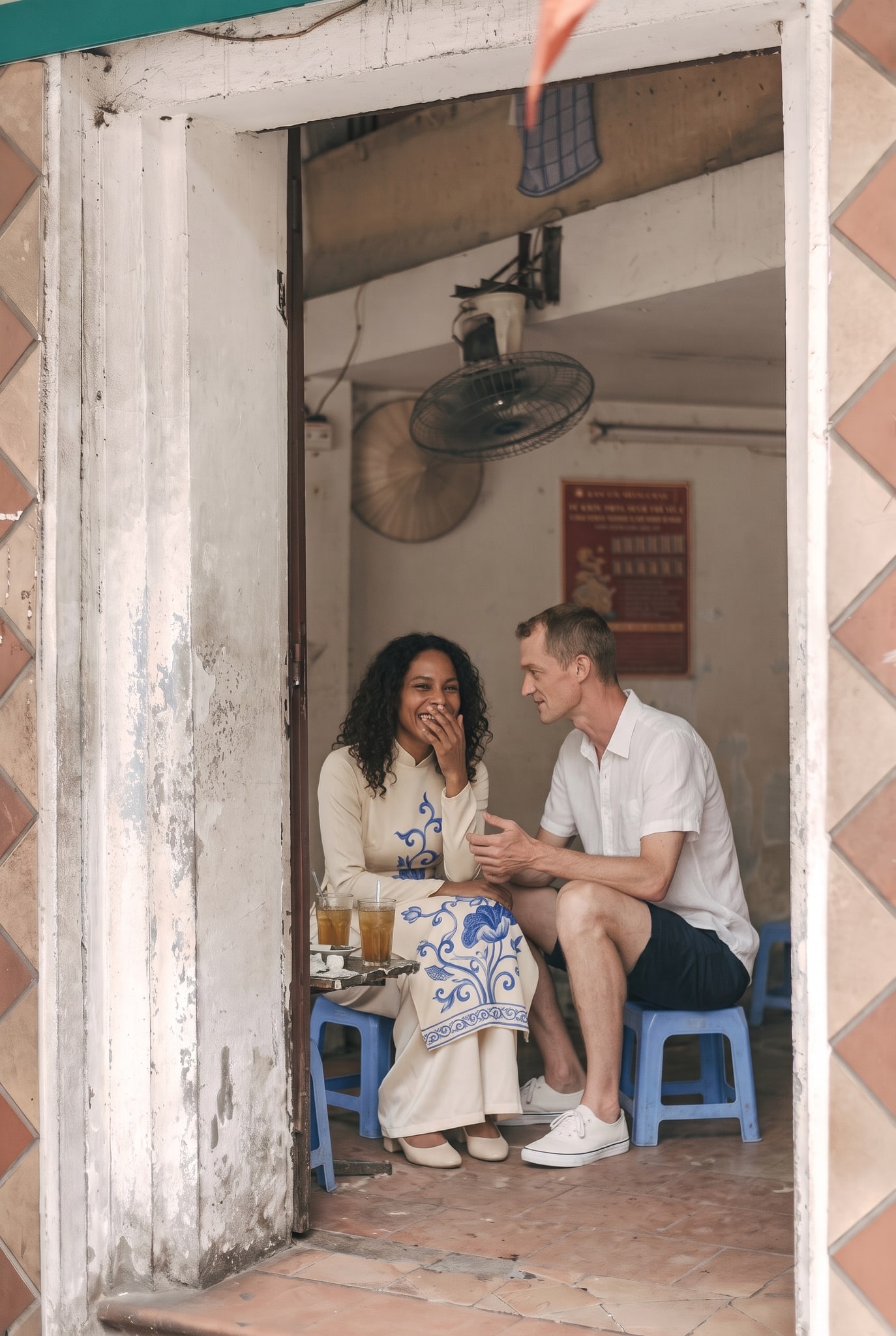
By 9 a.m. in May through September, humidity climbs above 80%, and sweat shows on foreheads and upper lips within 15 minutes. Makeup artists on our team retouch every 5–10 shots during these months. Poses that require tight physical contact—foreheads touching, bodies pressed together—show skin oils and sweat stains later. We default to poses with small gaps: hands touching but torsos angled apart, his hand on her lower back (not squeezed), her chin resting on his shoulder rather than both pressed cheek-to-cheek. Lighter fabrics (linen, raw silk, thin cotton) don't cling to wet skin the way satin does. The insight: humidity is invisible until you look at the final images, so wardrobe and pose choice matter more than you'd expect.
Which Opera House side gives the best light at different times?
The Opera House faces northwest. At sunrise (6:00 to 6:45 a.m.), the eastern side gets soft backlighting—creates a halo effect if you expose for the face. The front steps stay cool and empty. By 8:00 a.m., side light hits the north face, deepening the cream color and making moldings pop. At 5:00 to 7:00 p.m., the building glows golden-orange, but the western flank gets direct sun and harsh shadows. We almost always shoot the south-facing side at 5:30 to 6:30 p.m., when the sun is low enough to not squint the couple but high enough to keep the whole façade evenly lit. Early morning is softer and lonelier—better for contemplative, intimate poses. Conclusion: choose your time based on the mood, not just convenience.
How do stairs, railings and narrow spaces change what poses work?
The Opera House's grand staircase looks cinematic in photos but constrains posing. Only two people fit side-by-side on a step comfortably; three across is a squeeze. We pose couples sitting on steps with legs extended downward (one person's leg over the other's), standing two steps apart with him a step higher (creates flattering height difference), or her sitting while he stands behind with hands on her shoulders. Railings can trap limbs awkwardly, so we avoid leaning on them; instead, we guide couples to use the railing as a line that leads away from them (the eye follows it out of the frame). Narrow side passages near the entrance work for close-up portraits where the architecture barely shows. The takeaway: tight spaces force simplicity, which often reads stronger than sprawling poses.
What should you wear so clothes don't fight the building?
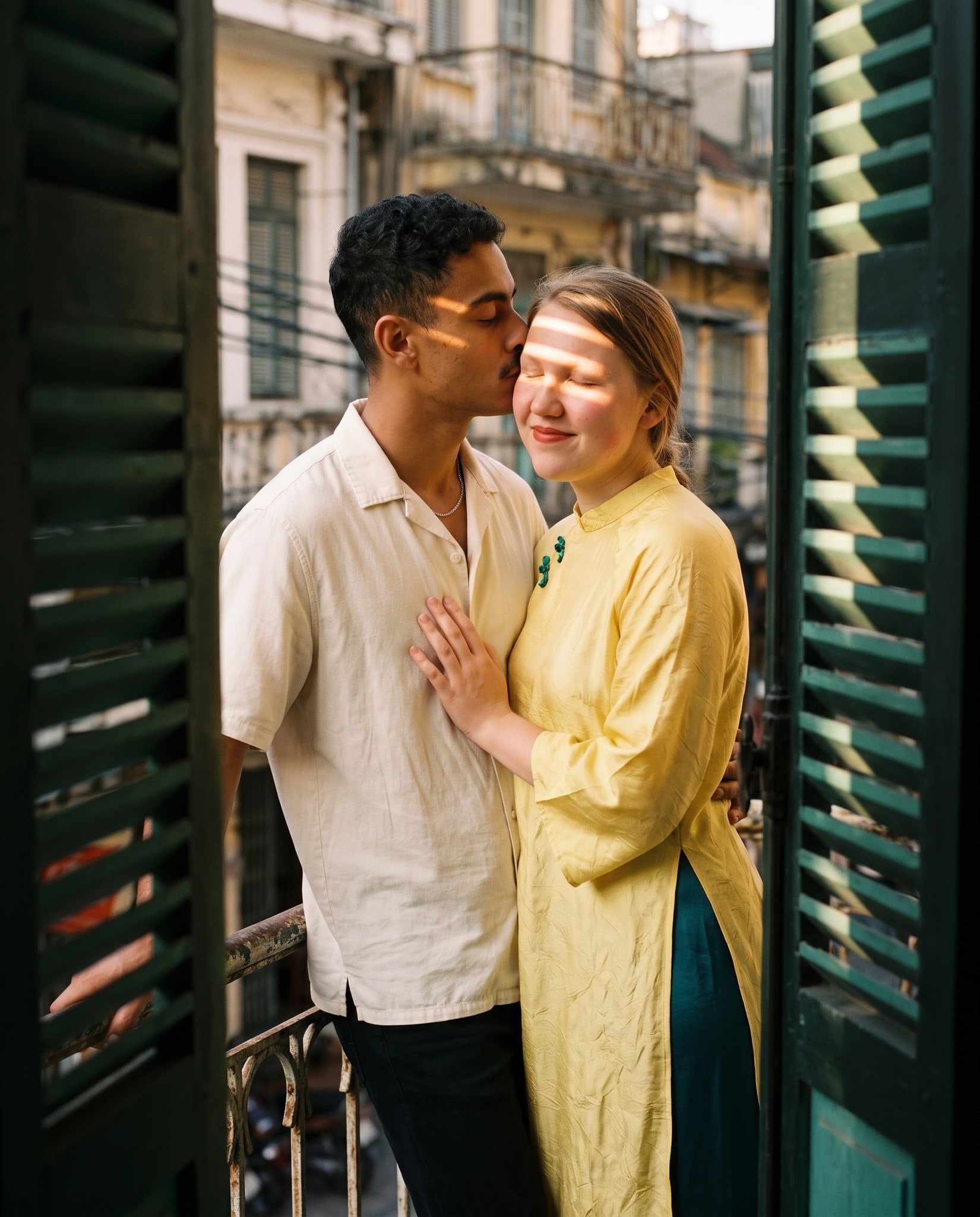
The Opera House's soft cream, gold and pale gray stonework needs outfits that either complement or contrast—never blend. Pale pink, beige, or cream áo dài wash out against the building; you become a blur. Jewel tones (emerald, sapphire, burgundy) and deep traditional colors (navy, black, wine silk) read—they separate the couple from the background. For Western dress, long, flowing fabrics (chiffon, organza, lightweight linen) photograph better than stiff taffeta, which bunches at the waist when sitting. Men in dark tailored suits work everywhere; light gray suits work only before 10 a.m. or after 5 p.m. Metallic accessories (gold jewelry, sequined clutch) catch golden-hour light and add energy without competing. Our stylists often suggest one partner in a darker, richer tone and the other in a slightly lighter complement—creates visual separation and draws the eye to both. Quick rule: ask yourself, "Will this color disappear into pale stone?"—if yes, change it.
| Outfit choice | Best time of day | Why it works | Avoid if |
|---|---|---|---|
| Emerald or sapphire áo dài | 7:00–8:00 a.m. or 5:30–6:30 p.m. | Rich color pops; jewel tones warm in golden light | You want a soft, romantic mood (jewel tones read bold) |
| Cream or pale silk áo dài | 6:00–7:00 a.m. only | Early light is soft enough not to overexpose pale fabric | It's after 10 a.m. or before 5 p.m. (you'll disappear) |
| Navy suit (groom) + burgundy áo dài (bride) | Any time 5:30 p.m. onward | Strong contrast; deep tones photograph richer as light fades | You prefer a light, morning aesthetic (colors feel heavy at dusk) |
| Black tailored suit + white dress | 6:00–8:00 a.m. or 6:00–7:00 p.m. | Maximum contrast; white glows in golden light | Midday (harsh shadows under white fabric look like stains) |
| Flowing, lightweight fabrics (chiffon, organza) | Golden hour, any season | Movement reads in photos; wrinkles smooth naturally | You're sitting still for extended periods (folds look awkward) |
What to check before you book an Opera House shoot
Permit and police. The Opera House grounds require no formal permit for pre-wedding shoots, but plainclothes security patrol the steps. If a guard stops you, move 20 meters down the street (the sidewalk outside the property is public). Most couples don't get stopped, but a 5-minute hiatus is normal. Our team knows the boundaries and positions shoots just outside the gate if needed—you won't notice in photos.
Weather windows. Rain in Hanoi is sudden and hard, especially May to August. Check the forecast 48 hours before; if rain is forecast, we can move the shoot to the covered colonnade inside the Opera House foyer (you'll need special permission booked 1–2 weeks early). Alternatively, we reschedule to the next dry window. Summer humidity turns makeup waxy by hour two, so we schedule shoots before 8:30 a.m. or after 5:00 p.m. in those months.
Foot traffic and crowds. Weekday mornings (Monday–Friday, 6:00 to 8:30 a.m.) are ghost-quiet. Weekends and evenings (5:00 p.m. onward) attract tourists and school groups. If you want solo isolation, pick a Tuesday or Wednesday at sunrise. Tourists in the background are actually useful for scale (they make the couple look more intimate), but if you want zero crowds, early morning is non-negotiable.
Physical fitness. The stairs are steep and long. If either partner has knee or ankle issues, we use the lower platform and side steps (just as cinematic, less climbing). Heels sink into stone cracks—bring flat shoes for arrival, change into heels for a few shots, then back to flats. We always tell guests to wear comfortable shoes to the session start.
Explore our pre-wedding photoshoot options
Our team has shot the Opera House in every season and time of day. Here's how we help: we arrive 20 minutes early to scout light, walk the couple through the staircase and poses, and bring a backup location (Hoàn Kiếm Lake, five minutes away) if police ask us to move. We shoot tethered to a tablet so you can see the frame in real time and request pose tweaks immediately. Hair and makeup touch-ups happen between location changes. We deliver 40–60 edited images within 10 days.
Want a full day that includes the Opera House plus a second location (sunrise at a temple, sunset at your hotel)? Check out our couple photoshoot package options. For áo dài-specific styling and poise coaching, the áo dài photoshoot adds hair, makeup and a stylist to help with draping and movement.
Need hair and makeup applied at your hotel before you leave for the Opera House? We offer hotel-based makeup and hair services so you arrive camera-ready, no rushing across Hanoi in traffic.
Chat with us on WhatsApp | See packages and prices on vietnamphotoshoot.com
How Cáo Studio shoots Hanoi Opera House differently
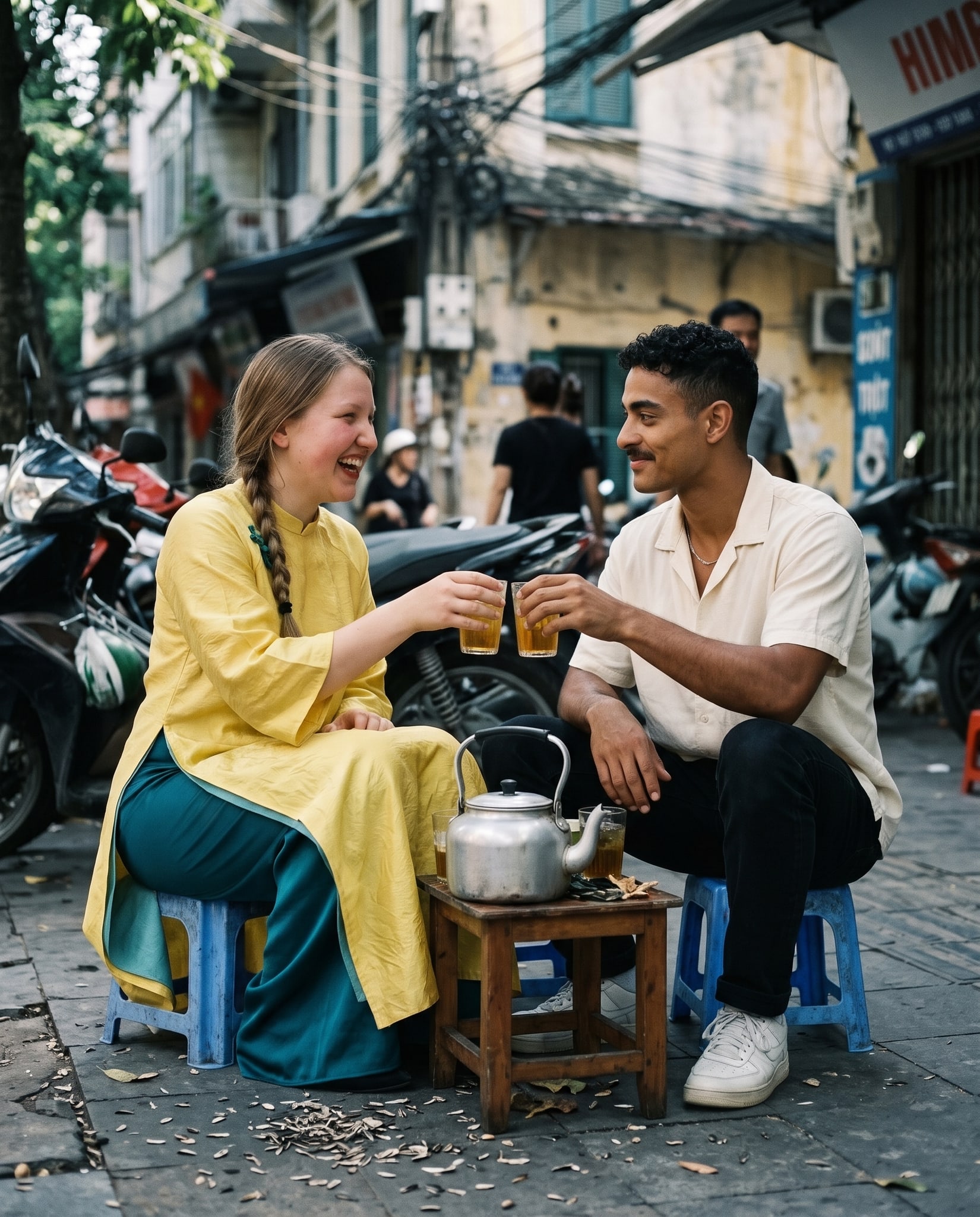
We know the light angles, the foot traffic patterns, and which security guards let us stay longer. We shoot on full-frame cameras (Canon 5D Mark IV, Sony A7 IV) that handle the Opera House's tricky mix of bright stone and shadowed arches without clipping highlights. We bring two photographers on every pre-wedding shoot—one captures portraits while the other shoots details (rings, fabric, your bride's expression)—then we pick the strongest 40–60 from 200+ frames. We also brief you on WhatsApp before the shoot: what to wear, when we'll arrive, where to park (there's no lot; Trang Tien Street has metered spots 2 minutes walk away). If you're coming from outside Hanoi, we can coordinate hair and makeup at our studio (Hang Bong, Old Quarter) and drive you to the Opera House directly. Read our blog for more Hanoi pre-wedding stories to see how other couples handled the venue and seasons.
FAQ
Can we shoot inside the Opera House building, not just the steps?
The Opera House interior requires permission from management, usually denied for pre-wedding photos. The foyer and grand staircase are occasionally available if you book 2–3 weeks in advance and pay a small access fee directly to the venue. We can arrange this—ask us via WhatsApp if it's a priority.
What time of year has the best light at the Opera House?
October to March (dry season, cooler, lower humidity) is ideal. Light is clearer, makeup lasts longer, and early morning feels less muggy. May to August is doable early morning (before 8:30 a.m.) but humidity and afternoon clouds reduce golden-hour quality. December and January are perfect but busier with other couples.
Do we need a permit or permission to shoot pre-wedding photos there?
No formal permit is required for the public steps and surroundings. Security may ask you to move if you're blocking foot traffic, but you can relocate 20 meters away (still in frame). We know the boundaries and move proactively. Some couples upgrade to an indoor or premium permit—we can help arrange that if you want guaranteed privacy.
How long does a typical Opera House pre-wedding shoot take?
Plan 2.5 to 3 hours total: 30 minutes for arrival, setup, and final wardrobe check; 90 minutes for poses and location changes; 30 minutes for touch-ups and close-ups. We shoot roughly 200 frames and deliver 40–60 edited images within 10 days.
Should we do the Opera House shoot in Western dress or áo dài?
Both work beautifully. Áo dài reads more formal and traditional (stunning in jewel tones against the cream façade); Western dress (long gown, tailored suit) offers a contemporary, elegant alternative. Many couples shoot both—áo dài in golden hour, Western dress at sunrise or a second location. Our áo dài photoshoot package includes professional styling if you want help choosing fabric and color.
What if it rains on the day of our shoot?
We reschedule to the next available dry window (usually within 1–2 days) at no extra cost. If rain is light and atmospheric, we can shoot it—wet steps and stone create moody, romantic frames. Heavy rain forces cancellation; you choose to reschedule or move to an indoor backup location like the Opera House foyer or our studio.
Pre-Wedding & Elopement
Inclusions, prices and booking are on our booking site.
FAQ
Can we shoot inside the Opera House building, not just the steps?
The Opera House interior requires permission from management, usually denied for pre-wedding photos. The foyer and grand staircase are occasionally available if you book 2–3 weeks in advance and pay a small access fee directly to the venue. We can arrange this—ask us via WhatsApp if it's a priority.
What time of year has the best light at the Opera House?
October to March (dry season, cooler, lower humidity) is ideal. Light is clearer, makeup lasts longer, and early morning feels less muggy. May to August is doable early morning (before 8:30 a.m.) but humidity and afternoon clouds reduce golden-hour quality. December and January are perfect but busier with other couples.
Do we need a permit or permission to shoot pre-wedding photos there?
No formal permit is required for the public steps and surroundings. Security may ask you to move if you're blocking foot traffic, but you can relocate 20 meters away (still in frame). We know the boundaries and move proactively. Some couples upgrade to an indoor or premium permit—we can help arrange that if you want guaranteed privacy.
How long does a typical Opera House pre-wedding shoot take?
Plan 2.5 to 3 hours total: 30 minutes for arrival, setup, and final wardrobe check; 90 minutes for poses and location changes; 30 minutes for touch-ups and close-ups. We shoot roughly 200 frames and deliver 40–60 edited images within 10 days.
Should we do the Opera House shoot in Western dress or áo dài?
Both work beautifully. Áo dài reads more formal and traditional (stunning in jewel tones against the cream façade); Western dress (long gown, tailored suit) offers a contemporary, elegant alternative. Many couples shoot both—áo dài in golden hour, Western dress at sunrise or a second location. Our [áo dài photoshoot package](/go/ao-dai-photoshoot) includes professional styling if you want help choosing fabric and color.
What if it rains on the day of our shoot?
We reschedule to the next available dry window (usually within 1–2 days) at no extra cost. If rain is light and atmospheric, we can shoot it—wet steps and stone create moody, romantic frames. Heavy rain forces cancellation; you choose to reschedule or move to an indoor backup location like the Opera House foyer or our studio.
More from the team
Boho pre-wedding photoshoot in Vietnam: Hanoi, Saigon, Hoi An
Boho pre-wedding shoots mix romantic, free-spirited aesthetics with Vietnam's landscapes and heritage sites. We run full-day sessions in three cities, handling styling, makeup, location scouts and edits.
Avoid crowds at Hoang Su Phi rice terraces: timing for wedding shoots
Hoang Su Phi's terraced landscape draws couples and tour buses in equal measure. We show how to shoot there alone, when to arrive, and what to arrange with us before you go.
Photography rules at Con Dao beaches: permits, drones and what to check
Con Dao's beaches demand prep before you shoot—permits, drone zones and tide timing all affect your day. We share what the Cáo Studio team verifies on every booking.