 Cáo Studio
Home › Blog › Pre-Wedding & Elopement
Pre-Wedding Photo Ideas and Poses at Hoi An Ancient Town
By the Cáo Studio team · Hanoi & Saigon · 2026-11-02
Pre-wedding shoots in Hoi An Ancient Town work best in two windows: early morning (06:00–08:00, empty streets, soft diffused light) and late afternoon (16:30–18:30, golden hour, lanterns beginning to glow). Cáo Studio books half-day sessions that begin before sunrise to capture the town in solitude, move through the Japanese Bridge and riverside markets by 07:30, then pause during midday heat and return for lantern-lit dusk shots. Budget 4–5 hours on-ground including hair and makeup touch-ups, outfit changes, and walking between sites. Couples should wear ao dai, Western formal wear, or casual Vietnamese fashion—each reads differently under river light and stone. Avoid shooting between 11:00–15:00 when sun is harsh and foot traffic peaks. Ask us for a quote on WhatsApp to include your chosen light windows and outfit count. Chat with us on WhatsApp | See packages and prices on vietnamphotoshoot.com
We have shot pre-wedding couples in Hoi An on every season and weather pattern since 2019. What surprises first-time planners is not the light or the locations—it is how much the tone of the town changes between 06:30 and 07:30. At 06:30 the French lanterns are still lit and the stone is cool-toned; by 07:30 natural light has won and the lanterns fade into the background. We time outfit changes and pose sequences around these transitions, not around a checklist.
How do we choose pose locations before a couple arrives?
The night before, we walk Hoi An with the couple's photographer and scout five to eight specific poses: two on the Japanese Bridge at sunrise, two in the riverside market, two in the narrow lantern alleys, and one or two at the old well or shophouse doorway. We check sight lines, where tourists will cluster by our shooting time, and which doorways have good background depth. We do not plan "poses" but camera angles—from this spot, shooting west into soft light, a couple's profile reads better; from that bench, a wide-angle captures both them and the bridge behind. On the day, if tour groups block the bridge by 07:15, we pivot to a secondary alley we marked the night before. Most couples do not need to know this happens; the images look equally strong.
What happens in the first 90 minutes of a shoot?
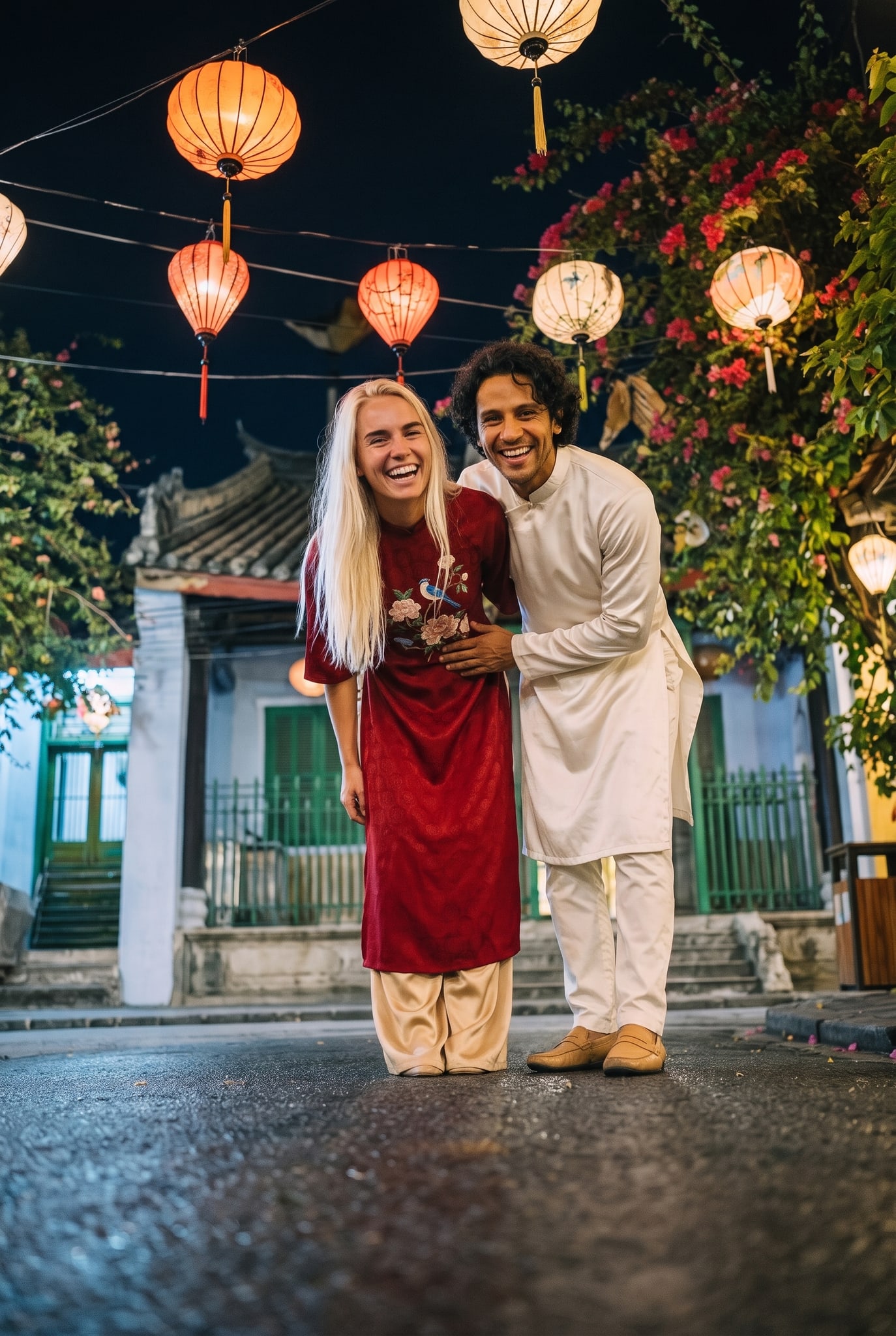
We arrive 30 minutes before the couple. Our makeup artist and stylist confirm lighting with the photographer, test focus on the bridge stone, and prepare touch-up kits. When the couple arrives (usually 06:00–06:30 for a sunrise start), we do a 15-minute hair and makeup check—powder the groom's forehead, reset the bride's eyeliner if she has been crying or smiling. The photographer takes 5–10 "arrival" frames while the couple is still calm and the light is at its cleanest. Then we walk to the Japanese Bridge. The key decision: do we shoot the couple on the bridge (crowded frames, strong lines) or beside it looking back (intimate, softer focus on architecture)? We usually do both, spending 20 minutes on each angle. By 06:50 we are walking to the riverside market; the light here is directional but not harsh. We position the couple near flower vendors or fruit stalls, have the couple walk toward camera naturally (not pose stiffly), and capture the motion. This is often where couples relax—they stop thinking and the images feel alive.
Why do we pause shooting during midday instead of pushing through?
Sun directly overhead creates shadow caves under cheekbones, hard edges on fabrics, and squinting. We have learned that couples who shoot straight through 11:00–15:00 end up with 200 images that all look identical and exhausted. Instead, we suggest a 2.5–3 hour break: the couple rests, eats, changes outfit if they planned a second look, and we review the morning's frames. At 16:30 the light shifts again. The sun is lower, the river reflects gold, and lanterns are being lit in shopfronts. This is when we shoot the most romantic images—the couple walking hand-in-hand down narrow alleys, the bride's áo dài catching golden light, both of them backlit by lantern windows. The second half often feels more intimate than the morning, even though the morning had better technical light. Couples feel more present.
Which outfits photograph best in Hoi An's light?
| Outfit Type | Light Window | Why It Works | Notes |
|---|---|---|---|
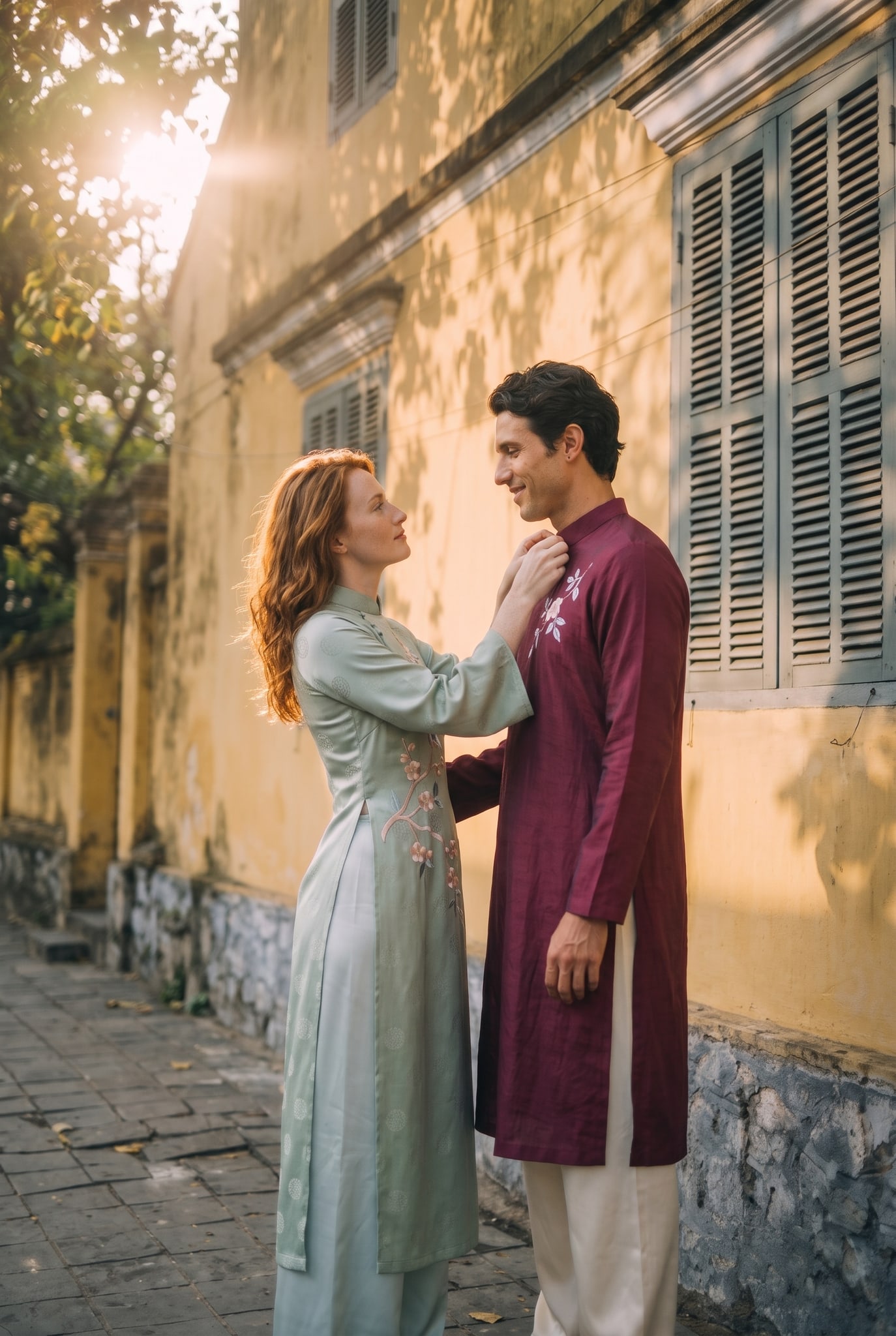
| Áo dài (traditional) | Both sunrise & sunset | Fabric catches directional light; silhouette reads clear against stone | Sunrise: cooler tones; sunset: warm tones. Choose one or both. |
| White/cream Western formal | Sunrise only | Avoids blown-out exposure in golden hour; reads elegant against aged architecture | Risk of shadow bands under trees—request open-sky locations. |
| Casual Vietnamese (linen shirt, silk pants) | Sunset preferred | Relaxed feel pairs with warm light; less formal but equally strong | Photographs well in market and alley scenes. |
We see couples overthink outfit count. One strong outfit worn for 3–4 hours, with styling changes (jacket on/off, hair re-pinned), often creates more authentic frames than three outfits rushed in 20 minutes each. If a couple does want multiple looks, plan one change during the midday rest, not during peak light windows when light is shifting every 3 minutes.
What do we fix on the day when plans fall apart?
Last month a pre-wedding couple arrived to rain at 06:00. The photographer shifted the shoot 30 minutes later; by 06:30 the clouds had thinned and light was actually more diffused and flattering than a clear dawn. We moved the Japanese Bridge shot to later (the light would be better in 45 minutes) and started in the riverside market, where the couple could walk under some shophouse overhangs if rain returned. Rain on stone creates reflections that look beautiful in the final frames. We tell couples this during the WhatsApp planning calls: "If there is drizzle, we stay. If there is heavy rain, we reschedule. Drizzle is often your best light."
Crowds are another reality. By 07:45 on weekends, foot traffic near the bridge picks up. We position the couple in spots where 1–2 passing tourists can be worked into the frame naturally, or we shoot in tighter angles that exclude the background altogether. The photographer has 15 years of experience framing around crowds; most couples do not realize they are in a busy place until they see the final images—the background feels intimate, almost empty. This is about camera height, lens choice, and timing the shutter when foot traffic pauses for a few seconds.
Which other Hoi An locations do we recommend beyond the Ancient Town center?
The Japanese Bridge is iconic, but we also use the Thu Bon River's northern bank (fewer crowds, same light, wider sky for sunset), the quiet alley behind the Assembly Hall of Fujian Chinese Congregation (moody, intimate, mid-tone light), and the old well near Tan Ky House (symbolic, tighter framing). Each location requires different gear and timing. The river bank works best 17:00–18:30 when the sun is low and the water is calm. The Assembly Hall alleys are strong 07:00–08:00 when light is diffused and no vendors have set up. We choose based on the couple's mood during the first 90 minutes—if they are playful, we move toward busier, lighter locations; if they are reflective, we shift toward intimate alleys and quieter riverside spots. The choice is made in real time, not booked weeks ahead.
For couples planning a pre-wedding photoshoot that includes Hoi An, ask during the WhatsApp consultation: Have you worn an áo dài before? Do you want one outfit or two? Are you more comfortable in busy public spaces or quiet corners? These answers shape the entire shoot. If a couple has never worn traditional dress, we book extra time for them to move and feel natural in it before the camera starts rolling.
Couples often ask whether they should hire a local guide or vehicle. We do not require either—our photographer knows every street and light angle. The couple walks with us, and we move at their pace. Most sessions cover 2–3 km of walking across 4.5 hours, which feels natural if broken by the midday rest. Comfortable walking shoes are essential; the cobblestone is uneven.
See packages and prices on vietnamphotoshoot.com
If you are considering a couple photoshoot in another Vietnamese location or a proposal and anniversary moment in Hoi An, the same light-timing principles apply. We adapt the pose sequences and location scouting to the couple's story, but we always return to the same core: early light is clean and intimate; midday is a rest point; golden hour is romantic. Ask us for a quote and we will map out a detailed hour-by-hour plan on WhatsApp before you book.
FAQ
Is it better to shoot pre-wedding photos in Hoi An during the week or weekend?
Weekday mornings (Monday–Thursday, 06:00–08:00) have 70% fewer tourists. Weekend mornings still work if you start before 06:30. We recommend weekdays if a couple prioritizes solitude; weekends work if they want some ambient life in the background.
How much walking is involved in a half-day Hoi An shoot?
Typically 2–3 km across 4.5 hours, broken into three segments (90 minutes morning, 2.5-hour rest, 90 minutes evening). We choose locations within 5–10 minutes of each other. Wear comfortable walking shoes.
What happens if it rains during the shoot?
Light drizzle often improves images—reflections on wet stone add depth. Heavy rain triggers a reschedule via WhatsApp agreement. Mist and overcast skies are ideal for flattering, diffused light.
Should we buy new clothes for the shoot or wear something we already own?
Wear what feels natural to you. A new áo dài often feels stiff in the first 30 minutes; a familiar piece of clothing lets you move and smile genuinely. If you buy new, practice wearing it the day before.
How many images should we expect from a half-day session?
A typical half-day yields 200–300 frames. We deliver 80–120 edited finals. The ratio depends on light continuity, number of outfit changes, and location moves. Ask for specifics during booking.
Can we hire Cáo Studio for a pre-wedding shoot in Hoi An if we are traveling from abroad?
Yes. We accept Visa, Mastercard, and bank transfer from abroad. Coordinate via WhatsApp 48 hours before arrival to confirm final timing, outfit details, and light windows. We handle all on-ground logistics.
Pre-Wedding & Elopement
Inclusions, prices and booking are on our booking site.
FAQ
Is it better to shoot pre-wedding photos in Hoi An during the week or weekend?
Weekday mornings (Monday–Thursday, 06:00–08:00) have 70% fewer tourists. Weekend mornings still work if you start before 06:30. We recommend weekdays if a couple prioritizes solitude; weekends work if they want some ambient life in the background.
How much walking is involved in a half-day Hoi An shoot?
Typically 2–3 km across 4.5 hours, broken into three segments (90 minutes morning, 2.5-hour rest, 90 minutes evening). We choose locations within 5–10 minutes of each other. Wear comfortable walking shoes.
What happens if it rains during the shoot?
Light drizzle often improves images—reflections on wet stone add depth. Heavy rain triggers a reschedule via WhatsApp agreement. Mist and overcast skies are ideal for flattering, diffused light.
Should we buy new clothes for the shoot or wear something we already own?
Wear what feels natural to you. A new áo dài often feels stiff in the first 30 minutes; a familiar piece of clothing lets you move and smile genuinely. If you buy new, practice wearing it the day before.
How many images should we expect from a half-day session?
A typical half-day yields 200–300 frames. We deliver 80–120 edited finals. The ratio depends on light continuity, number of outfit changes, and location moves. Ask for specifics during booking.
Can we hire Cáo Studio for a pre-wedding shoot in Hoi An if we are traveling from abroad?
Yes. We accept Visa, Mastercard, and bank transfer from abroad. Coordinate via WhatsApp 48 hours before arrival to confirm final timing, outfit details, and light windows. We handle all on-ground logistics.
More from the team
Boho pre-wedding photoshoot in Vietnam: Hanoi, Saigon, Hoi An
Boho pre-wedding shoots mix romantic, free-spirited aesthetics with Vietnam's landscapes and heritage sites. We run full-day sessions in three cities, handling styling, makeup, location scouts and edits.
Avoid crowds at Hoang Su Phi rice terraces: timing for wedding shoots
Hoang Su Phi's terraced landscape draws couples and tour buses in equal measure. We show how to shoot there alone, when to arrive, and what to arrange with us before you go.
Photography rules at Con Dao beaches: permits, drones and what to check
Con Dao's beaches demand prep before you shoot—permits, drone zones and tide timing all affect your day. We share what the Cáo Studio team verifies on every booking.