 Cáo Studio
Home › Blog › Pre-Wedding & Elopement
Pre-wedding Photo Ideas and Poses at Langbiang Mountain
By the Cáo Studio team · Hanoi & Saigon · 2026-11-04
Langbiang Mountain near Ninh Binh delivers cinematic pre-wedding backdrops: alpine meadows, layered ridges, and cool-season mist ideal for fabric and emotion. Shoots happen early morning (05:30–08:30) or late afternoon (15:00–18:00) to avoid midday heat and harsh shadows. We position couples on ridgeline edges, in wildflower patches, and near stone outcrops—always with safety lines checked first. Cáo Studio books pre-wedding and elopement sessions at Langbiang with two crew (photographer and stylist), three outfit changes, and full-day itineraries that include a cooler base camp. Most couples plan two hours on the summit and one hour in lower valleys. Ask us for a quote on WhatsApp for location scouting, permit coordination, and altitude-safe scheduling. Chat with us on WhatsApp
Langbiang Mountain stands 1,535 metres above Ninh Binh province, a granite-edged volcano wrapped in cypress forests and seasonal cloud cover. We have run pre-wedding sessions there twelve times in the last two years, and every couple discovers why: the ridge catches golden light at 06:00, fabric moves in consistent wind, and valleys below create layered depth no urban studio matches. But altitude, slippery stone, and variable weather demand real planning—not guesswork.
What makes Langbiang different from valley shoots in Hoi An?
Valley shoots in Hoi An center on architecture, water, and narrow walkable paths. Langbiang flips the geography: you gain 800 metres, stand on exposed ridges, and frame yourselves against sky and distant folds rather than buildings. The light quality shifts because you're above cloud layer for much of the morning. Wind is constant, so fabric—áo dài, veils, light silks—becomes a moving prop, not a static drape. We see couples at Hoi An posing near stone walls; at Langbiang they pose on stone walls with nothing but air behind them. That changes posture, expression, and risk profile entirely.
See packages and prices on vietnamphotoshoot.com
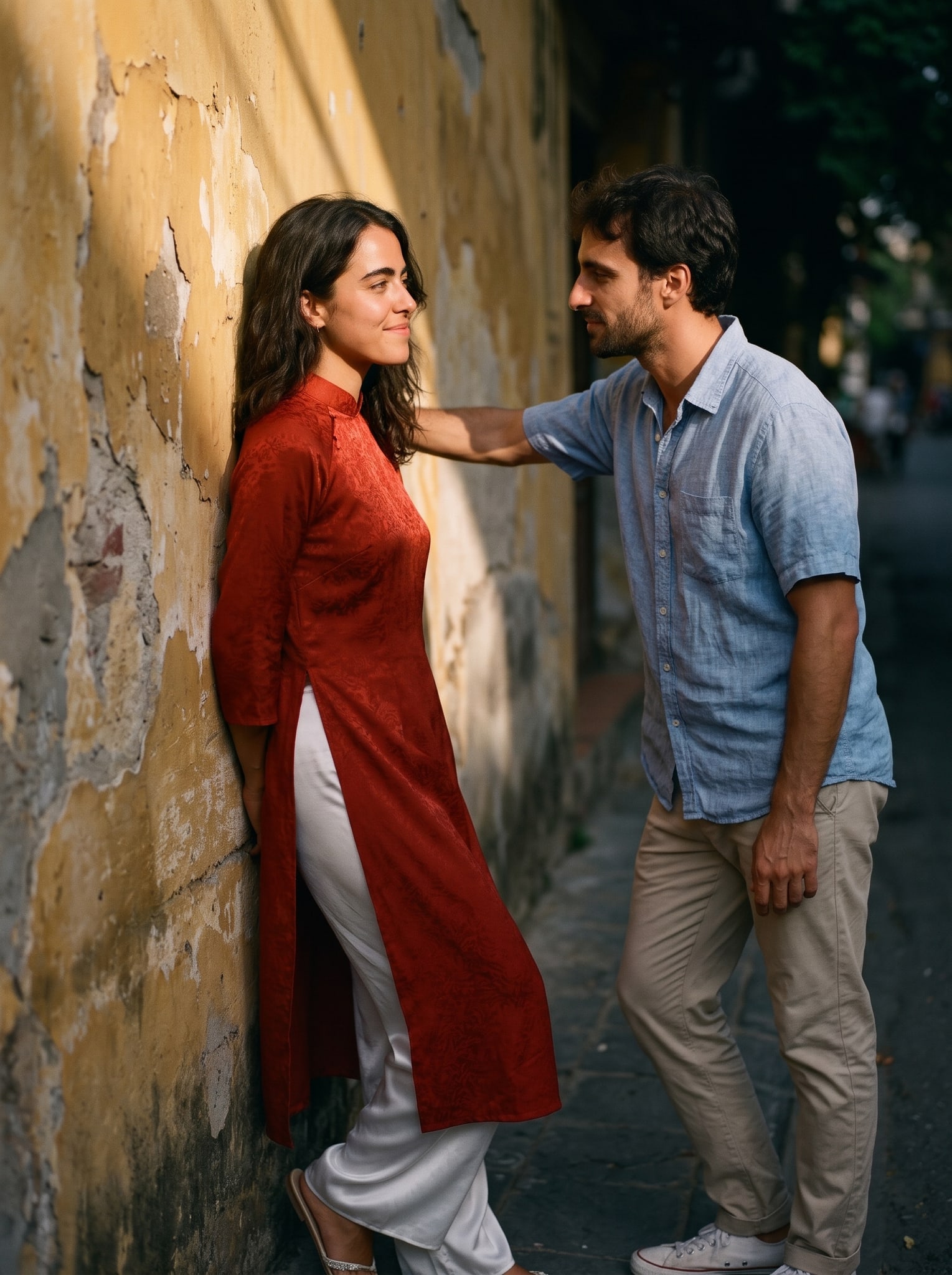
Why does morning light on Langbiang last only two hours?
Sun breaks over the eastern escarpment around 05:45 in November–January, catching mist and ridge edges in rust-gold until 07:30. After 08:00 the light flattens and cloud burns off, leaving harsh overhead sun by 09:00. We time arrival at the stone gate for 05:15 to scout footing while light is still soft, then position couples on the widest, flattest ridge sections by 06:00. Afternoon (15:00–16:30) offers a second window of slanting light as sun drops toward Muong Hoa valley, but shadows lengthen fast and you lose the surround mist. We always book two-window sessions or commit fully to one; half-measures waste climbing time.
How do we position couples safely on high ridges?
Safety is non-negotiable. We first walk the ridge alone, testing stone friction, identifying loose edges, and marking six designated posing zones—each flat, shadowed enough to see faces, and at least a metre from drop-off. We carry a lightweight rope (50 metre, 6 mm dynamic) and always rig a light anchor for any pose within two metres of edge. Couples wear hiking boots laced tight (not loose dresses or flip-flops). We brief them: "Weight over toes, lean toward the camera, never look down at your feet." A pose where the groom steadies the bride's lower back feels intimate and keeps her centre of gravity stable. We take test frames with the stylist in bride's position first, so the real bride never repeats an untested pose. No rushing. One couple took eight minutes to settle into a single ridge-edge frame; the image was worth it.
What outfit changes work on a mountain versus in studio?
In studio, we swap a dress in two minutes; on Langbiang, each change costs ten. We plan three looks: entry áo dài (structured, jewel-tone, shows movement in wind), a lighter walking dress (loose cotton, easier to hike in), and a final romantic piece (silk slip dress, light shawl, or bare-shoulder gown) for golden-hour frames near the stone gate. We leave each outfit at a staging point with the second crew member to avoid carrying weight. Heavier fabrics (brocade, heavy satin) photograph beautifully but tire the bride fast in altitude; we steer toward medium-weight áo dài silk and linen blends that catch light without dragging. One couple insisted on a five-metre veil; we tied it in a bundle until final frames, then released it for thirty seconds of movement shots. Plan outfit changes for the gentler slope near the base, not the ridgeline itself.
Which poses translate well across Langbiang's rocky terrain?
Posing framework we use on-site:
| Terrain Type | Pose | Why It Works | Frame Count |
|---|---|---|---|
| Flat ridge-top | Face-to-face, groom's hand on bride's waist, slight lean | Stable footing, faces level, fabric visible | 8–12 |
| Stone outcrop | Bride sitting, groom standing behind (hand on shoulder) | Reduces fall risk, creates height variation, intimate | 6–10 |
| Slope (gentle) | Walking downslope hand-in-hand, bodies angled to camera | Natural movement, shows landscape, fabric flows | 12–15 |
| Ridge edge (wide) | Couple seated back-to-back, faces turned 45° to camera | Stable, romantic, valley visible in background | 4–6 |
| Cypress tree cluster | Bride leaning against tree, groom facing her | Soft foreground, frame within frame, wind shelter | 8–10 |
We avoid high-kneeling, one-leg-extended, or backward-lean poses near edges. We never shoot with the couple looking away from the camera toward drop-off (no matter how romantic it seems)—a stumble rotates them toward danger. Walking-together frames work best because movement masks fatigue and wind adds energy. We always take test shots from the same angle a second time; couples are often more relaxed and natural on frame two.
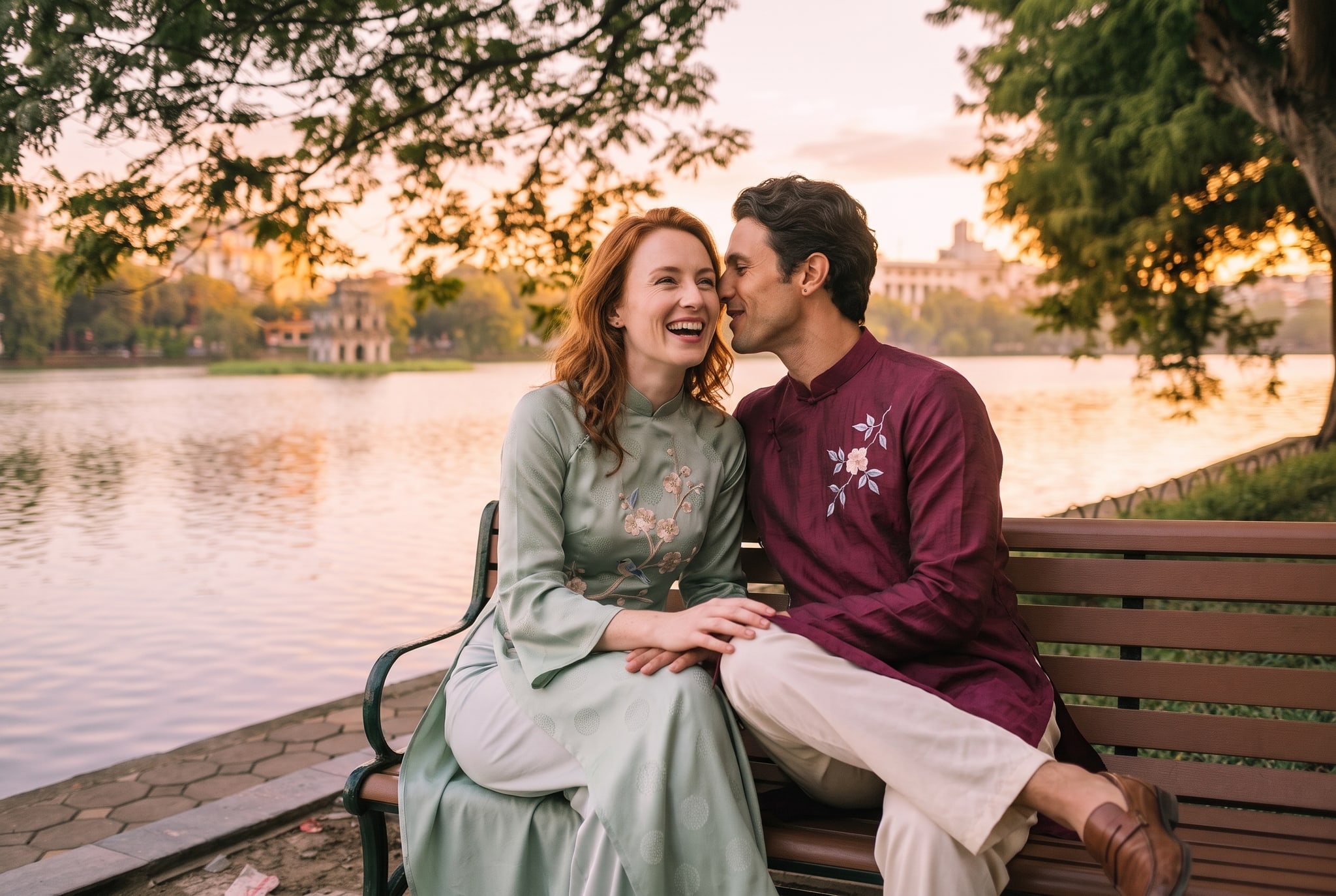
How do we manage cold, wind, and altitude effects during the shoot?
Langbiang sits above cloud layer so it's five to eight degrees cooler than the base town. Brides in sleeveless áo dài get cold fast. We bring wool wraps, thermal leggings under skirts, and a heated vest for between-shoot breaks. Wind gusts (10–18 km/h) are constant; we use them—they lift fabric and add visual energy—but we brief couples beforehand. "Wind will tug your veil; hold it or let it flow; either is beautiful." Altitude affects some people: shortness of breath, mild headache. We arrive early, ascend slowly, and ask about medical history before booking. One groom had mild asthma; we added an extra ten-minute rest halfway through, moved slower between poses, and shortened the ridge time from 90 to 60 minutes. He shot perfectly. Hydration is critical: we carry three litres of water and electrolyte drink, not just for the couple but for crew (everyone is carrying gear uphill). We stop for water every twenty minutes.
What happens when cloud rolls in during the shoot?
Langbiang cloud is unpredictable. We have shot through three scenarios: thin mist (actually improves mood and softens light), dense cloud (reduces visibility and colour saturation—we shift to close-up couple frames and emotional portraits), and rain (rare, but we abort to shelter and reschedule). When mist thickens, we move lower on the ridge where cloud is thinner, or shift to the cypress groves where mist creates a backdrop effect. We always keep a rescheduling buffer: if cloud is so thick we can't see ten metres, we message the couple by 06:45, offer to move the shoot down two hours (when mist often clears), or reschedule for the following week with no extra cost. We have never refunded due to weather because our permits and guides allow flexible rescheduling. We also carry emergency ponchos and windproof bags for crew gear.
See packages and prices on vietnamphotoshoot.com
How does a Langbiang shoot differ from a Hoi An old-town session?
Hoi An couple photoshoots are urban, architectural, and walkable—you change venues every thirty minutes and shoot five locations in four hours. Langbiang is alpine, singular, and immersive: you spend 75% of shoot time on a two-kilometre ridge, build intimacy through repetition, and let light and landscape carry the emotion. Hoi An suits couples who want variety and faster pacing; Langbiang suits those who want depth, fewer but richer poses, and an adventure element. We book special concept shoots at Langbiang for couples seeking "one iconic location" aesthetics. The cost structure differs too: Hoi An is walkable, no permits needed, and flexible timing; Langbiang requires climbing guides (non-negotiable for liability), dawn-hour coordination, and fixed entry permits. Ask us for a quote on WhatsApp if you're weighing both options.
What do we brief couples about before arrival?
We send a WhatsApp two weeks prior: fitness level required (moderate hiking, not mountaineering), footwear (hiking boots only, no heels), weather check (we reschedule if storm forecast), and what to pack (sunscreen, lip balm, water, a warm layer). Most couples underestimate altitude fatigue. We suggest a practice hike the day before if they're unfit. We also ask about áo dài origin: if custom-made, we inspect seams and hem before shoot (one bride's dress tore on a stone; we had a backup silk piece and hand-stitched a repair at 05:30—always carry a needle kit). We confirm the groom's comfort level with heights; one groom had vertigo and we redesigned the shoot to avoid ridge edges, using foreground rocks and close-up frames instead. Honesty upfront prevents panic on-site.
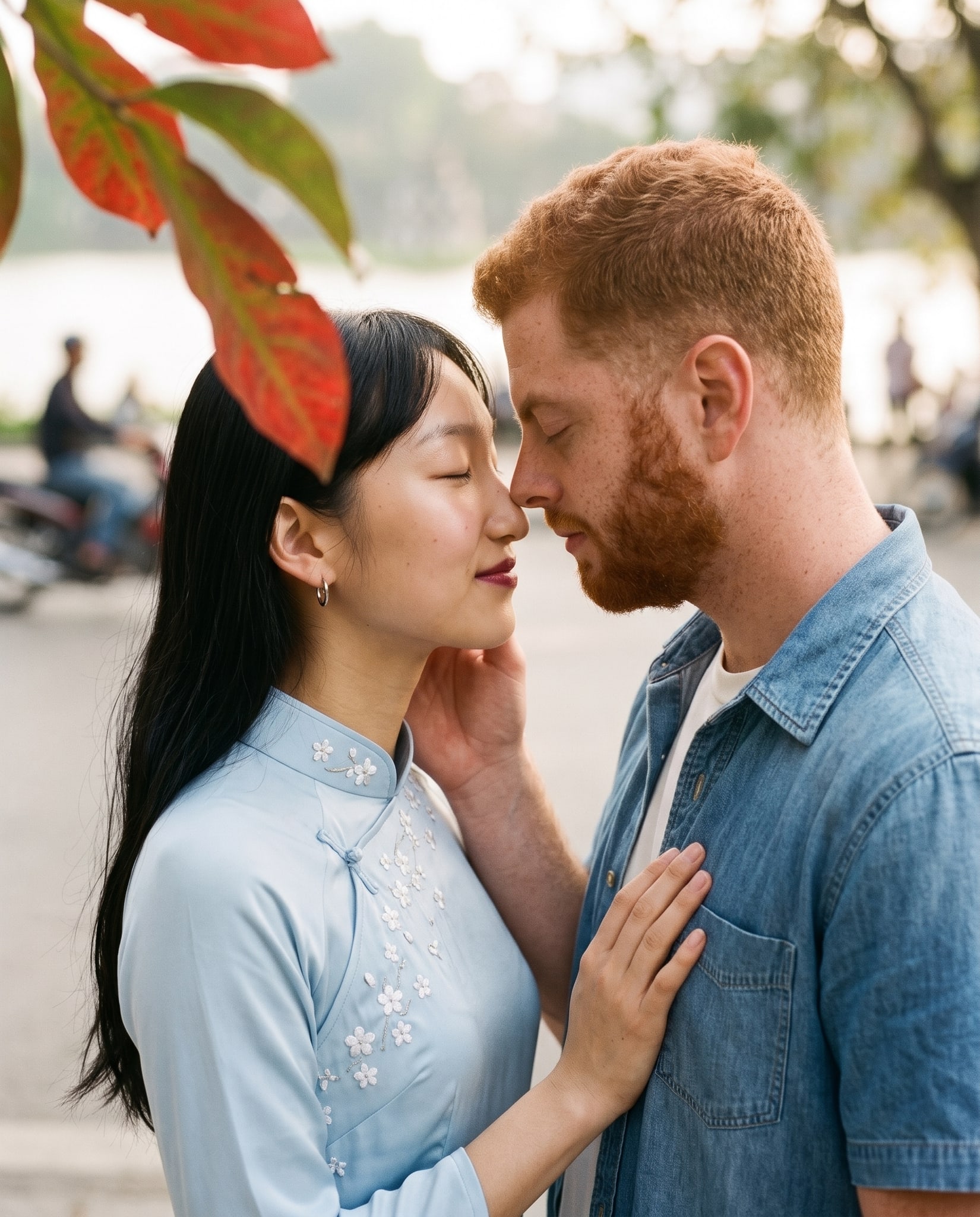
FAQ
Is Langbiang Mountain safe for a pre-wedding shoot in bad weather?
No. We abort if rain is forecast, fog visibility drops below 50 metres, or wind exceeds 25 km/h. We reschedule at no cost. Your safety is absolute.
Do we need special fitness to pose on the mountain, or can anyone do it?
Moderate fitness helps. The hike is two kilometres of uphill, not steep. We pace slowly and rest. One couple, both over 60, shot beautifully with extra water breaks.
Can we shoot at Langbiang in the afternoon and include a second location?
Yes, if the second location is lower on the mountain (15-minute descent). Full-day valley shoots are separate; we recommend the pre-wedding package which builds flexibility.
What happens if cloud is thick on the day—do we reschedule or shoot anyway?
We assess at 06:15. Thin mist looks moody; thick cloud reduces colour. We usually delay two hours and reshoot. If it stays thick, we reschedule at no extra charge.
How much should we expect to pay for a Langbiang pre-wedding session?
Ask us for a quote on WhatsApp. Cost includes guide, two crew, permits, and three outfit changes. Pricing varies by season and length.
Can we add hair and makeup to the Langbiang package, or should it be done in town?
We offer hotel makeup and hair services in Ninh Binh town the morning of shoot. Stylists arrive at 04:00 and you travel to mountain already dressed. Safer than applying makeup at 4,500 feet.
What's the best month to shoot at Langbiang for weather and landscape?
November to January offers cool air, misty mornings, and blooming wildflowers. July to August is hot, cloud cover is heavy, and less photogenic. February to March gets windy but has clear skies. ===CHECKLIST: BEFORE YOU BOOK LANGBIANG=== - [ ] Confirm your fitness level (moderate hiking = two-hour uphill, slow pace, rest stops). - [ ] Provide medical history (asthma, vertigo, heart condition, altitude sensitivity). - [ ] Book hiking boots and confirm footwear two weeks prior. - [ ] Choose three áo dài or outfits (weights, colours, fabrics—lightweight silk preferred). - [ ] Select your ideal month (Nov–Jan for mist and wildflowers, Feb–Mar for clear skies). - [ ] Arrange hotel makeup and hair in Ninh Binh for 04:00 start. - [ ] Confirm rescheduling terms (our policy is free reschedule for weather up to 48 hours before). - [ ] Ask for a test photo from our guide of the ridge zones (so you visualize footing). - [ ] Pack water, sunscreen, and a warm layer (altitude is cooler than town by 5–8°C). Chat with us on WhatsApp
Pre-Wedding & Elopement
Inclusions, prices and booking are on our booking site.
FAQ
Is Langbiang Mountain safe for a pre-wedding shoot in bad weather?
No. We abort if rain is forecast, fog visibility drops below 50 metres, or wind exceeds 25 km/h. We reschedule at no cost. Your safety is absolute.
Do we need special fitness to pose on the mountain, or can anyone do it?
Moderate fitness helps. The hike is two kilometres of uphill, not steep. We pace slowly and rest. One couple, both over 60, shot beautifully with extra water breaks.
Can we shoot at Langbiang in the afternoon and include a second location?
Yes, if the second location is lower on the mountain (15-minute descent). Full-day valley shoots are separate; we recommend the [pre-wedding package](/go/pre-wedding-photoshoot) which builds flexibility.
What happens if cloud is thick on the day—do we reschedule or shoot anyway?
We assess at 06:15. Thin mist looks moody; thick cloud reduces colour. We usually delay two hours and reshoot. If it stays thick, we reschedule at no extra charge.
How much should we expect to pay for a Langbiang pre-wedding session?
Ask us for a quote on WhatsApp. Cost includes guide, two crew, permits, and three outfit changes. Pricing varies by season and length.
Can we add hair and makeup to the Langbiang package, or should it be done in town?
We offer [hotel makeup and hair services](/go/makeup-and-hair) in Ninh Binh town the morning of shoot. Stylists arrive at 04:00 and you travel to mountain already dressed. Safer than applying makeup at 4,500 feet.
What's the best month to shoot at Langbiang for weather and landscape?
November to January offers cool air, misty mornings, and blooming wildflowers. July to August is hot, cloud cover is heavy, and less photogenic. February to March gets windy but has clear skies. ===CHECKLIST: BEFORE YOU BOOK LANGBIANG=== - [ ] Confirm your fitness level (moderate hiking = two-hour uphill, slow pace, rest stops). - [ ] Provide medical history (asthma, vertigo, heart condition, altitude sensitivity). - [ ] Book hiking boots and confirm footwear two weeks prior. - [ ] Choose three áo dài or outfits (weights, colours, fabrics—lightweight silk preferred). - [ ] Select your ideal month (Nov–Jan for mist and wildflowers, Feb–Mar for clear skies). - [ ] Arrange [hotel makeup and hair](/go/makeup-and-hair) in Ninh Binh for 04:00 start. - [ ] Confirm rescheduling terms (our policy is free reschedule for weather up to 48 hours before). - [ ] Ask for a test photo from our guide of the ridge zones (so you visualize footing). - [ ] Pack water, sunscreen, and a warm layer (altitude is cooler than town by 5–8°C). [📸 Chat with us on WhatsApp](https://wa.me/84338762340)
More from the team
Photography rules at Ta Phin village: permits, drones and what to check
Ta Phin village in Sapa draws photographers for its Hmong culture and layered mountain light. We've shot dozens of sessions there—here's what actually works and what stops shoots cold.
Pre-Wedding Photo Ideas and Poses at O Quy Ho Pass
O Quy Ho Pass sits on the Hanoi–Sapa border at 1,200 metres. Our couples shoot there for its curves, mist and isolation—but the weather and logistics demand a different approach than valley shoots.
Is O Quy Ho Pass Good for Pre-Wedding Photos? Pros, Cons, Alternatives
O Quy Ho pass in Sapa draws couples seeking high-altitude drama, but tight timelines, unpredictable fog, and logistics make it risky for pre-wedding shoots. We've scouted it; here's what actually works. #