 Cáo Studio
Home › Blog › Pre-Wedding & Elopement
Pre-wedding photo ideas and poses at Temple of Literature
By the Cáo Studio team · Hanoi & Saigon · 2026-11-02
The Temple of Literature in central Hanoi is Vietnam's premier pre-wedding shoot location: 900 years old, UNESCO grounds, and a sequence of five courtyards with distinct moods—from formal stone gates to intimate cypress-lined paths. Sessions typically run 2–3 hours with a pre-wedding and elopement package that includes ao dai styling, professional makeup and hair, a photographer, and one stylist. The site is free to enter before 8 a.m. or after 4:30 p.m., but most of Cáo Studio's shoots happen in the golden-hour slots around 5–6 p.m. to avoid tour crowds. Avoid midday harsh sunlight and weekends during peak tourist season (November–February). Budget for travel from Hanoi's city center (5–10 km), and plan at least one wardrobe change to maximize the stone, foliage, and architectural contrast the temple offers.
What makes Temple of Literature ideal for pre-wedding shoots?
The Temple of Literature works because it has five distinct zones, each with its own light and mood. The outer gate (Cổng Quốc Tử Giám) is formal and symmetrical—good for wide couple shots. The first courtyard has manicured garden boxes. The second opens to an ornamental pond where cypress trees frame portraits. The third and fourth courtyards narrow and darken, creating intimacy. We use this progression to show story: arrival, joy, reflection, intimacy, legacy—all without moving the couple far. The stone is naturally grey, so ao dai colors (deep crimson, navy, white) and skin tones read cleanly. No neon signage or modern clutter. That's rare in Hanoi.
Chat with us on WhatsApp | See packages and prices on vietnamphotoshoot.com
How do we style ao dai specifically for this location?
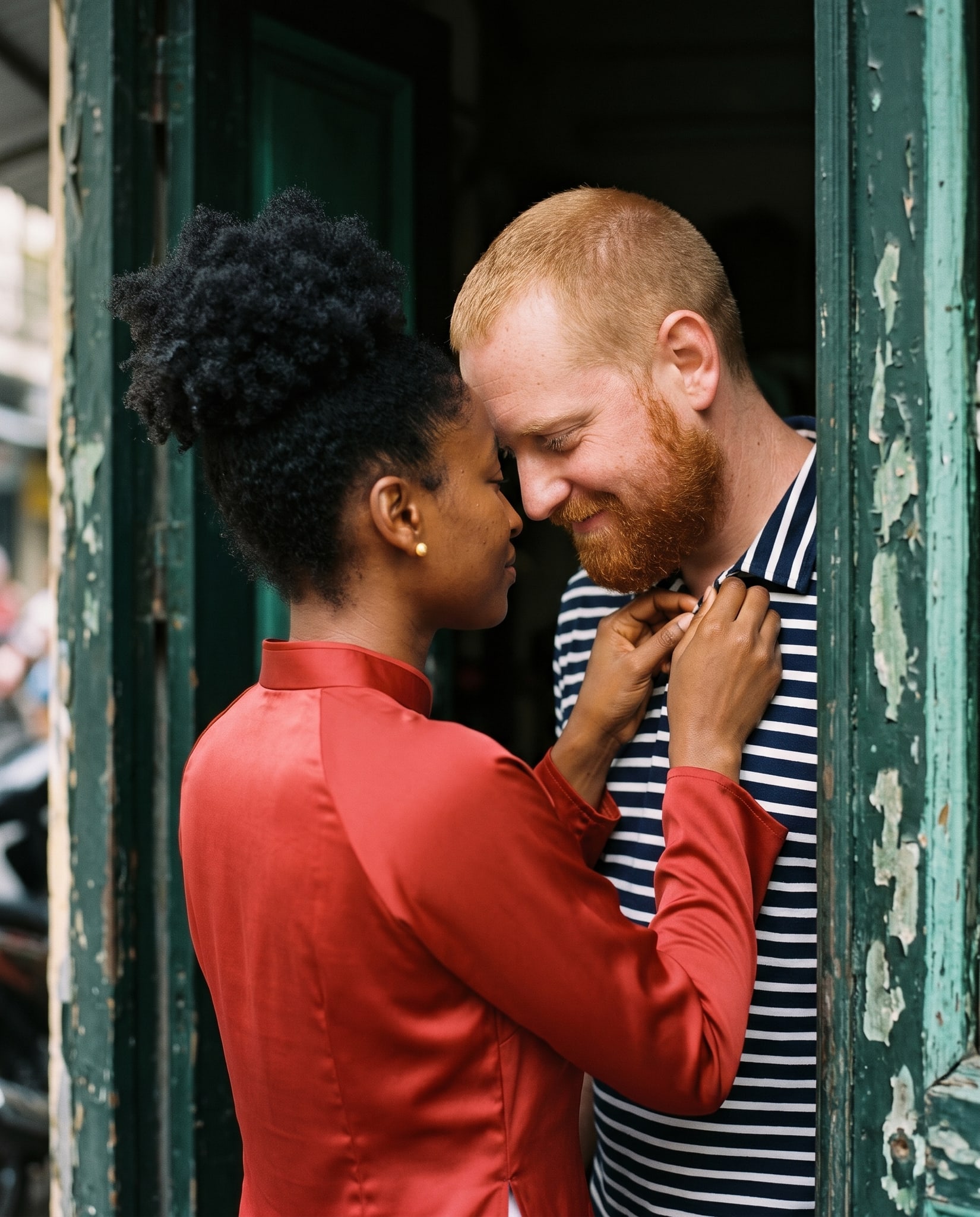
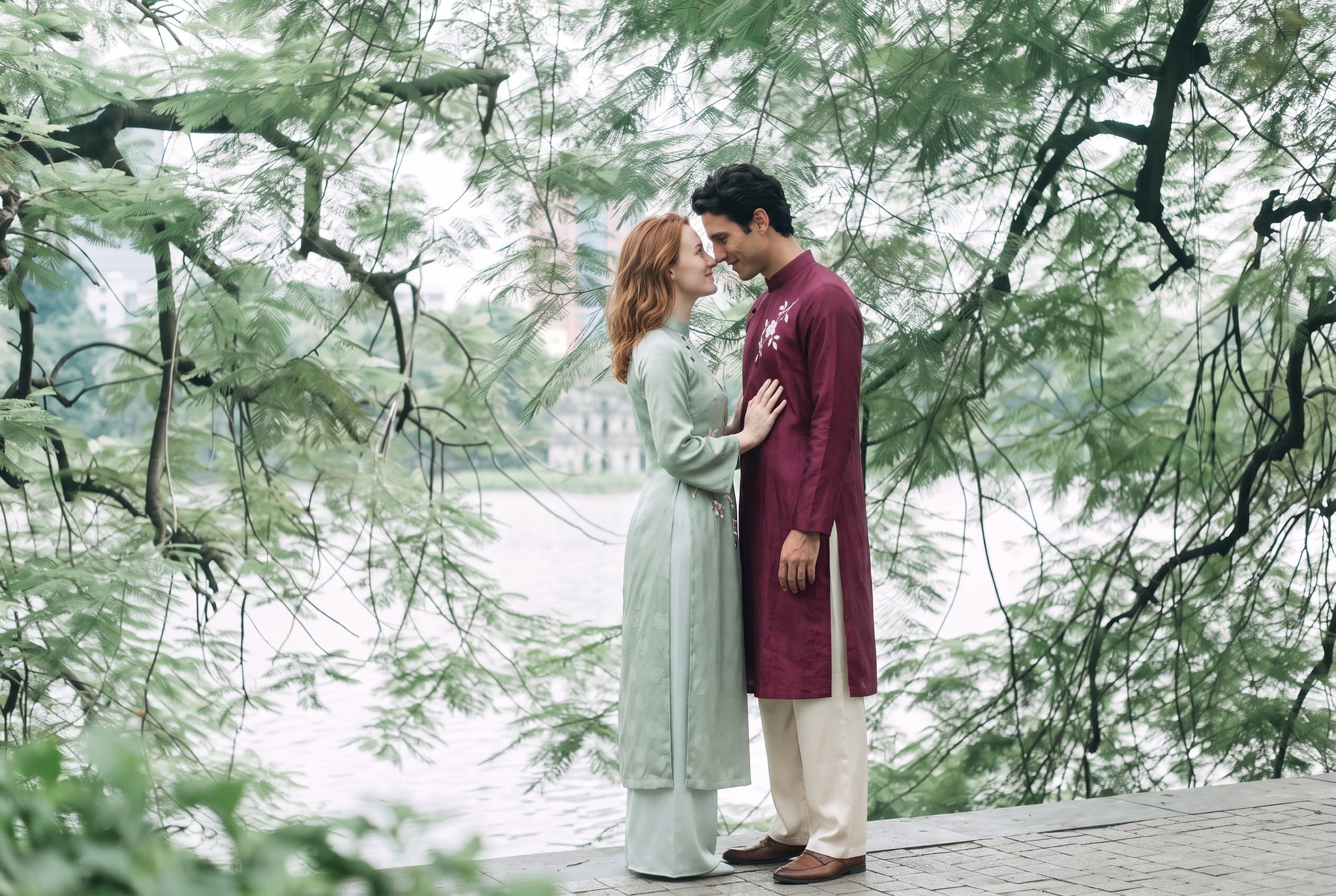
We learned early that the temple's grey stone and muted foliage mean bright or heavily embroidered ao dai can feel over-styled. So we lean into deep jewel tones: burgundy, forest green, navy, or cream with subtle gold thread. The stylist arrives with three options and we consult the couple on arrival. Loose, straight cuts photograph better than fitted waist-hugging silhouettes because the photographer can frame the fabric movement against the stone columns. Long-sleeved ao dai reads more formal and works for couples wanting gravitas; sleeveless or short-sleeved versions feel modern and romantic, especially in the cypress courtyard where filtered light softens the fabric. We always bring a pashmina or silk shawl—afternoon wind can toss the áo, and a draped shawl adds layering and fixes accidental creases. The groom's áo should match in tone but not exact color; a darker shade or subtle contrast makes them read as a unit.
Which poses and interactions actually work in each courtyard?
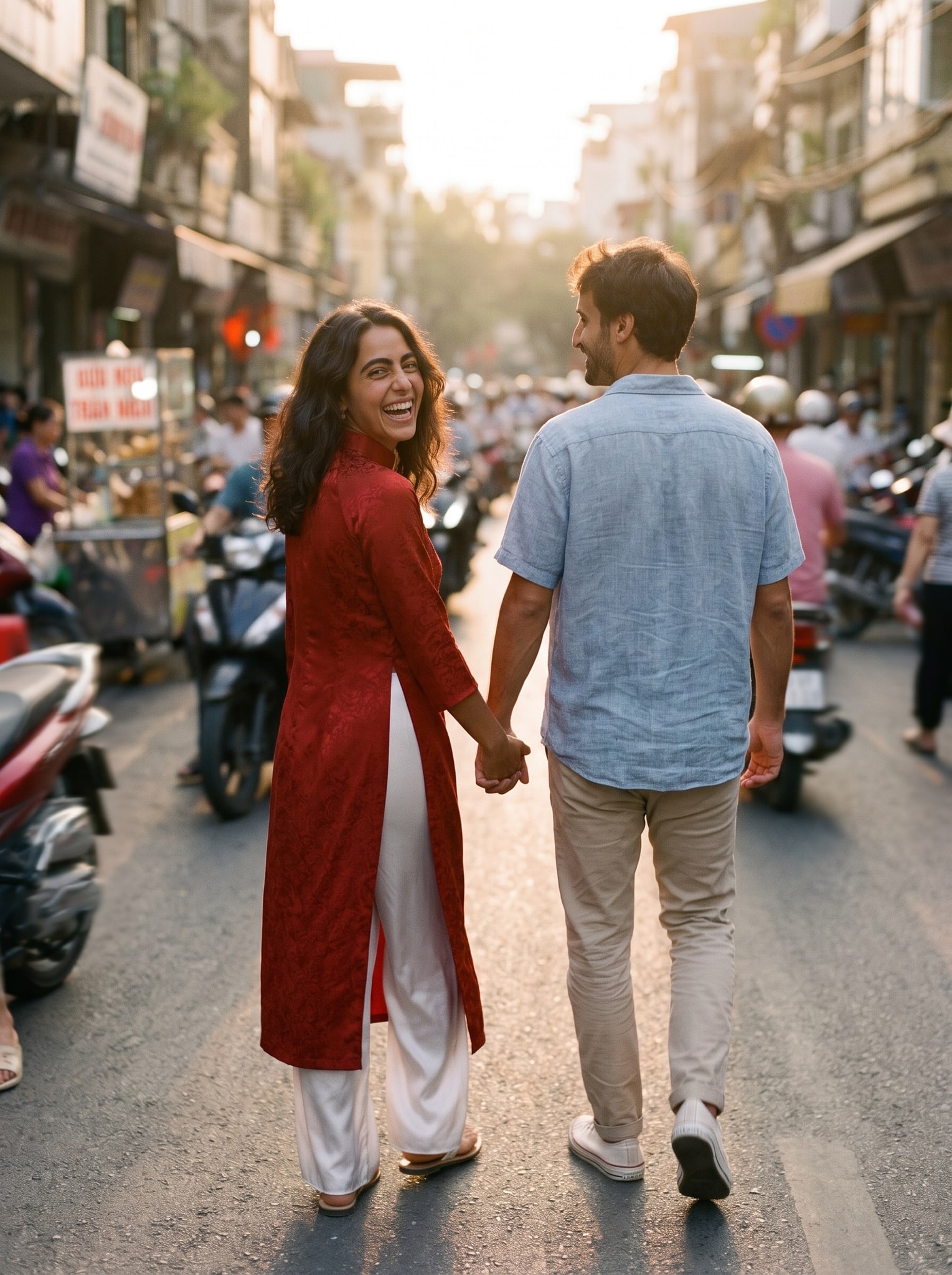
The outer gate is where we pose them formally facing the gate, then turning to face us—it anchors them in the place. In the first courtyard, we move them to the corner gardens: she sits on a low stone wall, he stands behind with his hand on her shoulder; the boxes and shrubs frame them. At the pond (second courtyard), this is where we slow down. Walking toward the cypress trees, hand in hand, works because the reflection catches light and the trees create depth. One person slightly ahead, looking back—that gesture always sells. In the third courtyard (the smallest, with the well), we do close-up frames: foreheads touching, his hand on her face, her hand on his chest. No artifice. The light is already intimate here. The fourth courtyard is nearly always empty; we reserve it for walking shots and slow spins. The groom holds her hand as she twirls; the ao dai catches and fills the frame. We shoot 200–300 frames in a two-hour session; maybe 40–50 make it to the final album.
See packages and prices on vietnamphotoshoot.com
What time of day and season give the best light?
Late afternoon (4:30–6:30 p.m.) is our standard window because the sun is low and warm—it fills the stone with amber and softens ao dai fabric. Midday (11 a.m.–3 p.m.) creates harsh shadows on faces and the stone looks almost white, so we avoid it. Early morning (6–7:30 a.m.) before crowds is calm and offers cool, even light, but the temple's interior courtyards stay shadowed. November through February (cooler, low humidity) is peak season—the air is clear, skin looks smoother, and the couple can move without sweat. March and April are still good but more humid. May through September is hot and wet; clouds can help diffuse sun, but sudden rain shuts everything down. We always have a backup date clause in the pre-wedding package. October is ideal: clear, warm, and not yet crowded.
What logistics do we handle, and what can go wrong?
We scout the temple two weeks before a session: which courtyards are under renovation, where the crowds peak, what gates are locked. On shoot day, the team arrives 30 minutes early—photographer checks light angles, the stylist preps the ao dai in a quiet corner (usually a temple staff office we've arranged), and makeup gets touched up. Common issues: tour groups blocking the pond at exactly 5 p.m. (we pivot to the third courtyard and return later); the couple's shoes get muddy in the pond courtyard (we bring tissue and a cleaning cloth); the ao dai's collar shifts after three hours (we safety-pin it). If unexpected crowds arrive, we move shots to early morning on a second day—most couples don't realize they can do a split session. Weather is the real wildcard: if rain is forecast, we move the entire session to the next week. We confirm via WhatsApp 48 hours before and finalize the exact timeline the morning of the shoot.
Comparison: Temple of Literature vs. other Hanoi pre-wedding backdrops
| Location | Mood | Best for | Light window | Crowd factor |
|---|---|---|---|---|
| Temple of Literature | Formal, timeless | Ao dai, legacy, story arc | 4:30–6:30 p.m. | High on weekends |
| Old Quarter streets | Urban, intimate | Modern couple, candids | 5–6 p.m. | Very high always |
| Hoan Kiem Lake (Ngoc Son) | Romantic, water | Couple connection | 5:30–6:30 p.m. | High weekends |
| One Pillar Pagoda grounds | Spiritual, zen | Minimal, contemplative | 6–7 a.m. | Low |
| Tran Quoc Pagoda (West Lake) | Serene, reflective | Intimate, detail shots | 5–6:30 p.m. | Medium |
Temple of Literature is the most requested because it offers narrative structure—the couple's journey through five spaces—without feeling like a checklist. The stone is photogenic regardless of weather. But it does draw tour buses.
What to check before you book a Temple of Literature session
Confirm the booking includes: a stylist on-site for wardrobe adjustments and ao dai care; the photographer's experience with the temple's lighting and layout (look at their portfolio); makeup and hair service at your hotel beforehand or at the temple (makeup and hair service can be added separately). Ask the studio: how many locations they'll shoot in the temple grounds; whether a second day is free if crowds were too high; what happens if rain forces rescheduling. Prepare yourself: wear comfortable shoes for the first fitting and scout (you'll walk the route); bring extra hairpins and safety pins; plan to change ao dai once if you want variety. Understand the contract: some studios charge extra to extend beyond 2.5 hours or to shoot multiple locations. Cáo Studio includes multiple courtyards and a second location trade if you want to use forest or lake time instead.
How do couples typically structure their full pre-wedding schedule?
Most couples we work with book a multi-day or multi-location plan. One shoot at the Temple of Literature, another in ao dai photoshoot mode at a studio or garden, sometimes a third session at a special concept location like a vintage streetscape or a rural village. The temple session usually happens first or second, after the couple has warmed up in front of the camera. We often recommend starting with a couple photoshoot in a lower-stakes environment (park, rooftop) one week prior, so by the temple date they're relaxed and natural. The entire timeline—booking to final album delivery—is typically 4–6 weeks. First week: consultation and outfit selection. Week two: makeup and hair session at hotel, fit-check of ao dai. Week three: shoot day(s). Weeks four to six: editing, album layout, and delivery.
FAQ
Do we need to wear ao dai, or can we do Western wedding clothes at the Temple of Literature?
Ao dai is traditional and photographs beautifully against the stone, but Western formal wear works too. The temple's grey tones suit jewel-tone ao dai best; if you wear a suit and white dress, the contrast is starker but can feel modern. Most couples choose ao dai for at least one part of the session. The pre-wedding package includes ao dai styling and fitting.
How many usable photos come from a typical Temple of Literature session?
We deliver 30–50 edited, fully retouched images from a 2.5-hour shoot—a mix of wide couple shots, detail frames (hands, faces, fabric), and environmental portraits. We shoot 200–300 frames total, culling about 80–100 for editing based on technical quality and storytelling. Couples usually see a preview of 60–70 selects and choose their final album.
What if the weather turns bad on the morning of our shoot?
We reschedule to the next available date at no extra cost—that's built into the package. If you're visiting from overseas and have a fixed departure date, we can move to an indoor backup (studio with theatrical lighting, hotel ballroom, or covered historical building) or accelerate an earlier date. We confirm two days before by WhatsApp.
Can we shoot at the Temple of Literature early morning to avoid crowds?
Yes, if you book an early slot (6–7:30 a.m.). The light is cooler and even, and the temple is almost empty. You'll need to enter before official opening time, which requires prior arrangement with temple staff—we handle this. Makeup and hair would need to be completed at your hotel before arrival, so add hotel makeup and hair service to your package.
How much space do we need for ao dai movement, and can we do spins or walking shots?
The temple's courtyards are spacious—easily 50+ meters long and 30+ meters wide. Yes, walking shots and gentle spins work perfectly, especially in the third and fourth courtyards. The ao dai fabric floats and catches light beautifully when she moves. We rehearse one slow spin together before the shot to make sure the groom is positioned right. Avoid running or sharp turns; they flatten the fabric and risk tripping.
Do we get to see proofs or drafts before final delivery?
Yes. After the shoot, the photographer selects 60–70 best frames and sends them as low-res proofs via WeTransfer or Google Drive within one week. You review and mark your favorites. The studio then fully retouches and color-grades those images and delivers them (usually 30–50) as high-res files within 3–4 weeks. You have unlimited rounds of small edits (brightness, crop, expression preference) for two weeks after delivery. --- See packages and prices on vietnamphotoshoot.com | Cáo Studio Hanoi location
Pre-Wedding & Elopement
Inclusions, prices and booking are on our booking site.
FAQ
Do we need to wear ao dai, or can we do Western wedding clothes at the Temple of Literature?
Ao dai is traditional and photographs beautifully against the stone, but Western formal wear works too. The temple's grey tones suit jewel-tone ao dai best; if you wear a suit and white dress, the contrast is starker but can feel modern. Most couples choose ao dai for at least one part of the session. The [pre-wedding package](/go/pre-wedding-photoshoot) includes ao dai styling and fitting.
How many usable photos come from a typical Temple of Literature session?
We deliver 30–50 edited, fully retouched images from a 2.5-hour shoot—a mix of wide couple shots, detail frames (hands, faces, fabric), and environmental portraits. We shoot 200–300 frames total, culling about 80–100 for editing based on technical quality and storytelling. Couples usually see a preview of 60–70 selects and choose their final album.
What if the weather turns bad on the morning of our shoot?
We reschedule to the next available date at no extra cost—that's built into the package. If you're visiting from overseas and have a fixed departure date, we can move to an indoor backup (studio with theatrical lighting, hotel ballroom, or covered historical building) or accelerate an earlier date. We confirm two days before by WhatsApp.
Can we shoot at the Temple of Literature early morning to avoid crowds?
Yes, if you book an early slot (6–7:30 a.m.). The light is cooler and even, and the temple is almost empty. You'll need to enter before official opening time, which requires prior arrangement with temple staff—we handle this. Makeup and hair would need to be completed at your hotel before arrival, so add [hotel makeup and hair service](/go/makeup-and-hair) to your package.
How much space do we need for ao dai movement, and can we do spins or walking shots?
The temple's courtyards are spacious—easily 50+ meters long and 30+ meters wide. Yes, walking shots and gentle spins work perfectly, especially in the third and fourth courtyards. The ao dai fabric floats and catches light beautifully when she moves. We rehearse one slow spin together before the shot to make sure the groom is positioned right. Avoid running or sharp turns; they flatten the fabric and risk tripping.
Do we get to see proofs or drafts before final delivery?
Yes. After the shoot, the photographer selects 60–70 best frames and sends them as low-res proofs via WeTransfer or Google Drive within one week. You review and mark your favorites. The studio then fully retouches and color-grades those images and delivers them (usually 30–50) as high-res files within 3–4 weeks. You have unlimited rounds of small edits (brightness, crop, expression preference) for two weeks after delivery. --- [✨ See packages and prices on vietnamphotoshoot.com](/go/pre-wedding-photoshoot) | [Cáo Studio Hanoi location](/go/hanoi)
More from the team
Boho pre-wedding photoshoot in Vietnam: Hanoi, Saigon, Hoi An
Boho pre-wedding shoots mix romantic, free-spirited aesthetics with Vietnam's landscapes and heritage sites. We run full-day sessions in three cities, handling styling, makeup, location scouts and edits.
Avoid crowds at Hoang Su Phi rice terraces: timing for wedding shoots
Hoang Su Phi's terraced landscape draws couples and tour buses in equal measure. We show how to shoot there alone, when to arrive, and what to arrange with us before you go.
Photography rules at Con Dao beaches: permits, drones and what to check
Con Dao's beaches demand prep before you shoot—permits, drone zones and tide timing all affect your day. We share what the Cáo Studio team verifies on every booking.