 Cáo Studio
Home › Blog › Pre-Wedding & Elopement
Pre-wedding photo ideas and poses at Tra Que vegetable village
By the Cáo Studio team · Hanoi & Saigon · 2026-11-02
Tra Que is a 3-hectare farm in Hanoi's suburban Tay Ho district where local families grow leafy greens and herbs year-round. Pre-wedding couples shoot there for 2–4 hours, typically arriving by 15:00 to catch golden light across rows of brassica and morning glory. A Cáo Studio session includes your photographer, stylist and a guide who arranges farm access and alerts you when a tractor is coming. Cost depends on your package choice—compare options on /go/pre-wedding-photoshoot. Wear layers: farms are muddy, wet and 2–4°C cooler than Hanoi city. Avoid white trainers, heavy jewelry and slippery-sole shoes. The farm closes at 18:00; light softens around 16:30 in winter, earlier in summer. Chat with us on WhatsApp | See packages and prices on vietnamphotoshoot.com
What happens during your first hour at Tra Que?
We arrive 20 minutes early to scout light, flag wet patches and confirm farm staff know you're coming. You'll change in a small farmhouse; our stylist steams your áo dài or dress. For the first 15 minutes, we shoot near the entrance where light is even and you're still learning how to move in front of the camera. This hour decides your rhythm: if you're stiff, we move into tighter two-shot frames; if you're relaxed, we step back and use more of the rows. The farm's dirt paths funnel light beautifully around 15:45–16:15 (winter) or 16:15–17:00 (summer). We stop before 17:30 because shadows become too harsh and mosquitoes intensify. Your photographer watches the sky constantly—a cloud cover that looks minor from the ground kills backlighting completely.
See packages and prices on vietnamphotoshoot.com
Which poses actually work on muddy farm rows?
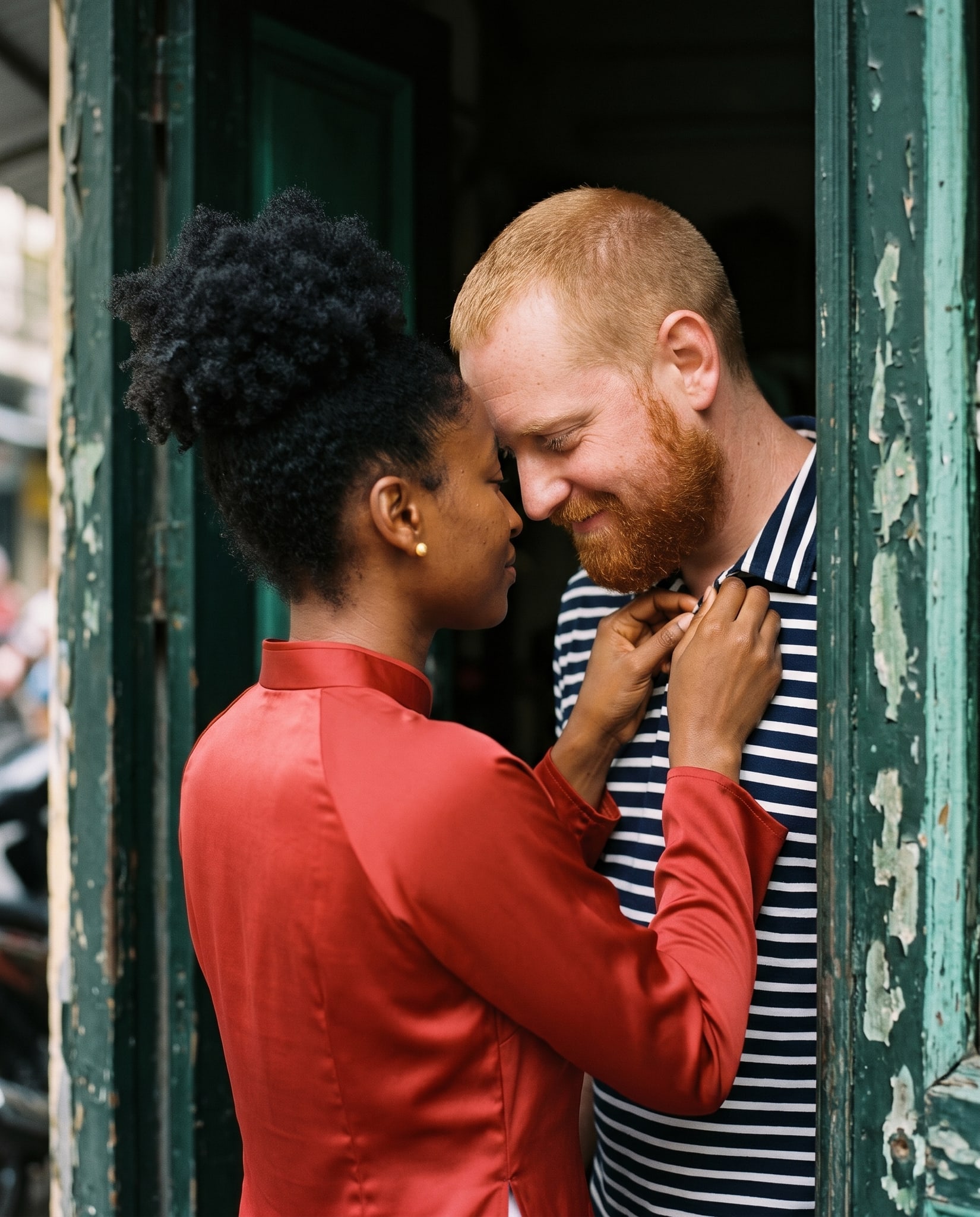
Couples ask for "lying down in the vegetables" or "running through the rows." Both are Instagram ideas and both fail here. Lying down stains áo dài and damages crops; farm staff stop the shoot immediately. Running photographs badly—motion blurs the background, and muddy soil splashes your clothes and shoes. What works: standing waist-deep in a harvested or re-planted row (no damage to live crops), walking toward the camera with your arm linked through your partner's, sitting on a clean wooden bench the farm provides, and standing close enough that you're in each other's personal space. We frame these so the rows run diagonal behind you, not straight—it adds depth. Kneeling on a yoga mat we bring stops mud transfer to knees and hems. The best physical pose is one you hold steady for 3–5 seconds while your photographer fires 15–20 frames; movement between frames creates blur and wastes time you've paid for. We always bring a small tarpaulin for outdoor sitting and a lint roller for your dress after each row shot.
How do you choose what to wear for a farm shoot?
| Garment type | Why it works | Why it fails | Cáo's typical choice |
|---|---|---|---|
| Áo dài (silk or cotton blend) | Photogenic, moves in wind, sits in farm rows without snagging | Mud stains cost 400k–800k to clean; hems catch on stubble if too long | Knee-length or midi; medium weight; cream, blush or pale green |
| Western wedding dress | Formal, high contrast, reads well at distance | Heavy hem gets muddy; trains snag; white shows soil instantly; needs constant steaming | A-line or sheath; shorter length; sleeveless or long sleeves for sun protection |
| Casual coupling outfit (matching tones) | Natural, outdoor-appropriate, less laundry risk | Looks less special; muddy shoes dominate the frame; cotton wrinkles by hour 3 | Linen or cotton blend; neutral or jewel tones; flat shoes or boots |
| Footwear | Flat shoes, loafers, soft boots with grip | High heels sink into mud; white trainers show soil; slippery soles cause falls | Suede loafers, minimalist canvas boots, or leather flats with rubber soles |
The farm environment picks your palette: greens and browns dominate, so jewel tones (emerald, sapphire, rust) photograph stronger than pastels. Bring a second outfit change for the last 30 minutes—that's when light turns golden and you look freshest in new clothes. On the day of your shoot, our team meets you 30 minutes early at the farmhouse to assess the actual light that afternoon and adjust your outfit. We've canceled áo dài for three couples in two years because the dye stained with farm water; we offered makeup and hair at your hotel instead and rescheduled for a cleaner location. Our stylist carries a steamer, lint roller, seam ripper and safety pins in the bag at all times.
See packages and prices on vietnamphotoshoot.com
Why does the time of year change where you can pose?
Winter (November–February) brings clear skies and cool air, but the farm is wetter after rain and light fades by 17:15. Summer (June–August) has long daylight until 18:30, but intense midday heat; we shoot early morning (07:00–10:00) instead. Spring (March–May) has blooming flowers in surrounding fields but pollen irritates eyes and wind tangles your hair constantly. Autumn (September–October) offers the clearest light and driest soil—it's the most popular season, which means farm staff are managing 5–8 shoots per day and certain rows are off-limits. Our experience across 50+ Tra Que sessions tells us that October 15–November 30 produces the sharpest images because humidity is moderate and vegetation is dense enough to frame the shot without looking barren. July–August requires a 06:30 start to avoid haze. January–February afternoon shoots risk your photographer's hands going numb (it's 12–14°C at 16:00). We work with our clients on the pre-wedding planning page to pick a season and time based on your light preferences and outfit choice. Specific dates: if you're booked for June 15, we'll message you on WhatsApp by May 20 with a reality check—temperature, humidity, recent rain—and ask if you want to reschedule to July.
What do you do when a farmer drives a tractor through your shoot?
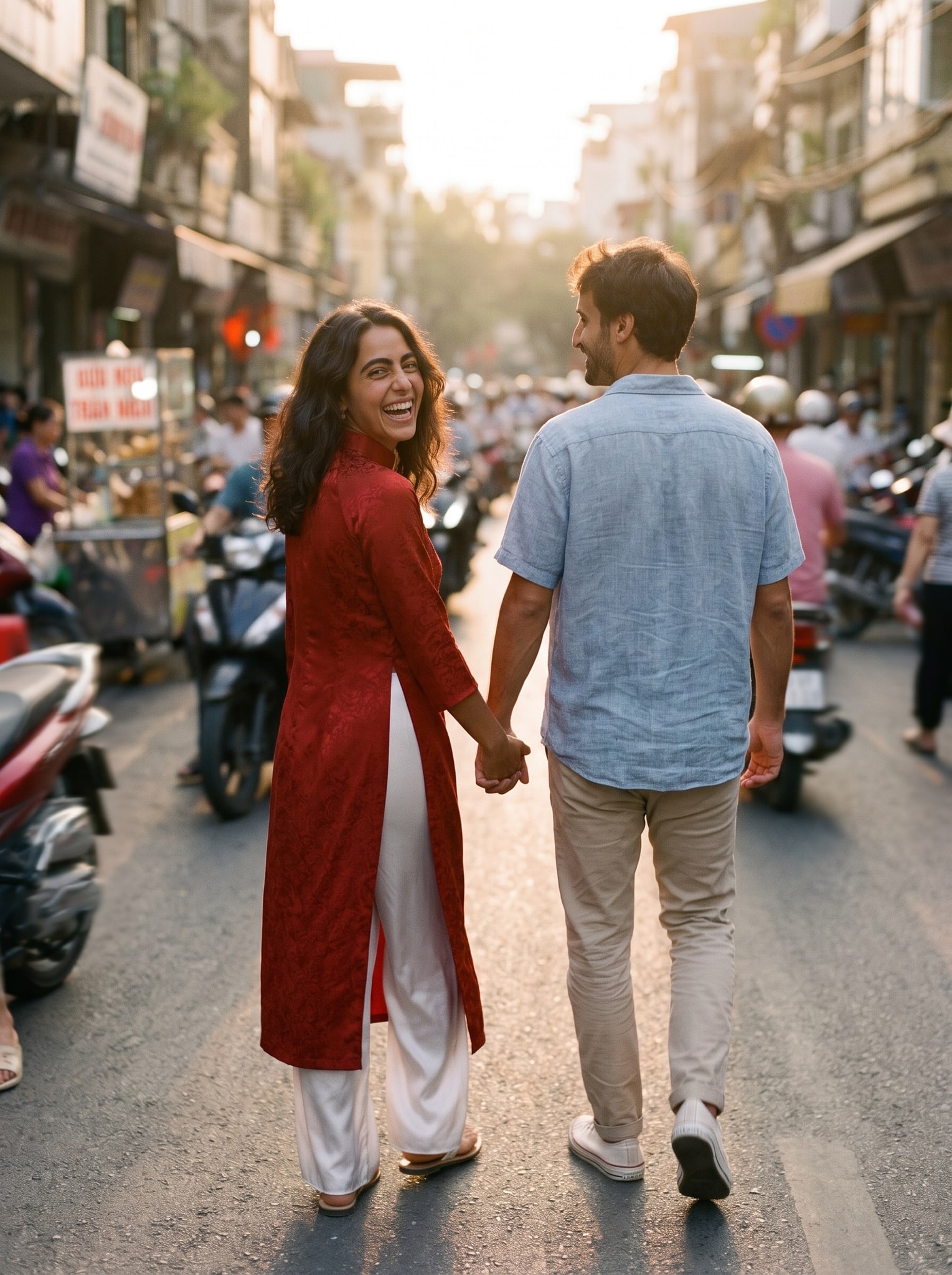
It happens roughly once every eight sessions. The farm is working land, not a museum. When a tractor appears, our guide stops shooting, moves you to a harvested section 20 meters away, and signals the driver. You lose 5–8 minutes of shooting time and the disruption breaks your mood. To minimize this: we book shoots between 15:00 and 17:30 specifically because that's outside the main farming hours (06:00–14:00 and after 18:00). We ask your guide which sections are being worked that day. We avoid Sundays and public holidays when the farm is busier with foot traffic. If a tractor or family member walks into your frame, your photographer keeps shooting—we'll remove them in post-processing, which takes 30–45 minutes of editing time per image. This is standard practice, not a hidden cost. On one October shoot, a farmer's daughter rode her bicycle through four consecutive frames; your photographer caught the next setup cleanly while our stylist wiped your dress. No one noticed in the final gallery. The mood-breaker is real, but experienced teams (we've logged 80+ days at Tra Que since 2019) see it as a 10-minute pause, not a crisis.
What photos actually make it into your final album?
Not every shot at Tra Qu becomes a finished image. From a typical 2-hour session, your photographer takes 400–600 raw frames. We select approximately 60–90 for editing based on these rules: sharp focus on both faces, neither of you is mid-blink or mid-speech, the background is visually balanced (no tractor halfway through), your posture is natural, not strained, and the light is directional, not flat. This process happens in our studio and takes 4–6 hours per couple. Your final count depends on your package; entry-level couple photoshoot selections include 40–60 edited images, while premium pre-wedding sessions deliver 80–120. Tra Que shoots often produce higher keeper rates than urban locations because the natural geometry of the rows creates automatic composition depth—your photographer doesn't fight the background. Edited images include color grading to warm the greens and browns, slight contrast boost, and removal of any visible distractions (a plastic bucket, a farm tool, a passing motorbike). We don't remove people or dramatically reshape your bodies. What we discard: three identical poses (we keep one), any frame where the light has shifted harshly between shots, and any two-shot where one person is noticeably more in focus. This quality cull is what separates a 600-frame memory card from a 90-image wedding album.
What to check before you book a Tra Que pre-wedding shoot
- Season and time. Confirm the exact date and time slot with our team; ask about recent weather in Hanoi and expected light duration for that month.
- Outfit condition. If wearing an heirloom áo dài, test it for stains after farm conditions; silk áo dài need professional cleaning, which costs extra. Bring backup flat shoes in case your first pair gets muddy mid-shoot.
- Farm access. The village is 30 km from central Hanoi (45 minutes by car in normal traffic, 75 minutes in rush hour). Your driver and guide are included; you don't arrange transport. Confirm your meeting point by WhatsApp 48 hours before.
- Editing timeline. Full edits and retouches take 10–14 days after your shoot date. Don't expect same-day previews.
- Backup location. If weather cancels your Tra Que date, we offer special concept shoots at alternate venues (Hoan Kiem Lake, old town Hanoi, silk factory) at the same time and cost. This swap is free; rescheduling is free if you initiate it 72 hours in advance.
FAQ
Can we do a Tra Que shoot in the rain?
No. Mud becomes slippery, camera equipment risks damage, and áo dài or wedding dresses stain permanently. We reschedule within 7 days at no extra cost; you keep your deposit.
How early should we arrive on the shoot day?
Arrive 30 minutes before your booked time. Our stylist needs 15 minutes to steam your dress and check your makeup. We start shooting at your official start time, not after setup.
Is there a bathroom or café at the farm?
A small bathroom exists in the farmhouse (squat toilet, no hot water). No café; bring water and snacks. We stop for 10 minutes mid-session for hydration.
What if we're scared or stiff in front of the camera?
All couples feel this in the first 10 minutes. Our photographer uses gentle direction ("step slightly left," "look at each other, not the camera") and shoots continuously so you relax between frames. By minute 20, most couples forget the camera is there. We also offer couple photoshoot coaching sessions (separate booking) beforehand.
Can we bring family or friends to watch?
No. The farm space is tight, and a crowd makes couples tense. If family wants photos, book a separate family photoshoot package at a different location with more comfortable waiting areas.
How many outfits can we change into during a 2-hour Tra Que session?
Two outfit changes maximum. Each change costs 12–15 minutes (walking to the farmhouse, steaming, returning to the shoot location). A third change eats into actual shooting time; most couples keep two and maximize poses within each outfit instead.
Pre-Wedding & Elopement
Inclusions, prices and booking are on our booking site.
FAQ
Can we do a Tra Que shoot in the rain?
No. Mud becomes slippery, camera equipment risks damage, and áo dài or wedding dresses stain permanently. We reschedule within 7 days at no extra cost; you keep your deposit.
How early should we arrive on the shoot day?
Arrive 30 minutes before your booked time. Our stylist needs 15 minutes to steam your dress and check your makeup. We start shooting at your official start time, not after setup.
Is there a bathroom or café at the farm?
A small bathroom exists in the farmhouse (squat toilet, no hot water). No café; bring water and snacks. We stop for 10 minutes mid-session for hydration.
What if we're scared or stiff in front of the camera?
All couples feel this in the first 10 minutes. Our photographer uses gentle direction ("step slightly left," "look at each other, not the camera") and shoots continuously so you relax between frames. By minute 20, most couples forget the camera is there. We also offer [couple photoshoot](/go/couple-photoshoot) coaching sessions (separate booking) beforehand.
Can we bring family or friends to watch?
No. The farm space is tight, and a crowd makes couples tense. If family wants photos, book a separate [family photoshoot package](/go/family-photoshoot) at a different location with more comfortable waiting areas.
How many outfits can we change into during a 2-hour Tra Que session?
Two outfit changes maximum. Each change costs 12–15 minutes (walking to the farmhouse, steaming, returning to the shoot location). A third change eats into actual shooting time; most couples keep two and maximize poses within each outfit instead.
More from the team
Boho pre-wedding photoshoot in Vietnam: Hanoi, Saigon, Hoi An
Boho pre-wedding shoots mix romantic, free-spirited aesthetics with Vietnam's landscapes and heritage sites. We run full-day sessions in three cities, handling styling, makeup, location scouts and edits.
Avoid crowds at Hoang Su Phi rice terraces: timing for wedding shoots
Hoang Su Phi's terraced landscape draws couples and tour buses in equal measure. We show how to shoot there alone, when to arrive, and what to arrange with us before you go.
Photography rules at Con Dao beaches: permits, drones and what to check
Con Dao's beaches demand prep before you shoot—permits, drone zones and tide timing all affect your day. We share what the Cáo Studio team verifies on every booking.