 Cáo Studio
Home › Blog › Pre-Wedding & Elopement
Pre-wedding photo ideas and poses at Tra Su cajuput forest
By the Cáo Studio team · Hanoi & Saigon · 2026-11-02
Tra Su cajuput forest near Can Tho offers narrow wooden walkways through reflective water, overhead canopy, and golden hour light trapped between trees—ideal for pre-wedding couples seeking intimate, moody frames. Most couples combine a 2–3 hour forest session with hotel or beach photography elsewhere. Sessions run during dry months (November–April) when water is stable and insects are fewer. A typical day includes hair and makeup at your hotel, 90 minutes on the boardwalk capturing candid and posed moments, outfit changes, and travel time. Costs depend on your package—ask us for a quote on WhatsApp. Cáo Studio books Tra Su shoots as part of full pre-wedding and elopement packages, often paired with other Can Tho or Mekong Delta locations. The main challenge is boardwalk crowds in mid-morning; we start early (6:30–7:00 a.m.) or book late afternoon (4:00–5:30 p.m.) to shoot alone. Chat with us on WhatsApp | See packages and prices on vietnamphotoshoot.com
Why does Tra Su work better for couples than solo travelers?
Tra Su's appeal lies in its intimate geometry—the boardwalk forces you to stand close, water mirrors emotion, and dense canopy creates soft overhead light that flatters skin. Solo travelers shoot here for fashion or art work, but couples naturally fill the frame because the space is about proximity. We notice pairs instinctively turn to each other between our prompts. The reflections double your silhouettes, so a simple hand-hold becomes compositionally full. Solo poses tend to feel staged here; couples breathe. For couple photoshoot sessions, Tra Su justifies its travel time. For solo or family work, we usually recommend Hoi An or central Hanoi, where varied backgrounds matter more.
Conclusion: Tra Su excels for couples because its geometry and light favor connection over variety.
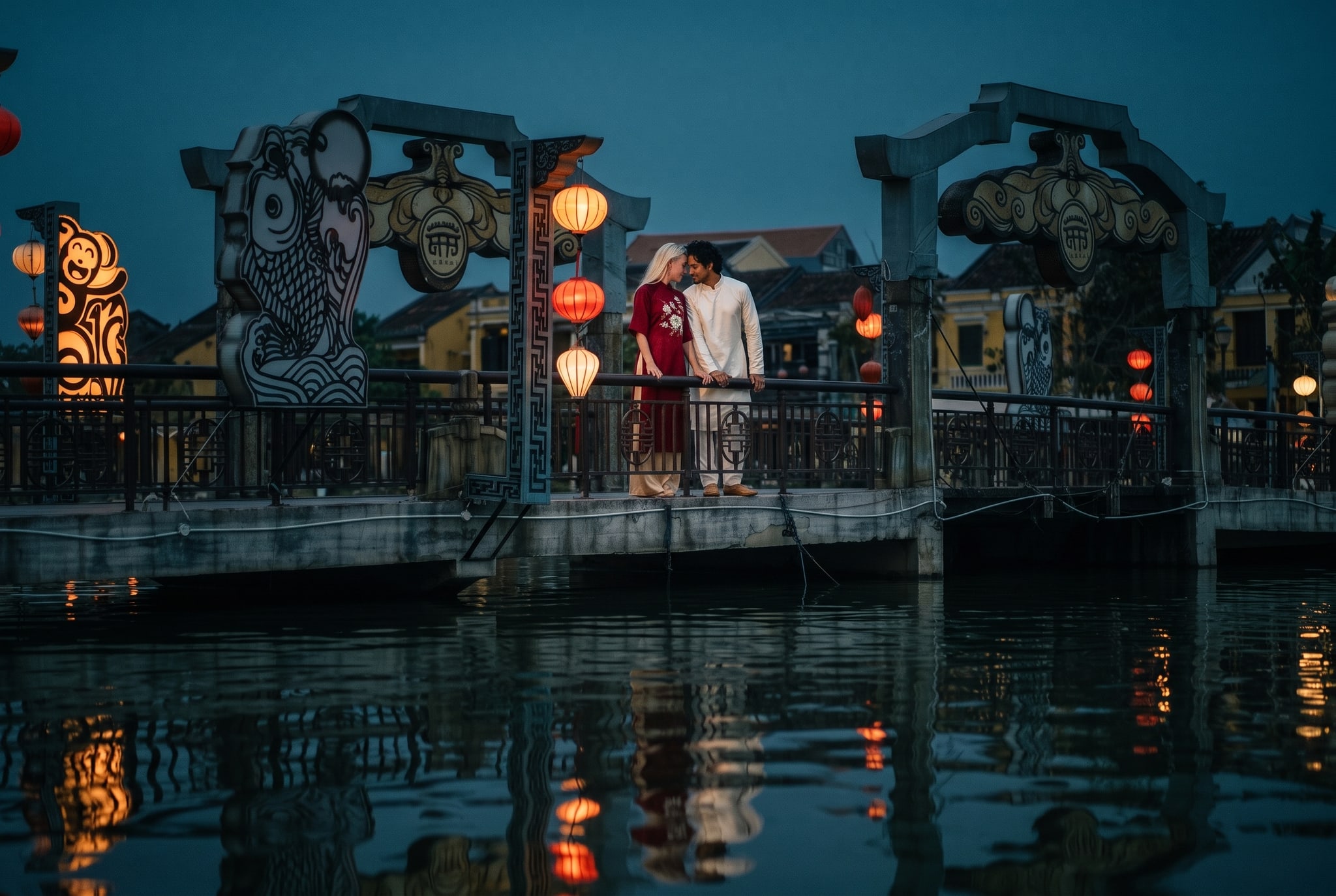
What time of day gives you the best light—and why we never skip scouting?
Golden hour is tempting but wrong. The canopy blocks direct sun completely until 4:00 p.m.; before that, light is scattered and blue-green, which sounds moody but photographs as murky. We've learned that 5:00–6:15 p.m. (May–August) or 4:30–5:45 p.m. (November–April) catches diffused warm light bouncing off water, painting faces without harsh shadows. Early morning (6:30–7:30 a.m.) works for soft, cool tones if couples want that aesthetic. The problem: tour boats start at 7:00 a.m. and crowd the boardwalk by 8:30 a.m. We always scout the week before to confirm which paths are quietest, where the water level sits, and whether fallen trees have changed sightlines since our last shoot. In one session last year, a floating bamboo raft blocked our main reflection spot; we pivoted to the north loop in 20 minutes because we'd scouted it beforehand.
Conclusion: Scout early; shoot 4:30–6:00 p.m. for warm, even light and manageable crowds.
How do you pose couples on a narrow boardwalk without looking stiff?
Stiffness happens when couples face the camera. We ask them to walk toward the camera, then stop mid-step and look at each other. The walking motion settles their shoulders, the eye contact is genuine, and the boardwalk's line becomes compositional depth. Another fail-safe: one person sits on the boardwalk edge (safely, feet visible, no dangling) while the other stands behind, hand on shoulder. Water below adds vulnerability. We avoid chest-to-camera standing poses; Tra Su's narrowness makes those look static. For outfit changes—typical in pre-wedding shoots—we position the couple under the densest canopy (less visible to boats) and work with a changing screen or wide angle to hide observers. A common mistake: we tell couples to hug for "natural" shots, but bodies tense. Instead, we ask them to hold hands and walk, stop, breathe, then look at each other. The pause before the look is where real emotion lives.
Conclusion: Pose through motion and proximity, not frontal stance; the boardwalk is your depth, not your barrier.
What should they wear, and how does fabric behave in humid forest air?
Pre-wedding couples usually choose a dress and suit for one outfit, then casual or traditional áo dài for another. Tra Su humidity (80–90%) swells natural fabrics and frizzles hair. We advise lightweight linen or cotton blends for the suit, raw silk or crepe for dresses—they breathe and photograph crisply. Dark colors (navy, forest green, burgundy) are safer than pastels in dappled light. Áo dài in silk or silk-blend works beautifully; the fabric catches water reflections without clinging. Avoid heavy brocades or thick satin that show sweat marks in 15 minutes. Shoes are critical—boardwalks are damp, sometimes slick. We tell couples to wear flat sandals or soft-soled shoes for the walk-in, then switch to heels or formal footwear for posed shots (only a few minutes). One couple wore white lace heels and slipped twice; we pivoted to their hotel flip-flops for safety, and those shots read as intimate and real, not formal.
Conclusion: Choose breathable fabrics and flat shoes; save heels for pose-only moments.
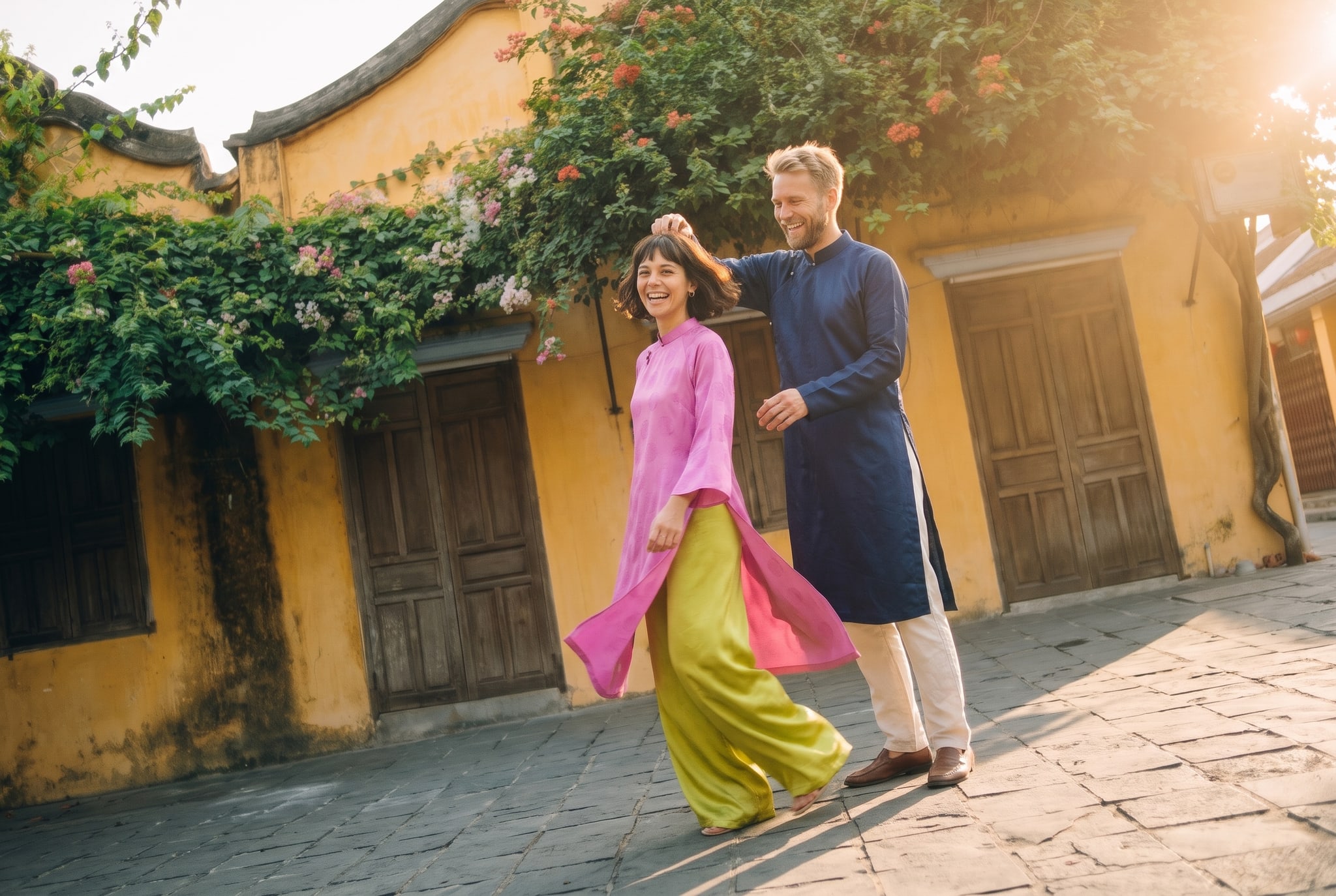
How much time do you actually need, and what does a real Tra Su shoot schedule look like?
A full pre-wedding day includes multiple locations. Tra Su alone takes 90 minutes on-site: 30 minutes arrival, walking the boardwalk to find quiet spots, testing light. Then 50 minutes of actual posing and outfit changes, with our photographer moving positions and our stylist managing wrinkles and hair. You lose 10 minutes to tourists asking for photos or boats passing close. If Tra Su is your only location, 2 hours (including buffer) is realistic. If you're doing hotel makeup and hair beforehand, add 1.5–2 hours in your room, then travel time (45 minutes from Can Tho city, longer if you're coming from elsewhere). A typical day: 6:00 a.m. makeup at hotel, 8:00 a.m. depart for Tra Su, 9:00 a.m.–10:30 a.m. shoot, 11:00 a.m. depart for second location (beach or temple). We block 6–8 hours total for a two-location pre-wedding package. Couples underestimate hair and makeup time; it's never 30 minutes, even if the makeup artist is fast. We build in a 20-minute cushion for traffic and unexpected crowds.
Conclusion: Budget 2 hours on-site, 6–8 hours total with multiple locations; don't rush makeup.
Comparison: Tra Su vs. other Mekong Delta and southern pre-wedding locations
| Location | Best for | Light quality | Crowds | Effort | Best season |
|---|---|---|---|---|---|
| Tra Su cajuput forest | Couples seeking intimate, moody frames | Soft, diffused, water-reflected | Peak 8 a.m.–2 p.m.; quiet early/late | Medium (45 min travel) | Nov–Apr |
| Cai Rang floating market | Couples wanting energetic, colorful scenes | Golden hour strong but chaotic | Boats and vendors everywhere | Low (Can Tho center) | Nov–Apr |
| Bac Lieu bird sanctuary | Couples who want open sky and silhouettes | Direct, high-contrast | Sparse except weekends | High (2 hr travel) | Dec–Feb |
| Mekong riverside temples | Couples blending culture and romance | Variable; depends on temple | Moderate | Low–medium | Year-round |
| Can Tho riverside parks | Couples wanting quick, accessible shoots | Even but flat | High weekends | Very low | Year-round |
For pre-wedding photoshoot packages, Tra Su stands out because its natural framing is tight; you don't need to hunt for composition. Cai Rang offers more visual variety but requires navigating boat traffic. Bac Lieu gives you expansive skies but feels less intimate. We often recommend Tra Su + one cultural location (a temple or market) to balance mood and context.
Chat with us on WhatsApp | See packages and prices on vietnamphotoshoot.com
What to check before you book a Tra Su shoot with any studio
- Verify entrance fees and guide requirements. Tra Su charges a small entrance fee per person; some studios roll this into the package, others don't. Confirm in writing. A guide is technically required but often optional if you're with a photographer.
- Ask about weather backup. Rain closes the boardwalk or makes it treacherous. What happens if you're rained out? Do you reschedule, reshoot elsewhere, or lose the booking? Get this in your contract.
- Check the studio's Tra Su portfolio. Ask to see 15–20 actual shots from their last three Tra Su shoots. If they show only 4–5 images or heavily edited test shots, they may not know the location well. Real studios have dozens of couple examples.
- Confirm arrival time and whose team travels. Will the photographer, stylist, and makeup artist go to Tra Su, or just the photographer? Hair and makeup touch-ups between locations require your stylist on-site.
- Ask about outfit-change logistics. Tra Su has no dressing rooms. Does the studio bring a privacy screen or expect you to change behind trees? This matters for áo dài or formal wear.
- Verify travel time and vehicle. Who arranges transport? Is it included? Do you meet them there? Travel from Can Tho to Tra Su takes 45–60 minutes; if you're from Saigon, add 3 hours. Clarify expectations.
Our team's honest take on Tra Su in 2026
Tra Su has become more popular with international pre-wedding couples, which means earlier starts and later finishes are now non-negotiable. The site is as beautiful as the photos suggest, but the magic lives in how you work it—timing, patience, and knowing which boardwalk loops stay quiet. We see couples who've researched Tra Su online expecting to shoot there solo; in reality, you'll share it with tour groups. That's okay; it just changes how we compose and when we ask you to move. The forest itself doesn't change—the water still mirrors, the light still softens, and couples still fall quiet when they're surrounded by that much green. Our pre-wedding and elopement packages include location scouting and a second-shooter if you want dual angles. If Tra Su is calling you, it's probably because you want something slower and more human than a temple or beach. That's exactly what we deliver there.
Chat with us on WhatsApp | See packages and prices on vietnamphotoshoot.com
FAQ
Can we do a Tra Su shoot in August or September (rainy season)?
Possible but risky. The boardwalk is slick, water is higher and murkier, and afternoon rain can trap you. We recommend November–April. If you must shoot then, start at dawn when rain is less likely.
Do we need to speak Vietnamese to go to Tra Su?
No. The entrance is clearly signed, the guide (if you hire one) usually speaks basic English, and you'll be with your photographer. We handle all logistics and translation if needed.
How many outfit changes can we do in a Tra Su shoot?
Realistically, two—one formal (dress/suit) and one casual or áo dài. The boardwalk has no shelter or mirrors for changing, and heat + humidity make longer sessions uncomfortable. More changes are better reserved for studio or hotel sessions.
Are there mosquitoes or insects at Tra Su?
Yes, especially dawn and dusk. Wear long sleeves or insect repellent before arrival. November–February is much better than summer. We always mention this when confirming bookings.
Can we include Tra Su in a larger multi-day pre-wedding tour?
Absolutely. Many couples pair Tra Su with Hoi An, Da Nang, or Saigon shoots. We coordinate timing and transport across all locations. This often works better than a single-day rush.
What if we're not a couple—can solo travelers or families shoot at Tra Su?
Yes. Solo travelers get moody, reflective shots; families get everyone framed by the forest. Family photoshoot packages work here too. The intimacy is different than couples', but the light and boardwalk are just as striking.
Pre-Wedding & Elopement
Inclusions, prices and booking are on our booking site.
FAQ
Can we do a Tra Su shoot in August or September (rainy season)?
Possible but risky. The boardwalk is slick, water is higher and murkier, and afternoon rain can trap you. We recommend November–April. If you must shoot then, start at dawn when rain is less likely.
Do we need to speak Vietnamese to go to Tra Su?
No. The entrance is clearly signed, the guide (if you hire one) usually speaks basic English, and you'll be with your photographer. We handle all logistics and translation if needed.
How many outfit changes can we do in a Tra Su shoot?
Realistically, two—one formal (dress/suit) and one casual or áo dài. The boardwalk has no shelter or mirrors for changing, and heat + humidity make longer sessions uncomfortable. More changes are better reserved for studio or hotel sessions.
Are there mosquitoes or insects at Tra Su?
Yes, especially dawn and dusk. Wear long sleeves or insect repellent before arrival. November–February is much better than summer. We always mention this when confirming bookings.
Can we include Tra Su in a larger multi-day pre-wedding tour?
Absolutely. Many couples pair Tra Su with Hoi An, Da Nang, or Saigon shoots. We coordinate timing and transport across all locations. This often works better than a single-day rush.
What if we're not a couple—can solo travelers or families shoot at Tra Su?
Yes. Solo travelers get moody, reflective shots; families get everyone framed by the forest. [Family photoshoot packages](/go/family-photoshoot) work here too. The intimacy is different than couples', but the light and boardwalk are just as striking.
More from the team
Boho pre-wedding photoshoot in Vietnam: Hanoi, Saigon, Hoi An
Boho pre-wedding shoots mix romantic, free-spirited aesthetics with Vietnam's landscapes and heritage sites. We run full-day sessions in three cities, handling styling, makeup, location scouts and edits.
Avoid crowds at Hoang Su Phi rice terraces: timing for wedding shoots
Hoang Su Phi's terraced landscape draws couples and tour buses in equal measure. We show how to shoot there alone, when to arrive, and what to arrange with us before you go.
Photography rules at Con Dao beaches: permits, drones and what to check
Con Dao's beaches demand prep before you shoot—permits, drone zones and tide timing all affect your day. We share what the Cáo Studio team verifies on every booking.