 Cáo Studio
Home › Blog › Pre-Wedding & Elopement
Pre-wedding photos in Vietnam's rice terrace season
By the Cáo Studio team · Hanoi & Saigon · 2026-11-02
Pre-wedding photos in Vietnam's rice terrace season means booking during the two annual windows when paddies are flooded and golden: September–October (autumn harvest) and May–June (spring planting). Cáo Studio shoots these at Mu Cang Chai (northern Yen Bai province, 8–10 hours from Hanoi), Ta Phin terraces (Sa Pa area, 5 hours north), or closer options like Ninh Binh's rice fields (2 hours from Hanoi). Sessions run 4–6 hours with a makeup artist, stylist, and photographer; you'll move between 3–5 field locations on foot. Expect monsoon rain, slippery mud, high humidity, and limited phone signal. The season window is short and tight—many couples book 2–3 months ahead. Cost depends on distance, team size, and whether you're doing an ao dai photoshoot package or pre-wedding and elopement shoot. Avoid booking during July–August (rain, low water) or November–April (dry, brown fields). --- Chat with us on WhatsApp
What actually happens in the terraces on shooting day?
Our team arrives before 7 a.m. with gear split between two backpacks because terrain forbids vehicles past a certain point. The makeup artist sets up in a local homestay or a guide's hut—no studios exist out there. Hair and makeup take 90 minutes while the photographer scouts light and paths. By 8:30 a.m., when mist lifts, you're walking into the first field. We move slowly: terraces are narrow, water is 2–3 feet deep, and ao dai (if you're wearing one) tangles in your legs. Every frame takes setup—we position you on a berm, check sight lines to the next ridge, wait for a farmer to move out of frame, then shoot 50–100 frames over 15 minutes. By 10 a.m., you're sweating, the sun is harsh, and we've used two locations. We break for water and a snack (always bring extra electrolyte packets). The 11 a.m.–1 p.m. window is too bright; we either move to shadowed terraces or sit in the homestay while the photographer edits test shots on laptop. The afternoon push (2–5 p.m.) happens on the opposite side of the valley where light turns golden. By 5 p.m., you're tired, clothes are mud-splattered, and we walk back in failing light. What we've noticed: couples who wore comfortable hiking boots instead of fashion sandals moved faster; those who didn't bring a change of pants regretted it. Rain showers at 3 p.m. aren't disasters—mist over terraces is actually more photogenic than clear skies.
Which season actually delivers the colors you're imagining?
September–October rice is golden-yellow because farmers have cut and bundled it; water between terraces reflects sky. This is the postcard image everyone wants, but the window lasts maybe three weeks before fields dry and farmers harvest entirely. We've shot couples here and noticed the light is softer than summer—less harsh shadow, better skin tones in candid frames. The tradeoff: afternoon temperatures hover around 26–28°C with 80% humidity, so makeup melts faster and you'll need touch-ups every two hours. May–June is green—seedlings in flooded paddies, lush hillsides, completely different mood—but fewer Western couples know about it, so you're less likely to clash with other shoots on the same day. Water reflection is stronger in June because levels are higher. We've found that May–June light is cooler (better for moody, romantic frames) while September–October is warmer and more celebratory. Both work; the choice depends on whether you want warmth or intimacy in your story. Avoid July–August entirely: monsoon downpours happen daily, visibility drops to 50 meters, and paddies are muddy soup rather than photogenic water. November–April fields are dry brown—technically shootable but visually flat.
How do you actually plan logistics from Hanoi or Saigon?
We book transport the week before because road conditions change (landslides, local festivals, checkpoints). From Cáo Studio Hanoi, Mu Cang Chai shoots require a 4 a.m. departure to arrive by noon, eat lunch, and start shooting by 2 p.m.—that's one afternoon session. Most couples do overnights: van leaves Hanoi at 4 p.m., arrives by 9 p.m., you rest, shoot from 6 a.m.–noon the next day in cooler light and fewer tourists, then drive home. That's our standard Mu Cang Chai package. Ta Phin (Sa Pa) takes 5 hours from Hanoi; overnight is almost mandatory. Ninh Binh is 2 hours away, so you can shoot in the morning and be back in Hanoi by dinner—useful if you're on a tight schedule. From Cáo Studio Saigon, the Mekong rice belt (An Giang, Kien Giang provinces) is drivable in 3–4 hours, but those fields look different—flatter, wider, less terraced. We've shot there and found the aesthetic is closer to documentary than fairy-tale. Most Saigon couples fly to Hanoi or drive to the central highlands (Dak Lak, Lam Dong) instead. What we tell couples on WhatsApp: "If you're in Saigon and want epic terraces, Hanoi base is cheaper than a mekong shoot because van + crew is already in the north." Permits aren't required for photography in rice fields, but local guides cost 800k–1.2M VND per day and are worth it: they know safe paths, speak to farmers if you want them in frames, and often have homestay connections for makeup setups.
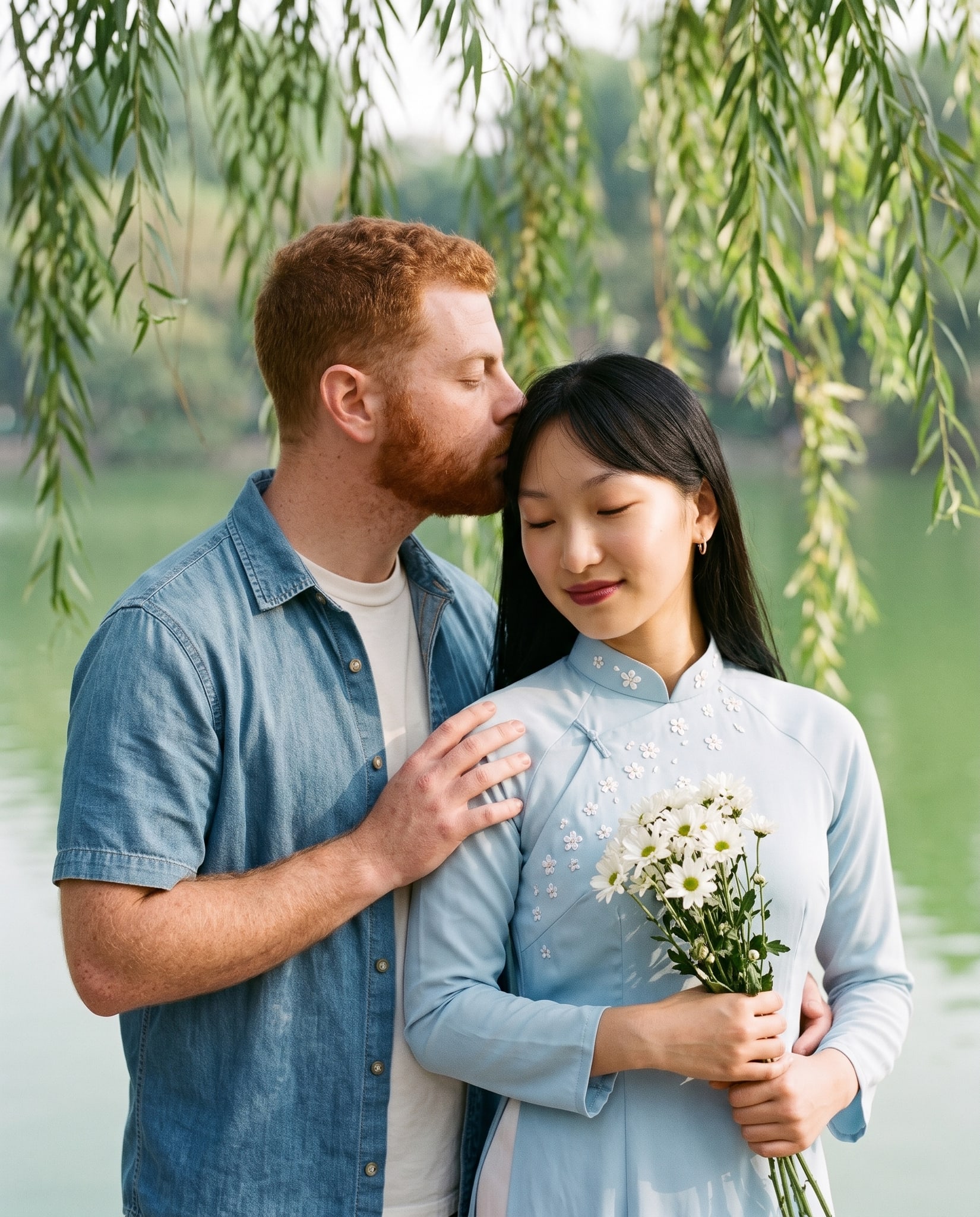
How do you dress for terraces without ruining the photos?
Ao dai is traditional for pre-wedding shots, but we've had to retrofit it five times mid-shoot because the hem drags in water and fabric stains muddy. Our stylist now wraps the bottom with a light cotton belt to keep it 15 cm above the waterline. Modern couples often choose tailored trousers and a silk shirt instead—easier to move in, faster to dry. Shoes: hiking boots or water sandals, not heels. We've watched brides sink one heel into soft mud and snap it clean off; replacements aren't available at 11 a.m. in a village. Fabric: cotton or linen absorbs sweat and photographs well; polyester looks plastic and clings in humidity. For the makeup artist's sake, avoid white or cream clothes—they show sweat marks and mud splatter in close-ups. We usually suggest a tonal palette: olive, rust, cream, or navy, repeated in two pieces so outfit changes feel intentional rather than accidental. Bring a separate outfit for location 3 or 4 (around 3 p.m.) so late-afternoon frames show freshness; the first outfit will look wilted by then. We pack a towel, a change of pants, and a dry shirt in the van for touch-ups. One unexpected win: a couple wore matching vintage floral shirts (not ao dai) and the casual, connected vibe worked better than formal in misty field light. What we've learned: the most-loved images rarely come from the fanciest outfit—they come from comfort and ease of movement.
See packages and prices on vietnamphotoshoot.com
What goes wrong, and how do you recover mid-shoot?
Weather is the main one. Forecast says 20% rain; 2 p.m. arrives with a downpour. We don't cancel—we pivot to a homestay porch or a covered terrace and shoot portrait-close frames, using the rain-dark backdrop for mood. Mist that rolled in unexpectedly becomes an asset; the softest light of the day. We've had farmers actively working in a field, making the background chaotic—our photographer reshuffles and shoots tighter crops, or we walk 10 minutes to an adjacent, empty terrace. Phone signal dies, and the couple can't contact family back home—we solve that by uploading test JPGs to shared Dropbox link in the van during lunch, or calling home on the guide's landline. Makeup melts; the artist carries blotting papers and a small spray bottle, and we add a 20-minute shade break at 1 p.m. A bride's dress strap tears on a thorn; we safety-pin it and shoot from angles that hide the repair. The van gets stuck in a rut on a side road; the guide calls a neighbor with a tractor. None of these are failures—they're the real shoot. The couples who remember their day best are the ones who rolled with mud, laughed at setbacks, and trusted the team. What we always say on WhatsApp before the shoot: "Weather will be unpredictable. Wear something you can move in and aren't afraid to get dirty. We've shot in rain, mud, and sweat—that's the adventure." The ones who arrive expecting a studio day get frustrated; the ones expecting a trek are thrilled.
Does a terrace shoot fit into a broader pre-wedding story?
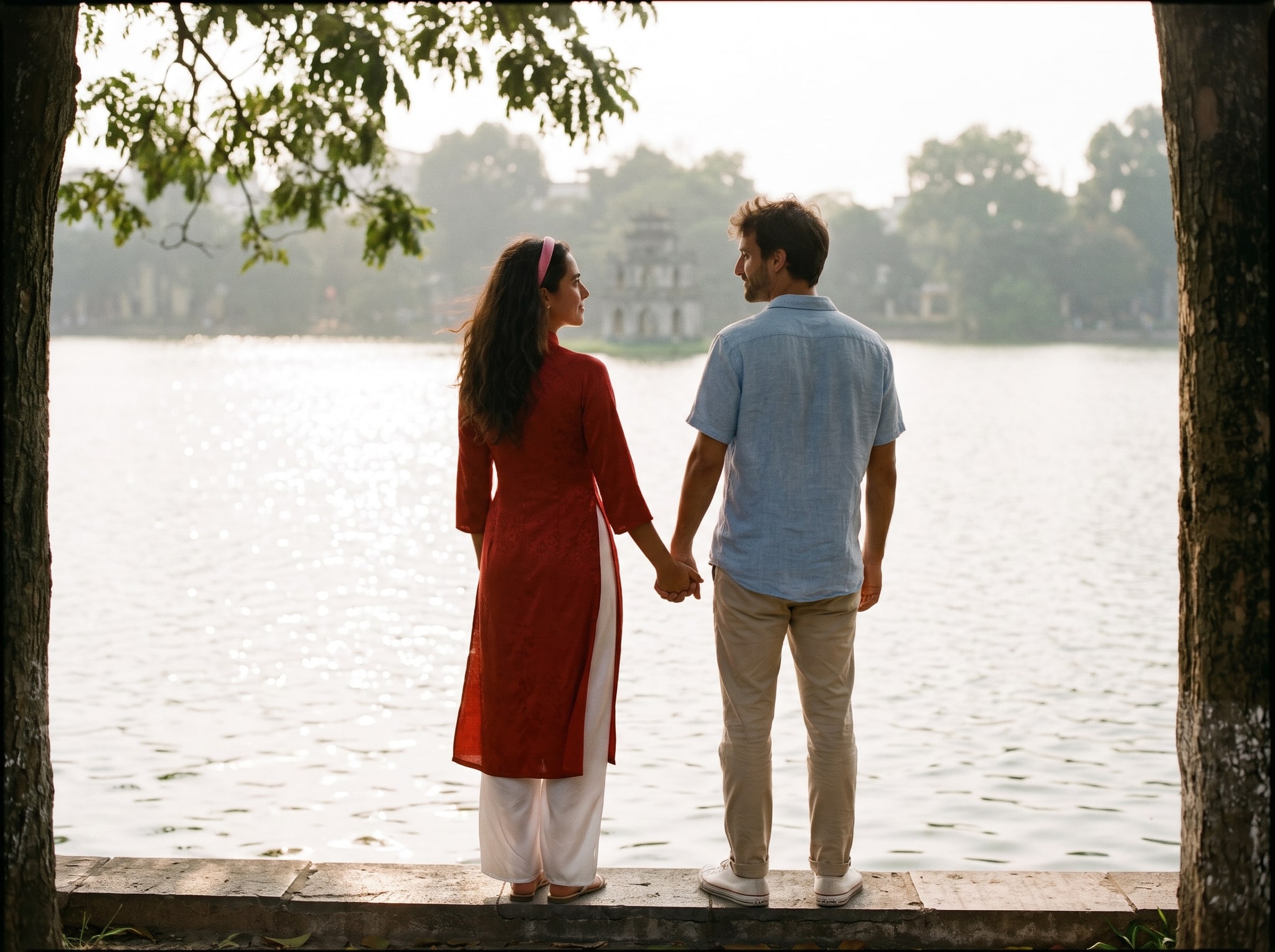
Terrace shoots are one location, 1 day, within a larger narrative. Most couples we work with do a couple photoshoot package that spans 2–3 days: Day 1 is urban (Hoan Kiem lake in Hanoi, or Binh Tay market in Saigon), Day 2 is the terrace, Day 3 is either a concept shoot (ao dai in a village, vintage Hanoi street) or a second location (beach, temple, old town). Terrace as Day 2 works because the couple is already warmed up with the photographer and makeup artist, the team has learned their vibe, and the ambitious, physical nature of hiking fields feels earned rather than shock. Some couples do terraces only—a single-day trip—if their timeline or budget is tight. That's valid, but we've noticed those couples sometimes wish they'd done a city day too, for variety and easier access to wardrobe changes. The proposal and anniversary package rarely includes terraces (proposals need crowd-free, accessible spots), but anniversaries often do—couples revisiting Vietnam love the epic-ness of a terrace redo-shoot. What we tell clients: "Terraces are not your entire story—they're the peak moment. The day before or after, capture the quiet, ordinary closeness. That's what you'll remember most." From a portfolio standpoint, terrace shoots stand out visually; but emotion comes from the full arc, not one location.
Making the decision: terrace shoot readiness checklist
| Factor | Terrace Fit | Not Ready Yet |
|---|---|---|
| Budget clarity | You've asked for a quote on WhatsApp and know rough package scope | You're waiting to see prices before discussing dates |
| Dates locked | Booking 8–10 weeks ahead for Sept–Oct or May–June window | Flexible dates or within 4 weeks of peak season |
| Physical comfort | You're fine hiking 8–10 km on uneven terrain in heat/humidity | You have knee/back issues or prefer air-conditioned setups |
| Outfit clarity | You've chosen ao dai, or picked tailored pants+shirt, confirmed with stylist | Still deciding between 5 outfit concepts, unsure about fabric |
| Team setup | You want hair/makeup in-field at a homestay (included) | You need a full salon setup—not possible at terrace locations |
| Narrative role | Terraces are one day in a 2–3 day shoot story | Terraces are your only shoot, no urban/village context |
An honest summary: if you're picturing yourself in golden rice fields at sunset, holding hands, glowing—that image is real and achievable. But it requires planning, physicality, and the willingness to embrace mud and sweat as part of the story. We've shot 50+ terrace sessions. The couples who felt most satisfied were the ones who read this kind of real breakdown beforehand, arrived prepared, and saw setbacks (rain, fatigue, a wrong turn) as texture, not disaster.
What to check before you book
- Confirm your season dates. Peak September–October slots fill by July. If you're reading this in August, call us immediately on WhatsApp—we may have last-minute cancellations.
- Be honest about fitness. Terraces aren't dangerous, but they're not a stroll. If hiking 3 hours with gear is daunting, ask us about vacation and solo photoshoot alternatives in flat, accessible areas.
- Nail down your outfit direction with our stylist before the shoot date. Purchasing a new ao dai two weeks before is risky—bring one you've worn, or choose tailored pieces you already own.
- Verify transport and guide costs are included in your quote. Some packages include the local guide; others don't. The difference is significant.
- Book makeup and hair at your hotel the night before if you want to arrive at the field with energy. Tiredness shows in facial expression and skin. We offer makeup and hair at your hotel as an add-on.
- Upload a Pinterest board of terrace mood and composition styles to the shared Dropbox or WhatsApp thread before the shoot. Our photographer will reference it and adapt on the day—saves misaligned expectations.
- Check the weather forecast 5 days before, then again 2 days before. We'll adjust times if needed (early morning start to beat afternoon rain, for instance).
See packages and prices on vietnamphotoshoot.com | Chat with us on WhatsApp
FAQ
What's the best month for rice terrace photos?
September–October and May–June are the peak windows. September–October is golden and warm; May–June is lush green and cooler. Both are equally photogenic—the choice depends on mood and your travel timeline. July–August is too rainy; November–April fields are dry and brown.
Do we need hiking boots, or are normal shoes okay?
Hiking boots or water sandals are essential. We've had couples lose heels in mud and slip on wet berms in regular shoes. Terraces are navigable but slippery—footwear matters as much as clothing.
Can we hire a local guide, or does Cáo Studio arrange that?
We arrange the guide as part of the pre-wedding package. Guides know safe paths, can manage farmer permissions if needed, and often have homestay connections for makeup setups. The cost is built into the package quote.
How long does a terrace shoot actually take?
4–6 hours in the field, plus 90 minutes for hair and makeup before, and 30 minutes travel each way. Most couples plan for a full day, either as a one-day trip from Hanoi or Saigon, or as Day 2 of a longer shoot package.
What if it rains on our shoot day?
We don't cancel for rain. Mist and light showers often create the most atmospheric light. We move to sheltered spots if needed, shoot tighter crops, and adapt the shot list. Rain is texture, not a disaster—the couples who expected weather report the most authentic memories.
Can we do a terrace shoot without an ao dai?
Absolutely. Tailored pants and a linen shirt work beautifully in terrace light, move easier, and dry faster than ao dai. Our stylist will help you choose fabrics and colors that photograph well. Ao dai is traditional but not mandatory.
How far in advance should we book?
For September–October peak season, 8–10 weeks is ideal. For May–June, 6–8 weeks. If you're reading this within 4 weeks of your desired dates, WhatsApp us immediately—cancellations happen, and we might have availability.
Is the terrace shoot part of a larger package, or can we do it alone?
Both work. Single-day terrace-only shoots are possible. Most couples, though, pair terraces with a city day (Hanoi, Saigon, Hoi An) or a concept shoot (ao dai village, vintage street) for narrative variety. We'll propose options based on your timeline and budget.
Pre-Wedding & Elopement
Inclusions, prices and booking are on our booking site.
FAQ
What's the best month for rice terrace photos?
September–October and May–June are the peak windows. September–October is golden and warm; May–June is lush green and cooler. Both are equally photogenic—the choice depends on mood and your travel timeline. July–August is too rainy; November–April fields are dry and brown.
Do we need hiking boots, or are normal shoes okay?
Hiking boots or water sandals are essential. We've had couples lose heels in mud and slip on wet berms in regular shoes. Terraces are navigable but slippery—footwear matters as much as clothing.
Can we hire a local guide, or does Cáo Studio arrange that?
We arrange the guide as part of the pre-wedding package. Guides know safe paths, can manage farmer permissions if needed, and often have homestay connections for makeup setups. The cost is built into the package quote.
How long does a terrace shoot actually take?
4–6 hours in the field, plus 90 minutes for hair and makeup before, and 30 minutes travel each way. Most couples plan for a full day, either as a one-day trip from Hanoi or Saigon, or as Day 2 of a longer shoot package.
What if it rains on our shoot day?
We don't cancel for rain. Mist and light showers often create the most atmospheric light. We move to sheltered spots if needed, shoot tighter crops, and adapt the shot list. Rain is texture, not a disaster—the couples who expected weather report the most authentic memories.
Can we do a terrace shoot without an ao dai?
Absolutely. Tailored pants and a linen shirt work beautifully in terrace light, move easier, and dry faster than ao dai. Our stylist will help you choose fabrics and colors that photograph well. Ao dai is traditional but not mandatory.
How far in advance should we book?
For September–October peak season, 8–10 weeks is ideal. For May–June, 6–8 weeks. If you're reading this within 4 weeks of your desired dates, WhatsApp us immediately—cancellations happen, and we might have availability.
Is the terrace shoot part of a larger package, or can we do it alone?
Both work. Single-day terrace-only shoots are possible. Most couples, though, pair terraces with a city day (Hanoi, Saigon, Hoi An) or a concept shoot (ao dai village, vintage street) for narrative variety. We'll propose options based on your timeline and budget.
More from the team
Boho pre-wedding photoshoot in Vietnam: Hanoi, Saigon, Hoi An
Boho pre-wedding shoots mix romantic, free-spirited aesthetics with Vietnam's landscapes and heritage sites. We run full-day sessions in three cities, handling styling, makeup, location scouts and edits.
Avoid crowds at Hoang Su Phi rice terraces: timing for wedding shoots
Hoang Su Phi's terraced landscape draws couples and tour buses in equal measure. We show how to shoot there alone, when to arrive, and what to arrange with us before you go.
Photography rules at Con Dao beaches: permits, drones and what to check
Con Dao's beaches demand prep before you shoot—permits, drone zones and tide timing all affect your day. We share what the Cáo Studio team verifies on every booking.