 Cáo Studio
Home › Blog › Pre-Wedding & Elopement
Pre-wedding photoshoot in Moc Chau February: light, weather, crowds
By the Cáo Studio team · Hanoi & Saigon · 2026-11-02
February pre-wedding shoots in Moc Chau work because cool, dry weather and morning mist create soft backlighting over tea terraces without summer heat or crowds. Day length (~11 hours of usable light) requires dawn starts—we typically arrive 5:30 a.m. to catch golden hour before 7 a.m. Mist usually clears by 9 a.m., leaving clear mid-morning light ideal for detail and outfit changes. Tourist flow is low compared to summer, though weekends see day-trippers. Cáo Studio books 2–3 hours for terrain and wardrobe changes; couples should wear layers (mornings drop to 12°C, afternoons reach 20°C) and bring weatherproof shoes. Expect muddy paths after rare rain; we scout locations the day before and have backup indoor venues. Plan arrival in Moc Chau the previous afternoon to avoid dawn-drive fatigue. Chat with us on WhatsApp | See packages and prices on vietnamphotoshoot.com
Why does February light in Moc Chau suit pre-wedding work?
February sun rises at 6:40 a.m. and sets at 5:15 p.m., compressing usable hours—but that constraint forces intentional timing. Morning mist (heavy 6–8 a.m.) refracts direct rays into diffuse, even illumination across tea rows, erasing harsh shadows on faces and textured foliage. By our third shoot here this season, we realized couples look most relaxed when we're racing morning light rather than managing noon glare. The trade-off: we've only 90 minutes of that premium soft window before the sun clears the valley. After 9 a.m., light is bright and clean but no longer directional—useful for clean outfit shots but less flattering for close-ups. February's cool air also keeps humidity low, so makeup holds without touch-ups for 4–5 hours; in summer, we're reapplying every 45 minutes. We always confirm shoot start time via WhatsApp the week before because morning fog depth varies—some days mist burns off at 7:45 a.m., others at 9:30 a.m. Early start is non-negotiable for pre-wedding quality here.
What weather surprises does our team encounter in February?
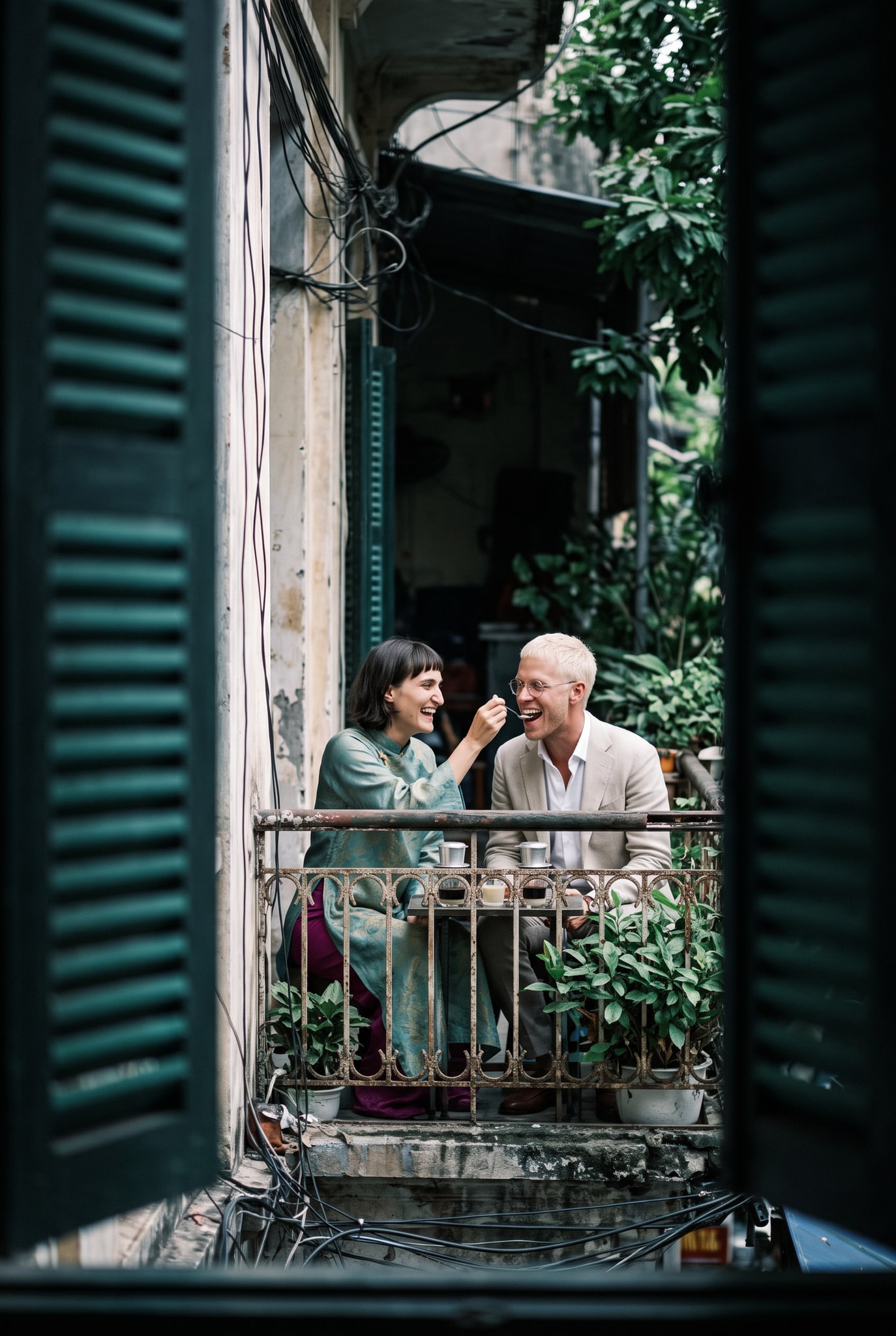
Rain arrives 2–3 times monthly in Moc Chau, usually light and brief (15–30 minutes). We've learned to check the hourly forecast at 5 a.m. and adjust location within the first 20 minutes on-site. In February 2025, a couple's shoot was halfway through when cold drizzle arrived; we moved under tea-drying sheds (local farmers allow this for a small courtesy tip), shot 40 minutes of intimate, moody frames against corrugated metal and wooden beams, then finished in open light once clouds broke. What we tell couples on WhatsApp: "If rain comes, we work with it—it's dramatic and real, not a disaster." Wind is more common than rain; at elevation (1,000 m), February afternoon winds gust 20–30 km/h, which tangles hair and moves fabric unpredictably. We position our hair and makeup artist downwind of the couple and carry clip-on silk scarves as backups. Temperature swings catch people off guard—sunrise at 12°C, midday at 19–22°C, then dropping again by 4 p.m. Couples in sleeveless áo dài or light silk get cold fast; we always recommend a cardigan or shawl to wear between outfit changes. Never trust the Hanoi forecast for Moc Chau; elevation and valley geography create localized conditions.
See packages and prices on vietnamphotoshoot.com
How do crowds and bookings affect your February schedule?
February is shoulder season—fewer tourists than Tet (late Jan–early Feb) or summer, but weekends fill up. We typically photograph 2–3 couples per week in February across both locations; mid-week slots (Tue–Thu) are easier to secure with minimal other visitors in frame. Tet week itself (varies yearly, roughly late January to early February) is chaos—thousands of domestic tourists visit for flower fairs and temple visits. We actively avoid Tet week unless couples specifically want bustling-market energy (which we can deliver if booked). Peak local-visitor times: Saturday 9 a.m.–12 p.m. and Sunday 8–10 a.m.; we schedule pre-wedding work either 5–8 a.m. (before day-trippers arrive) or 2–5 p.m. (after the morning rush). Weekday mornings are genuinely empty—in early February, we've had entire tea plantations to ourselves. Our booking site (pre-wedding and elopement packages) shows real availability; we don't oversell February slots because location scouting and backup-location confirmations take time the day before. If you book a weekend, expect 3–4 other groups visible in wide landscape shots; we frame tighter to minimize this, but it's honest to mention.
What does a typical February shoot day look like, hour by hour?
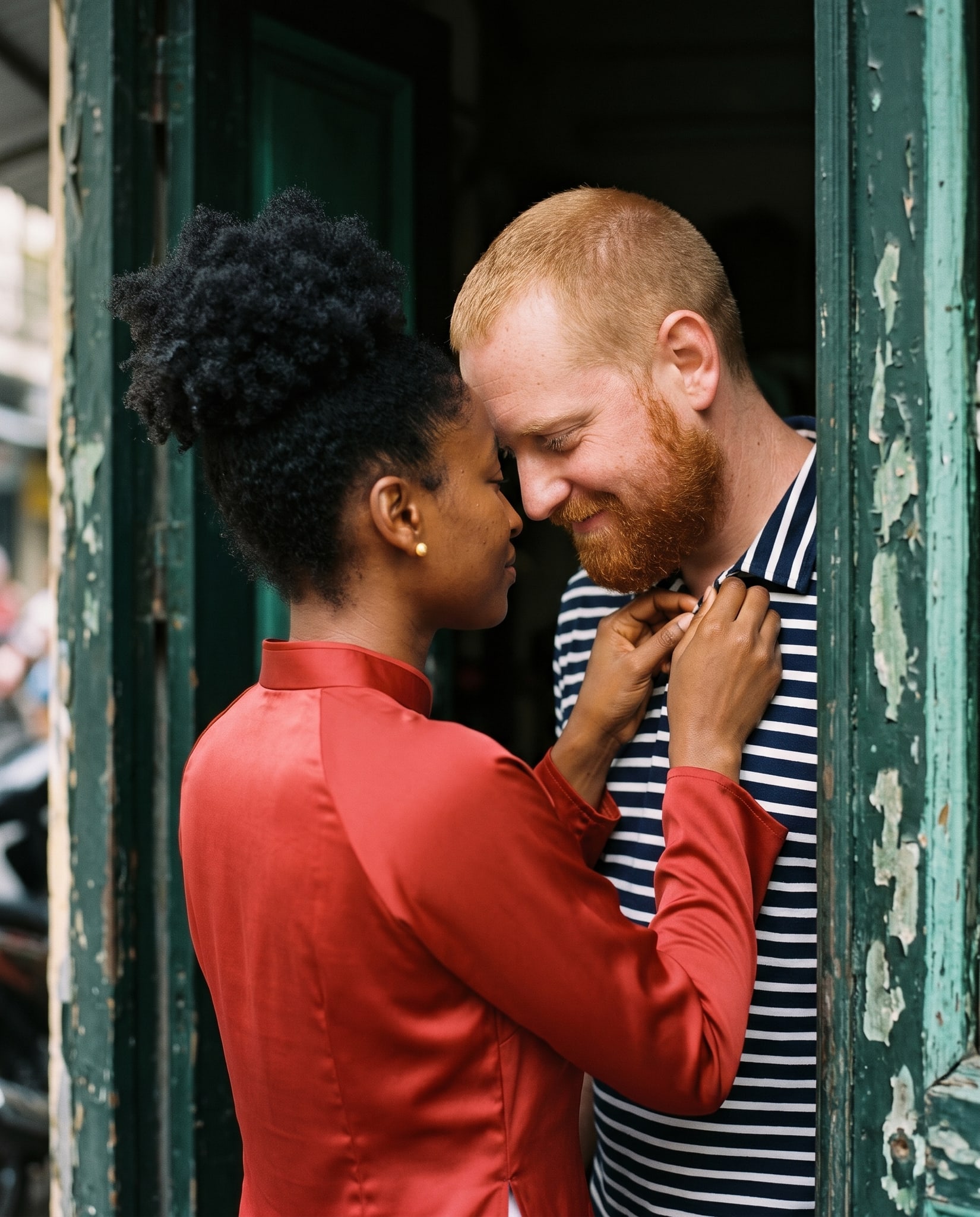
We meet couples at their hotel in Moc Chau town (usually 6:15 a.m.; they arrive the prior evening). Hair and makeup happen 6:15–7:00 a.m. in-room—our team brings studio lighting to the hotel (part of makeup and hair at your hotel service). We drive to the first location by 7:15 a.m., arriving as mist peaks. First location (tea terraces or valley overlook) runs 7:30–8:45 a.m.—roughly 8–10 frames per outfit, two outfit changes. By 8:50 a.m., mist visibly lifts; we've usually captured the softest light and move to a second, sunnier location (village paths, water buffalo, wooden gates). Midday 10:30 a.m.–12:30 p.m. is reserved for detailed close-ups and couple interaction—by now, couples relax, light is stable, and we're 3+ hours into rapport. We break 12:30–1:15 p.m. for lunch (bring snacks; local cafés are basic). Afternoon location (2–4 p.m.) is highest-energy—bright, clear light, couple is tired but smiling naturally. Final 30 minutes (4:15–4:45 p.m.) is pure cushion time for emergency reshoot of any frame the couple felt uncertain about. We're back at the hotel by 5:30 p.m. tired, muddy, and with 300–400 RAW files. Couple selects 40–60 frames for editing over the next 2 weeks via online gallery.
Which outfit and location choices actually work in February Moc Chau?
Áo dài in jewel tones (emerald, burgundy, navy) pop against mist and tea green; pastels (cream, pale pink, white) blur into fog. We've noticed silk áo dài photographs richer than cotton in cool light because the drape catches directional mist-filtered sun. Heavy fabrics work better—thin áo dài billow in wind and look ghostly in dim morning light. Second outfits work best as contrast: if the first is áo dài, the second is casual (jeans, light sweater, scarves) to show personality and give couple variety. Location chart (based on 12 shoots in Feb 2024–2025):
| Location | Best light | Why it works | Outfit choice |
|---|---|---|---|
| Tea terraces (central) | 7–8:30 a.m. | Mist frames rows; backlighting | Dark áo dài or silk |
| Valley overlook (north edge) | 8–10 a.m. | Clear view after mist; warm light | Color or patterned áo dài |
| Village paths (Lac village) | 10 a.m.–2 p.m. | Neutral backdrop; people-scale | Casual outfit, natural interaction |
| Water buffalo pond (west) | 3–4:30 p.m. | Golden light; animal adds life | Second outfit; dynamic poses |
| Wooden farmhouse gates | 2–3 p.m. | Shade + dappled light; intimate | Either outfit; close-up frames |
Sunset (around 5:15 p.m.) is too late—light drops fast, and you're traveling back in dim conditions. We always finish by 4:45 p.m.
What should couples confirm before booking a February Moc Chau shoot?
Before clicking "Book," check this:
- Visa and transport: Do you arrive in Vietnam at least 2 days early to adjust to time and travel? Moc Chau is 4.5 hours northwest of Hanoi (by car or bus).
- Weather flexibility: Can you reschedule if rain is heavy the morning of your shoot? (Rare, but happens.) We've never cancelled outright—we pivot locations—but couples need to know.
- Altitude readiness: Moc Chau sits at 1,000 m. Some people feel lightheaded at early dawn. Drink water the night before; no heavy breakfast before 6 a.m.
- Footwear: Bring waterproof hiking boots or slip-ons with grip. Terraces are muddy even 2 days after rain. Áo dài footwear won't work; save fancy shoes for in-room detail shots.
- Outfit delivery: If your áo dài is being made locally or shipped, confirm it arrives 3+ days before the shoot. February heat is fine for fabric, but customs delays are unpredictable.
- Hotel booking: Stay in Moc Chau town itself (roughly 10 hotels in town). Budget 40–60 minutes travel time from Hanoi if driving; early morning drive on a 1-lane mountain road is tiring and risky. We'll send you the hotel we recommend via WhatsApp after booking.
We've shot pre-wedding work in Moc Chau every February since 2021. The light is unbeatable in that first golden hour, and the quiet is real—no crowds, no noise, just two people and a landscape. February works because cool air and mist are features, not obstacles. If you're drawn to serene, moody backdrops and genuine solitude, Moc Chau in February is the answer. Ready to plan?
Our pre-wedding packages include location scouting, full-day coverage, and all edits. Reach out via WhatsApp to discuss your Moc Chau dates; we'll confirm availability and send you the real shoot timeline so there's no surprise about wake-up times or light windows.
For couples considering couple photoshoot packages elsewhere in Vietnam or special concept shoots with a specific vision, we'll adapt the same logic—scout the location in your season, nail the light window, and build the day around what the weather actually gives us, not what we hope for.
See packages and prices on vietnamphotoshoot.com
FAQ
Is February too cold for outdoor pre-wedding shoots?
No. Morning is 12–15°C, midday 18–22°C—cool but comfortable if you wear layers under your áo dài and bring a cardigan. We've shot dozens of couples in February; none have complained of cold. Wind chill is the real factor, not temperature.
How much mist is there, and does it ruin photos?
Mist is feature, not flaw. Heavy mist 6–8:30 a.m. creates soft, diffuse light and mood. By 9 a.m. it usually clears. If mist is too thick (rare), we move to slightly lower elevations where visibility is better. Plan to embrace it, not avoid it.
Can we shoot after 4 p.m. to avoid the early start?
Not recommended. Sunset is 5:15 p.m. in February; after 4 p.m., light drops rapidly and becomes orange-warm (hard to edit). Early start captures the best light window. We can shift to 6 a.m. instead of 5:30 a.m. if 5:30 is too early, but not later.
What if it rains on our shoot day?
Light rain (drizzle) doesn't stop us; we've shot in it with moody results. Heavy rain (downpour) triggers location pivot within 30 minutes—we have backup venues. We've never cancelled a February shoot. Reschedule options are available if weather is severe.
Should we hire a local guide or just book your team?
Our team is your guide. We scout locations, handle logistics, direct you through poses, and know the land. You don't need a separate tour guide. If you want cultural context (tea farming history, local life), tell us via WhatsApp and we'll weave it into the shoot narrative.
Are there other people in the photos during February?
Weekday mornings: almost none. Weekend mornings: 3–5 other visitor groups visible in wide landscape shots. We frame tighter to minimize them. If solitude is critical, book mid-week.
Pre-Wedding & Elopement
Inclusions, prices and booking are on our booking site.
FAQ
Is February too cold for outdoor pre-wedding shoots?
No. Morning is 12–15°C, midday 18–22°C—cool but comfortable if you wear layers under your áo dài and bring a cardigan. We've shot dozens of couples in February; none have complained of cold. Wind chill is the real factor, not temperature.
How much mist is there, and does it ruin photos?
Mist is feature, not flaw. Heavy mist 6–8:30 a.m. creates soft, diffuse light and mood. By 9 a.m. it usually clears. If mist is too thick (rare), we move to slightly lower elevations where visibility is better. Plan to embrace it, not avoid it.
Can we shoot after 4 p.m. to avoid the early start?
Not recommended. Sunset is 5:15 p.m. in February; after 4 p.m., light drops rapidly and becomes orange-warm (hard to edit). Early start captures the best light window. We can shift to 6 a.m. instead of 5:30 a.m. if 5:30 is too early, but not later.
What if it rains on our shoot day?
Light rain (drizzle) doesn't stop us; we've shot in it with moody results. Heavy rain (downpour) triggers location pivot within 30 minutes—we have backup venues. We've never cancelled a February shoot. Reschedule options are available if weather is severe.
Should we hire a local guide or just book your team?
Our team is your guide. We scout locations, handle logistics, direct you through poses, and know the land. You don't need a separate tour guide. If you want cultural context (tea farming history, local life), tell us via WhatsApp and we'll weave it into the shoot narrative.
Are there other people in the photos during February?
Weekday mornings: almost none. Weekend mornings: 3–5 other visitor groups visible in wide landscape shots. We frame tighter to minimize them. If solitude is critical, book mid-week.
More from the team
Boho pre-wedding photoshoot in Vietnam: Hanoi, Saigon, Hoi An
Boho pre-wedding shoots mix romantic, free-spirited aesthetics with Vietnam's landscapes and heritage sites. We run full-day sessions in three cities, handling styling, makeup, location scouts and edits.
Avoid crowds at Hoang Su Phi rice terraces: timing for wedding shoots
Hoang Su Phi's terraced landscape draws couples and tour buses in equal measure. We show how to shoot there alone, when to arrive, and what to arrange with us before you go.
Photography rules at Con Dao beaches: permits, drones and what to check
Con Dao's beaches demand prep before you shoot—permits, drone zones and tide timing all affect your day. We share what the Cáo Studio team verifies on every booking.