 Cáo Studio
Home › Blog › Pre-Wedding & Elopement
Pre-wedding photoshoot in Quy Nhon February: weather, light and crowds
By the Cáo Studio team · Hanoi & Saigon · 2026-11-02
February is Quy Nhon's sweet spot for pre-wedding shoots. Daytime highs reach 24–26°C, humidity drops to 65–70%, and afternoon light stays soft from 2–5 pm due to the sun's lower arc—ideal for outdoor portraits without harsh shadows. Crowds thin out after Lunar New Year, so major beaches like Quy Nhon city beach and remote spots near Eo Gio cliffs stay clear. Winds pick up (northeast monsoon, 15–20 km/h on average), which affects hair and fabric movement; we brief couples on this and adjust styling. Cáo Studio typically books 1–2 full days for pre-wedding couples in Quy Nhon, mixing beach, urban and nature backdrops. Sunrise (6:40 am) gives cool, directional light; golden hour (4:30–5:30 pm) is peak. Pack a light jacket, sunscreen and a backup outfit for wind-resistant shots. Avoid midday (11 am–2 pm) when the sun climbs high and heat bounces off sand. --- Chat with us on WhatsApp | See packages and prices on vietnamphotoshoot.com
Why does Quy Nhon light in February feel different from other months?
The sun's lower position in the February sky—between 45–50° at noon—means it never sits directly overhead. We've noticed this stretches golden hour and soft-light windows across most of the afternoon. Compare that to summer (June–August) when the sun peaks at 75°+, and shadows collapse into dark pools under chins and noses within minutes. February light is diffuse and directional at once; photographers can shoot into-sun backlighting without exposing skin to glare that usually forces us into shade-hunting by 1 pm. Humidity stays below 70%, so hair holds shape longer and skin reads true on camera without the matte sheen that June brings. This consistency is why we push February bookings hard—we need fewer gear workarounds and fewer location pivots mid-shoot.
What wind patterns should couples expect, and how do we work around them?
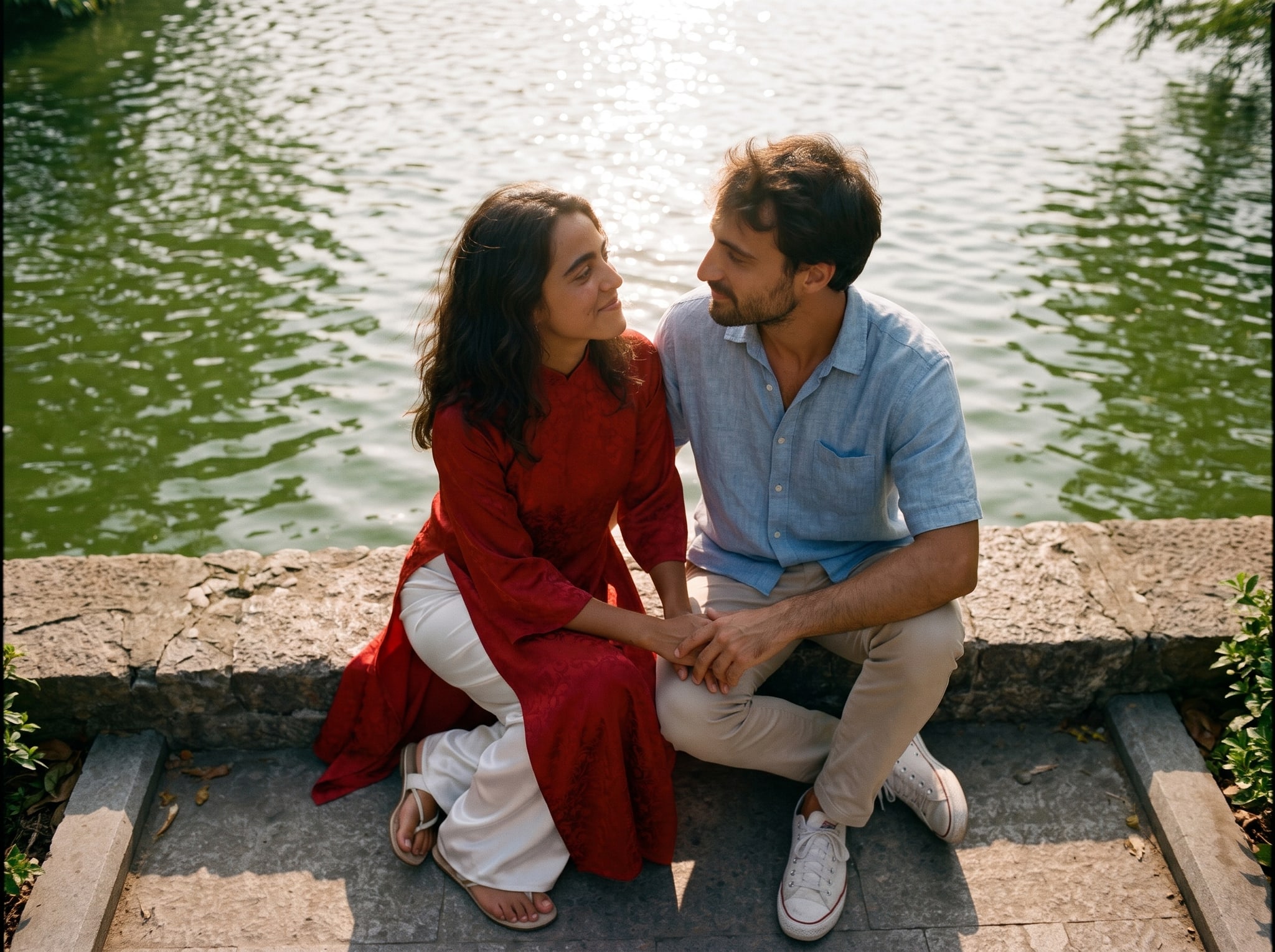
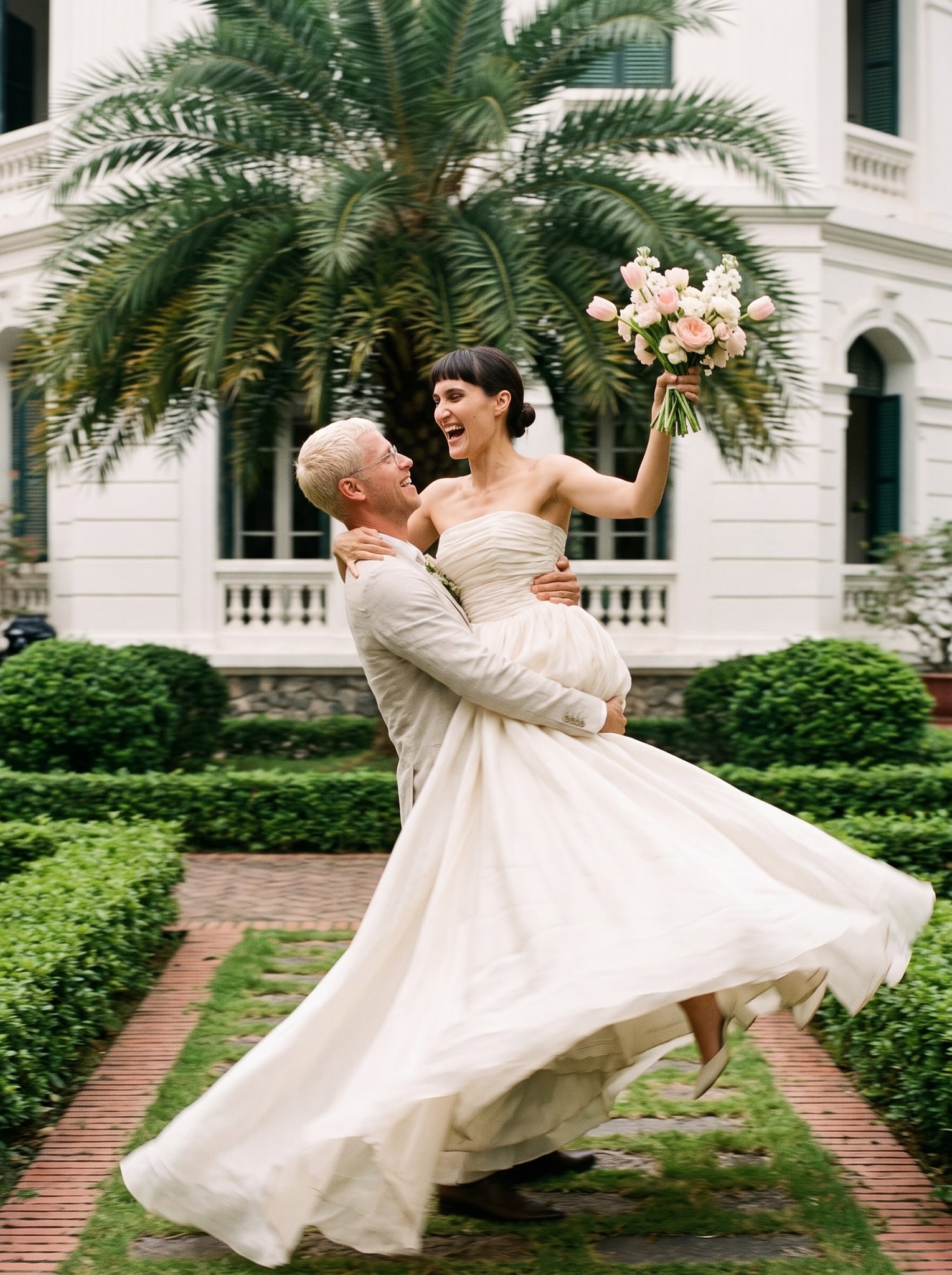
Northeast monsoon winds (Đông Bắc) average 12–20 km/h in February; on 2–3 shoot days per month, gusts touch 25 km/h. Our stylists tell couples upfront: lightweight fabrics (silk, cotton lawn, linen) will move, and that's often beautiful for editorial shots. Heavy satin áo dài (traditional Vietnamese silk gown) can look stiff in still air; February wind gives it natural flow. We carry clip-in extensions and bobby pins rated for wind (thicker, angled types grip better than standard pins). Loose waves photograph better than tight braids in these conditions. Our makeup artists use setting spray (a step most don't mention but we always do). We've learned to position shots with the wind at the couple's back, so it pushes fabric toward camera rather than tangles it. On high-wind days, we move shoots toward sheltered spots: Eo Gio's rock formations block wind, and narrow streets in central Quy Nhon act as natural windbreaks.
Are beaches in Quy Nhon crowded in February, and where do we find quiet spots?
February post-Lunar New Year is quiet across coastal Vietnam. Quy Nhon's main urban beach (near the promenade, Tran Hung Dao ward) sees maybe 100–150 people on a weekday afternoon, mostly local walkers—not tourists. We shoot there 1–2 mornings per month without issue. Eo Gio (the rocky cape with white stone formations, 10 km northeast) is emptier; we've had full days there with only fishermen visible. Soft sand beaches near Bai Sao (south of the city) are almost deserted. The trade-off: these spots need 30–45 minutes' travel from central hotels, and sand stays damp until noon (tidal flats). We brief couples: arrive by 7 am if you want dry sand; after 1 pm, the beach fills with locals by 4 pm as work ends. Our recommendation is sunrise (6:40–7:30 am) on a main beach, then move to a quiet inland spot (rice paddies near An Phu, 20 km west) for midday outfit changes.
| Beach / location | crowd level | light quality | travel time | best time | wind exposure |
|---|---|---|---|---|---|
| Quy Nhon city beach (main) | low weekdays, medium weekends | golden (4–5:30 pm) | 10 min from hotel | 7–8:30 am or 4–5:30 pm | high (open bay) |
| Eo Gio cliffs | very low | soft (7–10 am, 3–5 pm) | 40 min | sunrise or late afternoon | moderate (cliffs block some) |
| Bai Sao (south) | low | neutral midday, good golden hour | 30 min | 9 am–12 pm | high (exposed) |
| Rice paddies (An Phu west) | deserted | soft all day, peak 2–4 pm | 25 min | 10 am–3 pm | low (shelter) |
What do we pack differently for February shoots in Quy Nhon versus other seasons?
Our kit adjusts. Summer (June–August) requires ND filters, a reflector with diffusion, and a second assistant purely for shade-moving. February needs a diffusion scrim (wind-proof style, heavier frame) but not as much fill light—the light is already soft. We bring heavier stands because wind tests lightweight tripod legs. Hair products change: we use matte hold sprays instead of glossy serums (humidity is low, so skin doesn't benefit from shine protection). Makeup palettes shift to powders over creams (the climate is drier, so we avoid the heavy base that reads cakey). We pack two jackets per couple (linen blazers, 400 g each) for outfit variety and warmth during early morning waits. Sunscreen becomes essential—February's cool feel masks the sun's UV intensity at coastal latitude 13°N, and couples often skip reapplication. We carry SPF 50+ and remind clients during outfit changes. The one thing we don't bring: umbrellas. Rain in Quy Nhon in February is rare (average 8 mm across the month); we've cancelled for rain maybe once in five years.
How do we time a full pre-wedding day shoot to maximize light without exhausting the couple?
We structure it around light windows, not 12-hour marathons. Sunrise (6:40 am) to 8:30 am is soft and cool—we shoot outdoor portraits, maybe the áo dài outfit, hair and makeup looking fresh. Couple returns to hotel by 9 am for rest, light food, second makeup touch. We scout locations and reset gear. Second shoot block: 2:30–5:30 pm, peak golden hour. This is editorial and detail work (hands, rings, fashion close-ups, wider environmental shots). Total on-camera time is 4.5–5 hours, split into two easy blocks. February's cool temps mean couples don't sweat through makeup or clothes as quickly as summer shoots; we've seen a 30-minute buffer of perfect makeup integrity versus June's 20 minutes. One realistic factor: Quy Nhon's distance from Hanoi (1,200 km) or Saigon (920 km) means most couples arrive the day before, tired. We always offer 9 am starts instead of 6 am for international travelers; the light trade-off is minimal (6:40–9 am is still directional and soft). We've learned that a rested couple photographs better than an exhausted one shot during optimal light.
What to check before you book a pre-wedding shoot in Quy Nhon in February
- Confirm the exact shoot date 4–6 weeks ahead. Our calendar fills fastest for February; changing dates mid-month often means losing your preferred morning slot.
- Specify outfit count and type. Áo dài, Western formal wear, casual beach outfits and concept costumes each need different prep time. Wind affects fabric differently per style.
- Ask about location scouting. We visit venues 1–3 days before your shoot to check light angle, crowd patterns and wind shelter. If you have specific landmarks in mind, mention them early so we can plan travel and timing.
- Clarify sunrise vs. standard start time. February's light quality is the same 6:40–9 am; choose based on your energy and hotel breakfast plan, not "golden hour pressure."
- Check wind-sensitive hair or fabrics. If you're planning hair extensions, a veil or light chiffon overlay, confirm our team has the right pins and clips on the day.
Why choose Cáo Studio for your February Quy Nhon pre-wedding shoot?
Our photographers have shot Quy Nhon across all seasons. We know which beaches flood at which tides, where wind shelters exist, and which local hotels have the best golden-hour views from their courtyards. We brief couples on what they'll actually experience (not a fantasy version) and adapt on the day without panic. Makeup and hair artists travel with us; styling adjustments happen in real time, not via email two days later. Our package includes location scouting, a full-day shoot with two outfit changes, edited digital files and a printed album option. Couples choose between beach-focused shoots, urban Quy Nhon backdrops (French colonial architecture near the harbor), concept work (adventurous theme shoots in rice paddies) or a mix.
Explore our pre-wedding photoshoot package to see what's included, or browse our couple photoshoot options if you're considering a non-traditional format.
See packages and prices on vietnamphotoshoot.com
Thinking about other locations or session types?
Quy Nhon suits couples seeking a quieter, slower-paced shoot away from Hanoi or Saigon crowds. If you're drawn to architecture, consider our Hanoi pre-wedding shoots (French colonial settings, lake light). Coastal couples in the south might prefer our Saigon couples photoshoots (urban fashion backdrops, riverside light). Want to wear an áo dài specifically? Our áo dài photoshoot package is designed for that tradition.
Couples often ask about combining a pre-wedding shoot with proposal coverage or anniversary renewal. We offer a proposal and anniversary package that pairs beautifully with a Quy Nhon backdrop in February.
FAQ
Is February too cool for outdoor pre-wedding shoots in Quy Nhon?
No. Daytime highs of 24–26°C feel warm in sunlight and ideal for sustained outdoor work. Couples don't sweat through makeup or wrinkle clothes. We bring light jackets for dawn shots (18–20°C) and for outfit variety, not warmth necessity.
How much wind should we expect, and will it ruin hair and fabric?
Northeast monsoon winds average 12–20 km/h; 2–3 days per month gust to 25 km/h. Wind moves lightweight fabrics beautifully (silk, linen, áo dài). Heavy, stiff fabrics benefit from the movement. Our stylists use wind-rated pins and setting spray. We position shots so wind pushes fabric toward the camera.
Can we shoot at sunrise and still look rested?
Yes, if you arrive one day early to rest. Sunrise (6:40 am) light is identical in quality to 8–9 am light in February. Many couples prefer a 9 am start to avoid jet lag fatigue; the light trade-off is negligible, and you'll photograph better.
What's the main risk for pre-wedding shoots in Quy Nhon in February?
Wind affecting lightweight items (veils, hair extensions, chiffon overlays) on shoot day. Communicate outfit plans 4–6 weeks ahead so our stylists can plan pin types and holding techniques. Communicate outfit plans 4–6 weeks ahead.
Do we need a second outfit for a full-day Quy Nhon pre-wedding shoot?
Yes. Our standard pre-wedding package includes two outfit changes across 5–6 hours of shooting (sunrise + golden hour blocks). This maximizes light quality and gives variety for your album.
How far in advance should we book a February pre-wedding shoot?
10–12 weeks. February books fastest; dates fill by mid-November. Late bookings risk losing your preferred beach or sunrise slot. We can accommodate late requests (4–6 weeks), but location and time options narrow significantly.
Pre-Wedding & Elopement
Inclusions, prices and booking are on our booking site.
FAQ
Is February too cool for outdoor pre-wedding shoots in Quy Nhon?
No. Daytime highs of 24–26°C feel warm in sunlight and ideal for sustained outdoor work. Couples don't sweat through makeup or wrinkle clothes. We bring light jackets for dawn shots (18–20°C) and for outfit variety, not warmth necessity.
How much wind should we expect, and will it ruin hair and fabric?
Northeast monsoon winds average 12–20 km/h; 2–3 days per month gust to 25 km/h. Wind moves lightweight fabrics beautifully (silk, linen, áo dài). Heavy, stiff fabrics benefit from the movement. Our stylists use wind-rated pins and setting spray. We position shots so wind pushes fabric toward the camera.
Can we shoot at sunrise and still look rested?
Yes, if you arrive one day early to rest. Sunrise (6:40 am) light is identical in quality to 8–9 am light in February. Many couples prefer a 9 am start to avoid jet lag fatigue; the light trade-off is negligible, and you'll photograph better.
What's the main risk for pre-wedding shoots in Quy Nhon in February?
Wind affecting lightweight items (veils, hair extensions, chiffon overlays) on shoot day. Communicate outfit plans 4–6 weeks ahead so our stylists can plan pin types and holding techniques. Communicate outfit plans 4–6 weeks ahead.
Do we need a second outfit for a full-day Quy Nhon pre-wedding shoot?
Yes. Our standard [pre-wedding package](/go/pre-wedding-photoshoot) includes two outfit changes across 5–6 hours of shooting (sunrise + golden hour blocks). This maximizes light quality and gives variety for your album.
How far in advance should we book a February pre-wedding shoot?
10–12 weeks. February books fastest; dates fill by mid-November. Late bookings risk losing your preferred beach or sunrise slot. We can accommodate late requests (4–6 weeks), but location and time options narrow significantly.
More from the team
Boho pre-wedding photoshoot in Vietnam: Hanoi, Saigon, Hoi An
Boho pre-wedding shoots mix romantic, free-spirited aesthetics with Vietnam's landscapes and heritage sites. We run full-day sessions in three cities, handling styling, makeup, location scouts and edits.
Avoid crowds at Hoang Su Phi rice terraces: timing for wedding shoots
Hoang Su Phi's terraced landscape draws couples and tour buses in equal measure. We show how to shoot there alone, when to arrive, and what to arrange with us before you go.
Photography rules at Con Dao beaches: permits, drones and what to check
Con Dao's beaches demand prep before you shoot—permits, drone zones and tide timing all affect your day. We share what the Cáo Studio team verifies on every booking.