 Cáo Studio
Home › Blog › Pre-Wedding & Elopement
Pre-wedding photoshoot Mui Ne white sand dunes: what we do
By the Cáo Studio team · Hanoi & Saigon · 2026-11-01
A pre-wedding photoshoot at Mui Ne white sand dunes is a 4–6 hour session where our team drives with you from Phan Thiết town to the dunes at sunrise or late afternoon, shoots ao dai and couple portraits against the sand landscape, and captures candid moments in wind and changing light. The dunes sit 30 km east of Phan Thiết; you can reach them by car in 45 minutes from Mui Ne town. Cáo Studio brings two photographers, one makeup artist, and a stylist who manages wardrobe changes and helps you move between locations. Sessions include raw files and edited photos delivered 3–4 weeks later. Most couples book a half-day slot (4 hours) or full-day (6–7 hours) with 2–4 outfit changes. Cost depends on which package you choose on vietnamphotoshoot.com—compare the couple option, the pre-wedding and elopement package, or add hotel makeup and hair the morning before. Avoid booking during midday sun (11 a.m.–3 p.m.) unless you want harsh shadows; early morning or 4–6 p.m. light is softer and more forgiving. Chat with us on WhatsApp | See packages and prices on vietnamphotoshoot.com
What time of year do we actually shoot at Mui Ne dunes?
We shoot year-round, but November to April feels safer because the light stays gentle and the sand doesn't heat as much. June to September brings humidity and afternoon rain; we've had to move shoots inland twice when storms rolled in fast. The beach winds also pick up in those months, which can blow sand into camera lenses and ruin makeup—we carry protective gear, but it slows us down. Per our booking records, over 70% of couples choose March through May. The trade-off: dry season is busier, so book 6–8 weeks ahead if you want specific dates.
How do we actually plan a Mui Ne shoot hour by hour?
Hour 0 (the WhatsApp prep): We message you 10 days before with a rough timeline and ask where you're staying. If you're in Phan Thiết town, we meet at your hotel at 4:30 a.m. for a sunrise shoot, or 3:30 p.m. for golden hour. If you're in Mui Ne resort area, we adjust to account for the 15–20 minute drive to dunes.
Hour 1–2: Drive to the dunes with you, lay out bags, set up the makeup station (we use a collapsible mirror, reflector, and battery-powered light if it's still dark). You change into outfit one while our makeup artist does quick touch-ups.
Hour 2–3: First location shoot—usually wider landscape shots with both of you, then closer couple portraits. Wind often kicks up here; we position our reflector to block gusts and check every frame for sand on the lens.
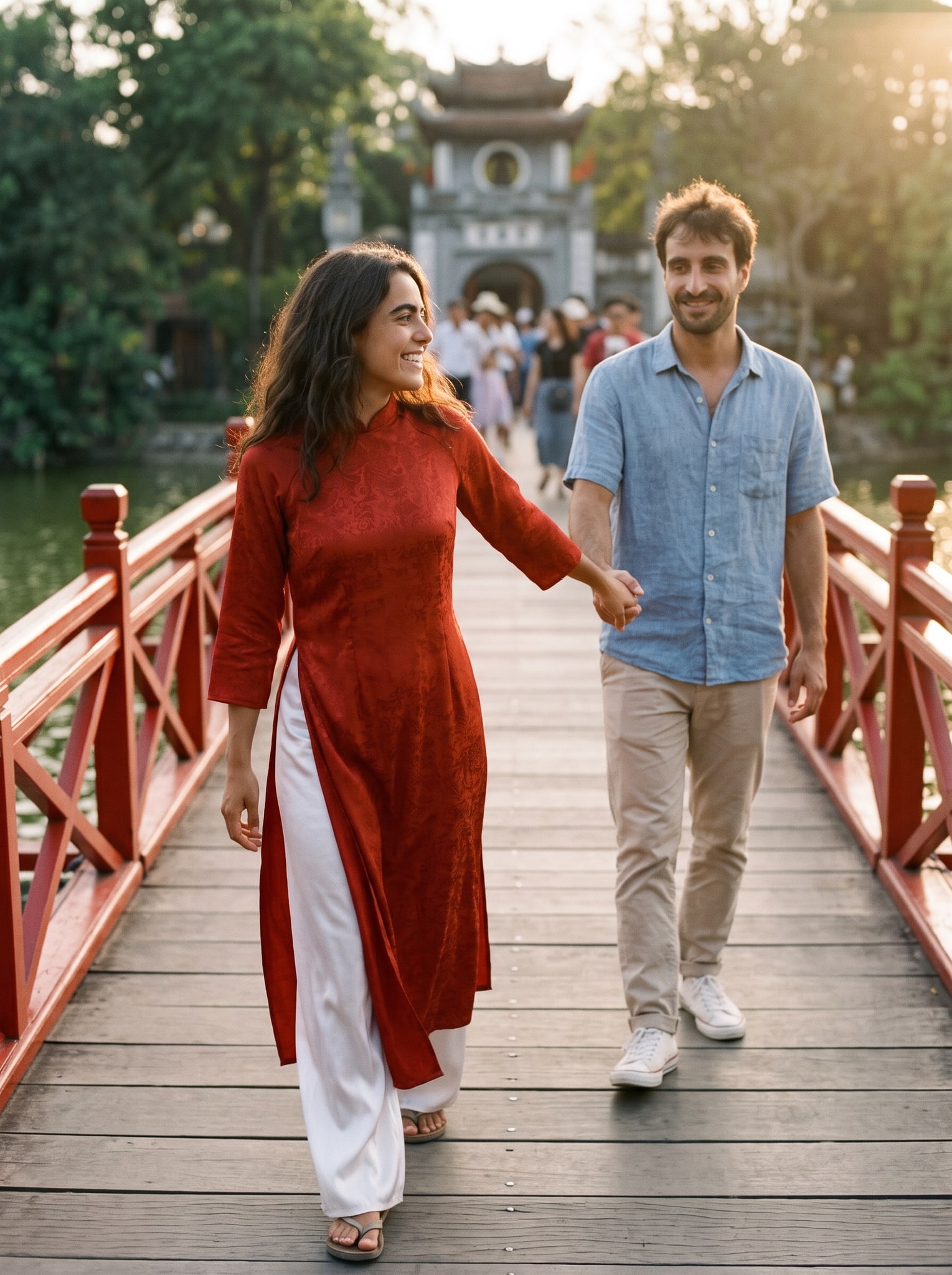
Hour 3–4: Outfit change two (usually the ao dai if it's a Vietnamese pre-wedding). We move to a different dune section to use fresher light. This is when couples often relax—we get the best candid shots in hour 3.5 because you're no longer stiff.
Hour 4–5: Second location. By now the sun is lower (if afternoon shoot) or higher (if sunrise). We're chasing light angles; if the wind changes, we pivot the shoot direction. One photographer shoots you close-up while the other gets wide landscape context shots.
Hour 5–6: Outfit three or final couple shots. If you booked a full 7-hour day, we'll do a final wardrobe change and shoot near the vehicle as backup (light is often best just before we leave anyway).
After: Pack up, drive back, transfer files that night, process and deliver 3–4 weeks later.
What changes us most: we build flexibility into every timeline because sand, wind, and light don't follow scripts.
Which Mui Ne dune location should we actually choose?
We use three main areas, each with a different feel and logistical trade-off:
| Location | Best for | Why it matters | Our notes |
|---|---|---|---|
| Red dunes (Bau Trang area) | Rich color contrast, sunset drama | The sand is reddish-orange; ao dai colors pop. Light is warm. | Takes 50 min from Phan Thiết. We only shoot here 4:30–6 p.m. because morning light washes out the red tones. Sand is softer; wind blows patterns. |
| White dunes (main tourist zone) | Classic, clean, high contrast | Bright white sand bounces light onto faces. Ao dai stands out. Less travel time. | 35 min from town. Midday is actually okay here because the white fills shadows. Busier; we sometimes have tourists in wide shots. We arrive before 9 a.m. or after 4 p.m. to avoid crowds. |
| Far east dunes (past tourist village) | Privacy, isolation, morning golden hour | Nearly empty at sunrise. Sand is packed hard. No crowds in backgrounds. | 60 min from Phan Thiết. Rough road; not suitable if you're in a sedan or very formal dress. We use this for adventurous couples who want a raw, alone feel. |
We choose the location based on your vision and outfit colors during the WhatsApp chat. Red dunes suit bold ao dai; white dunes work for every color and are easiest logistically. Far east dunes are for couples who've said, "We don't care about crowds—we want to feel alone."
What outfit combinations actually work best at Mui Ne?
Here's what we've learned from 100+ shoots: the winning format is outfit one (Western), outfit two (ao dai), outfit three (optional—either casual wear or a second ao dai in a different color). The sand and sky are neutral, so your clothes carry the color story.
Why this order matters: We shoot Western first because you're fresh, the light is new, and makeup is perfect. Ao dai goes second because sand sticks to the fabric—by then you don't mind a few grains, and the fabric's flowing movement looks best in soft, directional light (late afternoon or early morning). If there's a third outfit, it's usually relaxed (linen pants, bare shoulders, a light shirt) because by hour 5 you're tired and the light is almost done.
What fails: Heavy, dark Western dresses absorb heat and show sweat by hour 3. Heels sink into sand and snap—we've had two broken heels. Outfit changes that take over 10 minutes kill momentum. Bare feet look stunning in photos but sand between toes is genuinely miserable; bring water and wet wipes.
Color choices we see work: Navy, white, cream, and soft pastels for Western wear (they read well against sand). Red, pink, and gold ao dai pop beautifully. Avoid all black unless you want very moody, contrasty shots—it's hard to expose for both the sky and black fabric.
What actually goes wrong at Mui Ne, and how do we fix it?
Wind and sand in gear: It happens almost every time. We carry sensor-cleaning kits and check lenses every hour. If sand gets on the sensor, one photographer pauses while the other continues shooting. We've never had to stop a session for this, but it costs us 10 minutes.
Makeup running or shifting: The combination of sweat, wind, and humidity can undo foundation by hour 3. Our makeup artist carries touch-up powder, setting spray, and waterproof eyeliner. We ask couples to bring a small mirror so they can do self-checks too. If makeup is significantly off, we pause for 5 minutes and re-do it properly.
Light changes faster than expected: Clouds can roll in or the sun can drop faster than forecast. We shoot extra frames in hour 3 and 4 because we know hour 5 might be compromised. If the light really dies, we ask if you want to extend the session by 30 minutes or trust the images we've captured. Most couples trust us by that point.
Couples are too stiff: This is emotional, not technical. By hour 2, most couples have relaxed enough that we get good candid shots. We talk constantly—make jokes, ask about your wedding plans, play music on a portable speaker. The best photos happen when you forget we're there.
Outfit change takes too long: If you brought a garment that needs steaming or careful arrangement, it can cost 15 minutes. We always ask couples to bring garments wrinkle-free and, for ao dai, to try it on at home once so you know how to adjust it.
Vehicle breaks down or gets stuck: Rare, but we've had it happen. Our drivers know which roads are safe year-round. We always have a second vehicle on standby if a shoot is booked more than 40 km away. This hasn't affected a shoot yet.
How to compare Mui Ne dunes against other pre-wedding locations in Vietnam
Mui Ne is one option; here's how we think about it alongside other shoots our team runs:
Mui Ne dunes vs. Hoi An ancient town: Dunes are minimalist and abstract; Hoi An is layered history and texture. Dunes work if you want color separation (bright, clean, your clothes are the story). Hoi An works if you want architectural storytelling. Dunes take 1 hour to reach from Phan Thiết. Hoi An's narrow streets can be crowded, and we have to wake up very early. Pick dunes if you want simplicity and drama; Hoi An if you want cultural context.
Mui Ne dunes vs. Hanoi urban (old town, West Lake): Same logic. Dunes are open sky and sand; Hanoi is alleyways, colonial villas, and water. Dunes photograph faster because there's less to compose around. Hanoi needs more planning for permits and crowd management. Our Hanoi studio handles urban shoots year-round; Saigon-based couples usually hire us for Mui Ne as a special destination trip.
Mui Ne dunes vs. Ninh Binh limestone: Both are dramatic landscapes. Ninh Binh is limestone mountains and rivers—more moody. Mui Ne is pure light and sand—more intimate. Ninh Binh shoots run longer (you're hiking; we shoot in multiple coves). Mui Ne is compact and fast. If you want a full adventure day, Ninh Binh. If you want to be back in town by lunch, Mui Ne.
Compare packages on our pre-wedding page to see what's included with each location.
What should you actually check before booking a Mui Ne pre-wedding shoot?
Before you hit "book," confirm these points with us on WhatsApp:
- Your exact dates and backup dates (if monsoon season, confirm you're okay with weather-dependent rescheduling)
- Where you'll be staying (we adjust pickup time based on location; Phan Thiết town vs. Mui Ne resort vs. elsewhere matters)
- Which outfit combination you want (Western + ao dai + optional third, or all Western, or all ao dai)
- Which dune location appeals to you (red, white, or far east) and why (color, privacy, light time)
- Makeup and hair needs (do you want our artist to meet you at your hotel before we drive, or meet us at the dunes)
- File delivery preference (raw + edited, or edited only; we always deliver via cloud link)
- Total hours you're committing (4-hour, 6-hour, or custom)
Review the couple photoshoot package and pre-wedding package on vietnamphotoshoot.com to see what's available. If you want makeup and hair beforehand, add our hotel makeup and hair service to your booking.
Chat with us on WhatsApp | See packages and prices on vietnamphotoshoot.com
FAQ
Can we shoot at Mui Ne if we're not staying in Phan Thiết or Mui Ne town?
Yes. Couples staying in Ho Chi Minh City or Hanoi can hire us for a 1–2 day trip; we coordinate with hotels and handle the drive. It costs more in transportation, so most couples stay overnight. Message us for custom quotes.
What happens if the weather is bad on our shoot day?
If it's heavy rain or a storm warning, we reschedule to your backup date. Light drizzle or wind is normal; we keep shooting. Refund policies depend on your package—check vietnamphotoshoot.com for details.
Do we bring our own wardrobe or does Cáo Studio provide outfits?
You bring your own. We don't rent or provide ao dai or dresses. We style and manage how you move in what you bring. If you don't own an ao dai, rent one from Phan Thiết town before the shoot.
How long does editing and delivery actually take?
We deliver a first batch of edited images 3–4 weeks after your shoot. Raw files are available on request. If you need images faster, mention it during booking; rush delivery may affect availability.
Can we extend the shoot if we're having fun and haven't finished our outfits?
Yes. Tell us on WhatsApp during the shoot, and if our schedule allows, we extend by 30 minutes or 1 hour. You'll pay for the additional time. Best to build in the hours you need upfront.
Is it really too hot to shoot at Mui Ne during midday?
The sand reflects intense light and heat between 11 a.m. and 3 p.m., making it uncomfortable for you and harsh for photos. We avoid it unless you specifically want contrasty, dramatic shadows. Early morning (5:30–9 a.m.) or late afternoon (3:30–6:30 p.m.) is much better.
Pre-Wedding & Elopement
Inclusions, prices and booking are on our booking site.
FAQ
Can we shoot at Mui Ne if we're not staying in Phan Thiết or Mui Ne town?
Yes. Couples staying in Ho Chi Minh City or Hanoi can hire us for a 1–2 day trip; we coordinate with hotels and handle the drive. It costs more in transportation, so most couples stay overnight. Message us for custom quotes.
What happens if the weather is bad on our shoot day?
If it's heavy rain or a storm warning, we reschedule to your backup date. Light drizzle or wind is normal; we keep shooting. Refund policies depend on your package—check vietnamphotoshoot.com for details.
Do we bring our own wardrobe or does Cáo Studio provide outfits?
You bring your own. We don't rent or provide ao dai or dresses. We style and manage how you move in what you bring. If you don't own an ao dai, rent one from Phan Thiết town before the shoot.
How long does editing and delivery actually take?
We deliver a first batch of edited images 3–4 weeks after your shoot. Raw files are available on request. If you need images faster, mention it during booking; rush delivery may affect availability.
Can we extend the shoot if we're having fun and haven't finished our outfits?
Yes. Tell us on WhatsApp during the shoot, and if our schedule allows, we extend by 30 minutes or 1 hour. You'll pay for the additional time. Best to build in the hours you need upfront.
Is it really too hot to shoot at Mui Ne during midday?
The sand reflects intense light and heat between 11 a.m. and 3 p.m., making it uncomfortable for you and harsh for photos. We avoid it unless you specifically want contrasty, dramatic shadows. Early morning (5:30–9 a.m.) or late afternoon (3:30–6:30 p.m.) is much better.
More from the team
Boho pre-wedding photoshoot in Vietnam: Hanoi, Saigon, Hoi An
Boho pre-wedding shoots mix romantic, free-spirited aesthetics with Vietnam's landscapes and heritage sites. We run full-day sessions in three cities, handling styling, makeup, location scouts and edits.
Avoid crowds at Hoang Su Phi rice terraces: timing for wedding shoots
Hoang Su Phi's terraced landscape draws couples and tour buses in equal measure. We show how to shoot there alone, when to arrive, and what to arrange with us before you go.
Photography rules at Con Dao beaches: permits, drones and what to check
Con Dao's beaches demand prep before you shoot—permits, drone zones and tide timing all affect your day. We share what the Cáo Studio team verifies on every booking.