 Cáo Studio
Home › Blog › Pre-Wedding & Elopement
Pre-wedding photoshoot poses for camera-shy couples
By the Cáo Studio team · Hanoi & Saigon · 2026-11-02
Camera-shy couples thrive on movement and connection rather than static poses. At Cáo Studio, we run pre-wedding shoots across Hanoi, Saigon, Hoi An and Ninh Binh, and notice that walking, hand-holding, and close whisper moments work far better than facing the camera head-on. The session runs 2–4 hours; we start with easier setups (walking together, back-to-back hugs, sitting with faces close) before moving to direct portrait shots once the couple feels warm. Avoid stiff arm placement, symmetrical standing, and long stretches of stillness. Our stylists match wardrobe to location and mood, and our photographers pause between shots so you can breathe. Cost varies by package—check our full range on vietnamphotoshoot.com—but the core is simple: poses that hide the camera work, not fight it. Chat with us on WhatsApp | See packages and prices on vietnamphotoshoot.com
Why stiff poses kill camera-shy moments
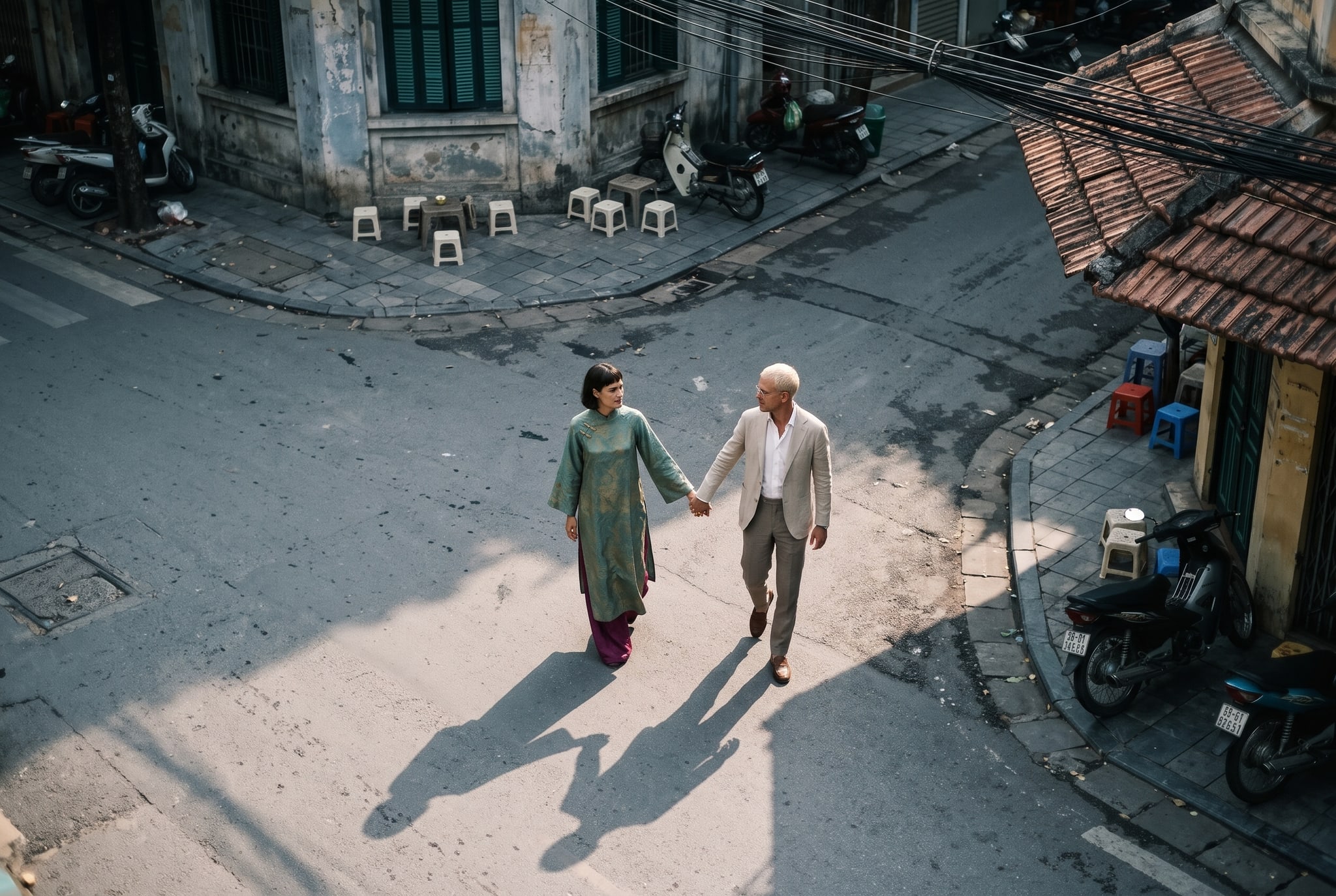
Static, symmetrical poses feel unnatural because they ask both people to hold tension. On our shoots, we watch couples' shoulders rise and jaws tighten within 30 seconds of "stand here facing the camera." The fix: movement. Walking side by side, one partner slightly ahead, lets shoulders drop and breathing settle. Hands can rest naturally in pockets or around the other person—no "where do I put my hands?" anxiety. Back-to-back hugs work because neither person sees the lens directly. We tell couples: "If you feel stiff, you probably look stiff." The solution is always motion or proximity that breaks the front-facing frame.
What really works: connection over positioning
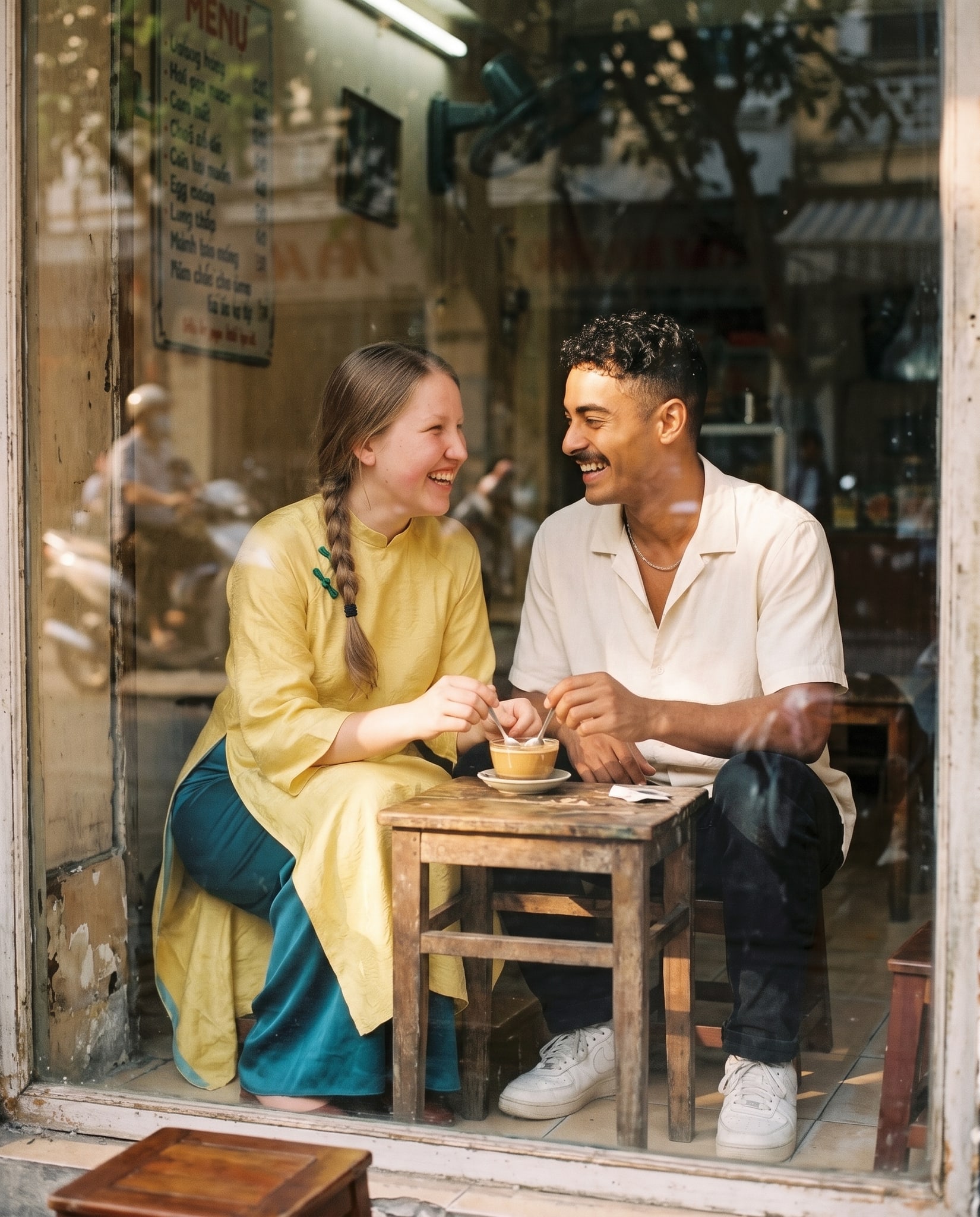
Our photographers notice couples relax fastest when they stop thinking about angles and start thinking about each other. Sitting on steps with heads close, one person's shoulder tucked under the other's chin—that pose requires zero instruction, feels safe, and reads as genuine closeness. Walking hand-in-hand down a Hanoi street or a Hoi An laneway, talking to each other instead of the camera, gives us dozens of natural frames where bodies are angled but minds are elsewhere. Whisper-in-ear shots (one person tilts, the other leans in as if sharing a secret) work because the vulnerable person is looking away and the listening partner is already turned inward. We've shot hundreds of couple photoshoot sessions and learned that the best poses are ones where at least one person isn't facing the camera directly.
Pose progression: how we sequence a shy couple's shoot
We never start with the hardest shots. Our hour-by-hour breakdown prevents freezing:
Hour 1: Warm-up (walking, environmental shots). The couple walks a familiar route—a Saigon park, Ninh Binh rice field, or Hanoi lake—talking naturally while we shoot from ahead and behind. No posing instructions. By minute 20, they've forgotten the camera exists.
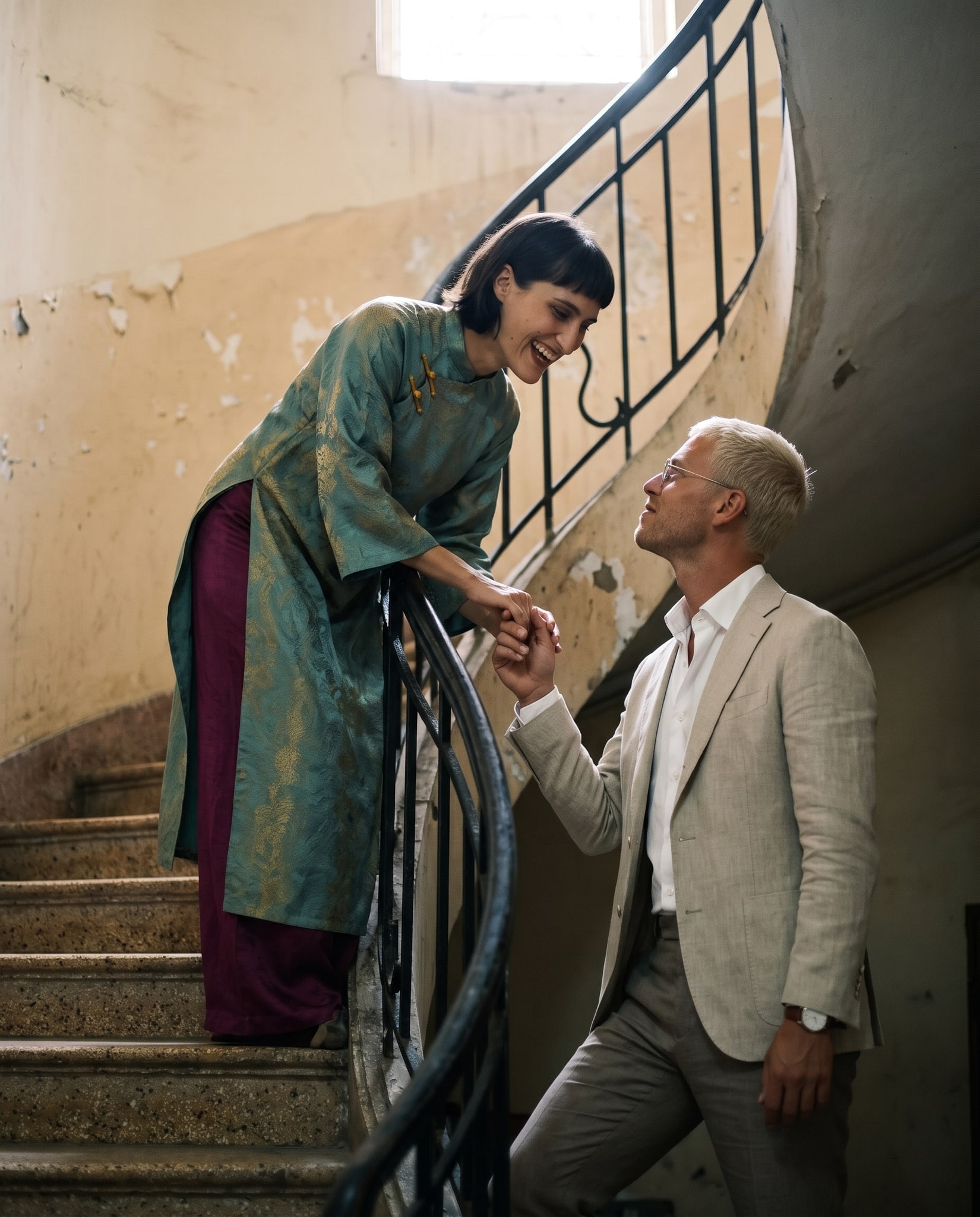
Hour 2: Seated and side-by-side frames. We move to a bench, stairs, or ground position. Sitting removes the "what do I do with my legs?" problem. Close proximity (shoulder to shoulder, one leg extended) allows genuine touch without choreography.
Hour 3: Closer portraits, some direct shots. Now confidence is higher. We ask for eye contact, but only after the couple has warmed. We shoot handheld rather than tripod—movement on our end signals the couple that they don't need to be rigid.
Hour 4 (if booked): Styled setup, final bold poses. If the couple has relaxed fully, we attempt stronger angles—one person on a chair, the other standing behind, wrapped arms, or facing the camera with hands together. By now, the anxiety has drained.
This sequence prevents the first-hour stiffness that ruins early frames.
Common freeze-ups and how we fix them on the day
| What happens | Why it stalls | Our fix | Result |
|---|---|---|---|
| Wide stance, arms at sides | Feels military, exposed | "Walk toward me slowly, take his hand" | Motion plus purpose; shoulders drop. |
| Both facing camera, forced smile | Eye contact feels confrontational when nervous | "Look at each other, I'll shoot the side angle" | Genuine emotion, less pressure. |
| Long stillness (>60 sec) | Muscles lock, breathing becomes shallow | "Chat between shots, let's reset every 45 seconds" | Tension releases; next frame is softer. |
| Staring at the camera | Hyper-awareness of the lens | "Pretend I'm not here; whisper something to her" | Gaze softens, redirected inward. |
| Standing at distance | Feels unsafe, exposes full body | "Come closer, shoulders touching" | Proximity replaces vulnerability. |
| Sitting too upright | Looks formal and tense | "Lean into each other, let your weight rest on them" | Relaxed posture reads as comfortable. |
Each fix relies on redirection—away from the camera, toward the partner, or into motion.
Location choice and how it changes pose confidence
A camera-shy couple in an open plaza feels exposed. Our photographers always scout locations that provide natural boundaries: a covered laneway in Hoi An, a park grove in Hanoi, a homestay garden in Ninh Binh. Enclosed or semi-enclosed spaces reduce the sense of being watched. When we've shot at special concept shoots in heritage settings, couples consistently relax faster because the environment draws attention—a centuries-old wall, a tea shop corner, a rice terrace—rather than the couple being the center of focus. The location's character also suggests poses naturally. A laneway invites walking and leaning on a wall. A tea garden invites sitting close at a small table. A field invites lying down. We choose the space partly for light and composition, but also because the setting tells the couple what to do without us asking.
Wardrobe and makeup as confidence builders
Feeling dressed well changes pose willingness. Our makeup and hair at your hotel service takes 60–90 minutes before the shoot; we've noticed couples who arrive in full glam (hair set, makeup done by our team, outfit fitted) are visibly more willing to look at the camera and hold longer poses. The makeup application itself becomes a bonding moment—often the groom or partner sits nearby, watching the stylist work, which starts the session in a closer, more intimate mood. We advise couples to wear clothes that fit snugly enough to allow motion without shifting—loose fabrics that catch wind distract. Áo dài wearers often feel more confident in that garment because it's structured and elegant; if you're choosing between casual and traditional dress, camera-shy couples often do better in áo dài on a ao dai photoshoot because the fabric does the work for you.
What to check before your shoot
- Ask if your photographer will direct or guide. We guide (give direction, offer instruction) rather than direct (demand exact poses). Ask your stylist's approach.
- Confirm the location's privacy level. A private villa garden or booked heritage site beats a public park if you're nervous.
- Book makeup on-site if possible. The prep time calms nerves and builds connection before the camera starts.
- Request a shot sequence. Knowing you'll start with walking helps manage anxiety.
- Bring a friend or trusted person. Some couples feel safer with a witness; others prefer privacy. Decide and tell your photographer.
- Wear something you've tested. Don't debut an outfit on shoot day; wear what you've moved in and felt confident in before.
Real pacing: what the first 30 minutes actually look like
Your photographer arrives at the meeting point (let's say a Saigon park near the Bitexco area or a Hanoi lake gate). You're nervous, maybe a bit stiff in the greeting. We don't jump into poses. Instead: "Let's walk that path over there, talk to each other like you would normally, and I'll walk alongside shooting." You start walking. For the first 10 minutes, you're acutely aware of the camera. By minute 15, you're pointing at something in the scenery or holding hands naturally because the forward motion normalizes it. Minute 20, you've forgotten. That's when the best frames arrive—not posed, just alive. Then we stop, sit somewhere, and reset. The reset is crucial: we ask "How are you feeling?" and pause long enough to hear the answer. If you're cold or thirsty, we address it. If you're gaining confidence, we move into slightly more deliberate poses. This rhythm—walk, relax, sit, reset, try slightly harder, repeat—is what a 2-hour session actually looks like.
See packages and prices on vietnamphotoshoot.com
FAQ
Can we do a full pre-wedding shoot if we both freeze on camera?
Yes. Most couples who think they'll freeze have no issue once the session starts. We manage timing, location, and sequence specifically for this. A 3-4 hour couple photoshoot gives us time to warm you up slowly rather than rushing.
Is it better to do a pre-wedding shoot alone first, or with your partner?
Partner shoots work better for camera-shy couples because the focus is on connection, not individual appearance. You're thinking about the other person, not yourself. Solo portraits come later, when confidence is already high.
What if we just want to avoid direct-facing-the-camera poses altogether?
We can absolutely plan a shoot around side angles, movement, and back-turned frames. Tell your photographer upfront. Many couples prefer this—it feels more natural anyway.
Does the time of day matter for calm couples?
Golden hour (early morning, late afternoon) is softer and often feels easier psychologically because the light is gentler and less harsh. Couples tend to relax more in warm, diffused light than in bright midday sun.
Can we do the shoot in áo dài if we're nervous?
Traditional áo dài often builds confidence because the garment is so structured and beautiful—it does emotional work for you. Check our ao dai photoshoot session format; many nervous couples choose this specifically.
What should we do if we start feeling frozen during the shoot?
Tell your photographer immediately. We pause, reset, shift location, or move to a different pose type. A 5-minute break to chat or have water resets everything. Freezing mid-shoot is solvable—it's not a failure.
Is it worth booking makeup and hair if we're already nervous?
Yes. The makeup and hair at your hotel prep hour before the shoot is a confidence builder. You feel polished, and the process itself is a bonding moment that warms the mood before shooting starts.
Pre-Wedding & Elopement
Inclusions, prices and booking are on our booking site.
FAQ
Can we do a full pre-wedding shoot if we both freeze on camera?
Yes. Most couples who think they'll freeze have no issue once the session starts. We manage timing, location, and sequence specifically for this. A 3-4 hour [couple photoshoot](/go/couple-photoshoot) gives us time to warm you up slowly rather than rushing.
Is it better to do a pre-wedding shoot alone first, or with your partner?
Partner shoots work better for camera-shy couples because the focus is on connection, not individual appearance. You're thinking about the other person, not yourself. Solo portraits come later, when confidence is already high.
What if we just want to avoid direct-facing-the-camera poses altogether?
We can absolutely plan a shoot around side angles, movement, and back-turned frames. Tell your photographer upfront. Many couples prefer this—it feels more natural anyway.
Does the time of day matter for calm couples?
Golden hour (early morning, late afternoon) is softer and often feels easier psychologically because the light is gentler and less harsh. Couples tend to relax more in warm, diffused light than in bright midday sun.
Can we do the shoot in áo dài if we're nervous?
Traditional áo dài often builds confidence because the garment is so structured and beautiful—it does emotional work for you. Check our [ao dai photoshoot](/go/ao-dai-photoshoot) session format; many nervous couples choose this specifically.
What should we do if we start feeling frozen during the shoot?
Tell your photographer immediately. We pause, reset, shift location, or move to a different pose type. A 5-minute break to chat or have water resets everything. Freezing mid-shoot is solvable—it's not a failure.
Is it worth booking makeup and hair if we're already nervous?
Yes. The [makeup and hair at your hotel](/go/makeup-and-hair) prep hour before the shoot is a confidence builder. You feel polished, and the process itself is a bonding moment that warms the mood before shooting starts.
More from the team
Boho pre-wedding photoshoot in Vietnam: Hanoi, Saigon, Hoi An
Boho pre-wedding shoots mix romantic, free-spirited aesthetics with Vietnam's landscapes and heritage sites. We run full-day sessions in three cities, handling styling, makeup, location scouts and edits.
Avoid crowds at Hoang Su Phi rice terraces: timing for wedding shoots
Hoang Su Phi's terraced landscape draws couples and tour buses in equal measure. We show how to shoot there alone, when to arrive, and what to arrange with us before you go.
Photography rules at Con Dao beaches: permits, drones and what to check
Con Dao's beaches demand prep before you shoot—permits, drone zones and tide timing all affect your day. We share what the Cáo Studio team verifies on every booking.