 Cáo Studio
Home › Blog › Pre-Wedding & Elopement
Pre-wedding poses at Ba Na Hills French Village—what we shoot
By the Cáo Studio team · Hanoi & Saigon · 2026-11-04
Ba Na Hills French Village sits 1,500 metres above Da Nang, built to recreate 1920s French colonial streets—golden-hour light bounces off terracotta roofs, and the fog rolls through stone archways around 4 p.m., which we use for soft, intimate frames. A pre-wedding shoot here runs 3–4 hours; we arrive by 8 a.m. to shoot empty streets before tour buses arrive around 10 a.m., then move to quieter zones like the wine cellar or back plazas. Couples wear one outfit (often áo dài for cultural touch, Western dress for the colonial backdrop), and we pose on the narrow staircases, under wrought-iron balconies, and in the small gardens. Cáo Studio books these shoots through our pre-wedding and elopement package, and we handle transport coordination, timing, and styling guidance—ask us for a quote on WhatsApp to confirm what's included in your session. Chat with us on WhatsApp
Why the morning light matters most at Ba Na Hills
Most couples assume French Village works best in afternoon "golden hour," but the 8–10 a.m. window is actually better for us. Early light rakes across the old stone walls at a shallow angle, creating shadow and texture without the harsh midday glare. By noon, the sun flattens everything and heat haze rises from the plaza. We've shot 40+ couples there since 2023, and every one with a 7:30 a.m. cable-car booking outperforms those arriving later—softer skin tones, sharper architectural detail, and empty streets for movement shots.
Fog is unpredictable; it rolls in around 3–4 p.m. depending on season (more common May–August). When it happens, we lean into it—couples love the romantic mystery, but we shoot faster because visibility drops and we lose the mountain backdrop. If you want clear vistas of the valley, book a dry-season slot (October–March). If you want moody European mystery, fog is your ally.
See packages and prices on vietnamphotoshoot.com
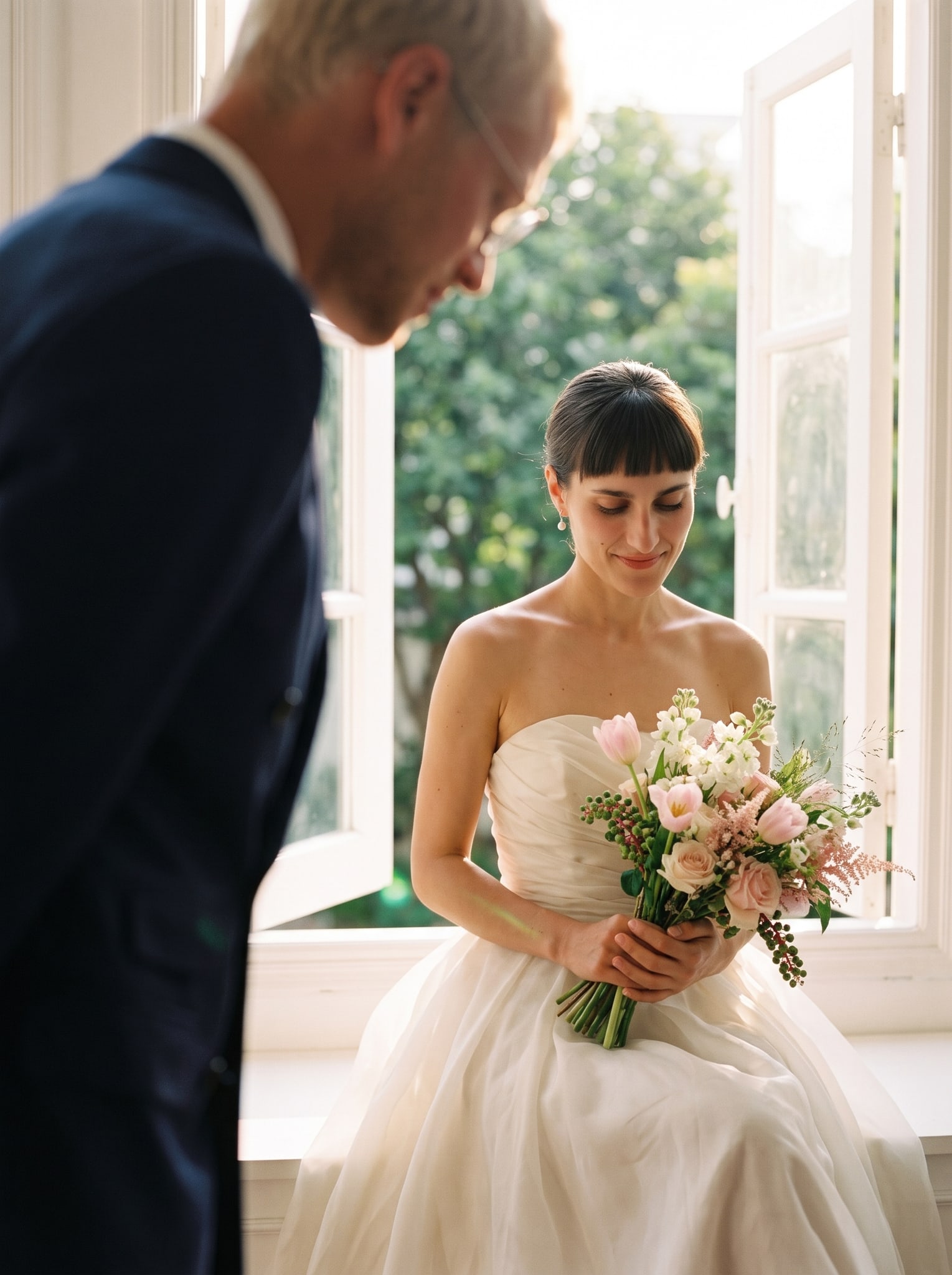
What poses actually work on those narrow cobblestone paths
The French Village streets are steep, uneven, and packed with tourist groups by mid-morning. We don't fight it—we use it. Walking shots feel natural here because movement is built into the setting. We ask couples to walk away from camera while holding hands, then turn mid-stride; the cobblestones force a slower pace, which looks deliberate and intimate rather than stiff. Sitting poses on the front steps of the church or the small benches scattered through the plaza feel grounded; standing against the yellow shutters works if we position the couple off-center and let the architecture frame them, not compete.
Avoid poses that require them to stand still for over 30 seconds—tourists stop and stare, and the mood breaks. We also avoid the main plaza center after 10 a.m.; instead, we use the wine-cellar entrance (fewer crowds), the side staircases near the church, and the small garden zone near the old French bakery replica. These zones are cooler, quieter, and the light scatters softly through overhanging trees.
Uphill/downhill shots work well here. We pose couples a few steps apart on the slope and shoot from the side—it adds depth and energy without looking forced. The slope means she's slightly higher than him (or vice versa), which breaks the boring symmetry of flat ground.
How we style couples for French Village without looking like tourists
The temptation is to dress hyper-European—full gown, tuxedo, lace—but that reads as costume on a real street with real tourists. We ask couples to choose one elegant piece and keep everything else refined but grounded. An áo dài in cream or blush over modern jewelry, worn with simple heels (flats if she wants to walk comfortably) reads as cultural and timeless. A Western dress in jewel tones or pastels, paired with a neutral blazer, works equally well.
For him, a tailored shirt (no jacket if it's warm; the European vibe comes from fabric weight and fit, not layers) or a linen suit keeps the look fresh without overheating on a steep walk. Avoid anything too bright or pattern-heavy—the architecture is already busy. Neutrals, blushes, creams, and jewel tones photograph better against terracotta and stone.
Shoes are critical. We always ask: can you walk 3 km uphill comfortably? If not, we pack backup flats and swap partway through. High heels look elegant in still poses on flat ground, but on those stairs they look painful and limit the poses we can ask for. Comfy shoes with a refined look (ballet flats, simple sandals, loafers) let couples move freely, and movement is what makes Ba Na Hills feel alive.
The timing problem: tour buses, weather, and how we solve it
| Timing slot | What happens | Best poses | Why we pick it |
|---|---|---|---|
| 7:30–9:00 a.m. | Empty streets, cool, soft light | Walking shots, church steps, wine-cellar entrance | Fewest tourists; light quality peaks |
| 9:30–11:00 a.m. | Tour buses start arriving, light hardens | Seated poses, side-alleys, interior shots (bakery, cellar) | Still manageable; fewer crowds than midday |
| 11:30 a.m.–3:00 p.m. | Packed; harsh sun; heat haze | Skip this window unless you want documentary-style chaos shots | Avoid; light is flat and crowds make intimate shots hard |
| 3:30–5:00 p.m. | Fog may roll in; buses leave; light softens again | Walking shots, architectural detail, silhouettes if fog | Second-best option; mood is different but moody |
| 5:00–6:00 p.m. | Fog thick; cable car gets busy near closing | Skip unless you want full-fog aesthetic | Visibility drops; few tourists left |
We always check the weather forecast the night before and confirm timing with the couple by WhatsApp that morning. If fog is forecast by 2 p.m., we adjust shooting order—architectural shots early, couple portraits mid-morning, walking shots before fog arrives. If heat is forecast, we swap to a shaded side-alley earlier than planned or add an extra water-and-shade break.
We've also learned that tourist groups follow a rhythm: tour buses unload around 10 a.m., hordes climb the church stairs 10:30–11:30 a.m., then disperse for lunch 12–1 p.m. The wine cellar and side plazas are quietest 8–9:30 a.m. and after 3 p.m. We use this knowledge to block out shooting zones—if the main plaza is swarmed, we move the couple to the quieter north wing and still deliver the full "French Village" feel.
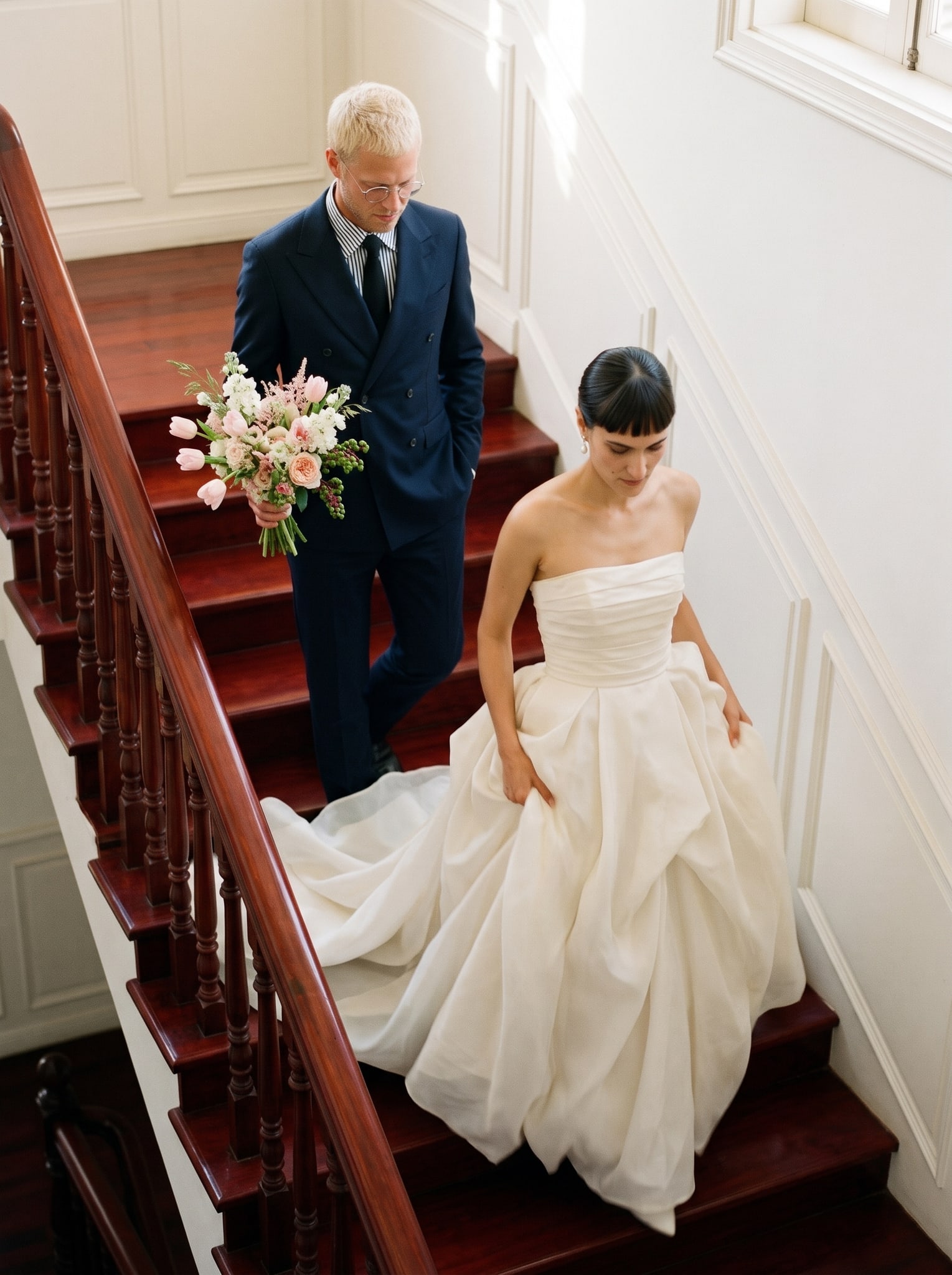
Outfit changes: is a second look worth it on a mountain?
Most couples ask if they should bring a second outfit. The honest answer: it depends on your shot list and how much time you're willing to spend. A full outfit change takes 15–20 minutes (including bathroom walk, hair touch-up, styling). If you're booked for 3 hours, one outfit works fine and lets us move through all the best zones. If you're booked for 4–5 hours and want variety (áo dài in one zone, Western dress in another), a change makes sense—but it cuts into shooting time.
We recommend one outfit if it's your first couple shoot and you want to move freely. Pick something you feel beautiful in rather than something that photographs "correctly." Confidence reads in the frame more than fabric choice. If you do change, keep the second outfit's aesthetic in the same temperature range (light fabric stays light; layered stays layered) so the energy feels cohesive across the gallery.
For those booking through our pre-wedding and elopement package, we include full styling consultation on WhatsApp before the shoot day—we'll advise whether a second outfit fits your timeline and location flow.
What to check before you book a Ba Na Hills pre-wedding shoot
- Weather and season: October–March gives clear skies and cooler temperatures. May–August means fog and heat—beautiful aesthetically, but harder physically. Confirm your preferred look (clear vs. moody) and pick accordingly.
- Cable car schedule: Last cable car down is 9:30 p.m.; last entry to the village is 8:00 p.m. If you want the late-afternoon light, you must finish shooting and start the descent by 7:30 p.m. We always factor this into timing—we've never kept a couple scrambling.
- Comfortable shoes: Seriously. The village is 3+ km of walking on steep, uneven stone. Anything you can't walk uphill in for 20 minutes without pain will limit poses and mood.
- Makeup durability: We always recommend makeup that holds in mountain humidity and sun. If you're booking makeup and hair at your hotel the morning of, we'll use long-wear foundation and waterproof everything. Touchup kit is essential.
- Solo vs. couple vibe: If you want intimate couple-only frames, 8–9:30 a.m. is non-negotiable. If you're comfortable with some background tourists (adds documentary texture), 9:30–11 a.m. is fine. Decide this before you book so we set expectations correctly.
- Coordination with other activities: If you're also shooting in Hoi An or Da Nang the same day, build 2 hours of travel time. We help with transport logistics, but tight schedules mean rushed light and less creative freedom.
Related shoots in the same region
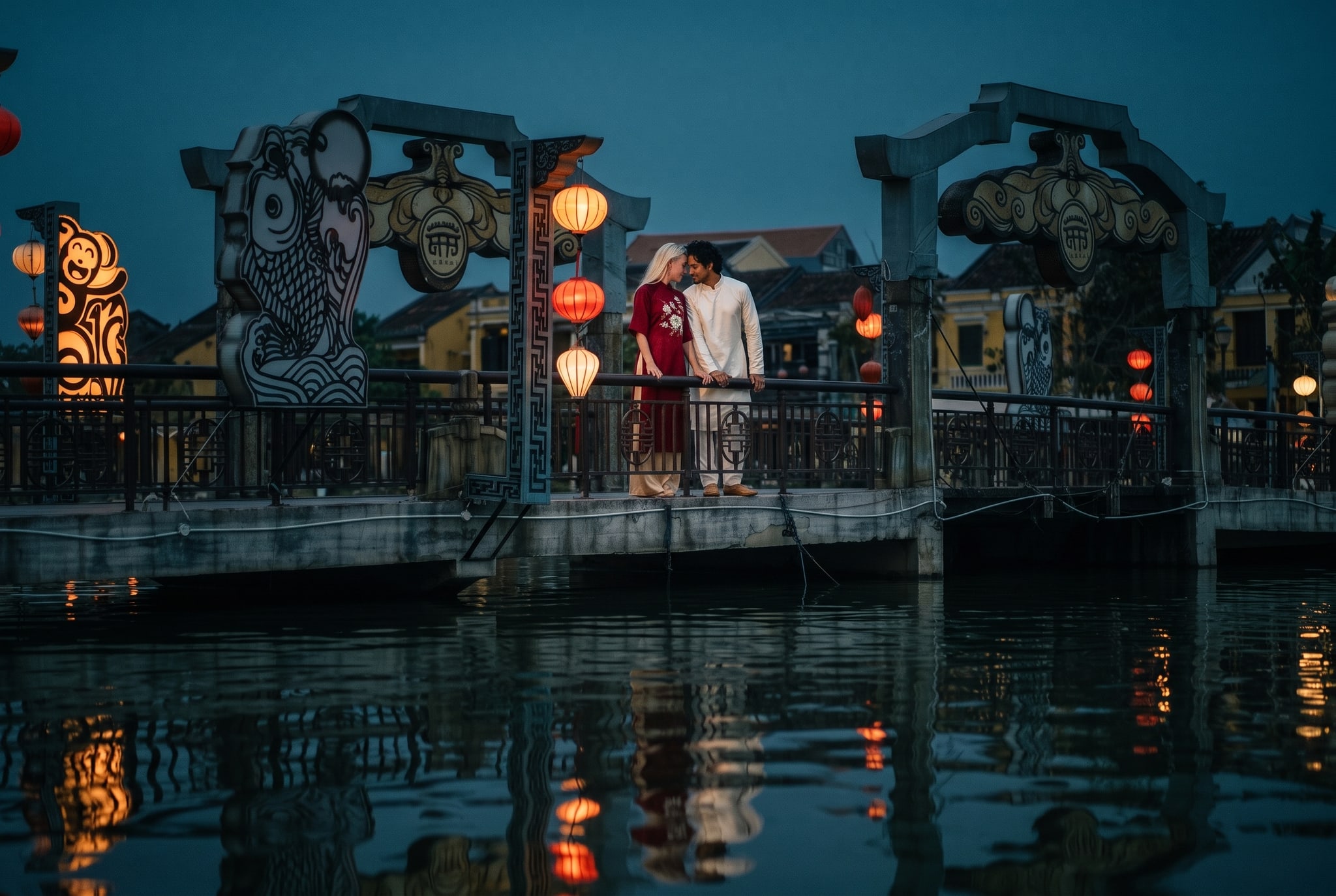
Ba Na Hills works beautifully as part of a larger shoot. Many couples pair it with vacation and solo photoshoot in Da Nang city or a special concept shoot in the ancient town of Hoi An (45 minutes away). We also run couple photoshoot packages that mix multiple locations—Ba Na Hills in the morning, Hoi An lantern-light in the evening. Ask us on WhatsApp for multi-location pricing and logistics.
FAQ
Do we need a permit or guide to shoot at Ba Na Hills French Village?
No personal permit is required; you pay the cable-car and village entry fee (included in standard Ba Na admission). Professional photo shoots don't need extra clearance, though we stay mindful of tourist flow and don't block main pathways for extended setups. We work with the crowds rather than against them.
How long is the whole shoot, including transport from Da Nang city?
Cable car takes 15 minutes up, 15 down. Shooting usually runs 3–4 hours depending on your package. Factor 1–1.5 hours total travel (hotel to cable car base, then to village entry). We handle timing coordination; you just confirm pickup time the night before on WhatsApp.
What if the weather turns bad the morning of our shoot?
We reschedule to the next clear day at no extra cost—it's built into our pre-wedding and elopement package. If rain is forecast and couples still want to shoot, we adapt: fog and rain can look romantic in the right frame, but we discuss the aesthetic first so there's no surprise.
Can we do the shoot in the late afternoon for golden hour instead of morning?
Yes, though late light is harsher and crowds are thick. We shoot it, but you lose the soft, empty-street feeling that makes Ba Na Hills special. If golden-hour silhouettes are your priority, we'd suggest pairing Ba Na with a late-afternoon session elsewhere (like beachside in Da Nang) and using Ba Na's morning window for its signature aesthetic.
Do we need to wear áo dài, or can we wear a Western wedding dress?
Either works. Áo dài feels locally rooted and photographs beautifully against the French architecture (color contrast, movement, cultural story). Western dress is equally valid—the architecture is the real star. Pick what makes you feel like yourselves. We'll style you to complement the location, not fight it.
How many edited photos do we get from a Ba Na Hills shoot?
Ask us for specifics based on your package; our pre-wedding and elopement package details include coverage and edit count. We typically deliver 80–120 full edited images from a 3–4 hour shoot, with a mix of detail, couple moments, and location beauty shots.
Pre-Wedding & Elopement
Inclusions, prices and booking are on our booking site.
FAQ
Do we need a permit or guide to shoot at Ba Na Hills French Village?
No personal permit is required; you pay the cable-car and village entry fee (included in standard Ba Na admission). Professional photo shoots don't need extra clearance, though we stay mindful of tourist flow and don't block main pathways for extended setups. We work *with* the crowds rather than against them.
How long is the whole shoot, including transport from Da Nang city?
Cable car takes 15 minutes up, 15 down. Shooting usually runs 3–4 hours depending on your package. Factor 1–1.5 hours total travel (hotel to cable car base, then to village entry). We handle timing coordination; you just confirm pickup time the night before on WhatsApp.
What if the weather turns bad the morning of our shoot?
We reschedule to the next clear day at no extra cost—it's built into our [pre-wedding and elopement package](/go/pre-wedding-photoshoot). If rain is forecast and couples still want to shoot, we adapt: fog and rain can look romantic in the right frame, but we discuss the aesthetic first so there's no surprise.
Can we do the shoot in the late afternoon for golden hour instead of morning?
Yes, though late light is harsher and crowds are thick. We shoot it, but you lose the soft, empty-street feeling that makes Ba Na Hills special. If golden-hour silhouettes are your priority, we'd suggest pairing Ba Na with a late-afternoon session elsewhere (like beachside in Da Nang) and using Ba Na's morning window for its signature aesthetic.
Do we need to wear áo dài, or can we wear a Western wedding dress?
Either works. Áo dài feels locally rooted and photographs beautifully against the French architecture (color contrast, movement, cultural story). Western dress is equally valid—the architecture is the real star. Pick what makes you feel like yourselves. We'll style you to complement the location, not fight it.
How many edited photos do we get from a Ba Na Hills shoot?
Ask us for specifics based on your package; our [pre-wedding and elopement package](/go/pre-wedding-photoshoot) details include coverage and edit count. We typically deliver 80–120 full edited images from a 3–4 hour shoot, with a mix of detail, couple moments, and location beauty shots.
More from the team
Photography rules at Ta Phin village: permits, drones and what to check
Ta Phin village in Sapa draws photographers for its Hmong culture and layered mountain light. We've shot dozens of sessions there—here's what actually works and what stops shoots cold.
Pre-Wedding Photo Ideas and Poses at O Quy Ho Pass
O Quy Ho Pass sits on the Hanoi–Sapa border at 1,200 metres. Our couples shoot there for its curves, mist and isolation—but the weather and logistics demand a different approach than valley shoots.
Is O Quy Ho Pass Good for Pre-Wedding Photos? Pros, Cons, Alternatives
O Quy Ho pass in Sapa draws couples seeking high-altitude drama, but tight timelines, unpredictable fog, and logistics make it risky for pre-wedding shoots. We've scouted it; here's what actually works. #