 Cáo Studio
Home › Blog › Pre-Wedding & Elopement
Pre-wedding poses at Hoi An yellow walls: what we shoot
By the Cáo Studio team · Hanoi & Saigon · 2026-11-04
Hoi An's yellow-walled streets (Ancient Town, Tran Phu Street, Japanese Bridge) are dream locations for pre-wedding photos—but the reality is tighter framing, harder light control, and foot traffic. We typically shoot couples in 2–3 hour blocks starting early (6–7 a.m.) or late afternoon (4–5 p.m.) to avoid harsh sun and crowds. Poses succeed when they're intimate (foreheads close, hands linked) and work with the narrow lanes rather than fight them. Cáo Studio books a dedicated photographer and stylist for these shoots; we handle outfit changes in a rented room nearby and scout spots the day before to dodge tourists. The session usually costs less than studio work because location fees don't apply, but expect unpredictability—a festival, vendor stall, or sudden rain reshapes the plan within minutes. Chat with us on WhatsApp
What makes Hoi An's yellow walls so hard to pose on?
The facades look flat in photos because they're not—they curve, jut, and hold deep shadows. Early light rakes across the plaster and creates depth; midday sun washes it into a blank wall. We avoid noon sessions entirely. Couples often stand stiffly in front of the wall when the real magic happens when they interact with it—leaning, walking into shadow, framed by doorways. The narrow lanes also mean we're 6–8 feet away maximum; wide lenses distort limbs, so we use 50–85mm primes. Hoi An's uneven stone streets are a hidden hazard; heeled shoes slip, and an ao dai hem catches on rough edges. We brief couples the day before about footwear and always scout the exact route.
How do we handle the crowds and light in one session?
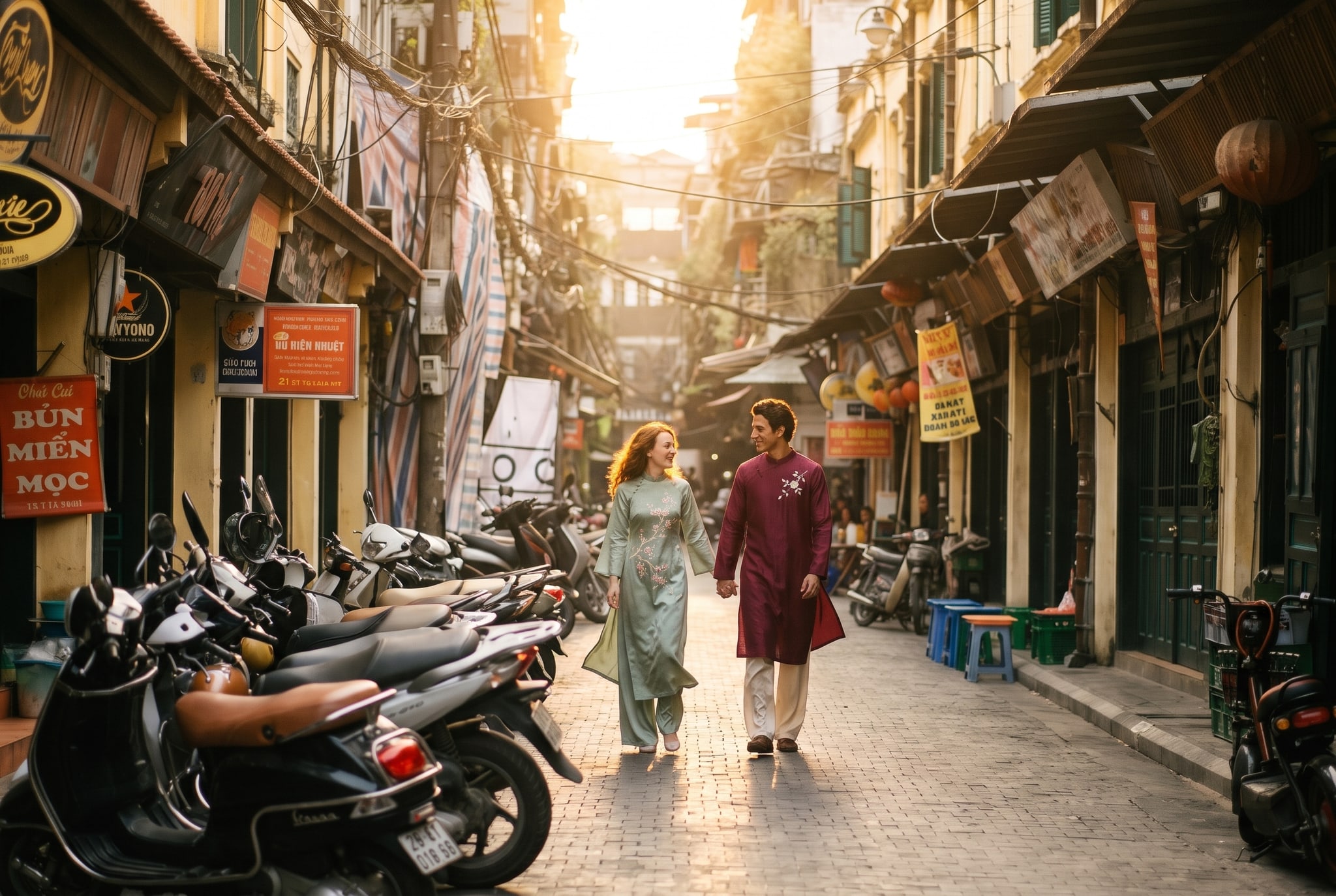
Tourist foot traffic peaks 8 a.m.–11 a.m. and 2–4 p.m. We schedule shoots for 6–7 a.m. or 4:30–6:30 p.m. to catch soft light and work alone. When crowds do appear—school groups, tour buses—we move 200 meters or ask politely for a 2-minute clear. We've never been refused. Light is the real puzzle: if clouds roll in, harsh shadows vanish but color flattens; if sun persists, we use reflectors and position couples so they're backlit (halos work) or sidelit (texture shows). Our photographer carries a small silver reflector and watches the minute-by-minute shift; we lose maybe 10 minutes of usable light per hour to cloud cover, so we're always three poses ahead in our mental checklist. An unexpected rain storm in July once forced us indoors—we pivoted to a covered market and shot under corrugated metal. The couple loved the moody framing.
Which poses actually work on narrow yellow streets?
We break down Hoi An poses into three types that work with the geometry:
Walking and talking Couples move toward or away from the camera; the yellow wall recedes into depth. The bride's ao dai flows; the groom stays half-step behind. We shoot at shutter speeds ≥1/250s to freeze motion. This pose hides awkwardness—people relax when they're moving.
Doorway and alcove framing Standing in a doorway or against a recessed entrance creates a natural frame within the frame. The couple's faces catch softer light; the wall and shadow create contrast. We use doorways on Tran Phu Street and near the old shops south of the bridge.
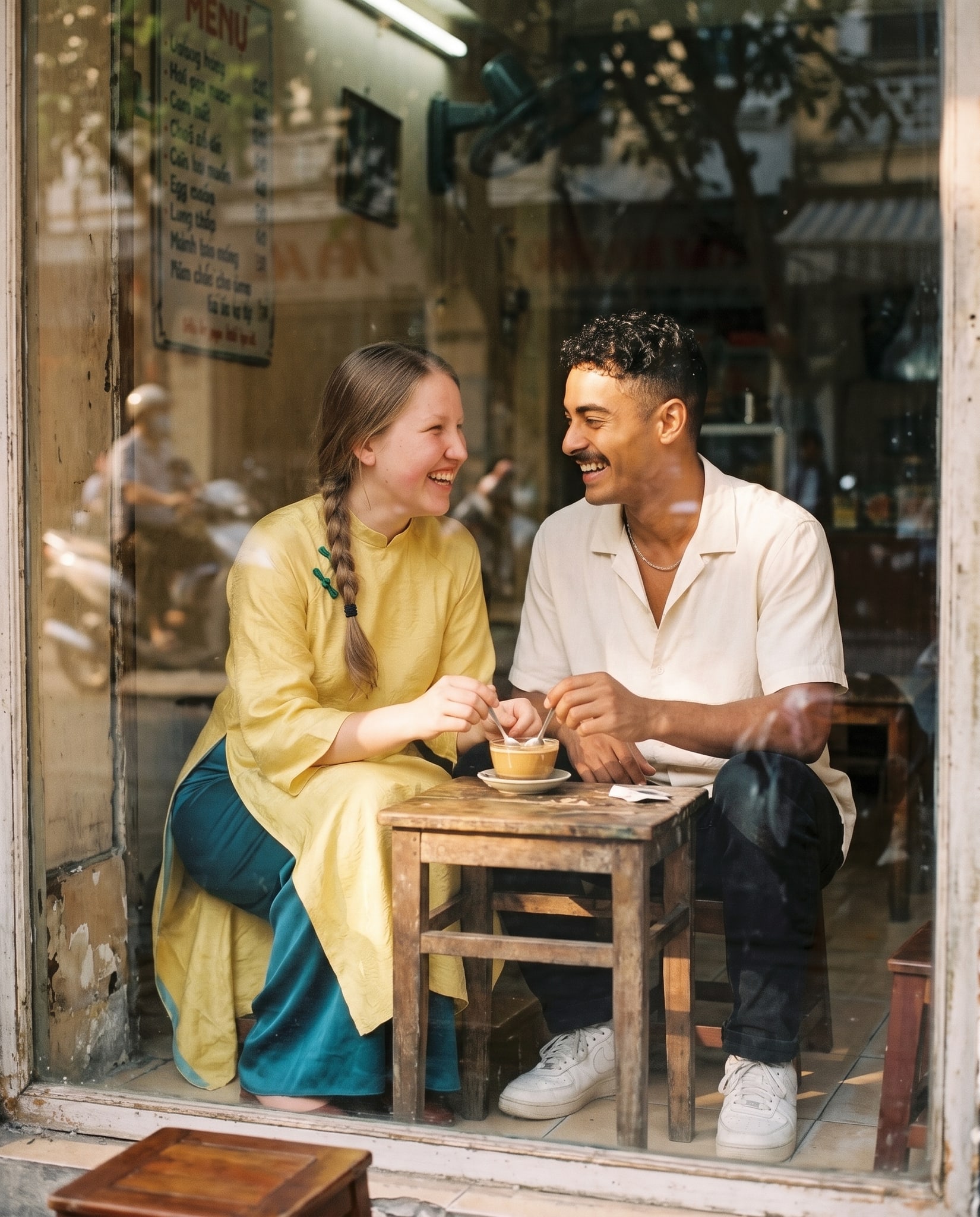
Foreheads close, hands intertwined The tightest pose, rarely fails. It works because the couple's faces fill the frame; the yellow wall becomes a soft, textured background. We shoot from a low angle (kneeling) to make the wall loom behind them. This pose is vulnerable—hands tremble—so we shoot 20–30 frames in 10 seconds.
A comparison: walking poses let couples breathe and hide insecurity, but they're harder to nail focus. Doorway poses are forgiving and romantic but need careful scouting. Close-foreheads are risky but yield the most emotional frames. We always mix all three in a single session.
| Pose type | Best time of day | Risk | Why couples choose it |
|---|---|---|---|
| Walking and talking | 6–7 a.m. or 5–6 p.m. | Motion blur if slow shutter | Natural, candid feel |
| Doorway framing | 4–5 p.m. (cross-light) | Wall shadow hides one face | Intimate, moody frames |
| Foreheads close | Anytime, but soft light best | Trembling hands, technical focus | Most emotional, timeless |
How do we brief couples and manage expectations before the shoot?
The day before, we send a WhatsApp showing the three streets we'll use, photos of past couples in similar poses, and a weather forecast. We tell them: "Wear flat shoes. The ao dai hem catches stone. We'll move fast if tourists arrive. Bring a cardigan for wind—the river makes it chilly at 6 a.m." We also set a pose count—usually 6–8 distinct looks in 2 hours—so couples aren't chasing perfection. Many expect Instagram-smooth light; we explain that Hoi An's uneven plaster and shadow create character, not polish. We ask their priority: do they want the iconic yellow, or emotional moments? That one question reshapes the shoot. A couple who wanted emotion over backdrop let us spend 40 minutes on one doorway pose; we shot 300 frames and found 12 gems. Couples chasing the perfect yellow-wall grid often leave disappointed because perfection is a myth outdoors. Honest framing upfront saves stress on the day.
See packages and prices on vietnamphotoshoot.com
What unexpected problems do we solve on set, and how?
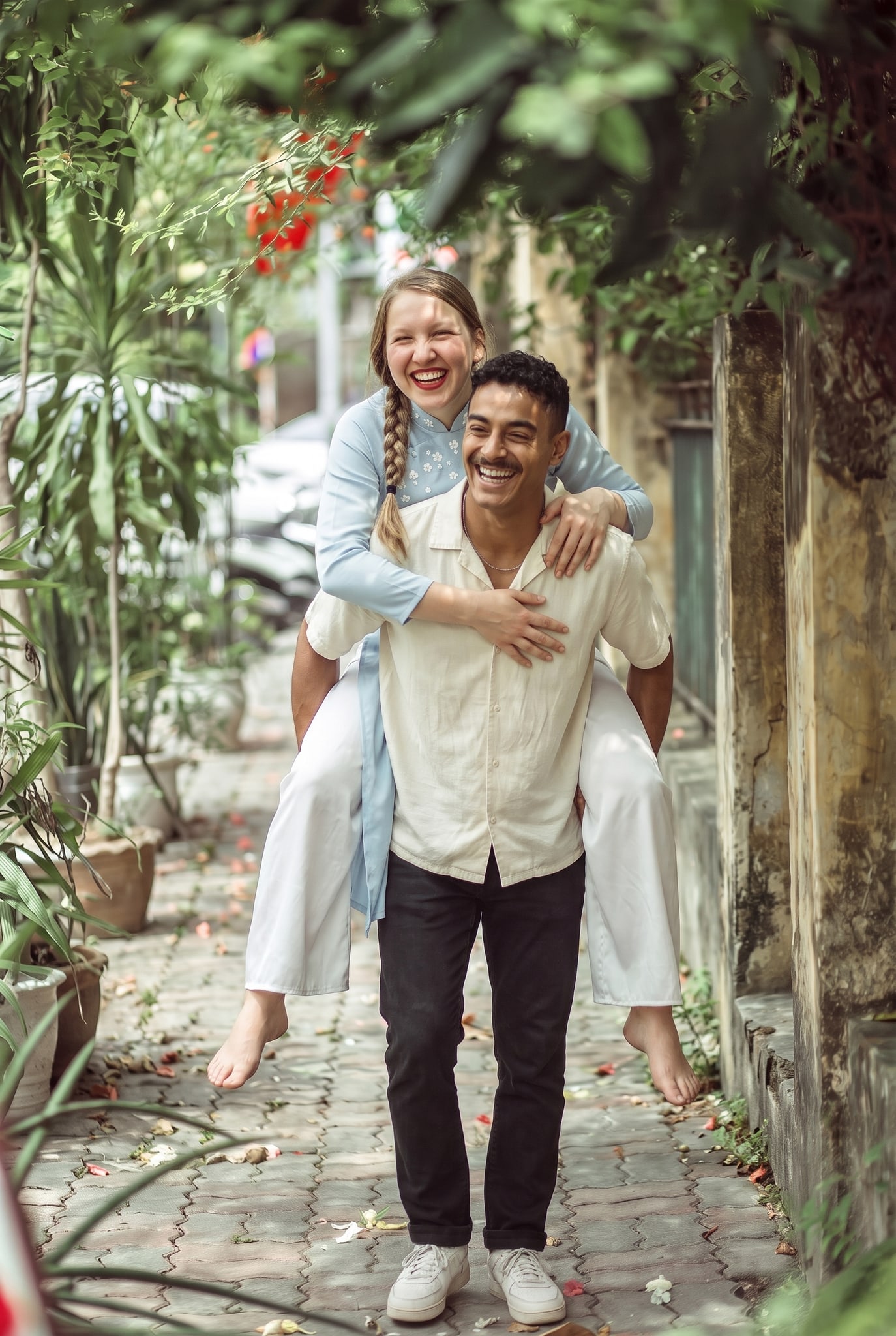
Wind and fabric chaos Ao dai hems flip, hair tangles. We bring hair clips, ask the bride to hold her hem on stairs, and embrace the movement—a candid flip often beats a static shot.
One person looks tired or tense We pause, ask them to step back and breathe, then shoot again. A 2-minute break resets everything. We never push through a bad moment.
Bad light or weather shift We either move (same street, 50 meters away) or change the pose type. If rain starts, we have a backup plan: a covered lantern-maker's shop or a narrow alley with a corrugated roof.
Out-of-focus frames or missed shots Our photographer shoots tethered to a tablet (visible to us live); we see focus issues during the pose, not after. If the groom's face is soft, we adjust distance or ask him to turn slightly. This real-time feedback cuts failed frames in half.
Tourist or vendor blocking the shot We politely ask for a moment. In 50+ Hoi An shoots, only once did someone refuse—a street sweeper. We moved 10 feet and kept shooting. In 95% of cases, locals smile and step aside; they understand.
Our pre-wedding photoshoot package includes a scout visit, outfit coordination, and two outfit changes. For Hoi An specifically, we add a second photographer (easier with crowds) and a 3-hour window so we're never rushed. The couple photoshoot option works too, though pre-wedding sessions let us focus on intimacy.
What to check before you book a Hoi An pre-wedding shoot with us
- Outfit fit: Tight ao dai hems catch stone. We advise a tailor 2 weeks prior—a small hem slip costs nothing then, costs an accident on set.
- Shoe grip: Test flat shoes on wet stone. Hoi An's streets are uneven year-round. Heels look beautiful in photos but are a liability.
- Weather window: Typhoon season (July–September) brings afternoon downpours. Book early morning only, or expect a backup date. Rain in the forecast doesn't kill the shoot—soft light is a gift—but torrential rain forces indoors.
- Timeline realism: 2 hours yields 4–6 strong poses and 80–120 edited finals. If you want 15 poses, ask for 3 hours and accept some will feel forced.
- Crowd tolerance: Ask yourself: do you want solitude (6 a.m., tougher light) or comfort (8 a.m., more people)? We'll work either way, but honesty here shapes the whole morning.
- Lighting expectations: Yellow walls are not a neutral studio backdrop. They have mood, shadow, and unpredictability. If you need consistency, book makeup and hair at your hotel plus a studio, then add Hoi An as a bonus location.
Pages from our team you may need
FAQ
Is 6 a.m. really the best time, or can we shoot at 9 a.m. and still get good frames?
Both work, but differently. 6 a.m. gives soft, directional light—perfect for texture and mood. 9 a.m. brings harsher sun, crowds, and blown-out sky behind the couple. We can shoot at 9 a.m. if you prefer fewer tourists, but expect more reflector use and less dimensional light. Ask us for timing advice based on your weather forecast.
Do we need two outfits, or will one ao dai be enough?
One ao dai works fine; two let us show contrast (elegant vs. playful, or different colors). We build outfit changes into the session timeline. If you have a second outfit, bring it—it adds variety without extending the shoot.
What if it rains the morning of the shoot?
Light rain is actually beautiful on yellow walls—colors saturate, and tourists disappear. We shoot unless it's a downpour or lightning. If weather forces cancellation, we reschedule free of charge. Check your contract for our reschedule terms.
How many edited photos do we get from a 2-hour Hoi An session?
Typically 80–120 edited finals—a mix of poses, moments, and details (rings, shoes, doorway framing). We deliver them within 7 days. Exact count depends on how many outfit changes and how much time was spent on each pose.
Can we bring our own stylist or is hair/makeup done by Cáo Studio?
You can bring your own stylist, or we can arrange hair and makeup at your hotel before the shoot. Our makeup artists arrive 90 minutes before to ensure ao dai and hair are camera-ready. If you bring someone else, we'll coordinate timing via WhatsApp. ===
Pre-Wedding & Elopement
Inclusions, prices and booking are on our booking site.
FAQ
Is 6 a.m. really the best time, or can we shoot at 9 a.m. and still get good frames?
Both work, but differently. 6 a.m. gives soft, directional light—perfect for texture and mood. 9 a.m. brings harsher sun, crowds, and blown-out sky behind the couple. We can shoot at 9 a.m. if you prefer fewer tourists, but expect more reflector use and less dimensional light. Ask us for timing advice based on your weather forecast.
Do we need two outfits, or will one ao dai be enough?
One ao dai works fine; two let us show contrast (elegant vs. playful, or different colors). We build outfit changes into the session timeline. If you have a second outfit, bring it—it adds variety without extending the shoot.
What if it rains the morning of the shoot?
Light rain is actually beautiful on yellow walls—colors saturate, and tourists disappear. We shoot unless it's a downpour or lightning. If weather forces cancellation, we reschedule free of charge. Check your contract for our reschedule terms.
How many edited photos do we get from a 2-hour Hoi An session?
Typically 80–120 edited finals—a mix of poses, moments, and details (rings, shoes, doorway framing). We deliver them within 7 days. Exact count depends on how many outfit changes and how much time was spent on each pose.
Can we bring our own stylist or is hair/makeup done by Cáo Studio?
You can bring your own stylist, or we can arrange hair and makeup at your hotel before the shoot. Our makeup artists arrive 90 minutes before to ensure ao dai and hair are camera-ready. If you bring someone else, we'll coordinate timing via WhatsApp. ===
More from the team
Elopement Photos at Mui Ne Fishing Village: What We Shoot
Mui Ne fishing village offers intimate sand dunes, colourful boats, and golden-hour light that feel timeless for elopement photography. We've shot dozens of couples there—here's what we learned.
Pre-wedding photoshoot in Hue in November: weather, light and crowds
November in Hue is one of Vietnam's most predictable months for outdoor photography. We've run dozens of sessions there and want to share what actually happens on the ground—the light, the crowds, and the decisions we make hour by hour.
Pre-wedding photoshoot in Hue in August: weather, light and crowds
August in Hue brings intense heat and unpredictable afternoon rain. We've run dozens of pre-wedding shoots there and learned what time of day works, which locations stay dry longest, and how to keep your hair and makeup perfect in the humidity.