 Cáo Studio
Home › Blog › Pre-Wedding & Elopement
Pre-wedding poses at Japanese Covered Bridge: what works in Hoi An
By the Cáo Studio team · Hanoi & Saigon · 2026-11-02
The Japanese Covered Bridge (Chùa Cầu) in Hoi An is a wooden-roofed structure spanning a small canal, built in the 16th century, roughly 18 metres long and 8 metres wide—tight for two people plus our photographer and crew. We typically book 30–40 minutes there; early morning (before 08:00) avoids crowds and tourist groups. A pre-wedding session at the bridge works best with an áo dài, Western gown, or semi-formal wear that photographs well against aged wood tones. The space demands close framing (shoulders, faces, hands) because wide shots include crowds, scaffolding, or tour groups. We position couples on the bridge itself, on the water's edge below, or on the stone steps leading up—each angle has different light and depth. Cost depends on session length and styling; check vietnamphotoshoot.com for current packages. Common mistake: arriving midday when sunlight is flat and tourist density is highest; we advise early slots or late afternoon (after 17:00) instead. Chat with us on WhatsApp
Why is the Japanese Covered Bridge so hard to photograph alone?
The bridge is a working pedestrian crossing in Hoi An's Old Town. Between 08:00 and 17:00, tour groups move through every 3–5 minutes; even with a permit, clearing the background takes timing. Our team scouts the bridge 20 minutes before each shoot, watches the foot traffic pattern, and shoots during the gaps—usually 2–4 minute windows. We've learned that "clearing" the bridge isn't realistic; instead, we frame tight on the couple and use the bridge's wooden railings or the canal water to soften backgrounds. The bridge's wooden beams and lanterns are uneven underfoot, so we position couples carefully to avoid stumbling mid-shot. A proposal or anniversary session with a professional crew means our photographer knows where to stand and when to move, rather than a couple trying to time their own phone shots between visitors.
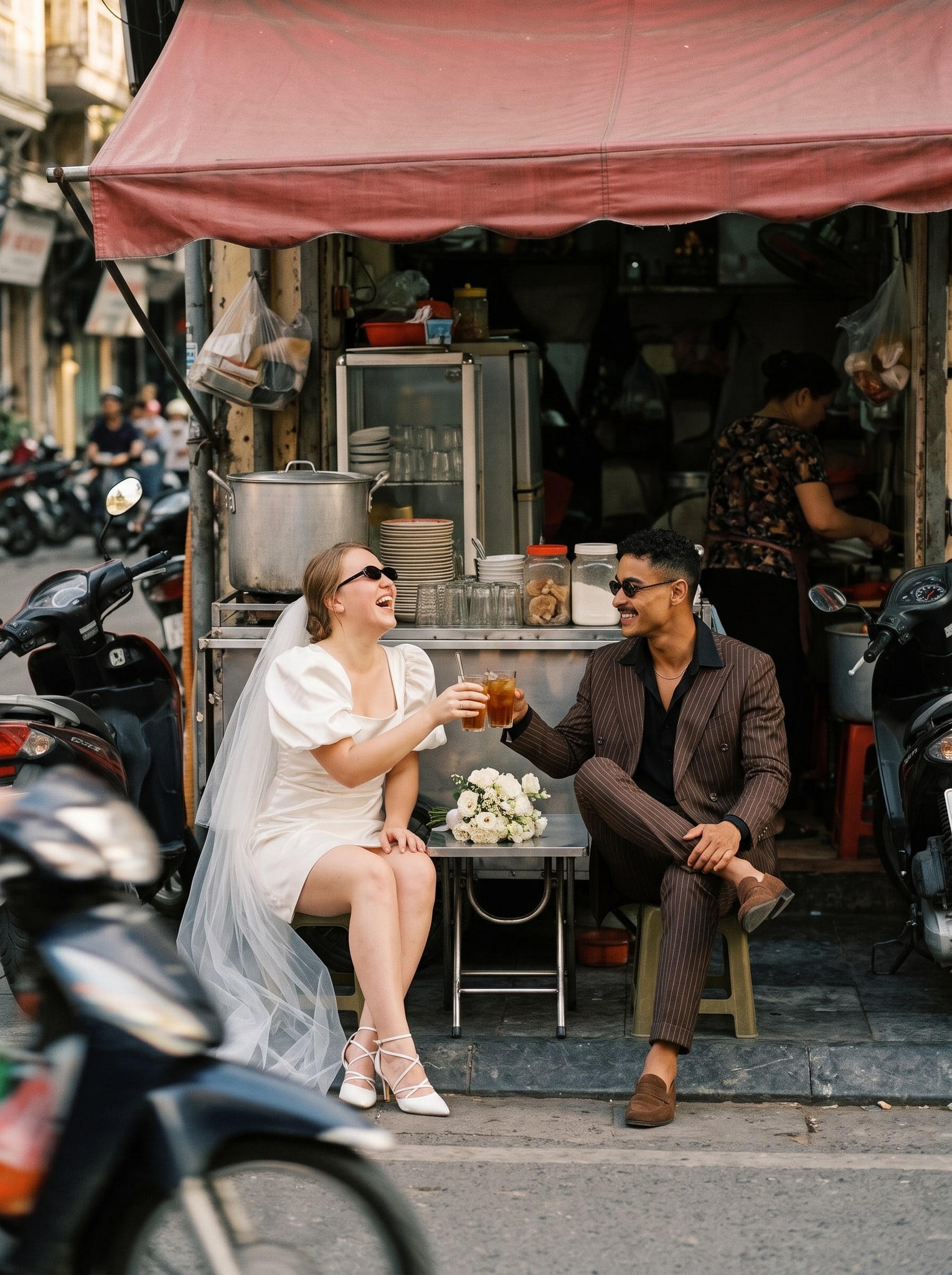
What poses work in such a narrow, crowded space?
The bridge's width (8 metres) and roof beams force us to shoot verticals (portrait orientation) rather than wide landscapes. We use four main poses: (1) couple standing face-to-face near the bridge's center, with one hand on the railing—the roof frames them naturally; (2) couple walking hand-in-hand toward or away from the camera, with lanterns in soft focus behind; (3) sitting on the bridge's inner ledge or steps, leaning together, with the water or railing as context; (4) bride alone on the steps or railing while the groom frames her from below—this uses the bridge's height for depth. Each pose works in 2–3 minutes because foot traffic resumes. We never ask couples to climb the railing or lean over water; the bridge's low walls and wet stone after rain make that unsafe. Our ao dai photoshoot package often includes bridge poses because the traditional fabric photographs beautifully against the wood's patina, and the garment's length and structure complement the vertical framing.
See packages and prices on vietnamphotoshoot.com
Which time of day produces the best light at the bridge?
Early morning (06:30–08:00) and late afternoon (17:00–18:30) are ideal; midday (10:00–16:00) flattens colour and throws sharp shadows from the roof beams across faces. At sunrise, the eastern end of the bridge catches warm, diffused light—gold tones reflect on the canal water, and the wooden structure glows. We arrive before 07:00 to shoot 20–30 minutes while the bridge is nearly empty. By 08:00, tour groups increase, so early booking is essential. Late afternoon backlight (sun low over the western rooftops) creates rim lighting on hair and fabric, which is striking for movement shots. Cloudy mornings work well too—no harsh shadows, even skin tone, and the lanterns' colours pop. We avoid midday unless the couple specifically wants bright, saturated colours; even then, we position them in the bridge's shadow and use the angle of the roof to create a natural diffuser. Cloud cover or haze (common June–August) actually improves the bridge shoot because it softens edges and reduces contrast.
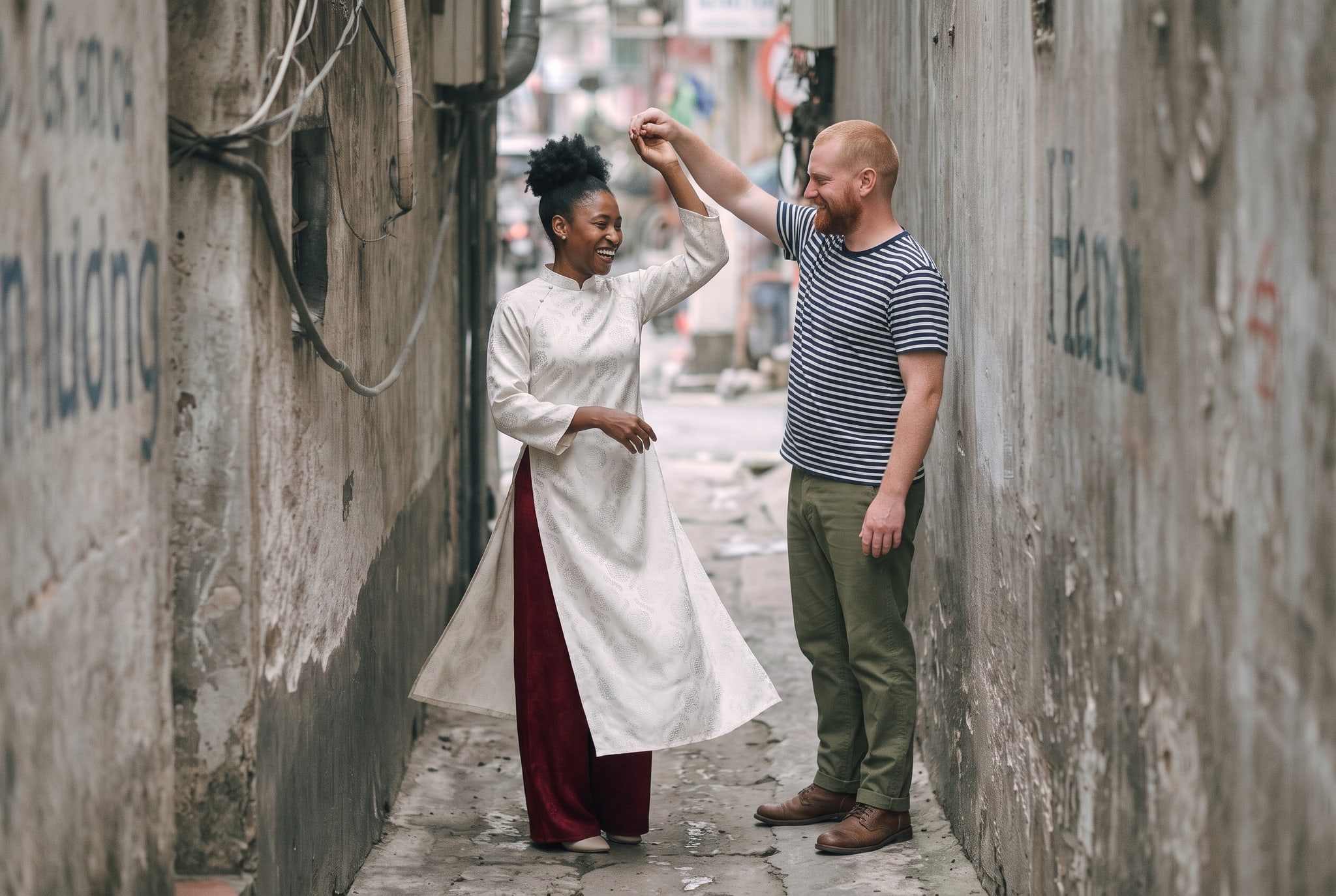
What should couples wear to photograph well against aged wood and stone?
Fabric colour, texture, and movement matter more than style. Áo dài in jewel tones (emerald, sapphire, burgundy) or soft pastels (blush, ivory, pale yellow) photograph beautifully against the bridge's brown and grey wood; the fabric's flowing sleeves add movement in still frames. Western wedding gowns in ivory, champagne, or blush work best; pure white can overexpose in bright light and clash with the bridge's warm tones. Grooms in tailored suits, linen shirts, or Vietnamese formal wear (lụa vàng, silk áo groom) coordinate well. Avoid very dark colours (black, navy) that disappear against the bridge's interior shadows unless backlit. Metallic or shiny fabrics (sequins, lamé) reflect light unevenly in the narrow space—matte silk, cotton, and linen are forgiving. Jewellery should not jangle or catch light erratically; simple pieces (rings, small earrings) work. Many couples ask about shoes; we recommend flat soles or low heels because the bridge's wooden surface is narrow and slightly slippery when damp. Makeup and hair at your hotel can be timed so that styling is fresh on arrival at the bridge; late-stage touchups happen in a nearby café or we bring a small kit.
| Outfit choice | Best time of day | Why it works | Length of session |
|---|---|---|---|
| Áo dài, jewel tones | Early morning (06:30–08:00) | Fabric colour glows against wood; fewer tourists | 30 minutes |
| Western gown, ivory/champagne | Late afternoon (17:00–18:30) | Backlight lifts fabric; warm tone harmony | 35 minutes |
| Groom suit + bride blush gown | Overcast morning | Even light; no harsh shadows; intimate feel | 40 minutes |
| Mixed (gown + Vietnamese formal) | Golden hour (sunrise or sunset) | Colour contrast; motion in fabric readable | 35 minutes |
What mistakes do we see, and how do we prevent them?
Arriving unprepared for crowds. Couples often think they'll "have the bridge to themselves" between 09:00 and 16:00; they won't. We book 06:30–08:00 slots and communicate this clearly on WhatsApp before the shoot. If a couple insists on a midday slot (for work or travel reasons), we shoot in the bridge's shadowed interior and frame tighter to exclude background chaos.
Slippery wooden surfaces. The bridge is older; boards are worn smooth and damp in rainy season (May–October). We walk couples through a test step on arrival, recommend flat shoes, and position them away from the bridge's edges.
Overexposed sky showing through roof gaps. In bright sunlight, the sky visible through the roof beams reads pure white and pulls focus away from the couple. We expose for skin tone and let the sky blow; alternatively, we shoot in shadow or frame upward to include only wood and lanterns, not sky.
Styling that doesn't travel well. Heavy makeup melts in Hoi An's heat and humidity; elaborate updos loosen after 10 minutes. We advise simpler makeup with waterproof products, hair pinned low or in braids, and a small touchup kit in a bag on set.
Underestimating time needed. Couples often want bridge shots plus Old Town street scenes, the riverside, and a temple interior—all in 90 minutes. We scope the couple's full wish list on the first WhatsApp call and recommend either a longer session or a second location with fewer constraints. A pre-wedding session that includes the bridge as one of three or four locations typically runs 3–4 hours.
What to check before you book a bridge session
- Time slot availability. Early morning (06:30–08:00) fills fastest; check vietnamphotoshoot.com's booking calendar and confirm within 48 hours.
- Weather and season. Rainy season (May–October) brings humidity and occasional showers; dry season (November–April) is clearer but busier. Ask about rescheduling options if storms arise.
- Outfit and hair plan. Confirm styling details on WhatsApp so our makeup and hair team can plan timing and products (waterproof, humidity-resistant).
- Crowd tolerance. If the couple is uncomfortable with visible tourists in some frames, request the earliest or latest slot. Clearing the bridge completely is not possible.
- Session length and locations. One location (the bridge) takes 30–40 minutes; combining it with street scenes or riverside adds 60+ minutes. Clarify the package scope.
- Post-processing style. Ask about colour grading and retouching. Some couples prefer warm, moody tones (matching the bridge's patina); others want bright, saturated colour. We discuss this during the pre-shoot call.
FAQ
Can we do a bridge shoot without a full pre-wedding package?
Yes. We offer couple photoshoot sessions that include the bridge and one or two other Hoi An locations; ask about shorter options on WhatsApp or the booking site.
What if it rains the morning of our shoot?
We can reschedule for the next available early slot, usually within 2–3 days. If the couple's travel timeline is fixed, we move the session to the bridge's interior (more sheltered) or nearby covered alley scenes. Check the booking site's weather clause.
Do we need a permit to photograph on the bridge?
No formal permit is required for personal shoots; our team coordinates with local guides and the bridge's custodians. Large commercial crews may need advance notice; we handle that.
How many photos will we get from a 30-minute bridge session?
Typically 80–120 unedited frames, of which 20–30 are finished and delivered as high-resolution files. This depends on light, outfit changes, and pose variety.
Can we hire just a photographer, not a full stylist team?
Yes. Vacation and solo photoshoot sessions include a photographer and guide; makeup and hair services are optional add-ons. Chat us on WhatsApp to customize your package.
What's the best way to coordinate timing between the bridge and other Hoi An locations?
We plan the shoot route on the first call: bridge first (earliest light, fewest people), then move to street scenes or riverside for softer evening light. This avoids backtracking and tires the couple least.
Pre-Wedding & Elopement
Inclusions, prices and booking are on our booking site.
FAQ
Can we do a bridge shoot without a full pre-wedding package?
Yes. We offer [couple photoshoot sessions](/go/couple-photoshoot) that include the bridge and one or two other Hoi An locations; ask about shorter options on WhatsApp or the booking site.
What if it rains the morning of our shoot?
We can reschedule for the next available early slot, usually within 2–3 days. If the couple's travel timeline is fixed, we move the session to the bridge's interior (more sheltered) or nearby covered alley scenes. Check the booking site's weather clause.
Do we need a permit to photograph on the bridge?
No formal permit is required for personal shoots; our team coordinates with local guides and the bridge's custodians. Large commercial crews may need advance notice; we handle that.
How many photos will we get from a 30-minute bridge session?
Typically 80–120 unedited frames, of which 20–30 are finished and delivered as high-resolution files. This depends on light, outfit changes, and pose variety.
Can we hire just a photographer, not a full stylist team?
Yes. [Vacation and solo photoshoot](/go/vacation-photoshoot) sessions include a photographer and guide; [makeup and hair](/go/makeup-and-hair) services are optional add-ons. Chat us on WhatsApp to customize your package.
What's the best way to coordinate timing between the bridge and other Hoi An locations?
We plan the shoot route on the first call: bridge first (earliest light, fewest people), then move to street scenes or riverside for softer evening light. This avoids backtracking and tires the couple least.
More from the team
Boho pre-wedding photoshoot in Vietnam: Hanoi, Saigon, Hoi An
Boho pre-wedding shoots mix romantic, free-spirited aesthetics with Vietnam's landscapes and heritage sites. We run full-day sessions in three cities, handling styling, makeup, location scouts and edits.
Avoid crowds at Hoang Su Phi rice terraces: timing for wedding shoots
Hoang Su Phi's terraced landscape draws couples and tour buses in equal measure. We show how to shoot there alone, when to arrive, and what to arrange with us before you go.
Photography rules at Con Dao beaches: permits, drones and what to check
Con Dao's beaches demand prep before you shoot—permits, drone zones and tide timing all affect your day. We share what the Cáo Studio team verifies on every booking.