 Cáo Studio
Home › Blog › Pre-Wedding & Elopement
Pre-wedding poses at Ma Pi Leng Pass: what works on the day
By the Cáo Studio team · Hanoi & Saigon · 2026-11-02
Ma Pi Leng Pass sits 1,200 metres above sea level on the Ha Giang–Meo Vac road, known for tight switchbacks and stunning valley views. Pre-wedding couples use the pass for backlit cliff silhouettes (dawn, 5:30–7 am), mid-slope rock formations and the famous "24 bends" highway as backdrop. A full session with Cáo Studio typically spans 3–4 hours with one outfit change, starting before sunrise to catch soft golden light on the limestone. Wind is constant and cold; loose fabrics catch light beautifully but require pinning. The pass sits 2.5 hours from Ha Giang town. Avoid midday (10 am–3 pm) when heat haze and overhead sun flatten colours. Most couples choose a second location (Lung Cu flagpole, Quan Ba heaven gate) to break the journey and add variety to the gallery.
Why does timing matter more than pose angle at Ma Pi Leng?
Light changes every 12 minutes at altitude before sunrise. We arrive 90 minutes early to scout stone textures and set up reflectors. At 6:15 am, backlit cliff edges glow amber; by 7:00 am, direct light erases shadow depth. If you pose at 6:45 instead, every cliff loses definition. We've resheduled 3 sessions in 2024 because couples arrived 30 minutes late—the window closed. A standing embrace against the valley works at 6:20 am but looks flat at 7:30 am, same pose, same couple. The decision we make on the day: wake earlier than the plan, or swap to the second location's shaded rock formations where light is forgiving until noon.
Which pose works best on the zigzag road itself?
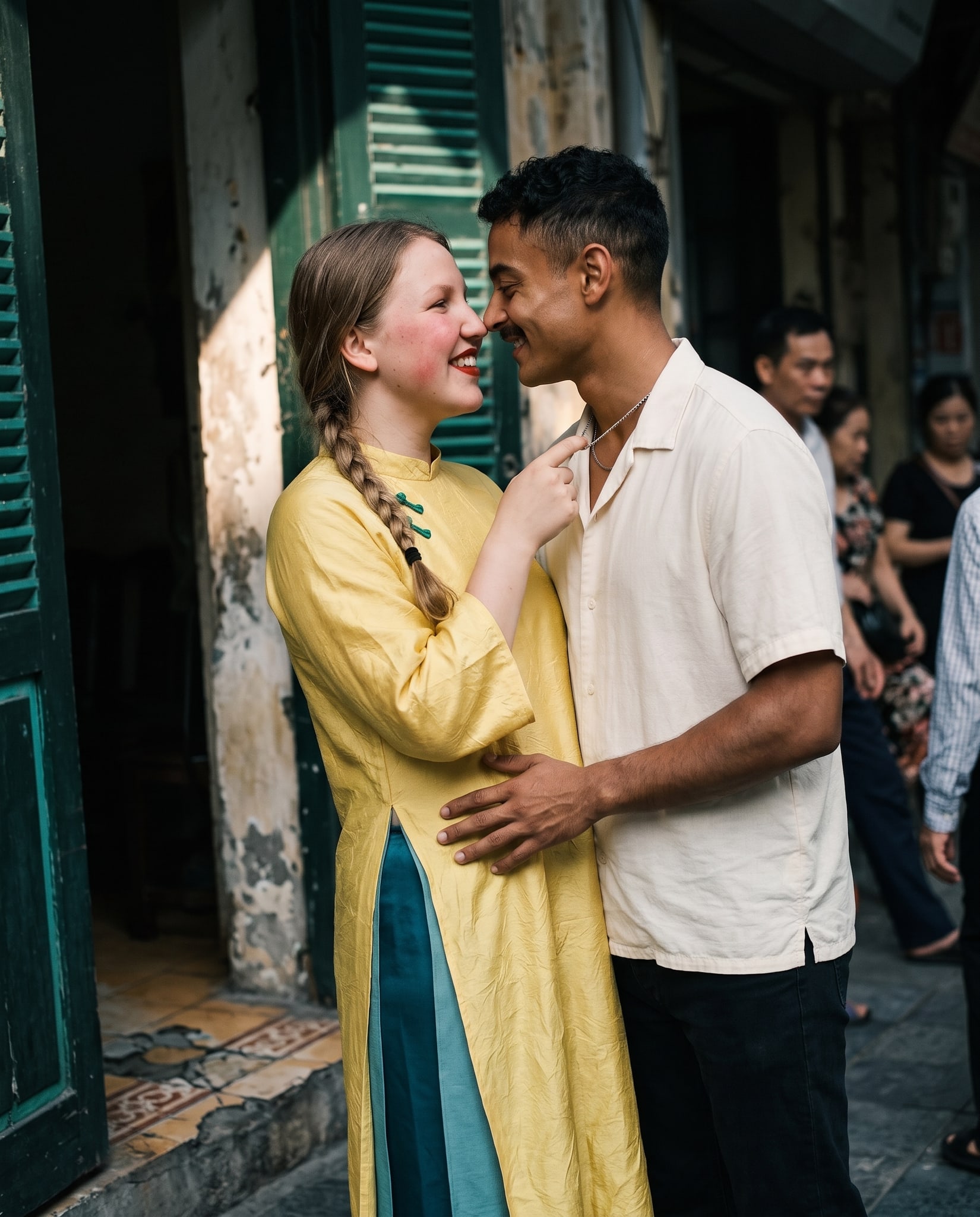
The 24 bends create leading lines that pull the eye downward. We position couples on the outer edge of a bend, the groom's shoulder angled into the curve, bride's hand on his chest, both facing the camera from slightly upslope so the road and valley stack behind them. The horizontal lines of the tarmac divide the frame naturally—foreground (road), midground (couple), background (far valley). This pose works in wind because standing weight forward keeps balance. We avoid side-by-side walking shots on the road because loose pebbles cause stumbles; we've had two couples slip in 18 months, and neither image was sharp. The angle should be 45 degrees to the road line, not parallel. Parking must be 200 metres away; motorbikes pass constantly, and we position a scout to signal them.
How do you use the limestone formations without looking stiff?
We tell couples: "Lean on the rock, don't pose against it." A bride leaning her back on warm stone, groom's arm around her waist, both looking toward the valley creates depth and ease. The rock must be above her hip—waist-high or shoulder-high—otherwise the angle compresses the body. We use the fractured stone layers as a step; sitting on a low ledge with feet dangling reads as genuine rest, not a forced moment. One couple in March 2025 stood rigid on a peak for 15 shots, then sat on a lower ridge to rest and we captured their best three images—laughter, movement, real connection. The difference: a rock is a prop only if you use it as a functional perch, not a backdrop. Wind pushes; we ask the groom to hold the bride's veil or dupatta if she's wearing one, and that protective gesture photographs better than any posed hand placement.
What gear and clothing prevent frustration on the pass?
| Wear | Why | What we've seen go wrong |
|---|---|---|
| Layers (thermal under, windbreaker outer) | Temp drops 8°C at dawn; couples shiver, faces tense | One bride's jaw clenched for 40 minutes; makeup artist retouched every frame |
| Pinned dupatta or veil, bobby pins (10+) | Wind gusts 20 kph; loose fabric obscures face or blows into mouth | Veil tangled in bride's face for an hour; we repinned five times; three outfit sets crumpled |
| Non-slip shoes (sport sole, not heels) | Shale and loose rock; heels sink or roll | Bride twisted ankle on bend; we rescheduled to next day; lost 4 hours of light |
| Long skirt or pants, not short shorts | UV reflection off white stone; exposed legs burn badly | One couple had visible redness by 8 am; sunscreen helped but images show discomfort |
| Minimal jewellery (clip-on earrings only) | Dangly pieces catch wind, move in every frame, distract | A necklace swung 3 inches in 4 consecutive shots; we had to ask couple to remove it |
Our makeup artist carries SPF 50, lip balm and a handheld mirror. The photographer brings a polarizing filter to reduce glare bounce off limestone. Bring your own water (2 litres per person); there are no shops on the pass.
See packages and prices on vietnamphotoshoot.com
What does our team decide when weather turns mid-shoot?
Fog rolls in at Ma Pi Leng without warning, especially 7:00–8:30 am. In April 2025, we started at 6:15 am with clear skies; by 7:45 am, visibility dropped to 50 metres. We pivoted: moved the couple to a lower ledge where mist became foreground atmosphere (not obstruction), shifted to tighter framing, and used the couple's silhouette against the fog as an unplanned aesthetic. It worked. Without a backup plan, we would have wasted the light and rebooked. Rain happens 1 in 8 sessions; water beads on polished stone beautifully, but hair and makeup suffer. We use microfibre towels, reapply makeup between shots, and pivot to covered overhang 200 metres south (a small shelter carved into the cliff). If rain is heavy, we move to Quan Ba Heaven Gate (30 minutes away) where a pavilion offers protection. That decision costs 90 minutes of light but saves the shoot from cancellation. We text the couple on WhatsApp: "Rain inbound—moving to backup location with same views. Still on track to finish by 2 pm."
How do we create variety across the gallery without returning to the same rock?
We shoot four distinct zones: the highest overlook (best for silhouettes, 6:15–7:00 am), the middle roadside bend (good for activity shots, 7:15–8:30 am), the lower shaded ledge (flattering for close-ups, 8:45–10:00 am), and a final location 15 minutes south (Quan Ba, for a warmer outfit change). Each zone changes the story: summit isolation, roadside movement, intimate shelter, open valley. We do 40–60 frames per zone, then review on the camera to confirm the couple's comfort and the light's direction. If a zone yields only 3 sharp images despite good light, we extend the shoot at that spot or combine two zones into one to free time. In June 2025, we shot 180 frames at Ma Pi Leng and only 90 at Quan Ba, flipping the plan because the couple's energy was highest at the pass and the light stayed exceptional past 8:30 am (rare). We've learned: never commit to a rigid location quota. Follow the couple's confidence and the light.
What to check before you book a Ma Pi Leng shoot
- Fitness level: steep climbs, loose shale, 2 hours of standing. If either partner has knee or ankle issues, we recommend a lowland location.
- Weather window: book December–March (cool, clear mornings). April–May brings fog. June–September is monsoon; October is unpredictable.
- Road access: during rare closures (landslide repair), the pass may be blocked. We monitor Ha Giang travel updates and reschedule 48 hours in advance if needed.
- Sunrise commitment: dawn shoots require a 4:00 am pickup from Ha Giang town. No exceptions; you cannot arrive late and capture the same light.
- Second location: Ma Pi Leng alone fills 2–3 hours. Most packages include a second location to reach 4 hours. Ask us where the couple is strongest (movement, light, comfort) and we'll pair it.
- Transport: we arrange a van with AC and a driver who knows the road. A private car is not recommended; roads are narrow and require local knowledge.
For more detail on pre-wedding photography in northern Vietnam, visit our main package page. If you're considering a couple photoshoot elsewhere or planning something unconventional, we also run special concept shoots and vacation sessions. Drop us a message on WhatsApp and we'll help you decide.
FAQ
Can we do a Ma Pi Leng session in the afternoon instead of dawn?
Yes, but the aesthetic changes entirely. Afternoon light is harsh and overhead (no drama), and haze fills the valley by 11 am. Dawn yields moody silhouettes; afternoon gives crisp detail in bright conditions. If you dislike early starts, we recommend Quan Ba Heaven Gate (same light issues, but a pavilion allows later shoots) or our Ho Chi Minh sessions with lower altitude and softer light year-round.
Do we need two outfit changes at Ma Pi Leng?
One outfit is standard for the pass itself; most couples change into a second look at a nearby location (Quan Ba or Lung Cu) 30–45 minutes away. A single outfit works if you prefer simplicity. We pack everything in the van—no need to arrange extra transport. Bring both outfits and decide on the morning based on energy and light conditions.
What if one of us is afraid of heights?
Ma Pi Leng sits on a steep road with deep valleys. Poses are on stable stone ledges (not cliff edges), 1–2 metres from the roadside. If heights cause panic, we position shots at the lower bend (much safer-feeling) or swap to Quan Ba or a rice terrace location. Let us know upfront on WhatsApp and we'll tailor the session.
How many photos do we receive, and what format?
Pre-wedding shoots at Ma Pi Leng typically yield 80–120 edited images (more if we shoot multiple locations). You receive high-resolution JPEG files via a secure cloud link, plus a small set of prints or an album if included in your package. Editing takes 2–3 weeks post-shoot. We send previews on day 10 so you can request adjustments.
Is the session refundable if weather is bad?
We offer a full reschedule to a future date if weather makes shooting unsafe or impossible (heavy rain, zero visibility). Partial refund is not standard; we prioritize keeping your deposit as a booking guarantee and offer rescheduling at no extra cost. Check the terms in your specific package contract, and ask us on WhatsApp before booking.
Can we hire a local guide to explain the area while you shoot?
Yes. Guides add 45–60 minutes to the itinerary and cost a small fee (arrange with us in advance). Some couples enjoy the history and geology context while posing; others prefer a quiet, meditative shoot. It's entirely optional and doesn't change the image quality.
Pre-Wedding & Elopement
Inclusions, prices and booking are on our booking site.
FAQ
Can we do a Ma Pi Leng session in the afternoon instead of dawn?
Yes, but the aesthetic changes entirely. Afternoon light is harsh and overhead (no drama), and haze fills the valley by 11 am. Dawn yields moody silhouettes; afternoon gives crisp detail in bright conditions. If you dislike early starts, we recommend Quan Ba Heaven Gate (same light issues, but a pavilion allows later shoots) or [our Ho Chi Minh sessions](/go/saigon) with lower altitude and softer light year-round.
Do we need two outfit changes at Ma Pi Leng?
One outfit is standard for the pass itself; most couples change into a second look at a nearby location (Quan Ba or Lung Cu) 30–45 minutes away. A single outfit works if you prefer simplicity. We pack everything in the van—no need to arrange extra transport. Bring both outfits and decide on the morning based on energy and light conditions.
What if one of us is afraid of heights?
Ma Pi Leng sits on a steep road with deep valleys. Poses are on stable stone ledges (not cliff edges), 1–2 metres from the roadside. If heights cause panic, we position shots at the lower bend (much safer-feeling) or swap to Quan Ba or a rice terrace location. Let us know upfront on WhatsApp and we'll tailor the session.
How many photos do we receive, and what format?
Pre-wedding shoots at Ma Pi Leng typically yield 80–120 edited images (more if we shoot multiple locations). You receive high-resolution JPEG files via a secure cloud link, plus a small set of prints or an album if included in your package. Editing takes 2–3 weeks post-shoot. We send previews on day 10 so you can request adjustments.
Is the session refundable if weather is bad?
We offer a full reschedule to a future date if weather makes shooting unsafe or impossible (heavy rain, zero visibility). Partial refund is not standard; we prioritize keeping your deposit as a booking guarantee and offer rescheduling at no extra cost. Check the terms in your specific package contract, and ask us on WhatsApp before booking.
Can we hire a local guide to explain the area while you shoot?
Yes. Guides add 45–60 minutes to the itinerary and cost a small fee (arrange with us in advance). Some couples enjoy the history and geology context while posing; others prefer a quiet, meditative shoot. It's entirely optional and doesn't change the image quality.
More from the team
Boho pre-wedding photoshoot in Vietnam: Hanoi, Saigon, Hoi An
Boho pre-wedding shoots mix romantic, free-spirited aesthetics with Vietnam's landscapes and heritage sites. We run full-day sessions in three cities, handling styling, makeup, location scouts and edits.
Avoid crowds at Hoang Su Phi rice terraces: timing for wedding shoots
Hoang Su Phi's terraced landscape draws couples and tour buses in equal measure. We show how to shoot there alone, when to arrive, and what to arrange with us before you go.
Photography rules at Con Dao beaches: permits, drones and what to check
Con Dao's beaches demand prep before you shoot—permits, drone zones and tide timing all affect your day. We share what the Cáo Studio team verifies on every booking.