 Cáo Studio
Home › Blog › Pre-Wedding & Elopement
Pre-Wedding Poses at Tran Quoc Pagoda: What Our Team Shoots
By the Cáo Studio team · Hanoi & Saigon · 2026-11-04
Tran Quoc Pagoda, on an island in Hoan Kiem Lake in central Hanoi, draws pre-wedding couples for its crimson railings, ancient stone, and morning lake reflections. A shoot there typically runs two to three hours with our team managing light angle (best before 9 a.m. or after 4 p.m.), crowd navigation, and composition within tight staircases and narrow pavilion edges. At Cáo Studio, we frame couples against the pagoda's layered eaves, have them sit on the stone embankment facing the lake, and use the red wooden railings as leading lines. Ask us for a quote on WhatsApp—your session length and styling choices shape the overall investment. The pagoda opens early; we often arrive before official hours to scout and position. Avoid midday harsh sun and weekend tourist rushes; weekday mornings yield cleaner, softer frames. Chat with us on WhatsApp
What makes Tran Quoc Pagoda unique for pre-wedding frames?
Tran Quoc Pagoda sits on a small peninsula jutting into Hoan Kiem Lake, surrounded by water on three sides. That isolation creates a natural separation from city noise and gives us a soft, diffused backdrop. The pagoda's crimson wooden railings and pale stone arches repeat across multiple angles—if we position a couple at the main gate, frame them through the central arch, or shoot from the water's edge looking back, every shot has architectural depth. What sets it apart from other Hanoi temples is the water proximity; we can shoot with the lake as a soft-focus foreground, which few urban sites offer. The narrow stone pathways mean we're shooting in shadow or dappled light most of the time, which flatters skin tone and reduces harsh shadows under eyes and cheekbones. Our teams notice the pagoda's geometry naturally composes couples in thirds—the railings lead the eye, the eaves frame height, and the stone platform grounds the composition. That visual rhythm happens almost automatically, so we spend less time correcting posture and more time catching genuine moments.
How do we time the light at Tran Quoc Pagoda?
Light at Tran Quoc Pagoda shifts dramatically within two hours because the water reflects and bounces rays unpredictably. We arrive before 8 a.m. when the sun is low and hits the pagoda's eastern face, bathing the stone in warm, diffused tones. Between 9 a.m. and 3 p.m., direct overhead light creates harsh shadows inside pavilions and under the eaves—unusable for close-up couple frames unless we position couples in full shade and expose for their faces. After 4 p.m., golden-hour light hits from the west; we move couples to the pagoda's western railings or the lake-facing embankment and shoot into the glow, silhouetting them softly against the water. We've learned to scout the exact angle the sun takes relative to each railing and pavilion during the season the couple books—pagoda orientation doesn't change, but seasonal sun height does. Our photographers carry a small light meter and check sky conditions the morning of the shoot; if clouds roll in, overcast diffuses the harsh midday light, so we adapt the schedule on the day. The golden-hour window (4:15–5:30 p.m. in late 2026) is tight, so we shoot that sequence first and use earlier slots for detail frames and walking shots if light is poor.
What poses and movements work in tight pagoda spaces?
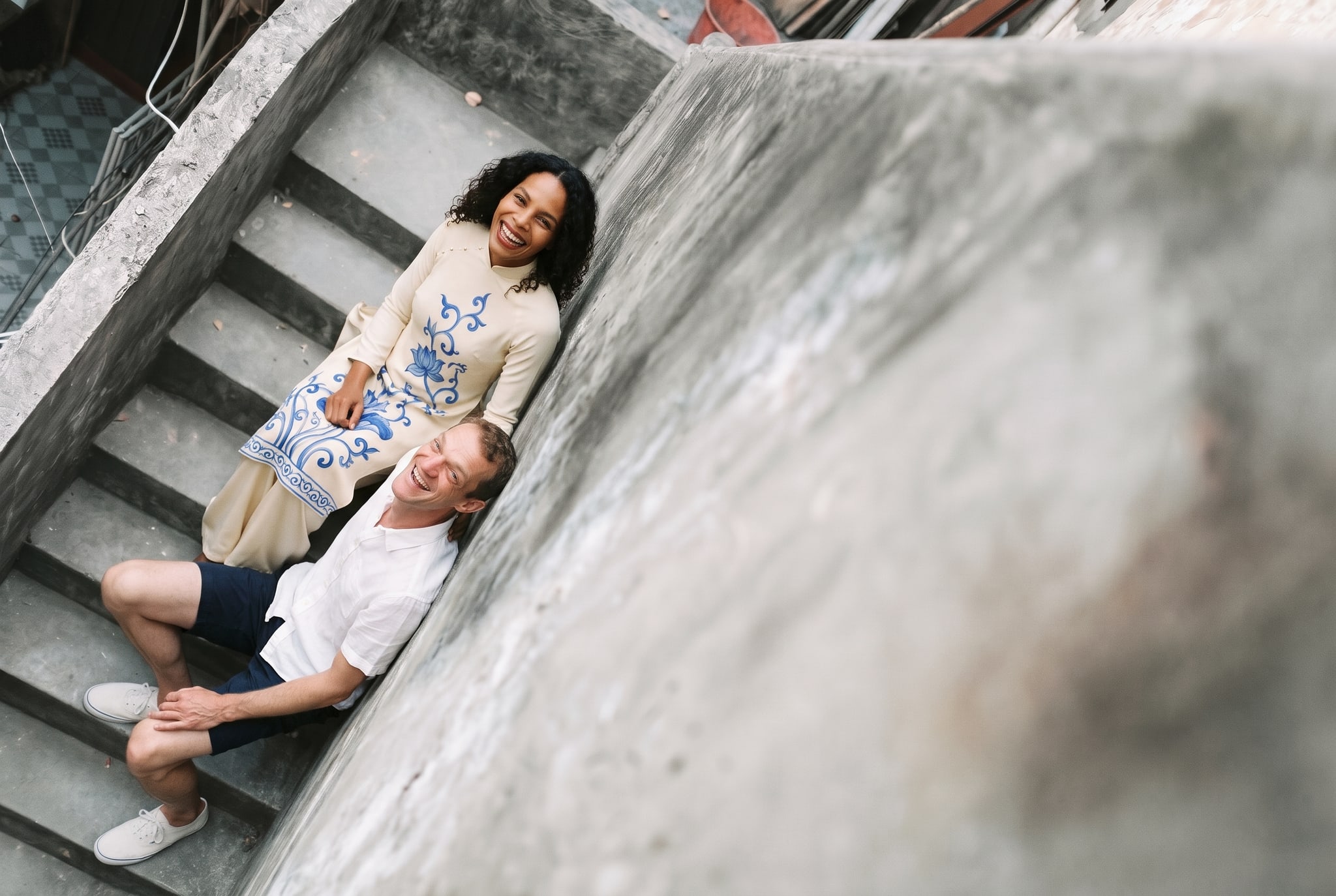
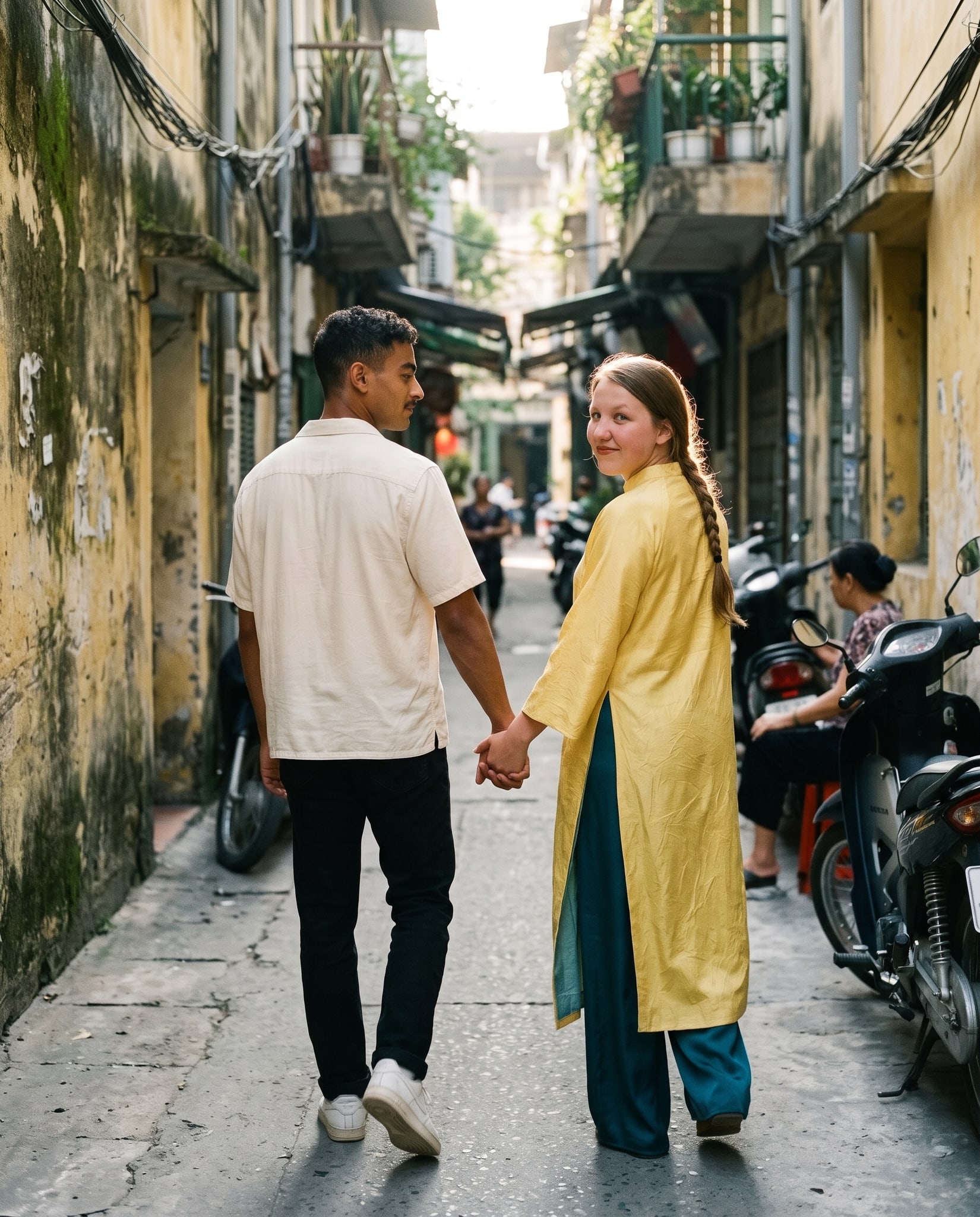
Tran Quoc Pagoda's staircases and pavilions are narrow—two people barely fit side by side on most steps. We've stopped asking couples to stand shoulder-to-shoulder there; instead, we pose them staggered. One person sits on a step, the other stands behind or beside, or they stand on different levels with one arm reaching across. That depth within the small footprint draws the eye through the frame and avoids the stiff "two people standing in line" look. The red railings are the strongest visual element, so we use them as active props—couples lean against them, frame faces between balusters, or walk along them with hands linked. We guide them to walk slowly down the stone paths rather than pose statically; motion softens the formality and the trailing robes of traditional áo dài catch the breeze naturally. On the main terrace overlooking the lake, we position couples at different distances from the pagoda—some shots with them near the central tower framing them against the eaves, others with them at the edge of the platform so the lake and Hoan Kiem Bridge fill the background. We avoid poses facing the sun directly; backlit or side-lit frames at Tran Quoc yield richer color in skin and fabric. Our stylists have noticed that couples in traditional áo dài move differently—the long tunic flowing around the legs creates natural lines—so we encourage walking, turning gently, and hand placement rather than rigid standing poses.
| Pose type | Where at pagoda | Light window | Why it works |
|---|---|---|---|
| Sitting on steps | Central staircase | Before 9 a.m. | Shadows from eaves soften faces; unequal heights create depth. |
| Leaning on railings | Eastern terrace | 4–5 p.m. | Golden light hits railing detail; couple's silhouettes glow against water. |
| Walking on stone path | West-facing path | 8–9 a.m. or 4–6 p.m. | Motion softens the frame; morning light is warm and diffused. |
| Framed by pavilion arch | Main pavilion entrance | 7–8 a.m. | Backlit arch creates natural vignette; couple's faces are lit by bounce. |
| Standing at water's edge | Southern terrace | Golden hour | Lake and sky fill background; reflections add dimension. |
See packages and prices on vietnamphotoshoot.com
How do we navigate crowds and book around peak times?
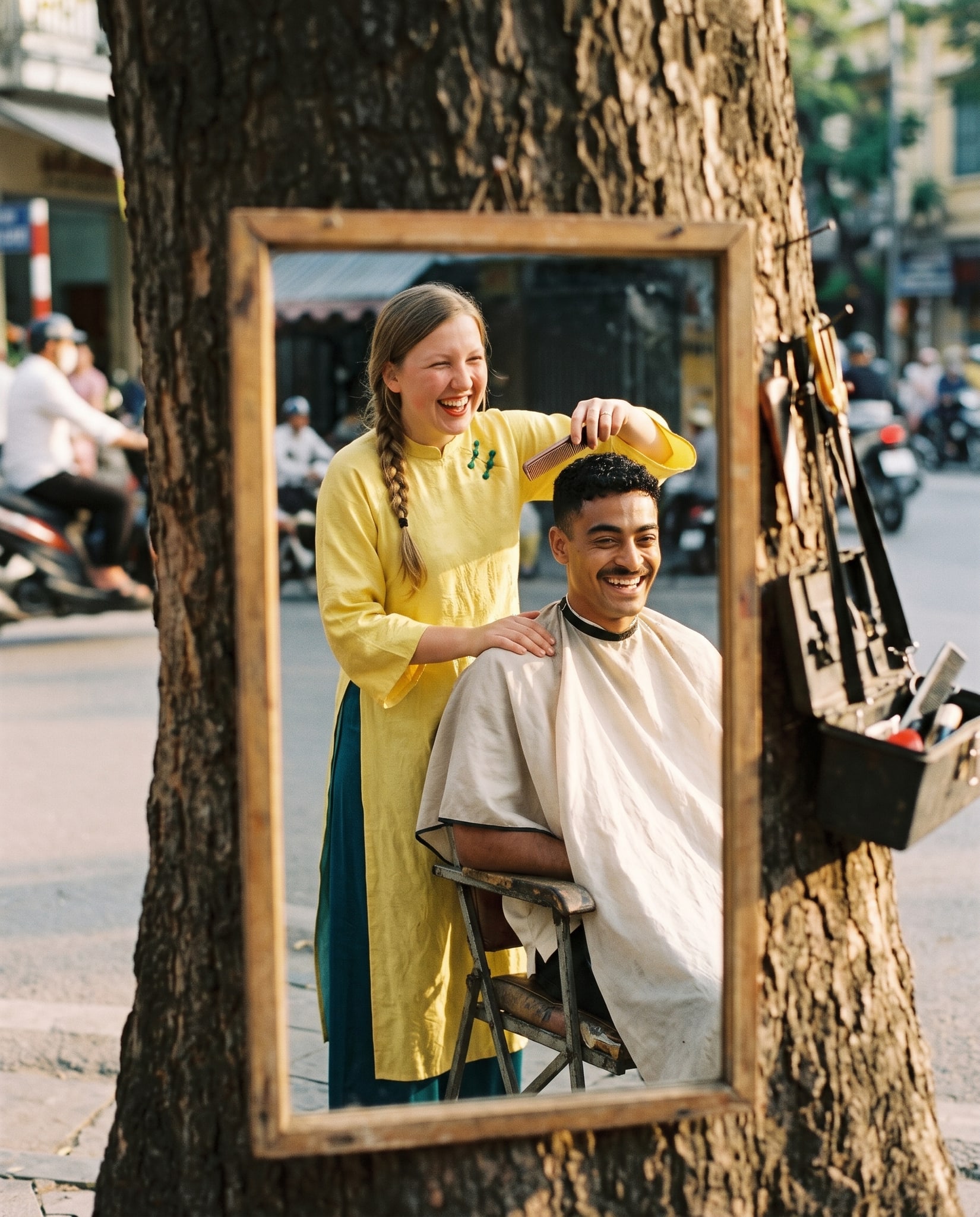
Tran Quoc Pagoda sees tourists from 9 a.m. onward; by 11 a.m., buses of school groups and tour parties fill the main pathways. We've learned to book shoots for early mornings (7–9 a.m.) or late afternoons (4–6 p.m.) to avoid the foot traffic. On weekends, even early morning gets busy; weekday shoots yield cleaner frames with fewer strangers in the background. When crowds do appear mid-shoot, we move our couple to the least-trafficked pavilion or step the group back and shoot tighter close-ups that exclude the bustle. Our photographers carry a small step-ladder; when crowds linger in a background, we shoot from a higher angle to crop them out entirely. We brief couples via WhatsApp before the day: arrive in relaxed clothes, carry the áo dài or formal wear in a bag, and dress on-site in a private corner near the pagoda's maintenance building. That saves time and keeps the outfit pristine during the drive to Hoan Kiem Lake. We also time our arrival to open hours—the pagoda gate opens at 8 a.m., so we either book with the gate authority for an earlier entry or position couples outside the gate on the approach path, where light is already excellent. If a major holiday or festival falls near the couple's booking, we proactively reach out and offer a reschedule to a quieter date, or we shift the shoot to a different Hanoi site—we've found couples appreciate the heads-up and the option far more than showing up to chaos.
Which package and styling options suit a Tran Quoc Pagoda shoot?
Our pre-wedding and elopement package is the natural fit for Tran Quoc Pagoda because it includes hair and makeup coordinated for the site's heritage aesthetic, multiple outfit changes if desired, and full-day coverage if a couple wants a ceremony or detail shots elsewhere in Hanoi. The áo dài is the dominant choice here—the pagoda's architecture and the traditional fabric language align visually. We've also run couple photoshoot sessions at Tran Quoc for couples who prefer Western formal wear or casual dress; the site adapts to both, though the red railings and stone arch speak loudest against áo dài or flowing gowns. Our makeup and hair at your hotel service is essential before a Tran Quoc shoot—we prepare the couple at their accommodation in Hanoi, so they arrive at the pagoda camera-ready and can focus on posing rather than logistics. For couples staying at a lakeside hotel near the pagoda, we can time this tight. We typically coordinate four to six outfit changes across a three-hour morning session—the couple changes behind the maintenance area or returns to a car parked nearby—so ask us for a quote on WhatsApp about your preferred styling scope. Some couples add a special concept shoot angle, like a maternity frame or a vow-renewal framing, and Tran Quoc's intimate pavilions suit that tenderness. If a couple is visiting Hanoi for the first time and wants multiple iconic sites, we discuss linking Tran Quoc with the Old Quarter or Hoan Kiem's opposite bank in a Cáo Studio Hanoi full-day itinerary—that's a different booking structure, so ask us on WhatsApp.
What do we check and advise before a Tran Quoc Pagoda booking?
Before you book, confirm these details with us:
- Season and light angle: Ask us what sun height and color to expect during your chosen month. If you're booking in winter (Nov–Feb), golden hour comes earlier; in summer, it's much later. That shapes outfit color and our shot list.
- Crowd tolerance: Do you mind if a few tourists appear in wide shots, or do you want zero background? Be explicit; it affects our positioning and our backup-site decision if the day is unexpectedly busy.
- Áo dài or Western wear: Decide early. Áo dài needs fitting time; some fabrics photograph better in morning diffused light, others in golden hour. Let us know so we can source and prep the garment.
- Physical comfort: The pagoda has many steps and narrow railings. If either partner has mobility concerns, let us know so we focus on level terraces and accessible poses.
- Rainy season (May–Sep): Afternoon storms are common. We'll offer an indoor pavilion backup frame or discuss a reschedule; don't book Tran Quoc in monsoon unless you embrace wet-weather drama.
- Timing of hair and makeup: Confirm whether you want us to prep you at your hotel or at the pagoda (less ideal, but possible). That sets the WhatsApp arrival schedule.
- Styling changes: Each outfit change adds 15 minutes; factor that into your session duration. More changes = longer shoot.
Chat with us on WhatsApp | See packages and prices on vietnamphotoshoot.com
FAQ
What is the best time of year to shoot at Tran Quoc Pagoda for pre-wedding frames?
October through December and February through March offer stable, cool light and lower humidity—ideal for makeup durability and skin clarity. May–September brings afternoon monsoons and harsh UV; if you shoot then, book an early morning slot (before 9 a.m.) or plan for the storm as part of the aesthetic. January can be cool but hazy; late April is hot and humid.
Can we shoot inside the pagoda's main tower or just the exterior?
The main tower is active; we shoot exterior pavilions, railings, staircases, and the surrounding stone terraces. Interior shots are rarely permitted because the space is a functioning religious site. We frame couples with the tower as a backdrop or framed through the main arch, which is the strongest composition anyway.
What should we wear under or over the áo dài during the shoot if the weather is cool?
A simple white or cream undershirt beneath the áo dài tunic keeps the wearer warm without adding bulk. Avoid bulky cardigans (they read awkwardly in frames). If it's cold, we shoot the couple in the áo dài for 30–40 minutes, then move to a covered pavilion or offer a warmer break. Ask us for a quote on WhatsApp about layering options during your season.
How many photos do we typically receive from a Tran Quoc Pagoda pre-wedding session?
The session length and package dictate the final count—a three-hour morning shoot usually yields 200–300 digital frames after our edit and curation. We deliver a curated gallery, not contact sheets; each image is color-corrected and matched to your style. Ask us on WhatsApp which package includes how many final deliverables.
Is Tran Quoc Pagoda crowded on weekday mornings, and do we need to book the site in advance?
Weekday mornings before 9 a.m. are usually quiet; weekends and holidays get busy. You do not need to book the pagoda separately—we handle the logistics with local authorities as part of your package. Arrive in relaxed clothes and change into your formal wear once we're positioned on-site.
Can we do a ceremony or vow renewal at Tran Quoc Pagoda as part of the shoot?
The pagoda is a Buddhist heritage site; formal ceremonies are not permitted. However, we can frame intimate vow exchanges, ring or jewelry detail, or hand-joining moments on the terrace and pavilions—it reads as part of the pre-wedding narrative. Discuss your vision on WhatsApp and we'll advise what's possible that day.
Pre-Wedding & Elopement
Inclusions, prices and booking are on our booking site.
FAQ
What is the best time of year to shoot at Tran Quoc Pagoda for pre-wedding frames?
October through December and February through March offer stable, cool light and lower humidity—ideal for makeup durability and skin clarity. May–September brings afternoon monsoons and harsh UV; if you shoot then, book an early morning slot (before 9 a.m.) or plan for the storm as part of the aesthetic. January can be cool but hazy; late April is hot and humid.
Can we shoot inside the pagoda's main tower or just the exterior?
The main tower is active; we shoot exterior pavilions, railings, staircases, and the surrounding stone terraces. Interior shots are rarely permitted because the space is a functioning religious site. We frame couples with the tower as a backdrop or framed *through* the main arch, which is the strongest composition anyway.
What should we wear under or over the áo dài during the shoot if the weather is cool?
A simple white or cream undershirt beneath the áo dài tunic keeps the wearer warm without adding bulk. Avoid bulky cardigans (they read awkwardly in frames). If it's cold, we shoot the couple in the áo dài for 30–40 minutes, then move to a covered pavilion or offer a warmer break. Ask us for a quote on WhatsApp about layering options during your season.
How many photos do we typically receive from a Tran Quoc Pagoda pre-wedding session?
The session length and package dictate the final count—a three-hour morning shoot usually yields 200–300 digital frames after our edit and curation. We deliver a curated gallery, not contact sheets; each image is color-corrected and matched to your style. Ask us on WhatsApp which package includes how many final deliverables.
Is Tran Quoc Pagoda crowded on weekday mornings, and do we need to book the site in advance?
Weekday mornings before 9 a.m. are usually quiet; weekends and holidays get busy. You do not need to book the pagoda separately—we handle the logistics with local authorities as part of your package. Arrive in relaxed clothes and change into your formal wear once we're positioned on-site.
Can we do a ceremony or vow renewal at Tran Quoc Pagoda as part of the shoot?
The pagoda is a Buddhist heritage site; formal ceremonies are not permitted. However, we can frame intimate vow exchanges, ring or jewelry detail, or hand-joining moments on the terrace and pavilions—it reads as part of the pre-wedding narrative. Discuss your vision on WhatsApp and we'll advise what's possible that day.
More from the team
Pre-wedding photoshoot in Ho Chi Minh City in June: weather, light and crowds
June is Saigon's hottest and wettest month. We've run dozens of pre-wedding shoots here in June; here's what we see on location, what fails, and how to time your session.
Pre-wedding photoshoot in Hanoi on a budget
Budget pre-wedding shoots in Hanoi don't mean poor light or rushed timing. We show you how to choose locations, timing and packages that keep costs down while delivering shots you'll frame forever.
Avoid crowds at Thung Nham bird garden: Cáo Studio's wedding photo timing guide
Thung Nham bird garden near Ninh Binh draws tourists year-round. We've timed dozens of shoots there—here's exactly when our team schedules sessions to sidestep crowds and capture your best moments.