 Cáo Studio
Home › Blog › Pre-Wedding & Elopement
Ta Van village wedding photos: best time of day and light
By the Cáo Studio team · Hanoi & Saigon · 2026-11-04
Ta Van village in Mu Cang Chai district (Yen Bai Province, northern Vietnam) offers steep rice terraces and limestone ridges that shift color dramatically across the day. The best light for wedding photos happens between 17:00–19:00 (golden hour before sunset), when warm amber light wraps around the landscape and softens couple skin tones. We at Cáo Studio book Ta Van shoots for 06:00–08:00 (morning mist rising off paddies) or the 17:00–19:00 golden window; midday (11:00–15:00) creates harsh shadows between terrace rows and blows out sky detail, so we avoid it unless couples want black-and-white silhouettes. The shoot runs 2–4 hours depending on package; ask us for a quote on WhatsApp to discuss your preferred season and light preference. Chat with us on WhatsApp
Why we avoid Ta Van midday shoots and what we do instead
Midday in Ta Van isn't kind. Sun hangs high, shadows punch dark lines across terraces, and the sky washes pale. Couples often ask, "Can't we just shoot at noon?" We've learned the hard way: at 13:00 in June, one groom's face was striped with shadow from terrace walls. We shifted the shoot 45 minutes early, angled into open sky, and bounced a reflector off his bride's white dress to lift the shadows—but that's reactive. We now tell couples upfront: midday Ta Van = black-and-white only, or we reschedule. If a couple insists on midday (tight travel schedule, village event), we move to shaded temple courtyards in Tan Tien commune or shoot at a small waterfall nearby where dappled light diffuses harsh rays. It costs the couple time and breaks the Ta Van story in half—so we position golden hour or early morning as the choice that keeps the shoot whole.
How we read Ta Van light by season and terrace angle
Light behaves differently depending which terrace face we're shooting toward. In November–January (cool season, low sun angle), golden hour at 17:00 lasts until 18:30 because the sun tracks lower on the horizon; we get 90 minutes of soft light instead of 45 in summer. In May–September (monsoon and early dry season), cloud cover is heavier, so overcast mornings at 07:00 scatter light evenly across faces and paddies—no shadows to fight. We scout Ta Van in late afternoon the day before a shoot; we walk the terrace ridges, watch light move across one face, check for machinery noise from a nearby village, and note where the couple stands so light falls from camera-left, not behind them (backlighting a bride in white washes her out unless we expose for her and let the paddies go dark). Our team then tells the couple via WhatsApp: "Light is best if we start at 17:15 on the east-facing terrace near Hang Waterfall, then move to the temple at 18:45 when sun drops lower." That specificity—grounded in what we saw—is worth more than generic "golden hour" advice.
Golden hour versus blue hour: which window serves your couple best
| Light window | When it peaks | Terrace mood | Skin tone | Sky color | Best for |
|---|---|---|---|---|---|
| Golden hour | 17:00–19:00 (varies by season) | Warm amber, deep shadows sharpen terraces | Flatters most skin tones, naturally warm | Orange fading to pink | Romantic, warm couple portraits, landscape layers |
| Blue hour | 19:15–20:15 (after sunset, before full dark) | Cool, moody, paddies turn slate-blue | Needs more light on faces (reflector or flash) | Deep indigo, surreal | Dramatic, editorial, night-time vibes, couples who love moody |
| Early morning | 06:00–08:00 | Soft, mist rises, cool greens pop | Slight cool cast, needs warm reflector | Pale gold, often cloudy | Quiet, intimate, fewer tourists, dewy paddies |
We choose golden hour for 80% of Ta Van weddings because it flatters both light-skinned and darker-skinned couples without extra gear, and the warm terrace color is what guests expect when they hear "rice paddies." Blue hour appeals to couples who've shot in cities before and want something editorial and otherworldly; we warn them: "Faces will need a small reflector or off-camera flash, and the shoot ends by 20:30 because it gets too dark to move safely on terrace steps." Morning works for couples who have a village event (temple blessing, tea ceremony) at 09:00 and can spare 06:00–08:00; we tell them mist is not guaranteed—if it's dry, paddies are green but flat, so the magic is softer.
How we move the couple through Ta Van as light shifts in real time
We don't park at one spot for two hours. We move. A typical golden-hour shoot (17:00–19:00) runs like this: 16:45, we arrive at the upper terrace near Tan Tien commune, camera ready, and take two "opener" shots with couple just arrived, soft light still high. 17:15, light drops onto the paddies at a 40-degree angle; we shift to a ridge 100 meters east, shoot 20 minutes of portraits and walking shots, then pause while light dips below a cloud for 10 minutes (we touch up makeup, hydrate the couple, check phone for WhatsApp updates from the coordinator). 17:50, light clears again, now more orange; we move downslope to a lower terrace where foreground is closer and catches warm light, bride in focus, paddies as textured backdrop. 18:20, sun touches the horizon line; we walk 300 meters to the Hang waterfall area where a small stream catches the last horizontal light—very dramatic, 15 minutes of shooting. 18:50, sun is nearly down, sky is pink; we move to the stone temple courtyard in Tan Tien (10-minute drive), set up with couple silhouetted against the pink sky, shoot the last 10 minutes, then wrap at 19:00 when light fades to blue. That sequence—five locations, four light transitions—is why we ask couples for 2–2.5 hours instead of a flat "2 hours." The movement itself is part of the story; couples are not static in light, they move with it.
What we tell couples to wear and avoid in Ta Van's landscape
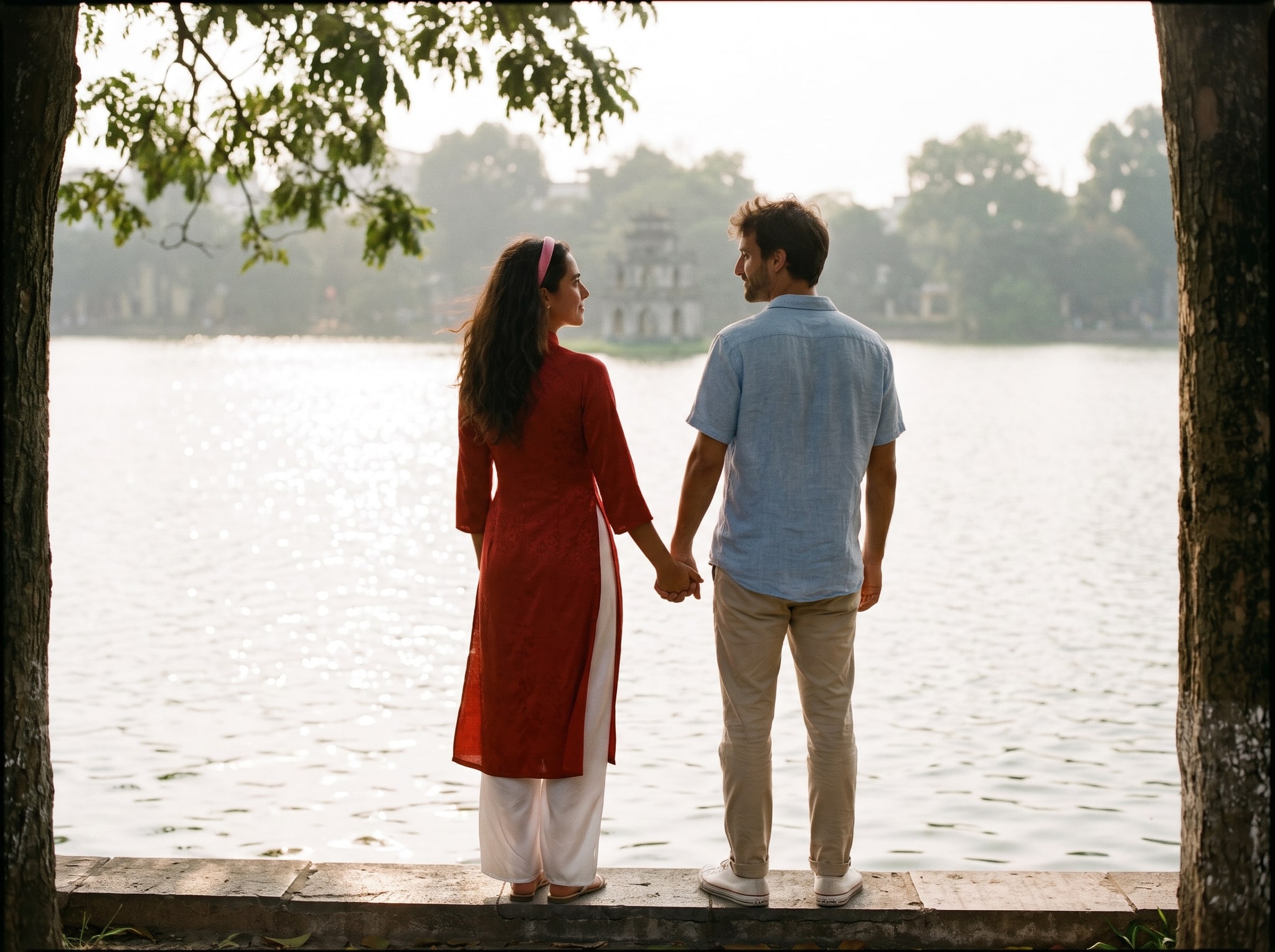
Ta Van is a working farm village. Terraces are muddy in rainy season, dusty in dry season, and always textured. We advise brides: avoid white dresses with long trains that drag; a knee-length or midi cut works better for walking terrace steps, and muddy hems photograph as authentic texture, not disaster. Grooms in dark suits absorb heat and can look stiff against the warm terrace; we suggest lighter colors (cream, pale blue, sage) or keeping the jacket off and rolling sleeves. Jewelry should be minimal—big rings and bangles catch sun glare in close-ups, especially during golden hour when light is already intense. We tell couples: "Ta Van is not a manicured venue. If you're uncomfortable with dust on your shoes or a loose strand of hair in afternoon wind, tell us—we'll adjust poses to frame you cleaner. If you love the raw feeling, we lean into that: real textures, real place, not a studio backdrop." That honesty shapes the tone of the shoot before we press the first shutter.
See packages and prices on vietnamphotoshoot.com
Comparing Ta Van with other northern Vietnam wedding shoot locations by light behavior
Ta Van's steep terraces create dramatic shadow play, but the venue itself limits flexibility—if light is wrong, you can't move far without losing the terrace landscape. Hoi An ancient town offers more options: narrow lanes, soft overhanging light, reflective walls; we can shoot at 14:00 there because shade is abundant. Ninh Binh's limestone karsts (Hang Mua, Tam Coc) offer water reflection, which bounces light onto faces naturally, reducing the need for a reflector—that's an advantage at midday. Hanoi's colonial villas and lake shores are urban and more forgiving of timing. We recommend Ta Van if the couple wants landscape-heavy storytelling and can commit to golden hour timing. If they're rigid on timing or prefer face-focused portraits, couple photoshoot at an urban location gives us more control. Many couples book a pre-wedding and elopement package that includes Ta Van for one half-day and a second location (often a city temple or villa) for another session, hedging their light-timing risk.
What to check before you book a Ta Van wedding shoot with us
Before you commit, ask us these questions:
- What is the exact date and start time you're proposing? We check weather forecast, moon phase (if you want stars), and other weddings booked that day so we're not rushed.
- Do you want terrace-focused or couple-focused shots? It changes how we position you in light.
- Are you okay with moving locations as light shifts? Some couples prefer to stay in one beautiful spot; Ta Van demands movement.
- What's your backup if rain clouds roll in? We have contingency plans, but they mean a shorter shoot or moving to temple/indoors.
- Can you commit to 06:00–08:00 or 17:00–19:00? Midday Ta Van is black-and-white or reschedule; we're honest about that upfront.
Ask us for a quote on WhatsApp with your date and these details; we'll send a custom proposal with the light window we recommend and the exact route we'll take.
We've also shot pre-wedding sessions at makeup and hair at your hotel before sending couples to Ta Van, so hair and makeup are fresh when golden hour hits. For couples who want a full northern Vietnam story, Cáo Studio Hanoi can combine Ta Van with a day in the capital or nearby valleys. And if Ta Van feels too rustic, our special concept shoot team can design a fantasy session in a studio with painted terrace backdrops—not authentic, but controlled light and timing. The choice depends on what story you want to tell. Ta Van, though, tells the truest one: real landscape, real light, real season. That's why we keep shooting there, hour after hour, season after season.
FAQ
What time should we shoot in Ta Van to avoid harsh shadows?
Start at 06:00–08:00 for soft morning light, or 17:00–19:00 for golden hour. Midday (11:00–15:00) creates deep shadows between terrace rows unless you want black-and-white silhouettes. We book the time that matches your light goal.
Does Ta Van light change between winter and summer?
Yes. Winter (November–January) has lower sun angle, so golden hour lasts 90 minutes instead of 45. Summer (May–September) has heavier cloud cover, which diffuses light. We scout one day before your shoot to time it exactly for the season.
Can we shoot Ta Van at midday if we're only in the village for a few hours?
We can, but we recommend black-and-white or moving to shaded temple courtyards nearby. Midday creates shadow stripes across faces and blown-out sky. If you're flexible by 45 minutes, we'll reschedule to late afternoon—better images, same location.
Do we need a reflector or flash in Ta Van?
Golden hour and morning light rarely need reflector. Blue hour (after sunset) needs one to lift faces. We carry reflectors; tell us your mood and we'll bring the right gear.
How long does a Ta Van shoot actually take when we're moving between locations?
2–2.5 hours for a golden-hour session (five locations, four light shifts). Early morning is 1.5–2 hours. We move as light moves; the walk between terraces is part of the story.
Is Ta Van safe to walk after sunset?
Yes, if we finish by 19:00 and move to village temple before 20:00. After 20:15, terrace steps are dark and unlit. We wrap blue-hour shoots by 20:00.
Pre-Wedding & Elopement
Inclusions, prices and booking are on our booking site.
FAQ
What time should we shoot in Ta Van to avoid harsh shadows?
Start at 06:00–08:00 for soft morning light, or 17:00–19:00 for golden hour. Midday (11:00–15:00) creates deep shadows between terrace rows unless you want black-and-white silhouettes. We book the time that matches your light goal.
Does Ta Van light change between winter and summer?
Yes. Winter (November–January) has lower sun angle, so golden hour lasts 90 minutes instead of 45. Summer (May–September) has heavier cloud cover, which diffuses light. We scout one day before your shoot to time it exactly for the season.
Can we shoot Ta Van at midday if we're only in the village for a few hours?
We can, but we recommend black-and-white or moving to shaded temple courtyards nearby. Midday creates shadow stripes across faces and blown-out sky. If you're flexible by 45 minutes, we'll reschedule to late afternoon—better images, same location.
Do we need a reflector or flash in Ta Van?
Golden hour and morning light rarely need reflector. Blue hour (after sunset) needs one to lift faces. We carry reflectors; tell us your mood and we'll bring the right gear.
How long does a Ta Van shoot actually take when we're moving between locations?
2–2.5 hours for a golden-hour session (five locations, four light shifts). Early morning is 1.5–2 hours. We move as light moves; the walk between terraces is part of the story.
Is Ta Van safe to walk after sunset?
Yes, if we finish by 19:00 and move to village temple before 20:00. After 20:15, terrace steps are dark and unlit. We wrap blue-hour shoots by 20:00.
More from the team
Pre-wedding photoshoot in Phu Quoc June: weather, light, crowds
June is Phu Quoc's monsoon season. Our studio has shot dozens of couples there in early summer—here's what weather and crowds really mean for your pre-wedding day.
Pre-wedding photoshoot in Phu Quoc July: weather, light, crowds
July is Phu Quoc's wet season, but it opens creative possibilities: moody skies, empty beaches after storms, and dramatic backlighting. We'll walk you through what happens on the ground.
Pre-wedding photoshoot in Phu Quoc November: weather, light, crowds
November is peak season for pre-wedding shoots in Phu Quoc: weather is stable, light is soft, but crowds peak mid-month. We share what our team sees on the ground.