 Cáo Studio
Home › Blog › Pre-Wedding & Elopement
Tam Giang Lagoon wedding photos: best time of day and light
By the Cáo Studio team · Hanoi & Saigon · 2026-11-04
Tam Giang Lagoon near Hue offers soft, diffused light most of the day because water reflects the sky evenly. Our team at Cáo Studio chooses golden hour (5–7 p.m.) for warm, romantic portraits and blue hour (after sunset, 6:30–7:30 p.m.) for moody couple shots with lagoon silhouettes. Midday (10 a.m.–2 p.m.) works only if you want harsh reflective water and need fast shutter speeds; we avoid it unless a couple explicitly asks for high-contrast editorial energy. Dawn (5:30–6:30 a.m.) gives mist over water and cool tones—best for ao dai sessions. Book a pre-wedding photoshoot package that runs 4–6 hours so we can capture two or three light phases. The lagoon's shallow banks mean we wade in for low angles; wear water-safe shoes and bring a second outfit. Water temperature in winter (Nov–Jan) sits around 18–20°C; in summer (Jun–Sep) 28–30°C. Ask us for a quote on WhatsApp and tell us your light preference so we can time the session correctly. Chat with us on WhatsApp
Why does the same location look completely different at 10 a.m. versus 5 p.m.?
Water is a mirror. At midday, when the sun is high and harsh, the lagoon bounces direct sunlight into your eyes and the camera sensor—faces look overexposed, skin loses texture, and the couple's expressions flatten under shadow. At 5 p.m., the sun sits low and diffuse; the water becomes a soft reflector instead of a glare source. Our portraits at that hour show eye catch-light, skin tone separation, and shadow definition without crushing blacks. The difference isn't subtle—it's the gap between an album you want to print and one you don't. We've reshoots with couples who booked 11 a.m. because they didn't know. Now we lead with light timing in every WhatsApp chat.
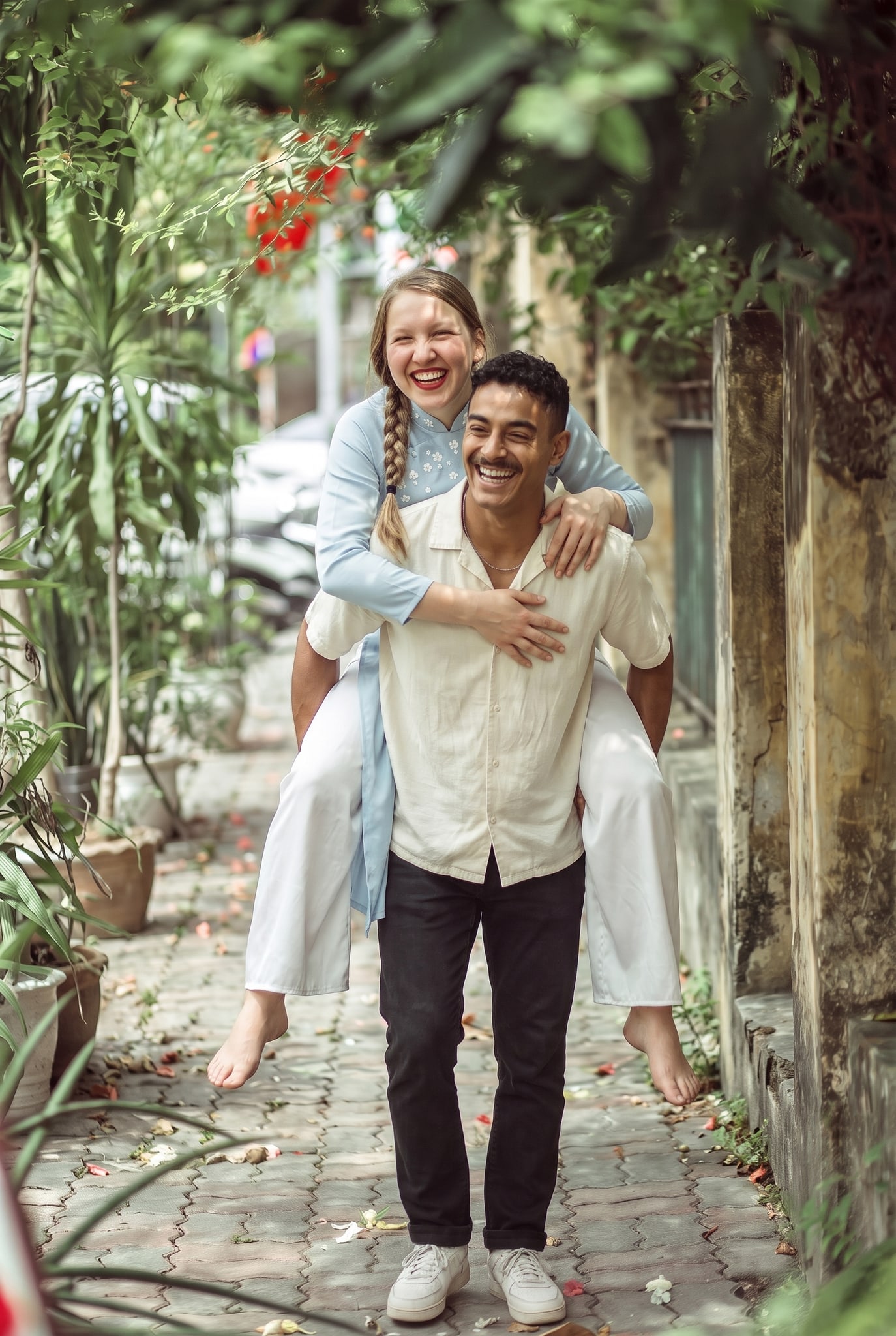
Should we shoot sunrise or golden hour—what does our team actually choose?
We choose based on energy, not just aesthetics. Golden hour (5–7 p.m.) suits couples who want warm, romantic, slightly soft-focus energy—relaxed poses, walking through water, intimate close-ups where the bride's ao dai glows amber. Sunrise (5:30–6:30 a.m.) suits editorial couples, moody pairs, or anyone who wants mist rolling off the water and cool jewel tones in post—it's also less crowded, which matters at Tam Giang because tourists arrive by 8 a.m. We've found sunrise attracts couples who love the Vogue aesthetic; golden hour attracts couples who prioritize romance. In summer (May–Sep), sunrise requires a 4 a.m. hotel pickup and means shooting in 18–22°C water—some brides refuse. In winter, sunrise is 6:45 a.m. but water temperature makes it less appealing for wading. Our stylists keep extra robes and hand warmers for cold-water shoots. Ask yourself: do you want light that feels like a hug or light that feels like a story?
What happens if you're stuck shooting midday at Tam Giang—can we still make it work?
Yes, but you need specific intentions. Midday at Tam Giang produces hard shadows and bright reflections—normally poison for portraiture. We lean into it for editorial energy: high-contrast black-and-white conversions, bold color saturation, geometric compositions using the lagoon's geometry. We position the couple with the sun to their side so it rims their profiles, we use polarizing filters to cut glare, and we shoot with fast shutter speeds (1/500 or faster) to lock exposure on skin. A midday shoot also suits couples who want movement—running through water, jumping shots, high-energy group photos—because the bright light lets us use smaller apertures and freeze motion crisply. But we do not recommend midday for soft couple portraits or ao dai close-ups. If your schedule forces midday, tell your photographer during the couple photoshoot package consultation so we plan shots that suit hard light, not fight it.
| Lagoon Light Phase | Best for | Skin tone result | Water mood | Crowd level | Temperature (Nov–Jan) |
|---|---|---|---|---|---|
| Sunrise (5:30–6:30 a.m.) | Editorial, moody, ao dai close-ups | Cool, jewel-toned | Mist, glassy | Empty | 18–20°C |
| Golden hour (5–7 p.m.) | Romance, walking, intimate | Warm, glowing | Reflective, soft | Light | 20–24°C |
| Blue hour (6:30–7:30 p.m.) | Silhouettes, night mood, drama | Dark, moody | Lagoon merges sky | Moderate | 19–21°C |
| Midday (10 a.m.–2 p.m.) | Editorial, movement, high contrast | Hot, blown-out (intentional) | Mirror glare | Heavy | 28–30°C (summer) |
| Late afternoon (3–4 p.m.) | Compromise shoot | Neutral to warm | Slightly softening | Heavy | Variable |
Blue hour creates a mood no other light can. After sunset (around 7 p.m. in winter, 8 p.m. in summer), the lagoon and sky turn the same deep blue-purple—the horizon disappears, and the couple becomes a silhouette or rim-lit shape against water that feels like infinity. It's moody, cinematic, and perfect for couples who want their album to feel like a film. The catch: you need excellent autofocus (we use Z9s and R5s), a tripod, and a clear sky—if it's overcast or rainy, blue hour collapses into flat gray. We've canceled blue hour shoots three times in two years because weather ruined it. In summer, blue hour lasts only 20–30 minutes before complete darkness; in winter, it stretches to 45 minutes. If you want blue hour, confirm your photographer's gear can handle ISO 3200 handheld and ask us to scout weather 48 hours before the shoot.
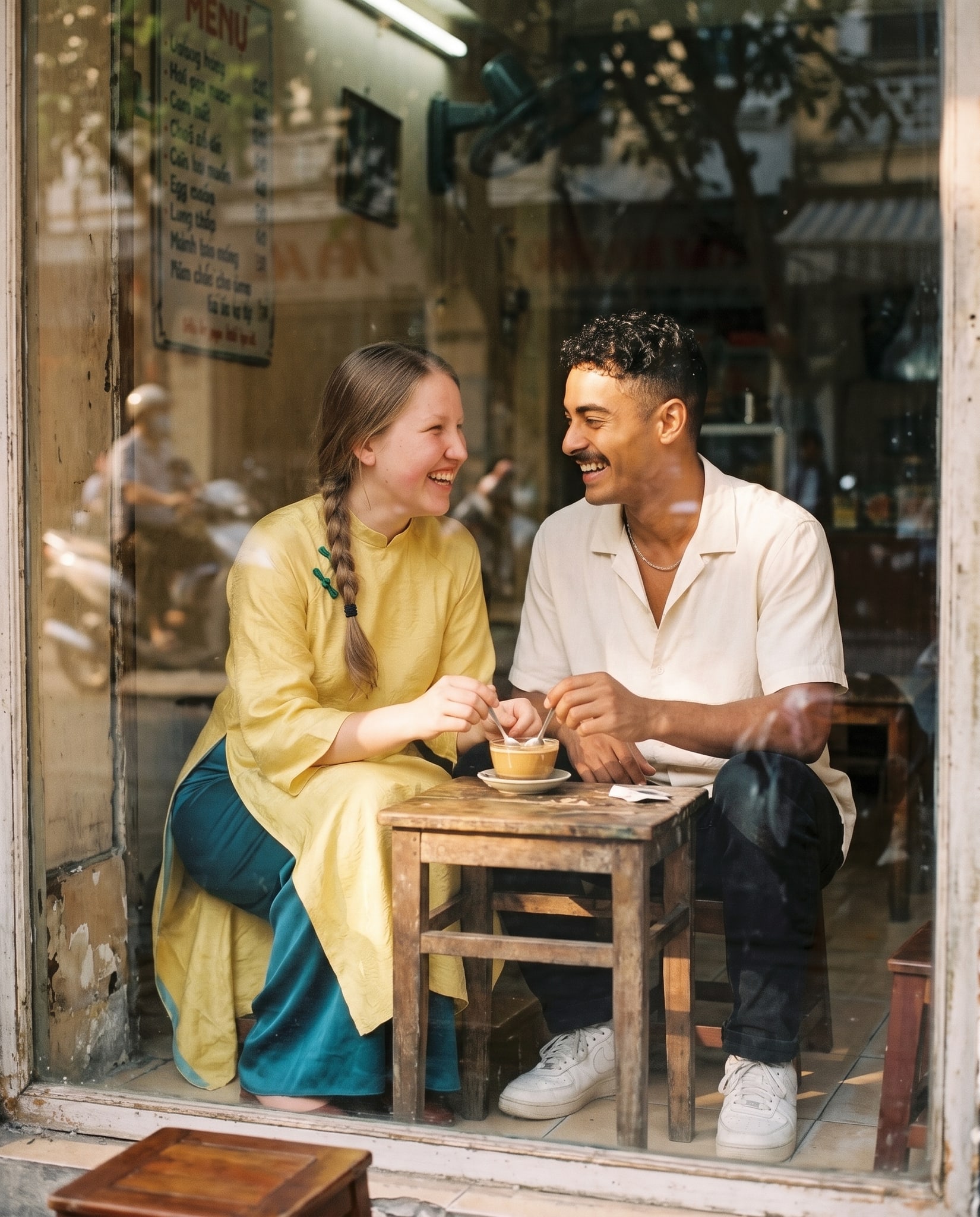
How do we handle water, clothing, and comfort when timing affects what you wear?
Water temperature and outfit choice are locked together. If you book sunrise, the water is cold (18–22°C in winter), so your ao dai is heavy, wet, and uncomfortable for more than 10 minutes—we recommend a quick wading shot plus dry-land portraits. If you book golden hour, the water is pleasant (22–26°C), so we extend wading time and get more intimate in-water poses. Blue hour means the water is cool but you're typically in the water for silhouette drama, not comfort—most couples wear a backup outfit (a second ao dai or a formal dress) and don't wade deep. Midday wading is feasible (water is 28–30°C in summer) but tiring on skin and makeup. Our styling advice: bring two outfits if you're shooting across multiple light phases. A lightweight ao dai for sunrise (it dries fast), a heavier ao dai or formal dress for golden hour (humidity locks water, so weight matters less), and a backup top layer for blue hour in case the breeze picks up. We always bring quick-dry microfiber robes and offer to call ahead to a nearby temple for a bathroom to change. Tell us your outfit count when you book so we don't waste light waiting for wardrobe swaps.
See packages and prices on vietnamphotoshoot.com
What to check before you book a Tam Giang session
- Confirm your light preference. Tell us golden hour, sunrise, or blue hour so we schedule the session and build in buffer time for weather delays or travel hiccups.
- Ask about water temperature and depth. We know the lagoon shifts seasonally; ask us the week of your shoot so you can prepare your body and outfit.
- Check our availability for your chosen hour. Popular sunset slots fill weeks ahead, especially Nov–Feb; off-peak times (midday, late afternoon) book faster because fewer couples want them.
- Verify our photographer's camera weather rating. Tam Giang shoots involve wading—we use sealed bodies (Z9, R5, 1DX Mark III). Ask us directly if your shoot involves deep water or rain risk.
- Plan two outfits minimum. Moving between light phases means wet fabric dries poorly in humid Hue air; we've seen couples regret single-outfit bookings. Bring a backup.
- Ask about post-processing for your light phase. Sunrise needs cool color grading; golden hour needs warm. Tell us your final album mood so we shoot accordingly.
We've learned these lessons shoot by shoot. A couple in Jan 2025 booked sunrise but arrived in a silk ao dai meant for 25°C water—we improvised with a second venue in warmer water nearby, but it ate 45 minutes. Another couple chose midday for speed, then hated the harsh shadows in 60% of their proofs. Now we educate upfront. Chat with us on WhatsApp about your light vision and we'll guide the decision.
Pages from our team you may need
FAQ
Does Tam Giang look good year-round, or are there bad seasons for light?
All seasons work for different reasons. Winter (Nov–Jan) has clear skies, cool light, and minimal haze—best for sharp, color-saturated photos. Summer (Jun–Sep) has humid haze that diffuses light further—best for soft, romantic tones. Monsoon (Sep–Oct) risks overcast days; we scout weather 48 hours ahead and offer date reschedules if light looks compromised.
How much longer should we book if we want to shoot both sunrise and golden hour?
Add 3–4 hours minimum. We need travel time between sunrise shoot (end 6:30 a.m.) and golden hour start (5 p.m.). Most couples book a full-day pre-wedding photoshoot package that lets us shoot Tam Giang in the morning, move to Hue Old Town or village backroads for midday, then return to Tam Giang for sunset.
Can we shoot Tam Giang in rain and still get good light photos?
Overcast rain softens light beautifully and kills reflection glare, so skin tones stay smooth. But we lose color vibrancy and sky drama—your blues become muddy grays. We recommend rain shoots only if you want soft, intimate, moody energy and you're okay with muted post-processing. Ask us about rescheduling if you want golden-hour pop.
Do we need a permit or local guide to shoot at Tam Giang Lagoon?
No permit required for portrait shoots. The lagoon is accessible public space, but asking a local boatman for water access is respectful and sometimes nets a better angle. We often arrange this during consultation—it adds 15 minutes to planning but improves site knowledge.
What camera settings do you use at Tam Giang to handle the bright water reflection?
We meter on skin, not water, and dial in 1–2 stops of negative exposure compensation so the lagoon doesn't blow out. In golden hour, we sit around f/2.8, 1/500 ISO 100–400. In blue hour, f/2.8, 1/250 ISO 3200–6400. A polarizing filter cuts glare and lets us open aperture further. We review histograms between shots because the water fools metering systems.
Pre-Wedding & Elopement
Inclusions, prices and booking are on our booking site.
FAQ
Does Tam Giang look good year-round, or are there bad seasons for light?
All seasons work for different reasons. Winter (Nov–Jan) has clear skies, cool light, and minimal haze—best for sharp, color-saturated photos. Summer (Jun–Sep) has humid haze that diffuses light further—best for soft, romantic tones. Monsoon (Sep–Oct) risks overcast days; we scout weather 48 hours ahead and offer date reschedules if light looks compromised.
How much longer should we book if we want to shoot both sunrise and golden hour?
Add 3–4 hours minimum. We need travel time between sunrise shoot (end 6:30 a.m.) and golden hour start (5 p.m.). Most couples book a full-day [pre-wedding photoshoot package](/go/pre-wedding-photoshoot) that lets us shoot Tam Giang in the morning, move to Hue Old Town or village backroads for midday, then return to Tam Giang for sunset.
Can we shoot Tam Giang in rain and still get good light photos?
Overcast rain softens light beautifully and kills reflection glare, so skin tones stay smooth. But we lose color vibrancy and sky drama—your blues become muddy grays. We recommend rain shoots only if you want soft, intimate, moody energy and you're okay with muted post-processing. Ask us about rescheduling if you want golden-hour pop.
Do we need a permit or local guide to shoot at Tam Giang Lagoon?
No permit required for portrait shoots. The lagoon is accessible public space, but asking a local boatman for water access is respectful and sometimes nets a better angle. We often arrange this during consultation—it adds 15 minutes to planning but improves site knowledge.
What camera settings do you use at Tam Giang to handle the bright water reflection?
We meter on skin, not water, and dial in 1–2 stops of negative exposure compensation so the lagoon doesn't blow out. In golden hour, we sit around f/2.8, 1/500 ISO 100–400. In blue hour, f/2.8, 1/250 ISO 3200–6400. A polarizing filter cuts glare and lets us open aperture further. We review histograms between shots because the water fools metering systems.
More from the team
Photography rules at Ta Phin village: permits, drones and what to check
Ta Phin village in Sapa draws photographers for its Hmong culture and layered mountain light. We've shot dozens of sessions there—here's what actually works and what stops shoots cold.
Pre-Wedding Photo Ideas and Poses at O Quy Ho Pass
O Quy Ho Pass sits on the Hanoi–Sapa border at 1,200 metres. Our couples shoot there for its curves, mist and isolation—but the weather and logistics demand a different approach than valley shoots.
Is O Quy Ho Pass Good for Pre-Wedding Photos? Pros, Cons, Alternatives
O Quy Ho pass in Sapa draws couples seeking high-altitude drama, but tight timelines, unpredictable fog, and logistics make it risky for pre-wedding shoots. We've scouted it; here's what actually works. #