 Cáo Studio
Home › Blog › Pre-Wedding & Elopement
Thap Doi Cham Towers wedding photos: best time of day and light
By the Cáo Studio team · Hanoi & Saigon · 2026-11-01
Thap Doi Cham towers in Ninh Binh glow strongest between 06:30–07:30 (sunrise) and 16:30–17:30 (golden hour). We typically book a 4-hour pre-wedding shoot to capture both: soft morning light on the stone, warm backlighting through the twin towers at dusk. The site sits at the intersection of Ninh Binh Province's limestone cliffs and river valleys, so mist rises and falls by season—October to December offers clear skies; June to August brings humidity that softens outlines. Cáo Studio pairs a photographer, stylist and makeup artist; we arrive 45 minutes before your chosen light window to scout angles and set your ao dai or dress. Rain, tour crowds (peak 08:00–11:00) and seasonal flooding near the base all happen—we reschedule at no cost or shift you to a concept backup plan. See our pre-wedding and elopement package options. Chat with us on WhatsApp | See packages and prices on vietnamphotoshoot.com
Which light window shows the towers best: sunrise or sunset?
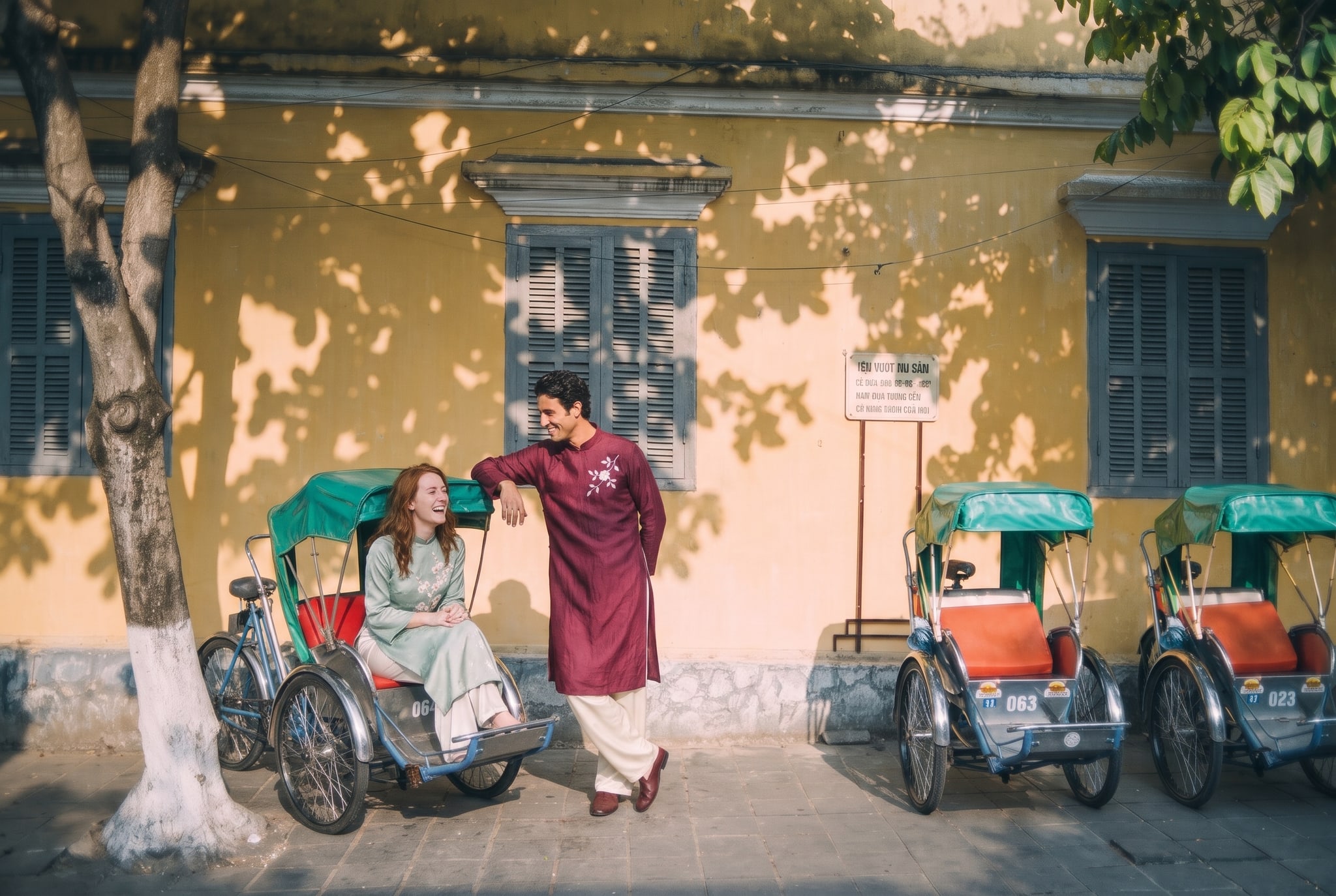
Sunrise (06:30–07:30) delivers cool, directional light that edges the limestone towers in silver and casts sharp shadows into the valleys below. We see clear definition—the stonework texture pops, mist clings to low ground, and the sky turns pale blue within 20 minutes. Sunset (16:30–17:30) washes the entire scene in amber and rose; the towers sit backlit, your silhouette reads against them, and ambient light is so soft we rarely use flash. Both work—neither is "better"—but they feel completely different in the final gallery. Sunrise suits couples who want architectural detail and crisp skies; sunset favors romantic, dreamlike moods. Our stylists dress clients differently for each: bright ao dai colours pop at sunrise, deeper jewel tones glow at sunset. Choose based on your final-photo feeling, not just Instagram trends.
How does season change what you'll see in your photos?
October through December brings northeast monsoon winds that clear the limestone haze; skies stay blue-grey, visibility reaches 50 metres across the cliffs, and the towers stand in cold, clear light. Couples see defined stonework and sharp shadows. January to March stays dry but clouds roll through Ninh Binh daily around 09:00–14:00; we work around them or embrace moody overcast tones. April to May heats up; haze thickens, light becomes diffuse and soft, perfect if you dislike harsh shadows but risky for landscape clarity. June to September: monsoon rains and humidity spike, mist rises thick at dawn, and the towers disappear into whiteness by 08:30. We've postponed shoots here and rescheduled for drier weeks at no penalty to the client—see our reschedule policy on vietnamphotoshoot.com.
| Season | Light character | Visibility | Best hour | Risk | Our call |
|---|---|---|---|---|---|
| Oct–Dec | Cool, sharp, defined | 40–60m | 06:30–07:30 sunrise | Low | Book with confidence |
| Jan–Mar | Clear morning, cloudy afternoon | 30–40m | 06:00–08:00 | Clouds 09:00–14:00 | Arrive early, plan backup |
| Apr–May | Soft, diffuse, hazy | 20–30m | 06:00–07:00 or 17:00–18:00 | Midday glare | Embrace romance, avoid noon |
| Jun–Sep | Mist-heavy, humid | 5–20m | Unpredictable | Flooding, rescheduling likely | Discuss alternate dates |
What happens on the ground during your shoot—and what goes wrong?
We arrive at Thap Doi Cham 45 minutes before light. Our photographer scouts angles while our stylist checks the stone path—wet moss, loose gravel, and three-metre drops on the cliff edge all exist. We map safe spots for your dress train or ao dai hem. The local temple sits adjacent; monks and tourists move through constantly 08:00–11:00 and 14:00–16:00. We've learned to time shoots outside those windows or shoot in angles that exclude crowds. Mid-morning, tour groups arrive in clusters—we pivot to a valley alcove or schedule an earlier slot next time. Rain doesn't stop us (we have backup dates at no fee), but flash flooding in the basin happens June–August—we monitor the forecast 48 hours ahead and reschedule if risk is high. What surprised us: the tower base is uneven stone; heels sink and slip. We tell clients to bring flat shoes, then change into heels for the final 30 minutes of golden-hour shots when the light is so forgiving the footwork matters less.
Chat with us on WhatsApp | See packages and prices on vietnamphotoshoot.com
How do we light your clothing and skin against the stone towers?
At sunrise, cool limestone already reflects north sky—we don't need to add light to the towers, but your face gets silhouetted. Our photographer exposes for the towers, then uses a silver reflector or a subtle fill flash to lift your cheekbones and eyes. Skin tones stay warm because the rising sun is angled low; lips and eyes read naturally. At sunset, the towers glow so bright your face falls into shadow. We position you slightly backlit so the amber light rims your hair and shoulders, then use a large white reflector (held by our assistant) to bounce ambient golden light onto your face—no flash, pure reflection. This technique is time-sensitive: it works for maybe 20 minutes before the sun dips below the ridge and backlighting vanishes. We schedule a second golden-hour window specifically for this. Overcast days flatten contrast—we use fill flash and lean on ao dai colour and your pose to carry the shot. Each light scenario means different decisions on the spot; this is why we scout and stay flexible.
What should you wear to photograph well against limestone and sky?
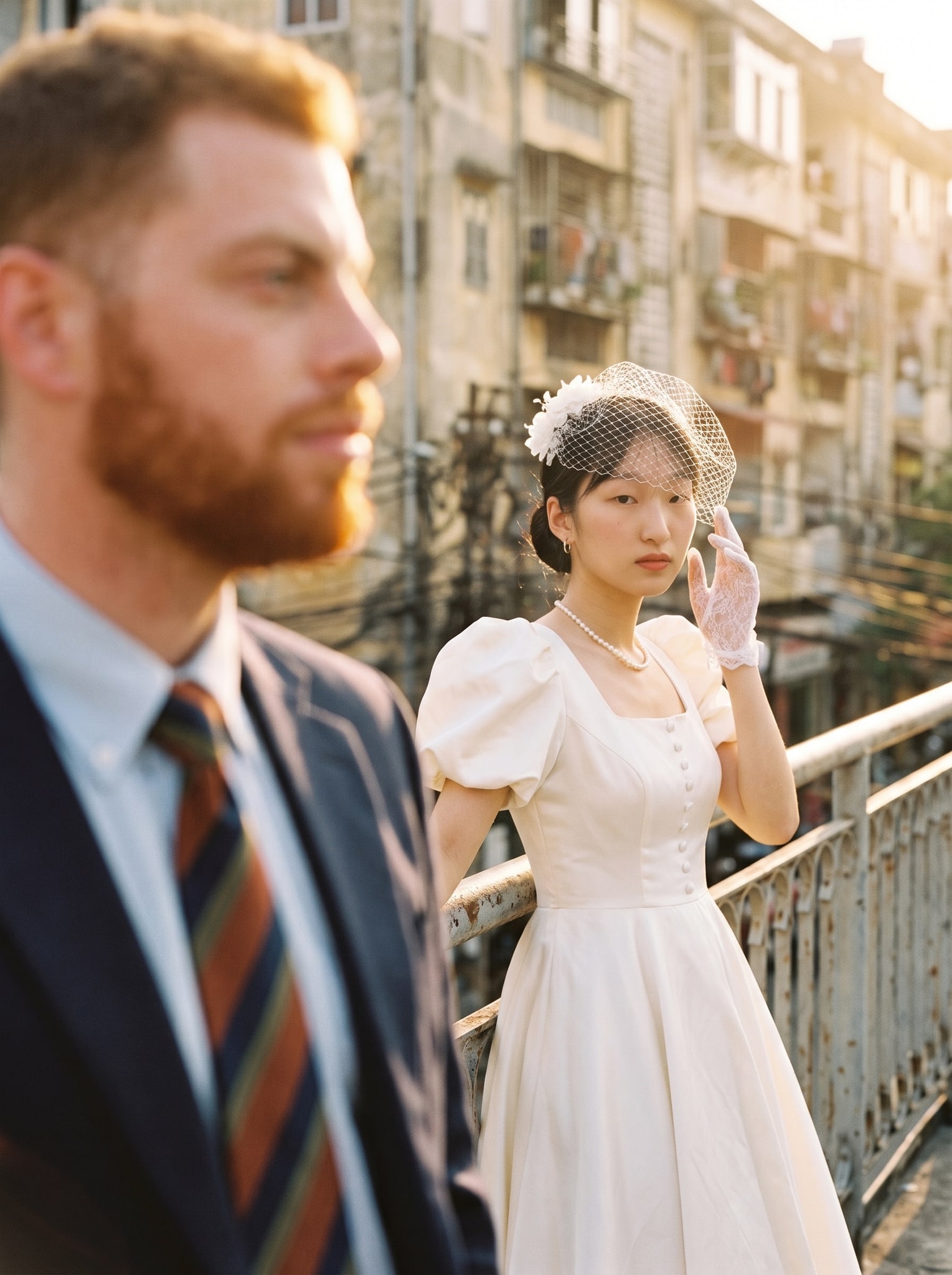
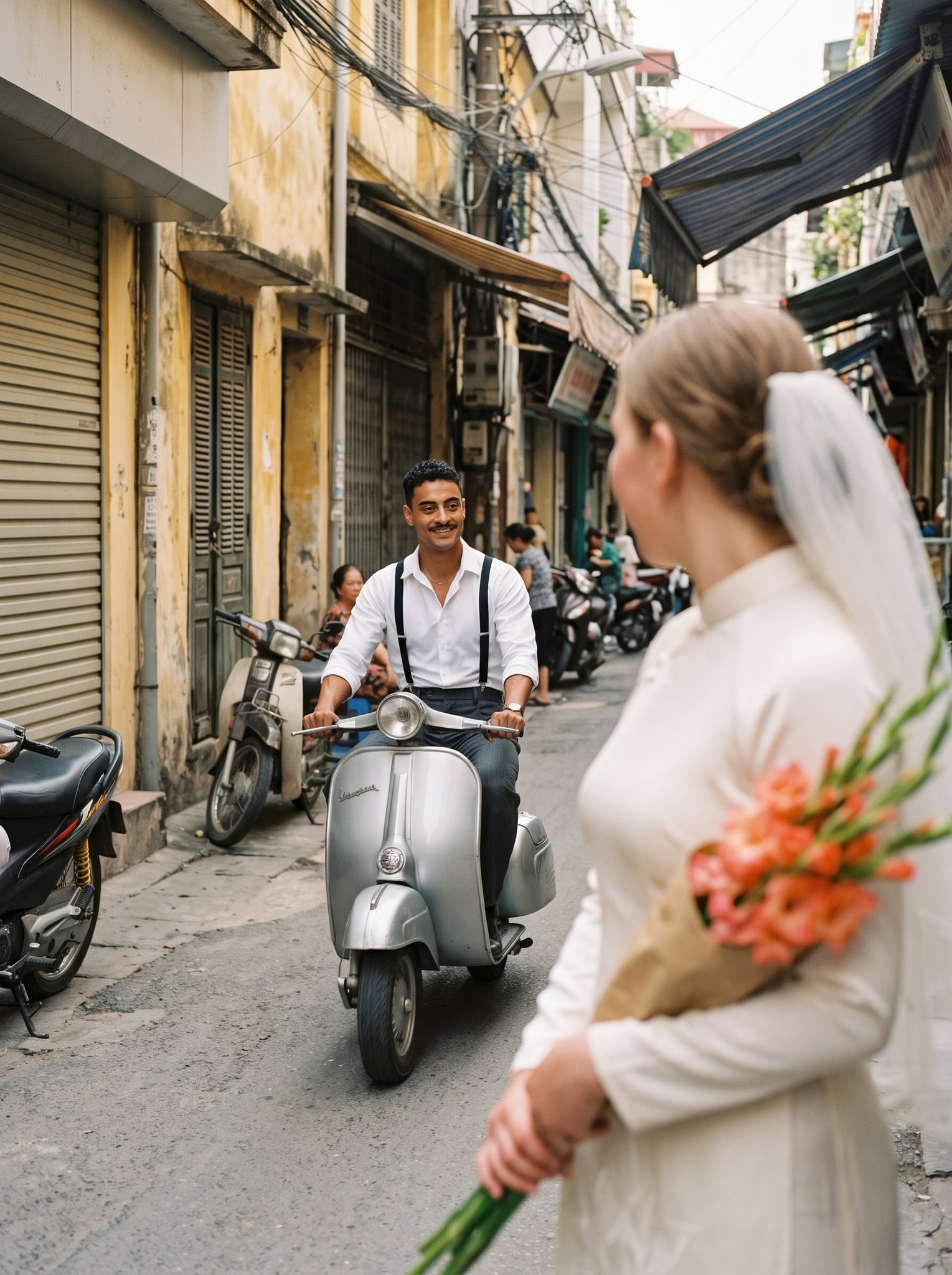
Bright, solid ao dai colours (ruby red, emerald, sapphire, butter yellow) photograph crisp against cool limestone and blue sky. Pastels (blush, lavender, cream) work best at sunset when golden light flatters them. White ao dai read clean and modern but can blow out in bright sun—we expose for skin, not fabric, and accept a slight fade. Patterned ao dai: geometric designs hold up; intricate embroidery reads as texture from a distance. Dark jewel tones (navy, maroon, deep teal) suit overcast days and sunset; avoid them at sunrise when they merge with shadow. Our stylists meet clients at Hanoi or Saigon studios for a pre-shoot trial; we review your wardrobe, test light with a phone photo, and confirm fit and colour. Accessories: long silk veils and scarves move beautifully in the Ninh Binh valley wind—we see them ripple and catch light. Metal jewellery (rings, earrings, bracelets) can reflect flash unintentionally in some angles; we note this and adjust. Groom/partner clothing: neutral tones (grey, charcoal, cream, soft blue) frame the bride without competing. See our ao dai photoshoot package and makeup and hair at your hotel for styling details.
When should you book, and what to confirm before you commit?
Reserve your Thap Doi Cham shoot 2–4 weeks ahead to secure your preferred light window and avoid overbooking. We ask: preferred date, season preference, sunrise or sunset (or both), weather backup plan (reschedule or alternate concept), and whether you want hair and makeup on-site or at your hotel beforehand. Confirm the number of outfit changes (we typically budget 30–40 minutes per outfit); more changes reduce time per shot and require longer booking. Check our proposal and anniversary package or couple photoshoot package for duration and inclusions—some sessions run 2 hours, others 6 hours with multiple locations. Understand that Thap Doi Cham is a heritage site; no commercial music, no drones, no fireworks. Weather forecasts here shift fast: we monitor 48 hours before and message you on WhatsApp if a reschedule is wise. Ask us in advance if you're nervous about physical fitness (the walk to the towers is uphill, 200 metres, moderately steep). A few couples have swapped Thap Doi Cham for easier terrain; we guide you to Cáo Studio Hanoi or Cáo Studio Saigon to explore other Ninh Binh spots or regional alternatives without penalty.
What to check before you order
- Light window preference: Sunrise (cool, defined) or sunset (warm, romantic)? Or both in a longer session?
- Season fit: October–December for clarity; June–September requires flexibility and rescheduling willingness.
- Outfit count: One ao dai, or two looks? Each adds 30–45 minutes to the timeline.
- Travel logistics: Does your hotel offer early morning pickup, or do you arrange transport to Ninh Binh?
- Hair and makeup timing: Pre-shoot at your hotel, or on-site with our team 45 minutes before light?
- Backup plan: Reschedule to another date, or pivot to a covered concept shoot (valley walk, temple detail, river boat) on the same day?
- Final gallery scope: Are stills only, or do you want a short cinematic edit?
Chat with us on WhatsApp | See packages and prices on vietnamphotoshoot.com
See more from our team
Explore our special concept shoot options, or browse our pre-wedding and elopement package for other curated locations across Hanoi, Saigon, Hoi An, and Ninh Binh.
FAQ
What time should we arrive at Thap Doi Cham before our 06:30 sunrise shoot?
We ask you to be at the base by 06:00. Our team meets you there; we scout angles, apply final makeup touch-ups, and walk to the towers so you're ready to shoot the moment light hits the stone. Sunrise moves fast.
Will tour crowds ruin our photos?
Peak tours run 08:00–11:00 and 14:00–16:00. We book either before 07:30 or after 17:00 to avoid crowds. If you book midday, we use valley alcoves and framing angles that exclude tourists. Reschedule options exist if crowds conflict.
Can we do both sunrise and sunset in one day?
Yes. A full-day session (typically 8–10 hours) covers sunrise at Thap Doi Cham, a break and outfit change, then sunset nearby or at a second location. This costs more; confirm duration and includes on our booking site.
What if it rains the night before our sunrise shoot?
We assess the site 12 hours ahead via phone. Light rain drains fast on stone; we proceed. Heavy overnight rain that floods the basin triggers a free reschedule to a drier date. We communicate via WhatsApp by 18:00 the day before.
Do we need hiking boots or special shoes?
Bring comfortable flat walking shoes for the 200-metre uphill walk on uneven stone. Change into heels or formal shoes for the final 20–30 minutes of light when safety risk is lowest. We time outfit and footwear changes to match peak light.
How many photos do we get from a Thap Doi Cham shoot?
A 4-hour pre-wedding session yields 250–400 edited photos (depends on outfit changes and movement). We deliver a private online gallery 1–2 weeks after the shoot. Ask for image count in your booking confirmation.
Pre-Wedding & Elopement
Inclusions, prices and booking are on our booking site.
FAQ
What time should we arrive at Thap Doi Cham before our 06:30 sunrise shoot?
We ask you to be at the base by 06:00. Our team meets you there; we scout angles, apply final makeup touch-ups, and walk to the towers so you're ready to shoot the moment light hits the stone. Sunrise moves fast.
Will tour crowds ruin our photos?
Peak tours run 08:00–11:00 and 14:00–16:00. We book either before 07:30 or after 17:00 to avoid crowds. If you book midday, we use valley alcoves and framing angles that exclude tourists. Reschedule options exist if crowds conflict.
Can we do both sunrise and sunset in one day?
Yes. A full-day session (typically 8–10 hours) covers sunrise at Thap Doi Cham, a break and outfit change, then sunset nearby or at a second location. This costs more; confirm duration and includes on our booking site.
What if it rains the night before our sunrise shoot?
We assess the site 12 hours ahead via phone. Light rain drains fast on stone; we proceed. Heavy overnight rain that floods the basin triggers a free reschedule to a drier date. We communicate via WhatsApp by 18:00 the day before.
Do we need hiking boots or special shoes?
Bring comfortable flat walking shoes for the 200-metre uphill walk on uneven stone. Change into heels or formal shoes for the final 20–30 minutes of light when safety risk is lowest. We time outfit and footwear changes to match peak light.
How many photos do we get from a Thap Doi Cham shoot?
A 4-hour pre-wedding session yields 250–400 edited photos (depends on outfit changes and movement). We deliver a private online gallery 1–2 weeks after the shoot. Ask for image count in your booking confirmation.
More from the team
Boho pre-wedding photoshoot in Vietnam: Hanoi, Saigon, Hoi An
Boho pre-wedding shoots mix romantic, free-spirited aesthetics with Vietnam's landscapes and heritage sites. We run full-day sessions in three cities, handling styling, makeup, location scouts and edits.
Avoid crowds at Hoang Su Phi rice terraces: timing for wedding shoots
Hoang Su Phi's terraced landscape draws couples and tour buses in equal measure. We show how to shoot there alone, when to arrive, and what to arrange with us before you go.
Photography rules at Con Dao beaches: permits, drones and what to check
Con Dao's beaches demand prep before you shoot—permits, drone zones and tide timing all affect your day. We share what the Cáo Studio team verifies on every booking.