 Cáo Studio
Home › Blog › Pre-Wedding & Elopement
Tra Que village for pre-wedding photos: worth it or skip it
By the Cáo Studio team · Hanoi & Saigon · 2026-11-01
Tra Que is a working agricultural village 20 km from Hoi An's town center where families grow vegetables on narrow plots. Morning sessions (6:00–8:30 AM) capture soft light across the fields; afternoons are too harsh and crowded with tourists. A typical Cáo Studio couple shoot there runs 2–3 hours and works best as one half of a pre-wedding photoshoot that also includes town, river, or rice paddy sites. The village is free to enter; the real cost is hiring a guide (recommended, paid separately) and transport. Pros: authentic greens, few other couples early morning. Cons: muddy after rain, paths too narrow for long dresses without staining, no shelter, and villagers' work routines mean scheduled timing is essential. Skip it if your áo dài or dress trains are long, or if you want pure romance—the reality is agricultural labor, not a theme park.
Tra Que hits Instagram hard: neat rows of water spinach, stilted herb drying racks, fishermen in conical hats. On paper it feels like a found paradise for couples. We've shot there 40+ times since 2019, and the truth is more mixed. Some sessions felt effortless; others cost us two hours of retakes because the light shifted sideways across the plots, or a sudden group of schoolchildren derailed the mood. Here's what we tell clients on WhatsApp before booking.
Why does Tra Que look so different in real photos versus Instagram?
The village is real, the light is real, but the context is not a backdrop—it's someone's workplace. Instagram stories show curated moments: a bride in the center of an empty green field, hands on a vegetable, golden hour hitting her face. When we arrive at 6:15 AM with a couple in a full white gown and rented áo dài, the reality is mud under the hem, a farmer starting to water the plots 50 meters away, and the sun hitting at a 40-degree angle that flattens the bride's face unless she turns north. The village photos that work best are the ones where we accept the labor context—bride and groom helping to harvest, laughing mid-task, or posed around the actual work, not replacing it. If you're picturing yourself alone in a field like a fairy tale, you're imagining a different place.
What time of day actually works for shooting at Tra Que?
Book 6:00–7:30 AM or you'll share the space with tourists and lose the quiet. By 8:00 AM, tour groups arrive in minibuses, and the light starts turning harsh. We've learned to brief couples beforehand: dress in the car, do hair and makeup at the hotel (hire our makeup and hair service if you're staying nearby), and be on the paths by 6:15. Rain is common in the monsoon; check the forecast and reschedule if it rained the night before—mud sticks to satin and cotton, and we spend an hour cleaning rather than shooting. Peak dry seasons are September through February. Late afternoon (5:00–6:30 PM) works as a second-choice slot if the sunrise is impossible, but the light is lateral and unforgiving. In both windows, have your guide (hire locally or ask us for a recommendation) brief you on which plots the family wants kept clear.
Does dress length and fabric matter at Tra Que?
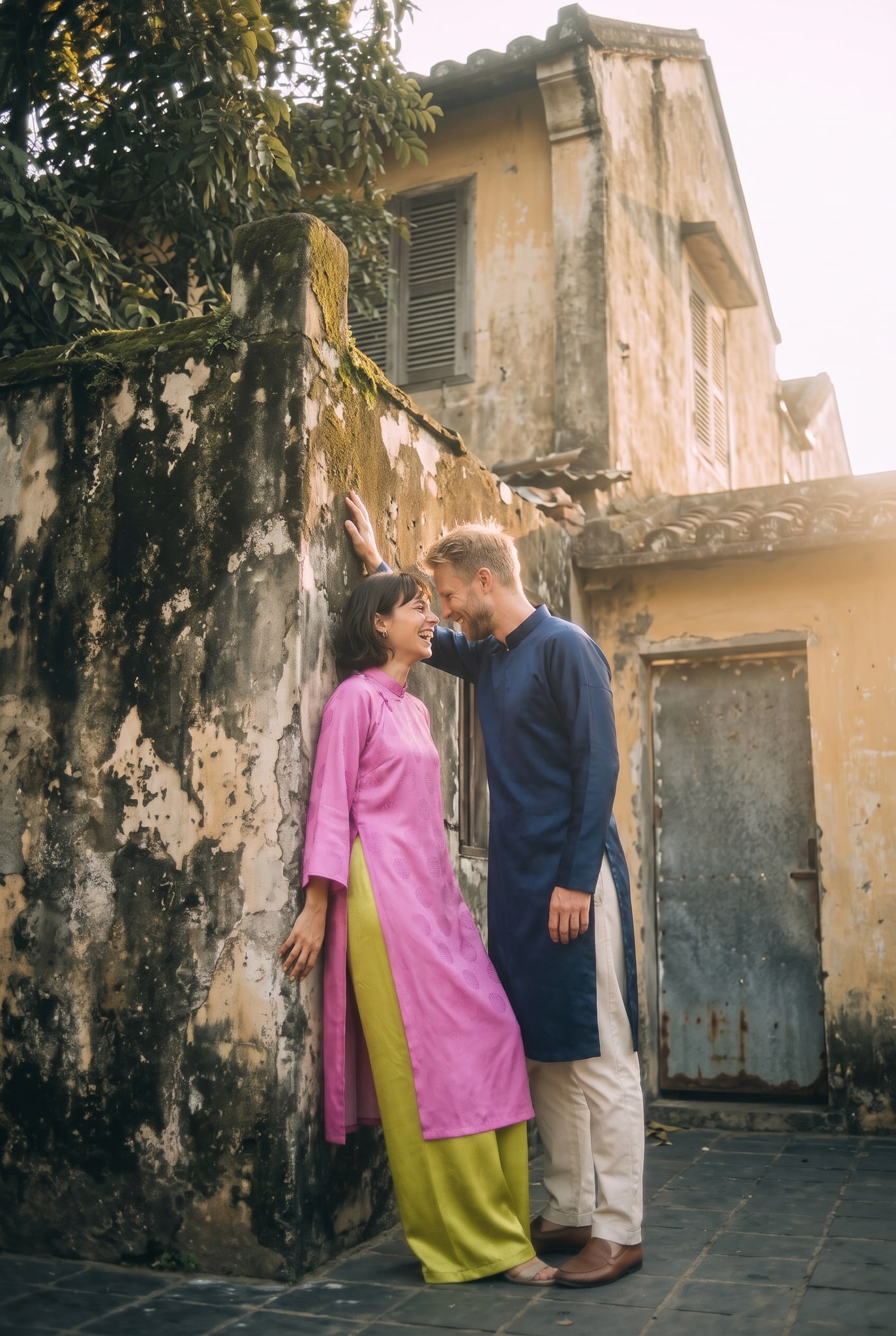
Yes, absolutely. Full white wedding dresses with long trains are impractical—the hem collects green water, mud, and bits of plants, and cleaning damage looks visible in photos. Short rehearsal dresses, jumpsuit styles, or knee-length áo dài work far better. If your heart is set on a long dress, plan for 45 minutes of cleanup time between locations and consider a special concept shoot where we stage the dress on a mat or boat instead. Áo dài in lightweight silk are safer than cotton because they're easier to rinse; avoid dark colors if you're worried about stains showing. Many couples change into a practical outfit (jeans, soft dress, matching shirt) partway through the session—this honestly produces the best photos because they're relaxed and the clothes move naturally. We keep a kit of microfiber towels and a portable water bottle to wipe mud before it dries.
| Outfit type | Works best? | Why | Recommended time |
|---|---|---|---|
| White wedding dress, long train | No | Stains visible, train catches mud, hard to move | Skip this location |
| Áo dài + áo ngũ quân (matching groom wear) | Yes | Silk versions dry fast, cultural fit, movement looks natural | 6:00–7:30 AM |
| Casual jeans + linen shirt | Yes | Practical, photo-real, easy cleanup, versatile poses | Any time window |
| Short reception dress, knee-length | Yes | Clean lines, no mud risk, pairs well with crops/trees | Late morning if clouds |
| Rehearsal dress, below-knee | Yes | Elegant without train burden, easier walk on paths | 6:00–8:00 AM |
What parts of Tra Que photograph worst, and where should we really focus?
The outer plots are crowded and featureless. The magic is in three specific zones: (1) the narrow paths between raised beds where afternoon light creates leading lines, (2) the dock area where fishermen pole boats through water channels, and (3) the small family shelter with herb racks and lanterns. We usually spend 40 minutes in zone 1 (poses, movement, mood), 30 minutes in zone 2 (couple interaction, dynamic shots), and 20 minutes in zone 3 (intimate, close framing). Avoid the entrance and the main road; the gift shop and signage wreck the frame. The herb-drying racks are picturesque but cramped—good for close portraits, risky for full-body shots because your feet can slip on wet boards. A professional guide knows which farmer families allow photos in their patch and which prefer you to stay on public paths; this saves 30 minutes of awkward positioning and reshooting.
When should we choose Tra Que over Hoi An's other pre-wedding spots?
Tra Que works if you want a single anchor location that reads "rural Vietnam" quickly and if you're willing to accept agricultural realism in exchange for authentic color and texture. If you want pure elegance, the Japanese Covered Bridge, silk shop interiors, or the riverside near An Hoi are less demanding and photograph more easily. If you want mountain scenery, Ninh Binh's caves and rice fields (where we do vacation and solo shoots) offer more dramatic geometry. If you have limited time—a half-day session—skip Tra Que and combine the Old Town with one garden. Tra Que shines when you have a full day and can pair it with another location (bridge, river, or a couple photoshoot that includes concept or candid work). It also suits adventurous couples who want the story, not the fantasy. First-time visitors to Hoi An often find it overrated; return visitors and couples doing extended shoots value it for its difference from town.
What to check before you book Tra Que into your shoot
- Monsoon and rain: Check the forecast 48 hours before. If heavy rain fell overnight, ask us to reschedule the location (we'll swap for town or a covered concept).
- Dress type and length: Share photos of your outfit so our stylist can advise on risk and cleanup time.
- Physical ability: Paths are uneven, muddy, and sloped. If mobility is a concern, we'll adapt the session or swap locations entirely.
- Sunrise time: Tell us your exact preferred date; sunrise in December is 6:30 AM, in June it's 5:15 AM. We schedule pickups around this.
- Guide and transport: Confirm whether you want us to arrange the local guide and transport, or if you're hiring separately. We recommend our recommendation to avoid scheduling confusion.
- Number of outfit changes: Each change adds 15–20 minutes. Plan a maximum of 2–3 if Tra Que is one of two locations.
Our team's honest take: Tra Que is stunning in the right conditions with the right mindset. If you're picturing a pristine garden shoot, recalibrate. If you're excited about the real story—hands in the soil, laughing at mud, standing in an actual village where people wake up to work—you'll have unforgettable photos. Many couples we've worked with say the "imperfection" is what makes the session feel true. Pair it with a location that's easier on logistics (like the riverside or bridge) for a balanced day, or commit to a full pre-wedding photoshoot that uses Tra Que as one of three scenes. We also run special concept shoots in alternative settings if you want the rural feel without the labor-site complexity.
See packages and prices on vietnamphotoshoot.com
If Hoi An timing is tight, consider our Saigon or Hanoi studios—we can build a pre-wedding plan that uses local landmarks you love, without the Tra Que gamble. WhatsApp us your dates and outfit plan; we'll recommend the best location mix for you.
FAQ
Can we shoot at Tra Que in the rain?
Not really. Wet paths become slippery, mud is heavier, and the light is flat and gray. We reschedule or substitute another location if rain is forecast.
Do we need a permit or permission to photograph at Tra Que?
No permit, but a local guide is essential—they know which families allow photos on their plots and arrange informal access smoothly. We can recommend a guide or you can hire one locally.
How long can we spend at Tra Que before it feels repetitive?
90 minutes is our typical window; beyond that, you're retaking similar shots. It pairs best with a second location to break up the day.
What if my dress train drags in the mud during the shoot?
We bring towels to wipe between poses, but staining is likely. Consider changing into a second outfit halfway through, or skip Tra Que if your dress is your priority.
Is Tra Que better for couples who want candid or posed photos?
Both work, but candid feels more natural there because the setting invites interaction (harvesting, walking, exploring). Posed shots work best in the herb-rack zone with close framing.
Can we do a [couple photoshoot](go/couple-photoshoot) at Tra Que alone, or should it be part of a bigger session?
A solo Tra Que session (2–3 hours) works, but many couples feel it's better paired with town or river locations for variety. Ask us about full-day multi-location options.
Pre-Wedding & Elopement
Inclusions, prices and booking are on our booking site.
FAQ
Can we shoot at Tra Que in the rain?
Not really. Wet paths become slippery, mud is heavier, and the light is flat and gray. We reschedule or substitute another location if rain is forecast.
Do we need a permit or permission to photograph at Tra Que?
No permit, but a local guide is essential—they know which families allow photos on their plots and arrange informal access smoothly. We can recommend a guide or you can hire one locally.
How long can we spend at Tra Que before it feels repetitive?
90 minutes is our typical window; beyond that, you're retaking similar shots. It pairs best with a second location to break up the day.
What if my dress train drags in the mud during the shoot?
We bring towels to wipe between poses, but staining is likely. Consider changing into a second outfit halfway through, or skip Tra Que if your dress is your priority.
Is Tra Que better for couples who want candid or posed photos?
Both work, but candid feels more natural there because the setting invites interaction (harvesting, walking, exploring). Posed shots work best in the herb-rack zone with close framing.
Can we do a [couple photoshoot](go/couple-photoshoot) at Tra Que alone, or should it be part of a bigger session?
A solo Tra Que session (2–3 hours) works, but many couples feel it's better paired with town or river locations for variety. Ask us about full-day multi-location options.
More from the team
Boho pre-wedding photoshoot in Vietnam: Hanoi, Saigon, Hoi An
Boho pre-wedding shoots mix romantic, free-spirited aesthetics with Vietnam's landscapes and heritage sites. We run full-day sessions in three cities, handling styling, makeup, location scouts and edits.
Avoid crowds at Hoang Su Phi rice terraces: timing for wedding shoots
Hoang Su Phi's terraced landscape draws couples and tour buses in equal measure. We show how to shoot there alone, when to arrive, and what to arrange with us before you go.
Photography rules at Con Dao beaches: permits, drones and what to check
Con Dao's beaches demand prep before you shoot—permits, drone zones and tide timing all affect your day. We share what the Cáo Studio team verifies on every booking.