 Cáo Studio
Home › Blog › Pre-Wedding & Elopement
Truong Tien Bridge Wedding Photos: Best Light and Timing
By the Cáo Studio team · Hanoi & Saigon · 2026-11-02
Truong Tien Bridge wedding photos work best during golden hour (roughly 5:30–6:30 p.m. in winter, 6:00–7:00 p.m. in summer) when the Red River reflects warm, directional light across the bridge's red pillars. Blue hour—the 20 minutes after sunset—creates moody, romantic tones if you want a different mood. Our Cáo Studio team has shot there hundreds of times; we book slots avoiding tour crowds (mornings before 8 a.m. or after 6:30 p.m. work best), bring reflectors to fill shadow on faces, and always scout 30 minutes early to confirm street light timing. Midday and early afternoon produce harsh overhead shadows that flatten features—avoid these. A pre-wedding photoshoot at Truong Tien typically runs 2–3 hours to capture multiple outfit changes and light shifts. Cost and package details are available on our booking site. Chat with us on WhatsApp
Why does Truong Tien Bridge light change so much hour by hour?
The bridge's east–west orientation and the Red River's reflective surface mean the sun's angle controls everything: north-facing pillars catch light only mid-morning, south faces glow at sunset. Water acts as a natural reflector, doubling light intensity but also creating glare if you're not positioned right. We position couples either on the bridge's pedestrian section facing upstream (evening light hits them from the left at 45 degrees) or on the riverbank below the pylons, where reflected water light fills shadow on their faces without harsh contrast. Between 3–5 p.m., the bridge casts a long shadow across the riverbank—useless for portraiture. Plan your session to hit the river's actual illumination window, not the bridge's time slot.
What time of year changes the golden hour window most?
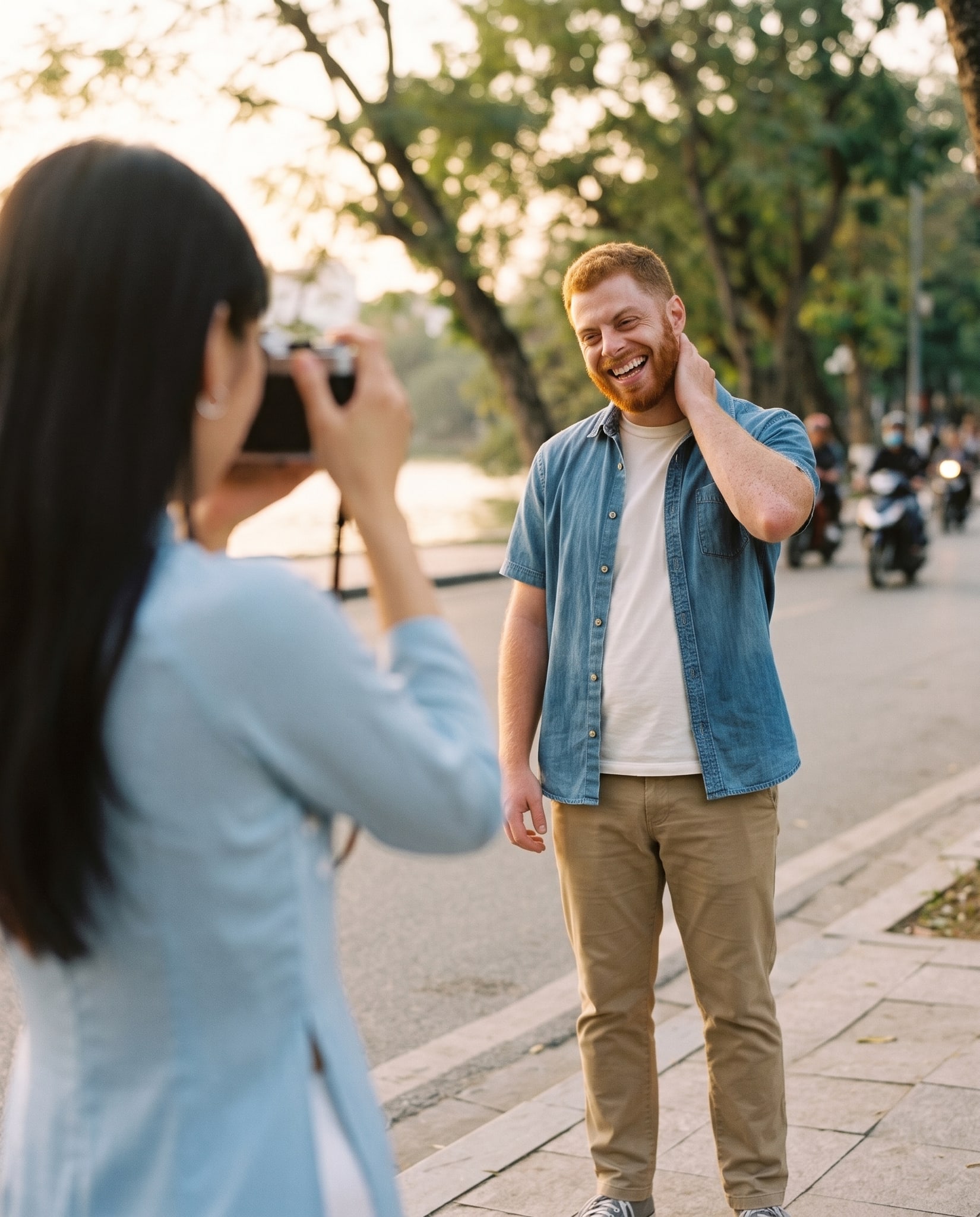
Winter (November–February) golden hour arrives at 5:00–5:30 p.m.; summer (May–August) it starts closer to 6:00 p.m. The difference matters for booking. In January, we schedule a 5:15 p.m. start to catch 45 minutes of usable light before blue hour at 6:00 p.m.; in July, the same client gets a 6:00 p.m. start and 75 minutes of golden light. Humidity also shifts color: winter light is crisp and warm, summer light often has a diffused yellow cast from air moisture over the river. Our stylists choose cooler-toned ao dai in summer (pale blue, white, lilac) and warmer tones (blush, gold, terracotta) in winter to balance the ambient temperature of the light. This seasonal adjustment is baked into how we plan each couple photoshoot timeline on WhatsApp before the shoot day.
How do you handle crowds and tour groups on the bridge?
Tourists peak 9 a.m.–12 p.m. and 3–5 p.m. We never shoot those windows. Early morning (6:30–7:30 a.m.) gives us empty bridge and soft, cool light—not romantic gold, but clean and moody. Evening (6:30–8:00 p.m.) is our main window: light is golden, foot traffic drops to local joggers and a few hotel guests, and we can occupy a 50-meter section for 2 hours without blocking anyone. On rainy days or when crowds won't clear, we pivot to the riverbank below the north pylon, where trees create natural framing and we're invisible to tourists. We tell couples via WhatsApp the day before: "Bridge will be busy Friday; we'll shoot the bank side instead—better water reflections anyway." Flexibility saves the shoot.
What camera settings does our team actually use at Truong Tien?
Golden hour at Truong Tien rarely requires high ISO because reflection amplifies available light. We shoot aperture f/2.8–4.0 (shallow depth of field to isolate couples from background clutter), shutter speed 1/250–1/500 (to freeze motion on a breezy riverbank), and ISO 400–800 even in evening light because the reflector board plus water bounce reduce shadows. Blue hour (after sunset) pushes ISO to 1600–3200 and we drop to f/2.0 to gather every photon, accepting a thinner depth of field for the ethereal, dreamy look clients expect. We never use on-camera flash—it flattens the natural light and draws unwanted attention from security. Backlighting (sun/light behind the couple, light toward the camera) is our default for Truong Tien: it separates them from the bridge and the sky, and rim-lights their hair. Reflectors in front fill their faces just enough to see eyes and skin texture.
How do seasonal weather patterns affect Truong Tien shoot quality?
| Season | Light Quality | Timing | Air Humidity | What We Adjust |
|---|---|---|---|---|
| Nov–Feb | Crisp, warm gold | 5:00–5:45 p.m. | Low (5–10%) | Warm ao dai tones; skin looks clear |
| Mar–Apr | Soft, neutral | 5:45–6:30 p.m. | Rising (15–25%) | Lighter fabrics; focus on reflection shots |
| May–Aug | Diffused yellow, hazy | 6:00–7:15 p.m. | High (60–75%) | Cool-tone outfits; more cloud cover = softer light |
| Sep–Oct | Mixed (rain possible) | 5:30–6:15 p.m. | High (50–70%) | Backup indoor location; waterproof gear; edit for haze |
Winter shoots reward couples with maximum contrast and vibrant color saturation. Summer trades saturation for softness—light scatters through humidity, reducing harsh shadows but flattening detail. Monsoon season (May–September) brings rain risk; we always have an alternate indoor location (nearby hotel corridors, Hoan Kiem Lake Museum, French colonial streets) booked as a backup. We confirm forecast at 2 p.m. the shoot day and notify couples immediately if we're shifting. No surprises.
See packages and prices on vietnamphotoshoot.com
What light angle should couples expect from the bridge's position?
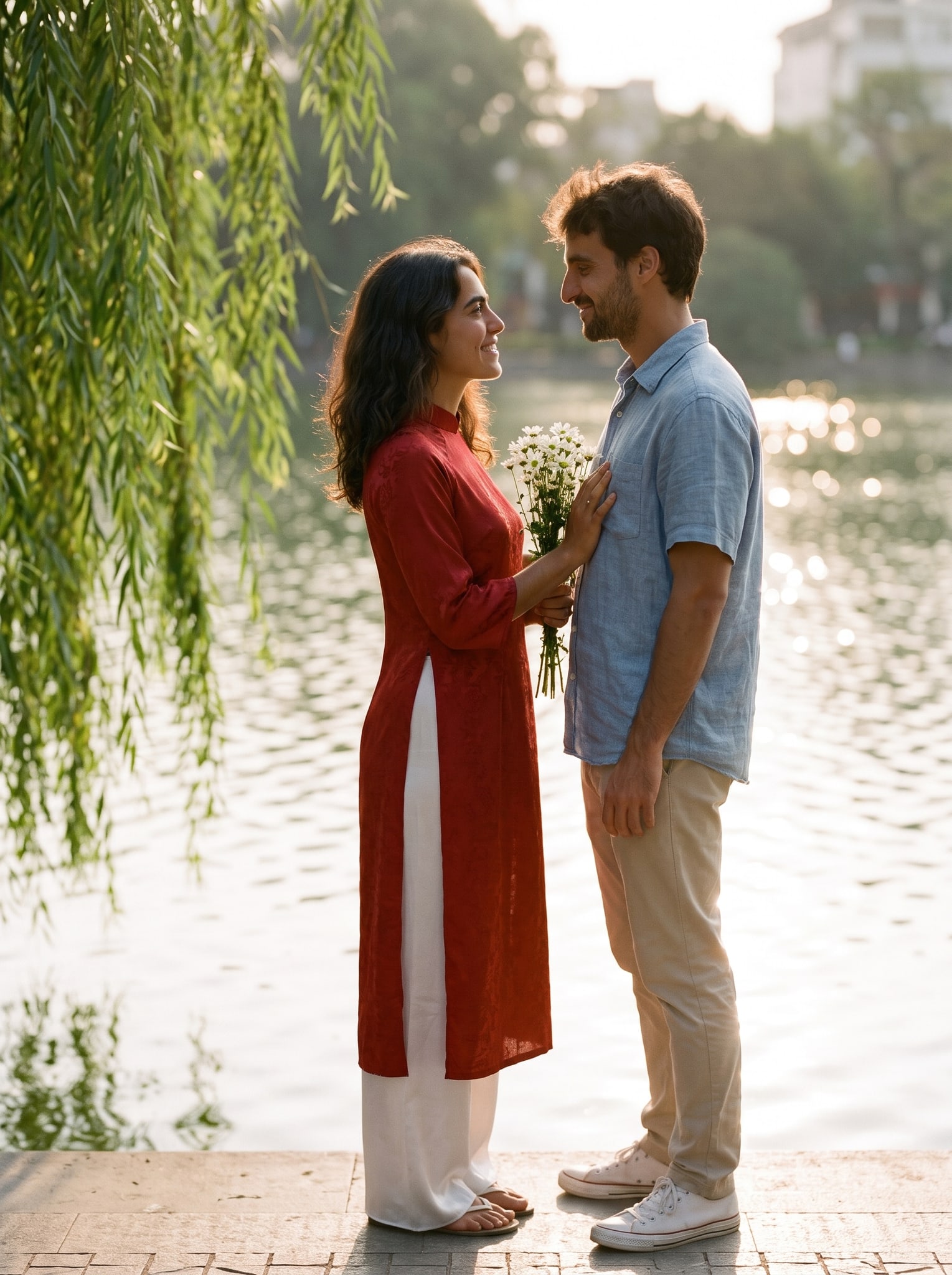
Truong Tien runs east–west across the Red River, with the city center to the south. Evening sun (setting in the west-southwest) means light comes from the left and slightly behind couples standing on the bridge, a flattering 45-degree angle that rims their hair and shoulders while reflecting onto their faces from the river below. If you stand facing north (away from the city), the bridge's pillars create natural columns framing the shot; if facing south toward the city skyline, the bridge becomes a textured backdrop. We rarely place couples directly on the bridge railings anymore—overcrowded Instagram look. Instead, we use the pedestrian walkway, the stone riverbank steps below, or the small park on the south side (Tran Hung Dao side), where light angles are more forgiving and the setting feels more intimate. Each position has a specific light window: the steps work best 5:45–6:15 p.m.; the park works 6:15–7:00 p.m. when side-light wraps around trees.
What do we tell couples to wear for Truong Tien light?
Light color and fabric sheen interact with bridge light in specific ways. Traditional ao dai in white or pale silk photographs beautifully during golden hour because warm light hits every thread; darker ao dai (navy, forest green) disappear into evening shadow unless backlit. We advise couples via WhatsApp: if you want the ao dai to glow, choose light colors and matte fabrics; if you want drama, go dark with strong backlighting and accept that detail will be lost. Groom's suit should complement: light gray or cream linen in summer (reduces heat and photographs cool against warm light), charcoal or navy in winter (doesn't compete with warm tones). Jewelry matters—simple pieces catch light and read well; ornate gold can compete with the sunset and create unwanted hotspots. Makeup should be warm-toned (golds, corals, bronzes) in winter golden hour, cool-toned (pinks, mauves) in summer diffused light. Our makeup and hair at your hotel team coordinates these choices the morning of the shoot.
What to check before you book a Truong Tien session with us
Light quality vs. timing trade-off: Early golden hour (5:00–5:30 p.m. in winter) is warmer but shorter; late golden hour (5:45–6:15 p.m.) gives you more time but slightly cooler tone. Decide whether you prioritize color warmth or shooting duration, then tell us. We'll build your timeline accordingly.
Outfit change count: Each outfit change takes 8–12 minutes on a public riverbank (no private changing room). If you want three outfit changes (traditional ao dai, Western dress, groom's formal), we need 3 hours minimum, which cuts into light quality for the last outfit. Two outfits in 2.5 hours is realistic; three requires starting at 5:00 p.m. sharp or accepting partial blue hour for the final set.
Weather backup plan: Confirm with us that a secondary location (hotel interior, covered colonnade, museum) is booked before you arrive. Truong Tien has no shelter; a 15-minute rain shower kills the golden hour window and we won't have time to recover outdoors.
Ground conditions: After rain, the riverbank becomes muddy. In dry season, dust from street traffic can haze the light. We scout 30 minutes early to assess and tell you what we'll adjust.
Tour group timing: Ask us the day before which hour has the least foot traffic. Peak hours change weekly based on cruise schedules. We use local knowledge to dodge crowds, but only if you ask.
How do we manage blue hour if couples want that mood?
Blue hour (20–25 minutes after sunset) creates deep blue skies, romantic moodiness, and the bridge lights itself—a magical window most tourists miss. We only use it if couples explicitly request it. Setup: we position them closer to the bridge pylons where city lights bounce off water, boost ISO to 3200, use wider apertures (f/1.8–2.0), and shoot primarily backlighting or silhouette. The result is dreamy, low-saturation, moody—very different from golden hour's warmth. Not all couples want this; it requires excellent focus technique (eyes must be sharp) and post-processing to recover skin tone from blue ambient light. We set expectations: blue hour shots are artistic and atmospheric but less flattering than golden hour for skin and facial features. Golden hour is traditional and foolproof. Blue hour is for couples who say, "We want something different, moodier." Offering both is why we usually book 2.5–3 hours for a pre-wedding session at Truong Tien.
Pages from our team you may need
FAQ
What month has the best light at Truong Tien?
November through February. Winter air clarity creates warm, saturated golden hour; humidity is lowest, so colors pop. Summer (June–August) diffuses light through moisture, reducing contrast. Both work, but winter light is more forgiving for first-time couples.
Can we shoot midday at Truong Tien?
Not well. Noon–3 p.m. light is overhead and harsh, creating dark eye sockets and unflattering shadows under the jaw. The river's midday reflection is glare, not fill light. We always recommend golden hour or early morning. If you're stuck with a midday slot, we use heavy reflectors and shoot in bridge shadows—far less ideal.
Do we need a permit to shoot at Truong Tien?
No formal permit for pre-wedding photography on public spaces. We're discreet, use small crews (photographer, stylist, one assistant), and never block pedestrians or traffic. Security may ask questions; we explain briefly and continue. Groups of 10+ people or all-day shoots require a local permit; we handle that coordination.
How much longer is blue hour than golden hour?
Golden hour is 45–75 minutes depending on season. Blue hour is 15–25 minutes. You can't plan a full shoot in blue hour alone; treat it as a bonus session ending golden hour, if couples want it.
Does the Red River ever flood and ruin access to the bridge?
Yes, during heavy monsoon (August–September). Water rises fast and security closes the riverbank. We monitor weather daily and pivot to our alternate location (hotel or indoor heritage site) without losing the shoot. This is why we confirm backup spots before the shoot day.
Which side of the bridge photographs best for light?
The south side (city-facing) in evening golden hour, because sun backlights from the west and river reflection fills faces. The north side works only in early morning (east-facing light) or if you want silhouette. We scout both and show you options when you arrive. --- Ready to book your Truong Tien Bridge pre-wedding session? Our team scouts location, manages light timing, and adjusts on the day to match weather and crowds. Chat with us on WhatsApp to lock in your golden hour slot—early morning and 5:30+ p.m. fill fastest in season. See packages and prices on vietnamphotoshoot.com
Pre-Wedding & Elopement
Inclusions, prices and booking are on our booking site.
FAQ
What month has the best light at Truong Tien?
November through February. Winter air clarity creates warm, saturated golden hour; humidity is lowest, so colors pop. Summer (June–August) diffuses light through moisture, reducing contrast. Both work, but winter light is more forgiving for first-time couples.
Can we shoot midday at Truong Tien?
Not well. Noon–3 p.m. light is overhead and harsh, creating dark eye sockets and unflattering shadows under the jaw. The river's midday reflection is glare, not fill light. We always recommend golden hour or early morning. If you're stuck with a midday slot, we use heavy reflectors and shoot in bridge shadows—far less ideal.
Do we need a permit to shoot at Truong Tien?
No formal permit for pre-wedding photography on public spaces. We're discreet, use small crews (photographer, stylist, one assistant), and never block pedestrians or traffic. Security may ask questions; we explain briefly and continue. Groups of 10+ people or all-day shoots require a local permit; we handle that coordination.
How much longer is blue hour than golden hour?
Golden hour is 45–75 minutes depending on season. Blue hour is 15–25 minutes. You can't plan a full shoot in blue hour alone; treat it as a bonus session ending golden hour, if couples want it.
Does the Red River ever flood and ruin access to the bridge?
Yes, during heavy monsoon (August–September). Water rises fast and security closes the riverbank. We monitor weather daily and pivot to our alternate location (hotel or indoor heritage site) without losing the shoot. This is why we confirm backup spots before the shoot day.
Which side of the bridge photographs best for light?
The south side (city-facing) in evening golden hour, because sun backlights from the west and river reflection fills faces. The north side works only in early morning (east-facing light) or if you want silhouette. We scout both and show you options when you arrive. --- Ready to book your Truong Tien Bridge pre-wedding session? Our team scouts location, manages light timing, and adjusts on the day to match weather and crowds. [Chat with us on WhatsApp](https://wa.me/84338762340) to lock in your golden hour slot—early morning and 5:30+ p.m. fill fastest in season. ✨ See packages and prices on vietnamphotoshoot.com
More from the team
Boho pre-wedding photoshoot in Vietnam: Hanoi, Saigon, Hoi An
Boho pre-wedding shoots mix romantic, free-spirited aesthetics with Vietnam's landscapes and heritage sites. We run full-day sessions in three cities, handling styling, makeup, location scouts and edits.
Avoid crowds at Hoang Su Phi rice terraces: timing for wedding shoots
Hoang Su Phi's terraced landscape draws couples and tour buses in equal measure. We show how to shoot there alone, when to arrive, and what to arrange with us before you go.
Photography rules at Con Dao beaches: permits, drones and what to check
Con Dao's beaches demand prep before you shoot—permits, drone zones and tide timing all affect your day. We share what the Cáo Studio team verifies on every booking.