 Cáo Studio
Home › Blog › Pre-Wedding & Elopement
Vintage Pre-Wedding Photoshoot in Vietnam: Studio Guide
By the Cáo Studio team · Hanoi & Saigon · 2026-11-01
A vintage pre-wedding photoshoot in Vietnam is a curated session where couples wear period or retro-inspired clothing—typically 1940s–1970s aesthetics—at carefully chosen locations: colonial villas in Hoi An, French architecture in Hanoi's Old Quarter, or rural farmland in Ninh Binh. Cáo Studio runs these shoots across both our Hanoi and Ho Chi Minh City studios, with sessions lasting 4–8 hours depending on location count and outfit changes. The package includes hair and makeup styling, photographer and videographer (when booked), and 40–80 edited digital images. Cost varies by season, location, and crew size; couples book via vietnamphotoshoot.com and pay via Visa, Mastercard, online link, or bank transfer—no hidden fees. Common pitfalls: booking during peak heat (March–May), choosing locations without shade, and underestimating travel time between sites. Avoid these by planning 3–4 weeks ahead, scouting in cooler months (September–February), and letting our team handle logistics. Chat with us on WhatsApp | See packages and prices on vietnamphotoshoot.com
What does "vintage" actually mean for your couple shoot?
When we talk vintage with clients on WhatsApp, it almost never means one fixed era. One couple wanted 1950s Saigon elegance—tailored áo dài in jewel tones, hair curled, sepia-toned edits. Another arrived with 1970s bohemian ideas: linen, earth tones, natural texture, film grain in post. A third booked us for 1930s colonial romance: linen suits, cream silk, villa grounds. We've learned: "vintage" is aesthetic direction, not costume rental. You're choosing a feeling—nostalgia, formality, candor—and we build hair, makeup, and location around it.
On the day, our stylists arrive with reference images and your Pinterest board. We pull together pieces that read "period" without feeling costume-y. A vintage shoot lives or dies on authenticity. If your áo dài looks rented, the lens sees it. If makeup is theatrical, the intimacy drops. We spend the first 30 minutes of prep confirming the mood with you, checking your clothes against light, and adjusting if a color reads too modern or a fabric catches glare wrong.
The era you pick shapes location choice. 1940s–1950s couples almost always choose Hoi An's lantern streets or colonial villas in Hanoi's French Quarter—those buildings are the era. Bohemian vintage works in rural Ninh Binh: rice paddies, old family homes, natural overgrowth. We nudge couples toward locations that feel period-appropriate, not forced.
Why location choice makes or breaks a vintage aesthetic.
Vintage photography is 60% location, 40% everything else. A 1950s shoot in a modern coffee shop looks budget. The same couple, same clothes, same hair, at a weathered villa with aged plaster and wooden shutters—that's a story.
We've learned the hard way: scout in person if you can, or trust our recommendations based on what we've seen work. In Hanoi, we cycle between Tran Quoc Pagoda's grounds (stone, water, minimal modern structures), the Old Quarter's narrow streets before 8 a.m. (fewer tourists, softer light), and private villas in Ba Dinh district—permission required, which we handle. In Ho Chi Minh City, Tao Đàn Park offers tree-lined paths and aged benches; we've shot there dozens of times for vintage work. Hoi An is obvious—the whole ancient town is a set—but book your shoot for 6–7 a.m., before crowds.
Light is everything. Vintage film stocks favored soft, directional morning or late-afternoon sun. We schedule shoots to match: 6–10 a.m. or 3–6 p.m., never midday. Cloudy days are actually ideal—they're forgiving for skin tone, kill harsh shadows, and create that slightly desaturated vintage mood naturally. We watch the weather obsessively in the weeks before your shoot and will suggest rescheduling if the forecast is rain (not drizzle—rain obscures settings and soaks clothing).
Travel time between locations eats hours. If you want two Hoi An locations and a rural site 45 minutes outside town, you're losing light and energy. We typically recommend two main locations for a standard vintage session, with a third "bonus" spot only if the client is energized and time allows. One couple once insisted on five locations; by location three, energy was visibly flat. We've adjusted our package guidance since then.
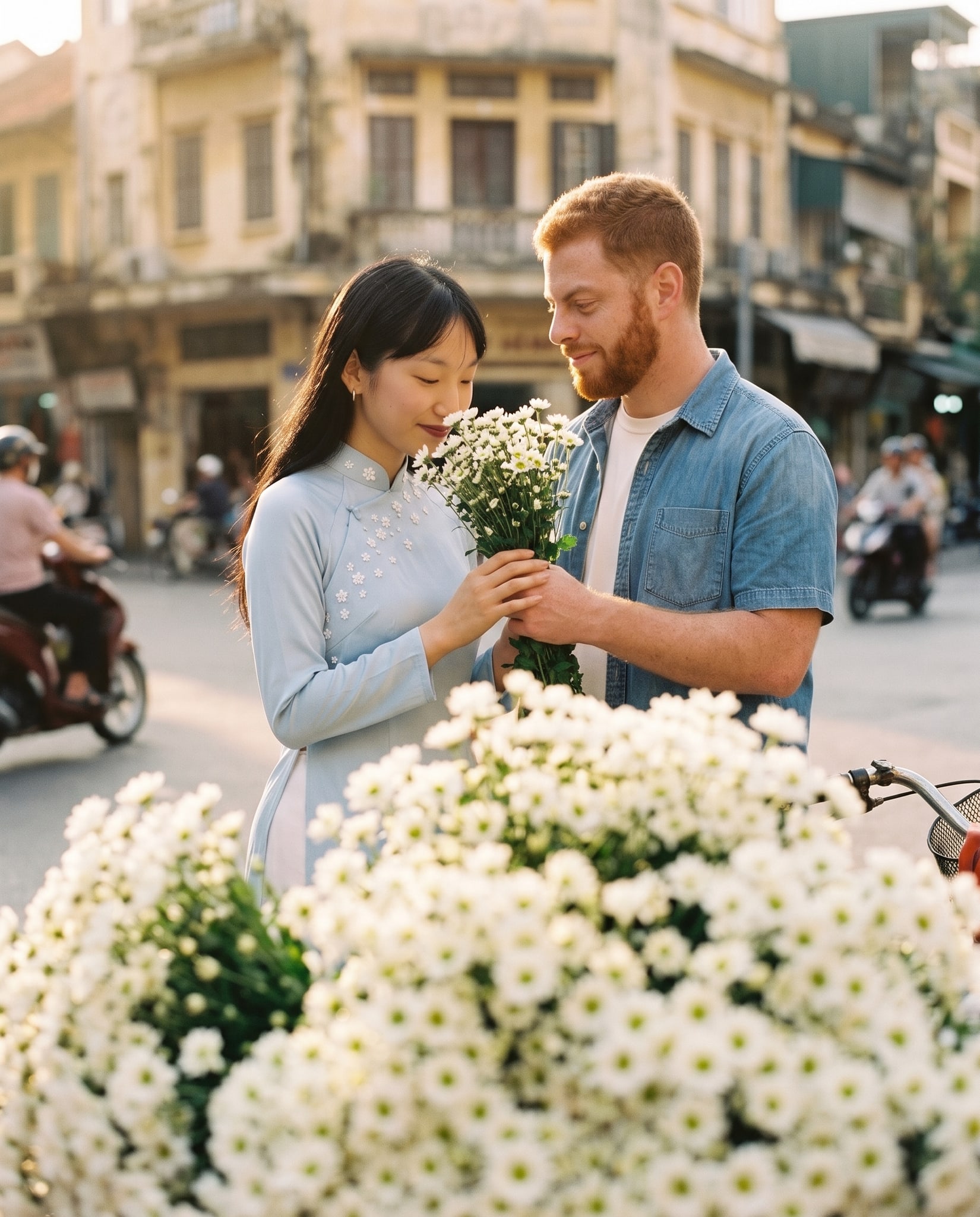
How do we style hair and makeup for period authenticity?
Vintage shoots fail if makeup looks current. That's where our makeup and hair team earns the fee. A 2026-style eyebrow shape and modern foundation tone will read "dated wrong" in your 1950s villa images.
For 1940s–1950s, we soften brows slightly, lift the eye with liquid liner, go warm on blush (apricot, coral), and use matte lip in berry or deep rose. Skin texture matters: we avoid heavy filter in edits and show pores, as vintage film would. Hair is either soft waves (pin curled the night before or set with our equipment day-of) or a sleek low updo. Curly and textured hair gets definition mousse, not flattening gel.
1970s vintage is almost opposite: fuller brows, bronze or terracotta eyeshadow, cream or mauve lips, a hint of blush placed higher. Hair is often center-parted and worn down, sometimes with a clip or scarf. Makeup sits slightly dewy, almost underdone by modern standards—that's period-correct.
We always do a test with you in natural light 10 minutes after makeup is done, before shooting. Artificial light in the prep room lies. We've caught undersaturated blush and too-pale foundation only when we stepped outside. If it's wrong, we adjust in real time—no penalty, no reshoot fee.
One decision we make: do we edit to match the era? A 1950s film would have warmer, slightly yellowed tones. A 1970s shoot might have enhanced color saturation with visible grain. We ask couples: do you want the look of period film, or period styling in modern digital color? Most choose the latter—beautiful color, period costume and hair. Some ask for both: a few edits in vintage film simulation, others in contemporary color. We build that into the package at booking.
Vintage outfit dos and don'ts we've learned from 50+ shoots.
We don't rent costumes. Rented áo dài bunch wrong, rented suits bag at the knees. Couples either bring pieces they own, commission custom tailors in Hanoi (we can recommend), or shop vintage markets ourselves—sometimes on the client's behalf.
If you're bringing an heirloom áo dài, tell us in advance. We'll have a seamstress on standby for minor fixes. One couple's grandmother's áo dài had a three-inch seam split during morning prep; our Hanoi seamstress fixed it in 40 minutes. Another áo dài's fabric was too delicate for humid outdoor shooting—we reinforced the underarm with stay fabric so it wouldn't tear.
For Western-style vintage: linen suits read better than cotton (cotton crumples, linen crumples intentionally). Fit matters. Oversized 1970s is intentional; tailored 1940s is not flexible. We steam everything on arrival and carry a kit: fabric freshener, stain pen, safety pins, needle and thread. We've saved shoots by pinning loose seams, invisible from camera.
Shoes and accessories complete the period. A couple in 1950s dress with modern white sneakers breaks the frame—one bride hadn't thought of this. We had her keep flats in the car and changed footwear between locations. Vintage watches, simple jewelry, scarves: these matter.
Heat and humidity kill expensive vintage fabrics. We always bring multiple outfit changes and swap if a piece shows sweat marks or color darkening. One groom in a linen suit in 28-degree heat soaked through in 90 minutes; we switched him to a lightweight shirt halfway through and saved the original suit for final images only.
| Outfit Choice | Best For | Common Issue | How We Fix It |
|---|---|---|---|
| Heirloom áo dài | Personal, sentimental | Seams weak, fit uncertain | Seamstress on call; fitting check before shoot |
| Custom tailored | Period-perfect fit | Lead time 2–3 weeks | Book 5 weeks before shoot date |
| Personal vintage pieces | Authentic, breaks budget | Sweat marks, wrinkles fast | Extra outfit swaps; portable steamer |
| Market/rental áo dài | Budget option | Fit varies, fabric feels thin | Inspect arrival day; backup piece standby |
See packages and prices on vietnamphotoshoot.com
What actually happens hour-by-hour on shoot day?
6:00 a.m.: Crew meets couple at location (say, Hoi An). We scout framing, check light angle, confirm outfit and shoe choices. One couple's shoes were too narrow for the stone lantern street; we improvised with borrowed flats from our stylist and never told them. Problem solved.
6:45 a.m.: Hair and makeup final touch. We're outside, in natural light, making real-time adjustments. Blush might be reapplied, a stray hair pinned, lip color confirmed. If the couple ate breakfast, we touch up lips. Light is usually soft and golden; we work fast to stay in it.
7:00 a.m.: First outfit, first location. Photographer is already composed three or four shots mentally. Videographer (if booked) is rolling. We shoot for 45 minutes in this spot, moving through it slowly. The couple is usually nervous; we talk them through poses, remind them to breathe, look for genuine moments between directed frames.
7:50 a.m.: Wardrobe change, touch-up makeup. We carry a kit with makeup, hairspray, steamer, safety pins. If weather has shifted—wind, unexpected cloud—we adapt. One couple wanted outdoor rings shot in the street; a vendor arrived with a cart. We pivoted: shot the ring detail on the vendor's cart, used the crowd as authentic backdrop, and the images looked stunning—unplanned.
8:15 a.m.: Second location, usually 5–10 minutes walk away in Hoi An, or a 20-minute drive if outside town. By this point, the couple is warmer with us. Poses feel less stiff. We shoot for 50 minutes here.
9:15 a.m.: Final touch-ups, optional third location if time and energy allow. Light is starting to flatten (getting toward midday). We usually wrap by 10 a.m., sometimes 10:30 a.m. if the location is extraordinary and we want one more outfit change.
Throughout: we're watching the couple's energy, checking focus and exposure, managing crew, and adjusting to surprises. A street vendor might block a frame—we wait or shoot around him. Rain might start—we cover with umbrellas and keep shooting (light is still good). A petal or leaf might be in hair—we fix it between frames.
On the return to base: hair comes down, makeup comes off, we hydrate everyone. Couple usually tells us they're exhausted and exhilarated. We deliver files within 10 days (standard turnaround) and a sneak-peek selection within 48 hours.
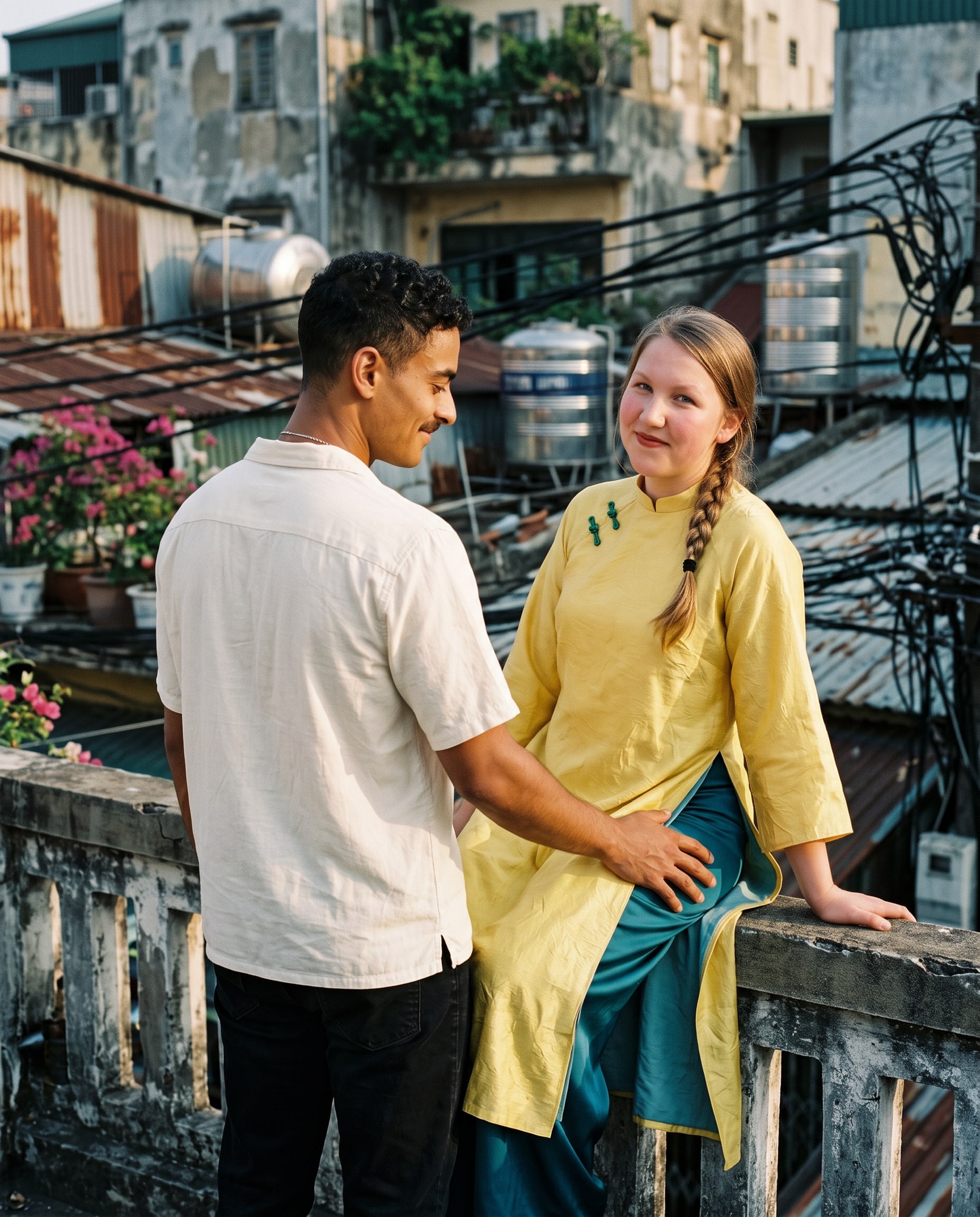
Editing: where vintage aesthetic is finalized.
The shoot is half the work. Editing is where a technically good image becomes a vintage mood.
For 1950s: we warm the color temperature 200–400K, add slight film grain (if client asks), lift shadows slightly (less contrast than modern), and use a faded blacks curve—means whites pop but blacks aren't true black. Skin tones are warm. Saturation is natural, maybe very slightly undersaturated to mimic aged film stock.
For 1970s: we often add visible grain, boost saturation slightly (70s film was punchy), and sometimes apply a slight color cast—maybe a touch of magenta or orange—depending on the film stock the couple chose. Blacks are richer. The overall feel is warm and slightly heavy.
We ask at the consultation: do you want subtle period editing (styling feels old; images look new) or immersive (images look like they were shot in the era)? Most choose subtle. A few request immersive and specify a film stock: Kodak Portra 400, Fujifilm Pro 400H, etc. We simulate that in post.
One couple asked for "period edit with modern color grading." We delivered two files per image: one in vintage simulation, one in contemporary color. They chose 60/40 in favor of contemporary. We've offered this dual-deliver option since.
Editing turnaround is 10 days for standard (200–300 images), 14 days for immersive vintage simulation. Express is available at higher cost (we don't state the fee here, but it's on vietnamphotoshoot.com).
What to check before you book a vintage shoot.
1. Location scouting: Have you visited the venue, or will you trust our recommendation? We have dozens of locations dialed in; if you pick somewhere we've never shot, budget extra prep time (and we may suggest alternatives). Ask for recent photos from the location.
2. Outfit readiness: Do you have all pieces? Try them on together before shoot day. A groom's suit that doesn't fit is a day-of crisis. A bride's áo dài with a hidden seam issue is fixable—but earlier than day-of is better.
3. Hair and makeup trial: Do you want a trial session before the shoot? We offer this separately; costs vary. A trial is wise if you're nervous about the period aesthetic or new to professional styling. It's not mandatory—many couples trust our team's eye—but it saves anxiety.
4. Backup plan for weather: Is your location outdoor-only, or is there a covered area if rain hits? We'll shoot in drizzle, but heavy rain means rescheduling. What's your alternate date?
5. Timeline realism: You want four locations and two outfit changes in a 5-hour session. That's tight. We'll deliver good images, but you won't have time to feel each location. Is that okay? Most couples say yes; some reconsider. Be honest with yourself.
6. Editing style: What is "vintage" to you? Ask us for five reference images in your chosen aesthetic. We'll find them on our archive or Pinterest and discuss whether we can match that mood.
Why the pre-wedding package includes vintage shoots.
Vintage is one option within our broader pre-wedding photoshoot service. Couples also book modern lifestyle, formal studio, or mixed aesthetics. Vintage appeals to couples who value storytelling over trends: it's timeless, it ages well, and it feels intentional.
Some couples combine a vintage session with a standard couple photoshoot elsewhere—one day period, one day contemporary. Others layer vintage styling with special concept shoots: vintage wedding dress with modern groom, or a retro location with contemporary fashion.
If you're drawn to the aesthetic, we recommend exploring our full pre-wedding package page to understand what's bundled and what can be customized.
FAQ
How much does a vintage pre-wedding shoot cost?
Pricing depends on location, crew size, duration, and edit intensity. We don't list prices here; see vietnamphotoshoot.com for exact packages and rates. Payment is via Visa, Mastercard, online link, or bank transfer—deposits secure your date.
Can we use a dress or suit we own, or do we have to rent?
You can use anything. We recommend pieces you own—rental looks obvious on camera. If you need custom tailoring, we recommend Hanoi tailors (2–3 week lead time). We don't rent; we source or advise.
What if it rains on shoot day?
We shoot in light rain and drizzle—soft light, moody mood. Heavy rain means rescheduling. Confirm your alternate date at booking. We'll use it only if weather is unsafe, and there's no rescheduling fee.
How long does editing take for vintage film effects?
Standard editing (natural color, period styling) takes 10 days. Full vintage film simulation takes 14 days. Express turnaround is available at higher cost—ask on WhatsApp for the rate.
Is a makeup and hair trial necessary before shoot day?
Not mandatory, but wise if you're nervous about period aesthetics or new to pro styling. A trial costs less than the shoot and saves anxiety. Book via makeup and hair service.
Do you shoot in Hanoi, Saigon, and Hoi An for vintage?
Yes. Hanoi locations include Old Quarter and French villas. Saigon offers parks and colonial sites. Hoi An is ideal for vintage—the entire town reads period. Ninh Binh adds rural texture. We travel to all.
Can we do a vintage shoot with video as well as photos?
Yes. Videography is booked separately or as an add-on. Video turnaround is longer (2–3 weeks). Confirm at booking whether you want same-day videography or video edit later.
Pre-Wedding & Elopement
Inclusions, prices and booking are on our booking site.
FAQ
How much does a vintage pre-wedding shoot cost?
Pricing depends on location, crew size, duration, and edit intensity. We don't list prices here; see vietnamphotoshoot.com for exact packages and rates. Payment is via Visa, Mastercard, online link, or bank transfer—deposits secure your date.
Can we use a dress or suit we own, or do we have to rent?
You can use anything. We recommend pieces you own—rental looks obvious on camera. If you need custom tailoring, we recommend Hanoi tailors (2–3 week lead time). We don't rent; we source or advise.
What if it rains on shoot day?
We shoot in light rain and drizzle—soft light, moody mood. Heavy rain means rescheduling. Confirm your alternate date at booking. We'll use it only if weather is unsafe, and there's no rescheduling fee.
How long does editing take for vintage film effects?
Standard editing (natural color, period styling) takes 10 days. Full vintage film simulation takes 14 days. Express turnaround is available at higher cost—ask on WhatsApp for the rate.
Is a makeup and hair trial necessary before shoot day?
Not mandatory, but wise if you're nervous about period aesthetics or new to pro styling. A trial costs less than the shoot and saves anxiety. Book via [makeup and hair service](/go/makeup-and-hair).
Do you shoot in Hanoi, Saigon, and Hoi An for vintage?
Yes. [Hanoi locations](/go/hanoi) include Old Quarter and French villas. [Saigon](/go/saigon) offers parks and colonial sites. Hoi An is ideal for vintage—the entire town reads period. Ninh Binh adds rural texture. We travel to all.
Can we do a vintage shoot with video as well as photos?
Yes. Videography is booked separately or as an add-on. Video turnaround is longer (2–3 weeks). Confirm at booking whether you want same-day videography or video edit later.
More from the team
Boho pre-wedding photoshoot in Vietnam: Hanoi, Saigon, Hoi An
Boho pre-wedding shoots mix romantic, free-spirited aesthetics with Vietnam's landscapes and heritage sites. We run full-day sessions in three cities, handling styling, makeup, location scouts and edits.
Avoid crowds at Hoang Su Phi rice terraces: timing for wedding shoots
Hoang Su Phi's terraced landscape draws couples and tour buses in equal measure. We show how to shoot there alone, when to arrive, and what to arrange with us before you go.
Photography rules at Con Dao beaches: permits, drones and what to check
Con Dao's beaches demand prep before you shoot—permits, drone zones and tide timing all affect your day. We share what the Cáo Studio team verifies on every booking.