 Cáo Studio
Home › Blog › Pre-Wedding & Elopement
What to Wear for Couple Photos at Cholon and Thien Hau Pagoda
By the Cáo Studio team · Hanoi & Saigon · 2026-11-04
Thien Hau Pagoda in Cholon (District 5, Saigon) demands outfits that read well in warm, diffused temple light while respecting a sacred space. We see couples struggle here: dark fabrics absorb heat in 32°C humidity; loose silks catch on door frames; shoes get removed constantly; gold tones compete with the altar's gilt. Soft pastels, structured linen, and monochromatic looks work. An áo dài or tailored separates suit the reverence. Plan 2–3 hours for a couple photoshoot mixing interior temple shots and exterior courtyard frames. Cáo Studio shoots here weekly and watches what actually photographs well versus what guests imagined. Ask us for a quote on WhatsApp—we'll guide your outfit choice once we know your skin tone and the time of day.
Thien Hau Pagoda in Cholon is one of Saigon's most photographed couple destinations: rose-carved beams, oil-lamp rows, and that piercing incense that sticks to clothes for hours afterward. We've done dozens of sessions here, and outfit choices make or break the shots. This isn't Tao Đàn Park's open-air freedom. The pagoda is a working shrine where tourists, worshippers, and couples rotate through narrow halls. Your clothes must move with you—not against you.
The core challenge we face on Cholon shoots isn't beauty; it's functionality under constraint. Humidity sits at 70–80% most days. Temple interiors have almost no air conditioning. Fabric sticks to skin within twenty minutes. Shoe soles grip wet stone floors differently than dry pavement. Incense smoke creates a soft veil that kills contrast but lifts skin tones—so pale, cool colors sing; muddy warm tones flatten. Our stylists know this from weeks of standing in that back courtyard, watching how light moves across the stone wall at 8 a.m. versus 3 p.m.
Should we wear áo dài or Western couple outfits?
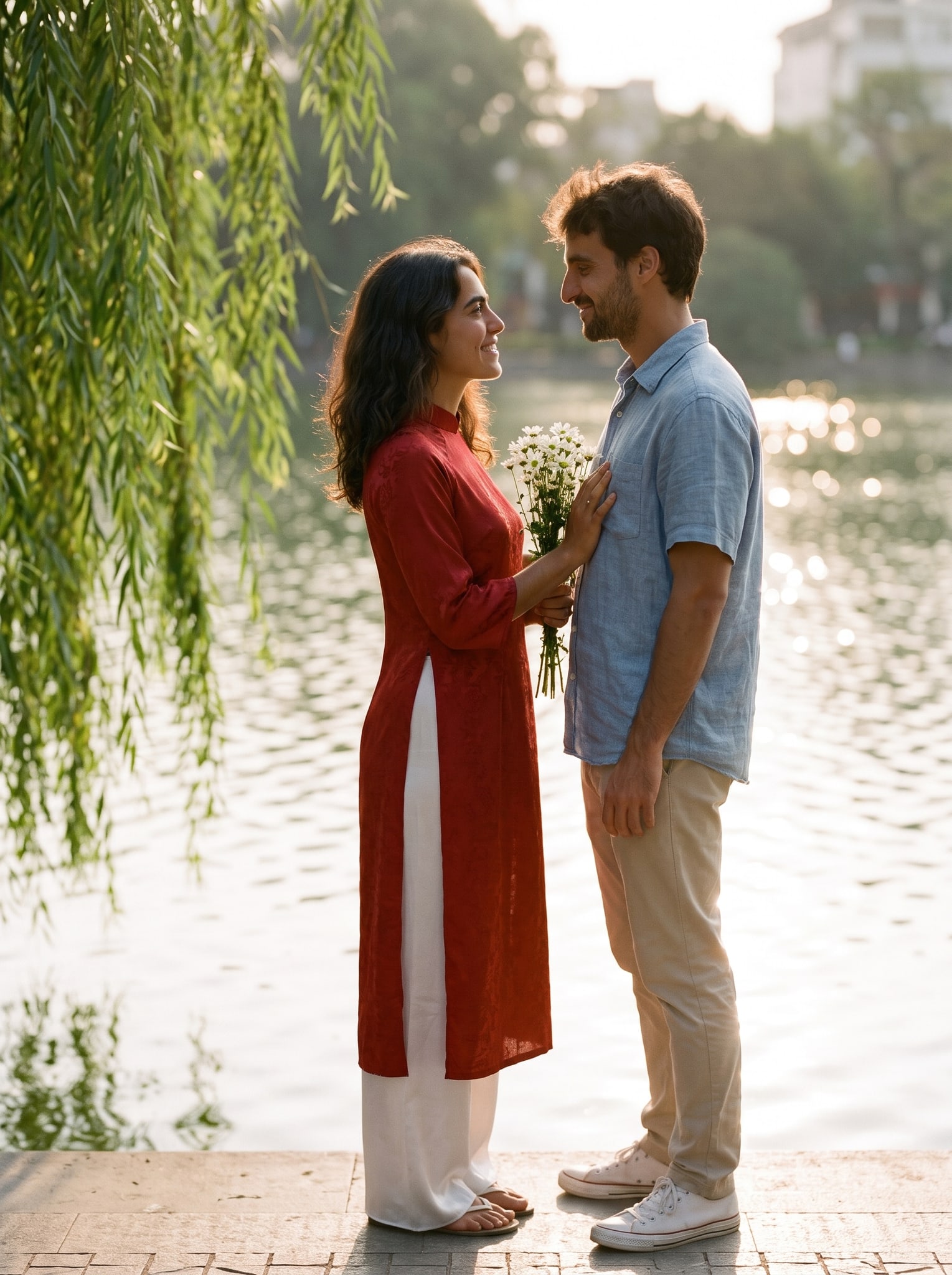
Áo dài is correct here—not optional. When you step into Thien Hau, you're in a Buddhist sanctuary where formal dress signals respect. Áo dài photographs like nothing else in temple light: the silk catches the golden altar glow, the long tunic skims past crowded tourists without catching things, and the silhouette draws the eye downward toward your feet, which often frame temple steps beautifully. Western black-tie or summer dresses can work, but they read as visiting rather than belonging. An áo dài makes the camera and the space feel united.
If you skip áo dài, tailored separates—linen trousers, structured blouse in cream or soft grey—are a respectful second. Loose sundresses snag on doorways and move too freely in a crowded shrine. We always suggest one partner in áo dài and the other in complementary neutral separates, or both in áo dài in coordinated tones. This honors the location and photographs as a unified couple narrative, not just two individuals standing together. A traditional áo dài photoshoot lets you bring 2–3 outfit changes; mixed-style shoots let you test what feels comfortable. Either way, plan for reverence.
What colors work best in temple light?
Temple interiors have warm, golden overhead light from oil lamps and altar candles, plus cool indirect light from high windows. This creates a split palette that trips up many guests. Dusty rose, soft sage, cream, and pale grey look elevated in this light. Bright whites blow out near the altar. Deep blacks absorb the warmth and read flat. Jewel tones—emerald, sapphire—pop but can feel theatrical in a sacred space.
We've learned to push couples toward monochromatic pairings here. If she wears blush áo dài silk, he wears a cream or soft taupe linen shirt—they bounce off each other without fighting. If both go grey, different tones (ash vs. pearl) create depth. Avoid matching prints or loud colors that divide the eye. The pagoda's architecture is already ornate; your clothes should whisper, not shout.
During hotel makeup and hair sessions before a Cholon shoot, our makeup artists always ask: "What's your outfit?" Because makeup shifts with fabric. A blush tone needs different lip work than a sage áo dài. We then prepare skin for humidity—loose powder over moisturizer, so sweat doesn't turn your face shiny under the diffused temple light. This coordination between styling and makeup is what separates a "we picked outfits" shoot from a cohesive visual story.
How do we dress for crowds without looking cramped?
Thien Hau pulls 200–300 visitors daily. Tourist groups block main halls 10 a.m.–noon and 2–4 p.m. We shoot early (7–8 a.m.) or late (5–6 p.m.) specifically to avoid crowds and chaos. But even off-peak, you'll step around worshippers, navigate narrow staircases, and shuffle through doorways.
Fitted clothes become a liability here. Wrap skirts tangle. Oversized sleeves catch on incense sticks or doorframe corners—we've had to gently untangle silk hems from temple decorations mid-shoot. Structured áo dài suits better than a looser traditional style because the side slits give your legs freedom and the tunic doesn't billow. For male partners, lightweight linen shirts (not cotton button-ups that wrinkle in humidity) with clean trousers work. Avoid anything with loose tassels, fringe, or beading that swings when you move.
We also always bring a small scarf or shawl for shoulders if you're wearing sleeveless. Not all shrine areas welcome exposed shoulders, and having one fold of fabric lets you adapt respectfully without scrambling. This isn't bureaucratic; it's just practical courtesy that lets you focus on each other instead of logistics. A couple photoshoot here should feel sacred, not stressful.
What about shoes and footwear choices?
This is where most guests falter. You'll remove shoes twice: once at the outer entrance, once before the main prayer hall. Many couples wear heels expecting to keep them on—then face barefoot stairs. Shoes with ankle straps or Velcro closures slip off easily and slide across stone without noise (respect for the space). Flip-flops and sandals are disrespectful in prayer areas; some shrine staff will gently ask you to leave them in specific spots, creating awkward pauses mid-shoot.
We always advise couples to wear removable flats: leather ballet flats, slip-on loafers, or soft moccasins. They photograph well, slip off without fuss, and protect your feet on rough temple stone. If the shoot involves shots of you walking the outer courtyard, you'll want shoes on. If you're posed inside near the altar, barefoot shots often feel more intimate than shoes anyway. The pagoda's old stone has a patina and warmth that your bare feet will feel in the moment, and the camera captures that presence.
For outdoor courtyard areas, avoid bright white sneakers or metallic sandals—they pull the eye downward and away from your faces. Neutral or slightly warm-toned shoes blend better. We've noticed couples who fret over shoes before arrival always relax once they're barefoot; it becomes part of the ritual rather than a wardrobe crisis. Plan for easy changes and you'll move through the space with grace instead of frustration.
How do we prepare for heat, humidity, and incense smell?
July–September sees 32–35°C and 80% humidity in Cholon. Incense smoke is thick enough to taste. Fabric choices matter enormously. Natural fibers—linen, cotton silk blends, raw silk—breathe. Polyester and satin trap moisture and stain visibly when you sweat. Loose weaves allow air to move. We tell clients: if you wouldn't wear it to a hot, crowded market for two hours, don't wear it to Thien Hau in summer.
Áo dài silk is traditionally designed for this climate—it's breathable and drapes away from skin—so it outperforms Western dresses in Cholon shoots. Our stylists apply anti-perspirant or a thin moisture barrier to the backs of shoulders and neckline before shoots, so sweat doesn't stain fabric. For male partners, lightweight linen (Thai weave or crushed linen) outperforms crisp cotton. Bring a small natural-fiber handkerchief; it's period-appropriate in a temple and practical if humidity fogging affects the camera lens.
Incense clings to everything. Wash your outfit the morning after a Cholon shoot to avoid that smell lingering for weeks. Some guests love it as a scent memory; others find it overwhelming. We mention this during WhatsApp planning so you can decide whether a favorite piece is worth exposing to a day of incense saturation.
Comparison: Outfit Styles by Vibe and Season
| Style | Who It Suits | Humidity Challenge | Incense Concern | Crowd Comfort | Best Season |
|---|---|---|---|---|---|
| Full áo dài set (silk) | Formal couples wanting reverent shots | Breathes well, clings slightly | Clings heavily—plan to wash | Slits allow easy movement | Oct–Apr (cooler) |
| Áo dài + neutral Western shirt | Mixed preferences, cultural bridge | Linen partner piece helps balance | Hybrid absorption | Very good | Any |
| Tailored separates (cream linen) | Minimalist, non-traditional preference | High breathability, wrinkles visible | Moderate cling | Good if fitted (not loose) | Oct–Apr best |
| Summer dress (cotton) | Casual summer couples | Cotton absorbs moisture, looks damp | Absorbs and holds smell | Risky—loose hems catch | May–Sep worst choice |
What to check before you commit to an outfit
Before finalizing your Cholon shoot outfit, ask yourself:
- Fit: Can you sit, stand, and climb stairs without adjusting constantly? Try the outfit on and move around your room for 10 minutes.
- Fabric weight: Does it breathe in a warm room? Hold it up to light—dense weaves trap heat.
- Shoes: Can they slip off without assistance? Will barefoot comfort matter to you?
- Color: Dust a fabric swatch with loose powder—does it show sweat stains? (A test for humid climate wear.)
- Respect: Does the neckline, shoulder coverage, and overall style feel appropriate for a sacred Buddhist space?
- Mobility: Can your partner move close to you, or do loose sleeves / skirt hems create barriers?
If you're unsure, ask us. We work with rentals and tailor recommendations to your exact shoot date, time, and personal style. A couple photoshoot package includes styling guidance during consultation—use it to pressure-test your outfit choices with someone who shoots Thien Hau weekly.
Why Cáo Studio clients choose support for Cholon shoots
We've learned that guests who ask before the shoot about outfit details always feel more confident on the day. There's a difference between "I thought this would work" and "My stylist confirmed this breathes in heat and reads well in temple light." That difference shows in your faces—you relax, you connect, the camera picks it up.
For a Saigon-based couple photoshoot, Cholon is often a first stop. We help you avoid the classic mistakes we've seen: deep black that reads flat, loose silks that tangle, shoes that can't slip off, or outfits so formal they read stiff instead of sacred. The goal is for you to feel like yourselves in a meaningful location, not costumes in a set.
If you're considering Thien Hau for pre-wedding shots or even a proposal moment, the outfit stakes feel higher. We can coordinate everything—áo dài rentals, makeup timing, hair prep for humidity—so you arrive ready and calm. Ask us for a quote on WhatsApp and describe your vision; we'll map out what works.
See packages and prices on vietnamphotoshoot.com
We also run shoots across Saigon, Hanoi, and beyond—check more stories from the team if you want to see how other locations shape outfit choices, or explore special concept shoots if Cholon is part of a larger narrative you want to tell.
FAQ
Can we wear Western formal wear instead of áo dài at Thien Hau Pagoda?
Yes, but áo dài is preferred in a Buddhist temple. If you choose Western wear, keep it minimal and respectful—tailored separates in neutral tones work better than dresses or bright colors. Avoid bare shoulders and very casual styles.
What time of day gives the best light for Cholon couple photos?
Early morning (7–8 a.m.) or late afternoon (5–6 p.m.) offer softer, diffused light and fewer crowds. Midday noon–2 p.m. brings harsh shadows and tourist groups. We typically recommend an early slot for the best mood and temple atmosphere.
Will incense smell ruin my outfit permanently?
No. Incense clings to fabric but washes out after one or two regular washes. Most couples embrace it as part of the memory; if you're concerned, air the outfit outside for 24 hours before washing and use a scent-neutralizing product.
Should my partner and I wear matching colors or coordinate differently?
Monochromatic pairs (different tones of the same color) photograph best in Thien Hau's warm, complex light. Matching exactly can look flat; too contrasting can feel chaotic. Soft coordination—blush with cream, grey with pearl—balances visual unity and interest.
Do we need to bring a shawl or cover-up for shoulders?
Bringing one is smart. Some shrine areas are strict about shoulder coverage; having a scarf lets you adapt respectfully without pausing the shoot. It also works as a styling element for different framing in different prayer halls.
Can we do a Cholon shoot without spending money on a rental áo dài?
Absolutely. Tailored separates in linen and cotton work well and photograph beautifully. However, an áo dài rental (ask us for options during WhatsApp planning) often costs less than you'd expect and transforms the entire story visually. Either way, focus on fit and breathability over price.
Pre-Wedding & Elopement
Inclusions, prices and booking are on our booking site.
FAQ
Can we wear Western formal wear instead of áo dài at Thien Hau Pagoda?
Yes, but áo dài is preferred in a Buddhist temple. If you choose Western wear, keep it minimal and respectful—tailored separates in neutral tones work better than dresses or bright colors. Avoid bare shoulders and very casual styles.
What time of day gives the best light for Cholon couple photos?
Early morning (7–8 a.m.) or late afternoon (5–6 p.m.) offer softer, diffused light and fewer crowds. Midday noon–2 p.m. brings harsh shadows and tourist groups. We typically recommend an early slot for the best mood and temple atmosphere.
Will incense smell ruin my outfit permanently?
No. Incense clings to fabric but washes out after one or two regular washes. Most couples embrace it as part of the memory; if you're concerned, air the outfit outside for 24 hours before washing and use a scent-neutralizing product.
Should my partner and I wear matching colors or coordinate differently?
Monochromatic pairs (different tones of the same color) photograph best in Thien Hau's warm, complex light. Matching exactly can look flat; too contrasting can feel chaotic. Soft coordination—blush with cream, grey with pearl—balances visual unity and interest.
Do we need to bring a shawl or cover-up for shoulders?
Bringing one is smart. Some shrine areas are strict about shoulder coverage; having a scarf lets you adapt respectfully without pausing the shoot. It also works as a styling element for different framing in different prayer halls.
Can we do a Cholon shoot without spending money on a rental áo dài?
Absolutely. Tailored separates in linen and cotton work well and photograph beautifully. However, an áo dài rental (ask us for options during WhatsApp planning) often costs less than you'd expect and transforms the entire story visually. Either way, focus on fit and breathability over price.
More from the team
Elopement Photos at Mui Ne Fishing Village: What We Shoot
Mui Ne fishing village offers intimate sand dunes, colourful boats, and golden-hour light that feel timeless for elopement photography. We've shot dozens of couples there—here's what we learned.
Pre-wedding photoshoot in Hue in November: weather, light and crowds
November in Hue is one of Vietnam's most predictable months for outdoor photography. We've run dozens of sessions there and want to share what actually happens on the ground—the light, the crowds, and the decisions we make hour by hour.
Pre-wedding photoshoot in Hue in August: weather, light and crowds
August in Hue brings intense heat and unpredictable afternoon rain. We've run dozens of pre-wedding shoots there and learned what time of day works, which locations stay dry longest, and how to keep your hair and makeup perfect in the humidity.